
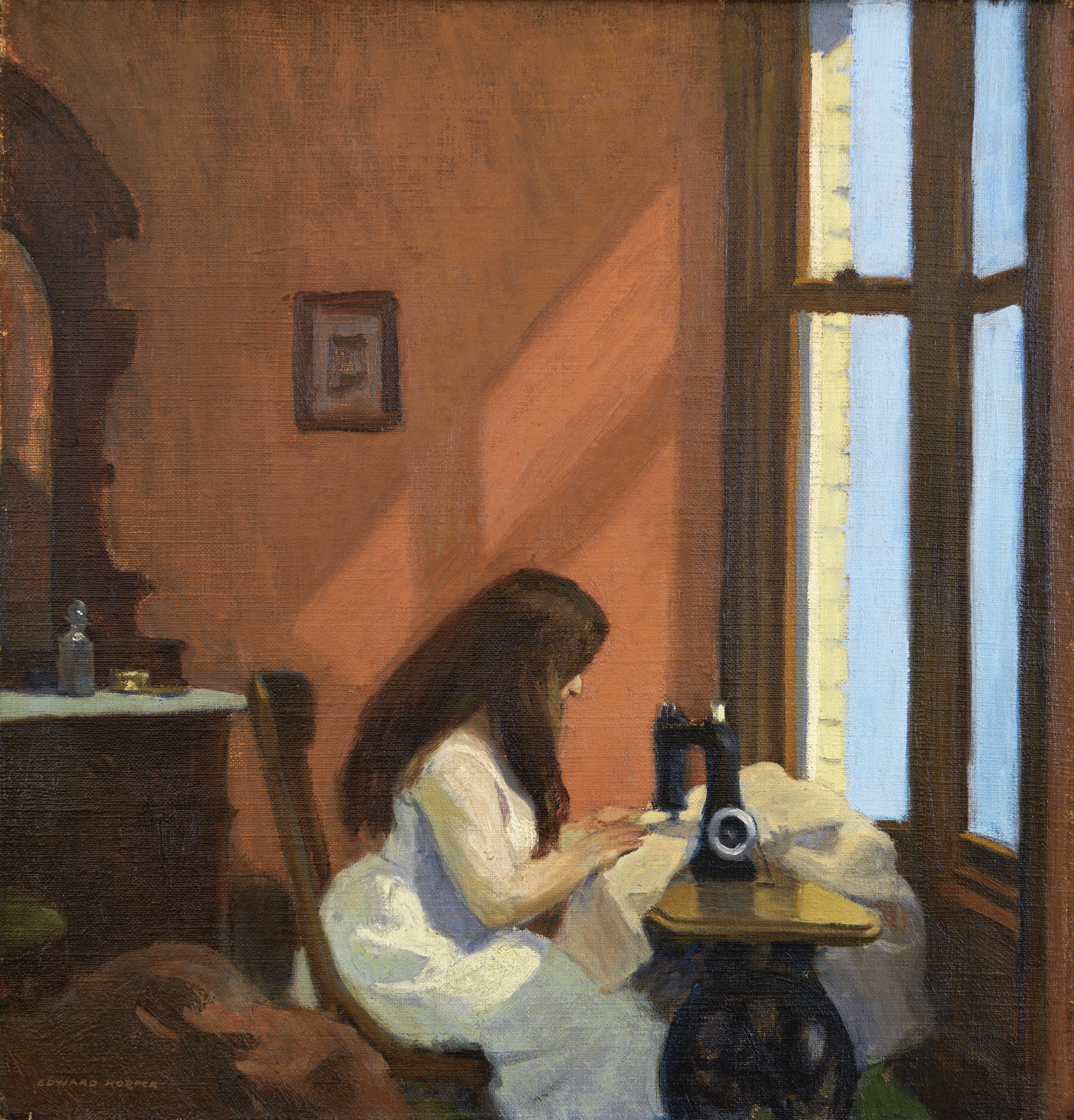
E. Hopper, Girl at a Sewing Machine (ca. 1921), oil on canvas, Museo Thyssen-Bornemisza (Madrid)
The gospel talks about the wedding banquet that a king prepares for his son, only to have the invited guests refuse to come and even mistreat his servants. The King then invites strangers to the meal, who have a great time. Then, in what really is a second parable, the king spots a man without the proper wedding garment. He throws the man out into the streets, away from the Banquet of Love, where there will be a weeping a gnashing of teeth. Perhaps you might wonder «Why is the Host so upset over this man’s clothes?» After all, this is a traveler. How can he be expected to have a fine wedding garment? That would be missing the point for the sake of the detail, something we always have to be careful of regarding scripture. This parable is not about wearing clothes. It is about wearing Jesus Christ. «Clothe yourselves with the Lord Jesus Christ,» St. Paul tells the Romans, the Galatians, the Colossians, and the Ephesians[1]. The man who came without the proper clothes is the Christian in name only, who refuses to put on Jesus Christ throughout his life. This is the person who accepts the invitation of the Lord, but refuses to exercise his or her responsibility in the Christian community. This is the point. We are invited to share the intimacy of the Banquet of Heaven. We are invited into God’s presence. God expects us to wear our Christianity. The way we respond to His Love must be evident to the world. People should know that we are Christians by the way we live our lives! As Christians we know that cannot just say we are Christians. We have to live our Christianity. Now this living of our Christianity may not always be public, but, and this sounds like a contradiction but isn’t, living our Christianity is always evident, even when not public. Wearing our Christianity is a solution to the problem of polarization in our society. When we identify ourselves first as Christians rather than as members of this or that political party or as liberal or conservative, then our primary mode of action will be to treat others with the kindness of Jesus Christ. Jesus Christ alone is the solution to all our society’s needs! If we really want to heal our country’s ills, we need to wear the garment of the Lord, so this morning let us ask the Lord for the grace to live an active Christianity. May we truly put on Christ, first in our homes, among God’s people, and in our world. Like our patron, the apostle Peter, may we live and die wearing the wedding garment of Christ • AE

Fr. Agustin’s Schedule for Sunday October 11, 2020.

Twenty-eight Sunday in Ordinary Time.
Saturday, October 10, 2020.
4.30 p.m. Sacrament of Confession
5.30 p.m. English Vigil Mass @ St. Peter Prince of the Apostles Catholic C.
Sunday, October 11, 2020.
11.00 a.m. English Mas @ St. Peter Prince of the Apostles Catholic Church
5.30 p.m. English Mas @ St. Peter Prince of the Apostles Catholic Church
XXVIII DOMINGO DEL TIEMPO ORDINARIO (Ciclo A)

De los invitados al banquete la parábola dice que “no hicieron caso. Uno se fue a su campo, otro a su negocio”. Son cada vez más los que entre nosotros se confiesan increyentes. Pero si observamos con cuidado, quizás haya que decir que su increencia no es tanto fruto de una decisión responsable cuanto resultado de una vida superficial, donde el espíritu vive aletargado. Vivimos un estilo de vida donde ni siquiera aparece la necesidad de dar un sentido último a la existencia. Como dice F. Jeanson, ateo contemporáneo, «somos nosotros los que tenemos que dar un sentido a nuestra vida, viviéndola». Dios no tiene la última palabra. Y al vivir buscando un bienestar material cada vez mayor, interesados únicamente en tener dinero y adquirir símbolos de prestigio, preocupados siempre por ser algo y no por ser alguien, vamos perdiendo la capacidad para escuchar la voz de Dios y, eventualmente, las voces de los hermanos, sin oídos para cualquier rumor que no sea el que proviene de su mundo de intereses ni ojos para percibir otras dimensiones que no sean las del bienestar material, la posesión y el prestigio social. Como diría Max Weber, son hombres que «carecen de oído para lo religioso». La parábola de este domingo nos recuerda que la perene invitación por parte de Dios a buscar la libertad y la plenitud está siempre presente. Nuestra mayor equivocación podría ser desoír esa llamada, esa invitación, poniendo atención a nuestras tierras y nuestros negocios. Los hombres seguiremos huyendo de nosotros mismos, perdiéndonos en mil formas de evasión, tratando de olvidarnos de nosotros mismos y de Dios, evitando cuidadosamente tomar en serio la vida. Aún con todo, la invitación sigue, y seguirá presente siempre, porque el Señor no se cansa de buscarnos. ¿No se esconde un temor al cambio que necesariamente se tendría que producir en nuestra vida si incluyéramos a Dios en nuestra vida? Sin duda se encierra una gran verdad en aquella inolvidable invocación de San Juan de la Cruz: «Señor, Dios mío, tú no eres extraño a quien no se extraña contigo. ¿Cómo dicen que te ausentas tú?» • AE

 LA MEDITACION DE LA ESPOSA