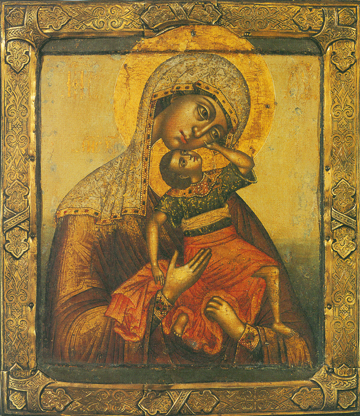
Mary, is not just the mother of God, she is also our mother. Jesus entrusted her to us and us to her on Calvary when he told St. John to behold his mother and Mary to behold her son. St. John represented the faithful disciple of the Lord. He represented you and me. But what does it mean when we say that Mary is our mother? A mother nurtures life. A woman’s body is built to nourish a baby. Her nurturing does not end when the baby is weaned. As the child grows, she finds new ways to care for her child. Mary nurtures us. She does this by leading us to her Son, the Bread we need to sustain our spiritual lives. “Bake us some bread, O Mary, O Mary, bake us some bread, we need to be fed,” the children sing in the Advent hymn, The Baker Woman. A mother continually teaches her child. Most of us learned to walk while our mothers held our arms. Our mothers did most of the work teaching us to talk. More important, most of our mothers taught us our first prayers. They taught us about God and how much we need Him in our lives. Mary teaches us. Her life is one of sacrificial love for God in union with her son. Jesus always comes first, even when it is painful to observe how the world responded to his love with hate. Simeon said to her in the Temple that a sword would pierce her heart, and it did, particularly as she stood under the cross. But her union with her Son would not allow her to turn away from His sacrifice. She joined him in sacrifice. She teaches us not to turn away from the sacrifice of the Lord, but to join Him in sacrifice. Mary teaches us that Christianity demands that we empty ourselves of all so we can be thoroughly united to her son. A mother nurtures, a mother teaches, but mostly, a mother loves. We began life just under our mothers’ hearts. We were cared for not out of obligation, but out of love. On this Solemnity of Mary, Mother of God, we are reminded that Mary is our mother too. We call out to her to protect us from the enemy who would destroy the life of her son within us and among us. We ask her as her children, to nurture us, to teach us and always to love us. So, does our devotion to Mary distract us from our devotion to Jesus? At all! It strengthens our devotion to God. He gave us Mary to be our mother so that we might always be guided by her to her Son • AE
Fr. Agustin’s Schedule for the Solemnity of Mary, Mother of God

Thursday, December 31, 2020
5.30 p.m. Vigil Mass @ St. Peter Prince of the Apostles Catholic Church.
Friday January 1, 2021
10.00 a.m. English Mass @ St. Peter Prince of the Apostles Catholic Church.
Solemnidad de María Santísima, Madre de Dios

El primer día del año civil la Iglesia lo dedica a contemplar a María a en su misterio de Madre de Dios, y lo hace recordándonos la asombrosa cercanía de lo humano y lo divino tal como se dio en esta mujer sencilla[1]. Esta mañana la Liturgia celebra que Dios se entrañó en María y María quedó totalmente entrañada de Dios, y que a la vez que la madre alimentaba al hijo que llevaba en las entrañas, estaba siendo ella alimentada por el Espíritu del propio Hijo y que María preparaba al hijo un vestido de carne, pero el hijo le bordaba a ella un vestido de divinidad. Lo que hoy podríamos recordar es que en el misterio de la maternidad divina se produce también una simbiosis entre Dios y ella; simbiosis progresiva que no dura sólo nueve meses sino toda su vida: María no fue madre de Dios por los meses de gestación y lactancia, sino que se fue haciendo madre de Dios según se iba ella alimentando de la palabra y del Espíritu de su hijo. Como todos los misterios de María, también éste es motivo de esperanza para nosotros: nosotros podemos llegar a esa misteriosa cercanía, a esa maravillosa unión con Dios «Mi madre y mis hermanos son los que oyen la palabra de Dios y la hacen», nos dijo Jesús[2]. Vivimos junto a Dios si escuchamos y acogemos su palabra si la entrañamos en nosotros y la consustanciamos, si la hacemos crecer y la vivimos, si ofrecemos los frutos que vaya produciendo; si acogemos su Espíritu y nos dejamos impregnar por él, si llegamos a sintonizar con sus deseos y mociones, si nos comunicamos íntimamente con él, y sobre todo si ponemos nuestra voluntad su disposición, como María Santísima, la esclava del Señor. Que la Virgen María, la Theotokos[3], nos ayude a vivir lo más cerca de Dios que nos sea posible • AE
[1] Cfr. Gal 4, 4. [2] Cfr. Lc 8, 21.
[3] Theotokos (en griego antiguo, Θεοτόκος, en latín, Deīpara o Deī genetrix) es una palabra griega que significa Madre de Dios (literalmente, ‘la que dio a luz a Dios’).1 Su equivalente en español, vía latín, es Deípara. Theotokos es el título que la Iglesia cristiana temprana le dio a María en referencia a su maternidad divina, título que se definió dogmáticamente en el Concilio de Éfeso de 431.
 LA MEDITACION DE LA ESPOSA