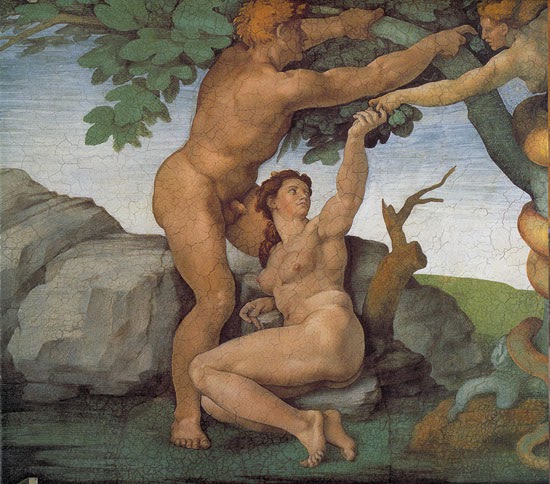
Corinth was the ancient equivalent of Sin City. Most of the people of the pagan world engaged in blatant immorality, but some of the worst were those in Corinth. They even had their own saying to justify their behavior. No, it was not, “What happens in Corinth stays in Corinth.” It was, “Food is for the stomach and the stomach for food.” It was like saying, “You have no choice: you gotta eat, and you have no choice: you’ve got to behave immorally.” Paul tells them and us that we are so much better than that. Our bodies belong to the Lord. We are members of the Body of Christ. We are far more than animals with nothing but animal instincts. We share in the Body of Christ. He goes on to use a very important phrase: our bodies are Temples of the Holy Spirit. If we are immoral, we are sinning against our own bodies, sinning against our union with Christ. That is a beautiful concept: we are Temples of the Holy Spirit. That is why we avoid immorality, particularly sexual immorality. It is not a matter of some sort of Catholic no no, rules that a person might not understand but does his or her best to follow. This whole area of morality is far more important than that. It goes to the heart of whom we are. We are Christ and He is ours. So, we do our best to fight off our temptations because we are united to Christ. He flows through us. We are not animals. We are so much better than that. Let us take a mental tour of Rome, specifically the most beautiful chapel in the world, the Sistine chapel. The chapel is beautiful not because on its architecture, it is rather plain that way. It is beautiful because of the artwork inside it. Here in this relatively small building attached to St. Peters Basilica in the Vatican complex in Rome, we come upon frescos by Michelangelo, Botticelli, Ghirlandaio, Perugino, and others. The cardinals who meet in conclave to pick a new pope also do so under these magnificent frescos. The paintings are often shocking to people who depict Catholics as sexually inhibited prudes. The frescos are, as you know, nudes. They emphasize the beauty of the human body with God himself as the source of this beauty. In the frescos, the creation of man begins with God touching Adam’s hand and concludes with the creation of Eve. Adam needed Eve and Eve needed Adam to overcome the loneliness of the human condition. They needed to give themselves totally to each other. And here is the message behind these frescos: the only way that we can find ourselves is by giving ourselves away. We are made in the image of God. God is a Trinity of Love, Father, Son and Spirit, forming a community of self-giving love for all eternity. We are created in the image of this love, in the image of God. When Adam and Eve gave themselves to each other, they felt no shame. They could be naked. Shame came when they began to use each other. St. John Paul II spoke about this in the lectures that make up the Theology of the Body. He said that human happiness depends on self-giving, not self-assertion. That is the difference between love and lust. Love makes a gift of oneself to another for his or her good. Lust is taking from another for personal pleasure. For us Catholics, sexual morality is more than self-control. It is self-mastery. For us sexual morality is the mastery of the desire that allows us to give ourselves to another in a way that affirms the other. Married love is the human reality that best images the commitment, the intensity and the passion of Christ’s love for the Church, for whom He laid down His Life. Using others to fulfill selfish wants is no different than the sexuality of animals. We have been created for love, love freely given and freely received, love which is based on a commitment for life. Chastity is a virtue that frees us to love another person as a person, not an object. We are called to holiness, to be separated from the world. Sexual morality itself is one of the many ways that we express this holiness. It takes a lot of determination and courage to be a Catholic. It takes determination and courage to love • AE

Fr. Agustin’s Schedule for Second Sunday in Ordinary Time.

Saturday, January 16, 2021.
4.30 p.m. Sacrament of Confession
5.30 p.m. English Mass @ St. Peter Prince of the Apostles Catholic Church
Sunday, January 17, 2021.
9.00 a.m. English Mass @ St. Peter Prince of the Apostles Catholic Church
11.00 a.m. English Mas @ St. Peter Prince of the Apostles Catholic Church
1.00 p.m. Funeral Mass for Eduardo Altamirano @ St. Peter Prince
of the Apostles Catholic Church.
5.30 p.m. English Mas @ St. Peter Prince of the Apostles Catholic Church
II DOMINGO DEL TIEMPO ORDINARIO

Samuel, en el silencio de la noche y en la quietud nocturna del santuario, oye que pronuncian su nombre y, como era de esperar, cree que es Elí el que llama; pero se equivoca. No es Elí, es el Señor. Esfuerzo le cuesta a a Samuel reconocerlo, pero cuando lo hace la respuesta fue perfecta: “Habla, Señor, que tu siervo escucha”. Y el Señor le habló. Surgió así el profeta Samuel. Aunque no lo creamos eso puede sucedernos a cada uno de nosotros. Vivimos tan inmersos en un mundo masificado, igualitario y unidimensional, que hemos olvidado algo impresionante: nuestra llamada personal por parte de Dios. Hemos olvidado el sentido de nuestra identidad, hemos olvidado eso tan maravilloso que es estar convencido de que hemos sido llamados personalmente por Dios, elegidos por Él para caminar un camino muy específico, un camino que no será igual al de ningún. El problema está en que seamos capaces de discernir la llamada, y es que estamos tan llenos de cosas, tan entretenidos, tan preocupados por tantos problemas, tan inquietos por tantos desasosiegos, que difícilmente encontramos un rato de silencio y tranquilidad para que la voz del Señor nos llegue a lo más profundo del corazón y nos despierte del sueño que nos invade. Pero la llamada existe. Esto es lo importante y puede quedar sin respuesta a causa de nuestra pertinaz sordera. Pero si respondemos, si somos capaces de decir como Samuel, con toda la sinceridad del corazón, «habla, Señor, que tu siervo escucha», se producirá el milagro de convertirnos en hombres y mujeres de Dios, en hombres capaces de hacer que el Reino de Dios que tanto anunciamos sea una realidad. Si respondemos, puede realizarse el milagro de convertirnos en hombres pacíficos, que reparten bondad, que se empeñan conscientemente en quitar las tinieblas que rodean el mundo para invadirlo de luz, una luz que hoy aparece nítidamente en el Jordán y que, si respondemos a la llamada de Dios, nos puede invadir para siempre • AE

 LA MEDITACION DE LA ESPOSA