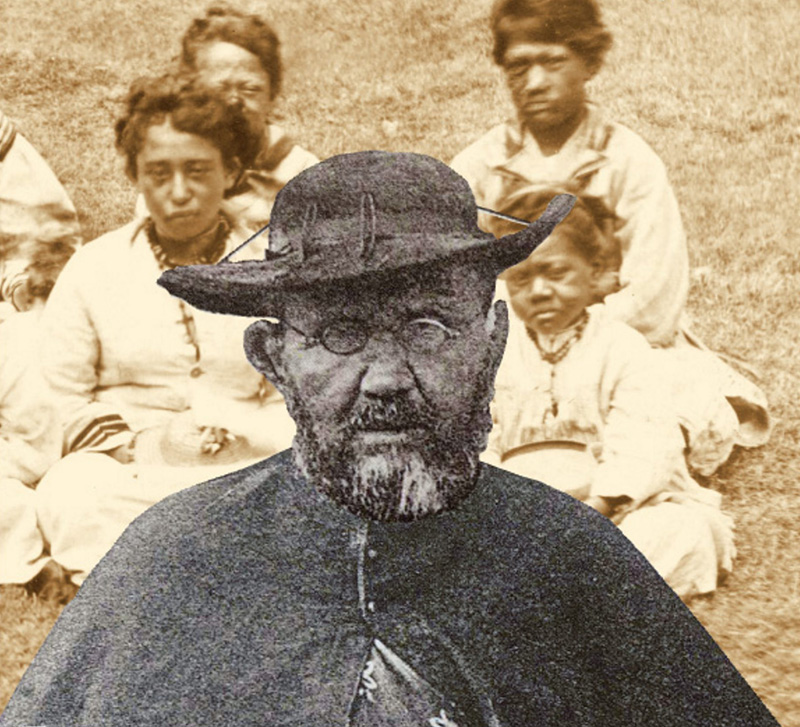
Up to seventy years ago, leprosy was feared and treated with a form of superstition. The people afflicted with leprosy were treated as though they were criminals. In Hawaii, as in other places throughout the world, hospitals would not treat lepers. Instead, the lepers were forced to live in colonies with laws separating them from society similar to those laws we heard in the first reading for today. In Hawaii the lepers were put into cages, shipped off to Molokai, and dumped into the ocean. Only those well enough to swim to shore would live. Once on shore, the lepers faced total chaos. Everyone was sick. There was no medicine, no doctors, no shelters, no blankets. Now, on the big island of Hawaii, there was a young priest from Belgium named Damien de Veuster. He had been a carpenter before he became a priest. Fr. Damien had built numerous small churches on the Big Island. The Bishop asked Fr. Damien to go to Kaluapapa and reassemble the little church that had been sent there. Fr. Damien was to have no contact with the lepers. The bishop did not have many priests, and he did not want to lose Fr. Damien. He told him that he was not to anoint or hear confessions of the lepers or to bury them or to have any contact with them at all. When Fr. Damien first saw the lepers, he was frightened. But he was different. He did not see the disease. He saw the people who were suffering. Fr. Damien was the first non-leper to stay overnight on Kaluapapa. He immediately began building shelters for the people. He constructed the Church and began saying Mass. He was the first to show Christ’s love to them. A ship came to pick up Fr. Damien after his 30-day medical visa expired, but the story goes that the lepers fought off the crew preventing them from landing and taking Fr. Damien. After six months, no one wanted Fr. Damien to leave the leper colony. The medical people in Honolulu were convinced that after being there that long, he probably already had contracted leprosy. So, Fr. Damien stayed. He built shelters, a water system, and turned Kaluapapa into a little functioning community. He planted over a thousand trees to protect the people from the elements. He built the Church and prayed for the people and with the people. Although leprosy is not as contagious as feared, Fr. Damien contracted leprosy, probably because he did not pay much attention to caring for his own health. Towards the end of his life Mother Marianne, St. Marianne Cope, and a group of sisters from Utica, New York, joined him on the island to continue his work and to build a hospital right there in Kaluapapa. On a little hill of Kaluapapa there is a cross with a few words from scripture that sums up what was at the heart of Fr. Damien’s work. The words are from St. Paul’s First Letter to the Corinthians «Love never fails». In 1864 the United States Congress invited each state to erect two statues of prominent citizens in Statuary Hall and throughout the Capital building in Washington D. C. Since then, all the states have followed this custom, some replacing statues with others such as California replacing one of its statues with one to honor Ronald Regan and Michigan doing the same to honor Gerald Ford. The State of Hawaii erected a statue of its unifying king, King Kamehameha, and a statue of its greatest citizen, St. Damien. What he and St. Marianne Cope did, their heroism, was extraordinary. They brought Jesus Christ to outcasts of society. Who are the outcasts of our society? Are the outcasts people with AIDS or other terrible illnesses? Are the outcasts the immigrants? Are we willing to reach out to them? Are we willing to touch the outcast, or are we afraid that we might become unclean? Perhaps, if we resume friendship with that difficult cousin, the rest of our family will have nothing to do with us. Or if we become advocates for migrants who work hard to send money to their impoverished families, then we will be accused of being aligned with the few bad among them who have done horrible things, even if the percentage of bad people among them is far less the percentage of evildoers who are American citizens. Still, some will say to those who reach out to the immigrants. The example of St. Damien and the message of our gospel, is that we can reach out to those who are suffering and touch them with the healing power of Jesus Christ. Yes, by doing this we may open ourselves up to insult and attack from those around us. But we have been empowered with the healing touch of Jesus Christ. And that healing touch can conquer the pain around us. The point is that Love never, ever fails • AE

Fr. Agustin’s Schedule for the Sixth Sunday in Ordinary Time

Saturday, February 13, 2021.
4.30 p.m. Sacrament of Confession @ St. Peter Prince of the Apostles Catholic Church
5.30 p.m. English Mass @ St. Peter Prince of the Apostles Catholic Church
Sunday, February 14, 2021
9.00 a.m. English Mass @ St. Peter Prince of the Apostles Catholic Church
11.00 a.m. English Mas @ St. Peter Prince of the Apostles Catholic Church
5.30 p.m. English Mas @ St. Peter Prince of the Apostles Catholic Church
VI Domingo del Tiempo Ordinario (Ciclo B)

La confianza del leproso es extraordinaria: «Si tú quieres, puedes curarme»[1]. Es exactamente la misma fe de la cananea, del centurión, del padre del muchacho epiléptico[2]. Hoy vemos a Jesús conmovido por esta fe, en un diálogo breve e intenso. Dos palabras le bastan al leproso para para revelar su fe y una palabra para señalar el efecto de esta fe. En este diálogo se encuentran frente a frente la terrible situación de un hombre y la fuerza del amor. La lepra inspiraba tanto miedo en aquella época que era considerada como un castigo de Dios y un contagio terrible; lo que importaba era no tocar a aquellos malditos. Y el evangelista nos dice que Jesús lo toca. Y lo cura. Eso es precisamente lo que pensaba el leproso: él puede todo lo que quiere. Al Señor no hay miseria alguna que lo escandalice, pero él espera nuestro «Si tú quieres…» que debería ser casi tan poderoso como el amor con que está dispuesto a acogernos. Hoy pienso en los leprosos de nuestros días, en los despreciados, en los marginados, en aquellos que se sienten avergonzados de su cuerpo, de su corazón, de su vida, de sus afectos. Y pienso también – ¡y pido perdón! – en mí mismo: ¿Acaso estoy sano? ¿De verdad estoy Limpio? Quizá mis encuentros con Jesús han sido inútiles porque nada me impulsaba a suplicarle: «Si tú quieres, puedes curarme», y es que para decir esto, con una fuerza capaz alcanzar un milagro, es necesario sentirnos leprosos y necesitados de su gracia. Este doble despertar de nuestra vergüenza y de nuestra fe es sin duda la mejor preparación para un encuentro[3]. Como cuando decimos, al inicio de la celebración de la Eucaristía: «Para celebrar dignamente éstos sagrados misterios reconozcamos humildemente nuestros pecados». Hoy podríamos pedir al Espíritu de Dios esa gracia tan particular de prepararnos para encontrarnos con el Señor Jesús reconociéndonos leprosos delante de Él, y esperando con alegría su bendita misericordia • AE
[1] Cfr. Mc 1, 40-45. [2] Cfr. Mt 15, 21-28; Lc 7, 1-10; Mt 17, 14-27. [3] Cfr. A. Seve, El Evangelio de los Domingos, Edit. Verbo Divino (Estella). 1984, p. 78, ss.

 LA MEDITACION DE LA ESPOSA