

Our society perpetuates the great lie that love can be won through an elixir. The elixir may be becoming a professional who makes a great deal of money. Money is supposed to guarantee that happiness can be bought. Or the elixir might be that having the perfect body will attract lasting love. But the beautiful bodies of the young become the bodies of the middle aged. Commercials try to convince us that the right perfume or cologne will do the job. That’s as close to an ancient elixir as you can come. But a good job never won anyone love, and a beautiful body may attract another person but it isn’t going to win his or her love. And a Chanel No. % is not going to be a love magnet. Today’s second reading from the First Letter of John, and our gospel reading is from John 15 both speak about love, Christian love. Christian love is not forced on a person. It isn’t due to an elixir, nor does it come merely from physical attraction, or any other attraction for that matter. Love, true love, lasting love, only results from the Love of Christ. And that love becomes a magnet. If a person loves the Lord, that love itself will attract other people who are seeking the Lord. Perhaps it will attract a person who is looking for someone to make a life with, certainly it will attract many others who are looking for the meaning to life. St. Teresa of Calcutta. Her work among the poorest of the poor spread throughout the world. Her religious order, the Missionaries of Charity, became the fastest growing religious order in the Church. Why were so many people attracted to Mother Teresa? Certainly, they felt called to join her in making the gospel a reality: «…when I was hungry you gave me food to eat, when I was thirsty you gave me drink, etc.»[1]. But there was even more than this that attracted people to Mother Teresa. They were drawn by Jesus’ love within her. And like a magnet, that love flowed through her into them. And then they attracted others to Christ. The love of Christ flowed through her into them. It still does. We have been attracted by the dynamism, the magnetism of Jesus Christ. We know that saying that we love Him is not enough. We have to live His Love. In the Gospel Jesus uses this phrase: “Remain in my love.” He tells us that we remain in His Love if we keep His commandments. But Jesus doesn’t give a whole list of commandments like Moses did when he came down from Mt. Sinai. Jesus just gives one commandment: Love one another. That is all that really matters, if we love each other, truly, in the sacrificial love of the Lord, everything else falls into place. St. Augustine put it this way: «Once and for all, a short rule is laid down for you: Love and do what you will. If you keep silence, do it out of love. If you cry out, do it out of love. If you refrain from punishing, do it out of love. Let the root of love be within you. From such a root, nothing but good can come»[2]. So, we are concerned about this or that member of the family. Maybe he or she is in a bad relationship, or behaving badly. If we strike out at them, let them feel our wrath for the people they are hurting, we will accomplish nothing. But if instead we allow the magnetism within us to be evident in our concern for them, and we seek the ways that we can we best expose them to the love of Christ, eventually, over time, Christ will prevail. The Easter message is that Jesus is the Victor. Christ wins. He always wins. Another example: we are invited to join an activity which is immoral; and we decline respectfully, but lovingly. A close friend asks us to join him or her. And we say, “I have to tell you what is happening inside of me. I just can’t reconcile going there and doing that with the deep love for God I feel within me. It just is not me. It is not my style.” And we leave it at that, then the person we are speaking to might eventually, someday, also say, “I want that deep love of God in my life.” Jesus Christ is the Elixir of Love. He is the potion that brings happiness. Let us pray today for the courage to love His Presence so much that His Love will flow through us and attract others to love as He Loves • AE
[1] Cf Matthew 25 [2] From St. Augustine’s sermon on 1 John 7

Fr. Agustin’s Schedule for the Sixth Sunday of Easter 2021

Saturday, May 8, 2021
11.00 a.m. First Communion Mass @ Our Lady of Grace
4.30 p.m. Sacrament of Reconciliation @ St. Peter Prince of the Apostles
5. 30 p.m. Mass @ St. Peter Prince of the Apostles
Sunday, May 9, 2021
9.00 a.m. Mass @ St. Peter Prince of the Apostles
11.00 a.m. Mass @ St. Peter Prince of the Apostles
5. 30 p.m. Mass @ St. Peter Prince of the Apostles
VI Domingo de Pascua (Ciclo B)
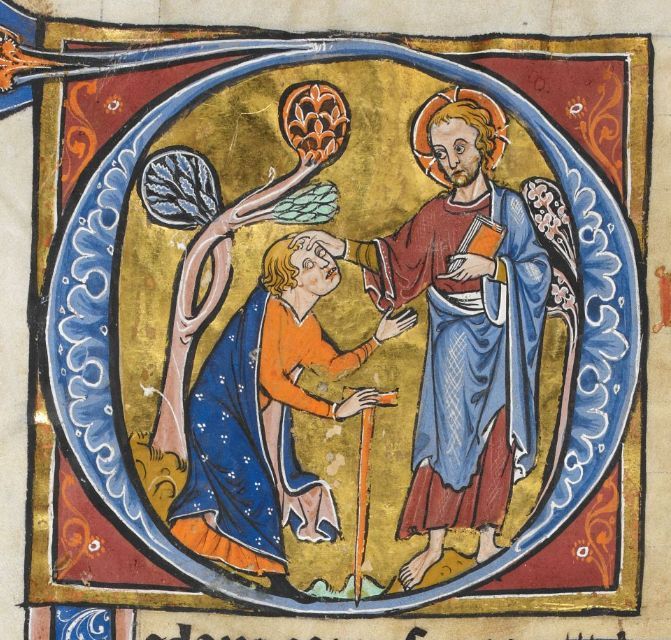
Autor anónimo, Cristo devolviendo la vista a un ciego, oro y tempera sobre papel, Salterio de Rutland (f 29v), British Library.
En el evangelio que la liturgia nos presenta este domingo, el sexto del tiempo de Pascua, Jesús se está despidiendo de sus discípulos[1]. Los ha querido apasionadamente. Los ha amado con el mismo amor con que lo ha amado el Padre. Ahora los tiene que dejar. Conoce su egoísmo y sabe que les cuesta quererse. Los ve discutiendo entre sí por obtener los primeros puestos. ¿Qué será de ellos? Las palabras de Jesús adquieren un tono solemne. Han de quedar bien grabadas en todos: «Éste es mi mandato: que os améis unos a otros como yo os he amado». Jesús no quiere que su estilo de amar se pierda entre los suyos. Si un día lo olvidan, nadie los podrá reconocer como discípulos suyos. De Jesús quedó un recuerdo imborrable. Las primeras generaciones resumían así su vida: «Pasó por todas partes haciendo el bien». Era bueno encontrarse con él. Buscaba siempre el bien de las personas. Ayudaba a vivir. Su vida fue una Buena Noticia. Se podía descubrir en él la cercanía buena de Dios. Jesús tiene un estilo de amar inconfundible. Es muy sensible al sufrimiento de la gente, a su dolor, a sus desgracias. No puede pasar de largo ante quien está sufriendo. Al entrar un día en la pequeña aldea de Naín, se encuentra con un entierro: una viuda se dirige a dar tierra a su hijo único. A Jesús le sale desde dentro su amor hacia aquella desconocida: «Mujer, no llores»[2]. Quien ama como Jesús, vive aliviando el sufrimiento y secando lágrimas. Los evangelios recuerdan en diversas ocasiones cómo Jesús captaba con su mirada el sufrimiento de la gente. Los miraba y se conmovía: los veía sufriendo, o abatidos o como ovejas sin pastor[3]. Rápidamente, se ponía a curar a los más enfermos o a alimentarlos con sus palabras. Quien ama como Jesús, aprende a mirar los rostros de las personas con compasión. Es admirable la disponibilidad de Jesús para hacer el bien. No piensa en sí mismo. Está atento a cualquier llamada, dispuesto siempre a hacer lo que pueda. A un ciego que le pide ayuda en el camino, lo acoge con estas palabras: «¿Qué quieres que haga por ti?»[4]. Con esta actitud anda por la vida quien ama como Jesús. Jesús sabe estar junto a los más desvalidos. No hace falta que se lo pidan. Hace lo que puede por curar sus dolencias, liberar sus conciencias o contagiar confianza en Dios. Pero no puede resolver todos los problemas de aquellas gentes. Entonces se dedica a tener gestos de bondad para con todos: abraza a los niños de la calle porque no quiere que nadie se sienta huérfano; bendice a los enfermos porque no quiere que se sientan olvidados por Dios; acaricia la piel de los leprosos porque no quiere que se vean excluidos[5]. Así son los gestos de quien ama como Jesús • AE
[1] Cfr. Jn 15, 9- [2] Lc 7, 11-17 [3] Cf Mt 9, 36. [4] Lc 18, 41-43 [5] Ídem 5, 12-16.

 LA MEDITACION DE LA ESPOSA
Agustin, he quedado muy conmovido despues de leer tanto el articulo sobre el magnetismo artificial que queremos usar para atraer a un ser querido, cuando solo lo puede atraer el amor de Dios, y la Homilia del 5º Domingo de Pascua.
Yo te conocia como amigo, pero no en esta faceta de Pastor de Ovejas. Y ¡¡cuanto me gustaria que estuviesemos mas cerca!!.
Yo necesito el amor de Dios y lo busco con todo mi corazón, pero hay algo que no consigo traspasar y en lugar de encontrar felicidad en esa busqueda, tan solo encuentro inquietud. Y sé que los cristianos tenemos que ser alegres, y yo no soy capaz de alcanzar esta alegría.
Supongo que no puedes recordar nuestra confesion cuando David se casó. Yo estaba en una confusión total y no sabía qué hacer. Hace 8 años yá que me uní al Camino Neocatecumenal, y my vida cambio totalmente, pero la felicidad me esta vedada, no sé por qué. Como el sentimiento del amor, lo quiero, lo deseo, lo busco pero no lo siento. Y no lo puedo explicar.
Perdona, solo queria agradecerte tus escritos que estoy encontrando por pura casualidad, porque yo apenas uso esa red social/profesional, y me han salido mis sentimientos sin control.
Gracias, muchas gracias. Que Dios nos bendiga.
J. B. Garcia.