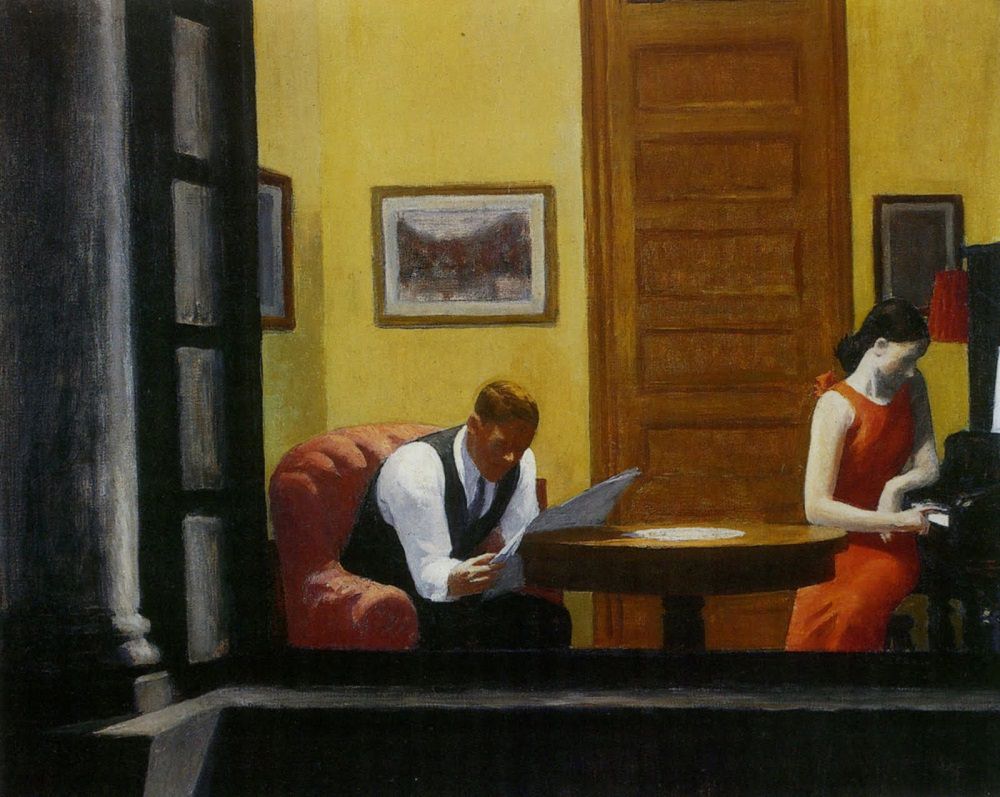
E. Hopper, Room in New York (1932), oil on canvas, Sheldon Museum of Art (Nebraska)
There are many people who at a certain point in their life have the impression of finding themselves in a dead end. What troubles them are not the normal problems of work, family or the minor things of regular life, but an inner restlessness that is difficult to explain. A time has come when they hardly have any taste for life. They don’t know exactly why, but they no longer manage to live with any joy. They may not reveal it to anyone, but there is a kind of inner emptiness in them. How to get life back? What to do to feel alive again within yourself? Where to find a liberating energy? How to open again to the «miracle» of life? Perhaps, first of all, we have to realize that what we need then is to discover where «the source of life» can be capable of regenerating us. According to K G. Dürckheim, who recently died in Germany, the greatest problem for many men and women today is living isolated from God. Depending on the moment or the circumstances, a person may feel alive or inert, euphoric or despondent, empty or dissatisfied, but the real problem is living «without roots», separated from the mysterious depths of existence, without contact with the source of life. Whether we know it or not, what worries us from the inside is always, in some way, the fear of losing ourselves, the bewilderment in the face of the absurd, the anguish in the face of loneliness. This triple anxiety marks our life and makes us always look for security, meaning and love. Consciously or unconsciously, man carries within himself the nostalgia for a life that is above all death, for a meaning that is beyond the meaning and nonsense of this world, for a protection and welcome that nothing can endanger. When we perceive this deeply enough, something tells us inside that God and only God can be the source of true life. Nothing that is not God is enough for us. If then one succeeds in humbly opening up to God, a liberating force penetrates and regenerates; everything changes, then we can live with a different confidence, with a new meaning, with true hope. The words of the Lord in today’s Gospel are a wonderful announcement to understand that in him and only in him is that solution that we have been looking for so much • AE
Fr. Agustin’s Schedule for Eigteenth Sunday in Ordinary Time.
Saturday, July 31, 2021
TBD
Sunday, August 1, 2021.
12.30 p.m. English Mass @ St. Dominic Catholic Church
3.00 p.m. Spanish Mass @ St. Dominic Catholic Church
XVIII Domingo del Tiempo Ordinario (Ciclo B)
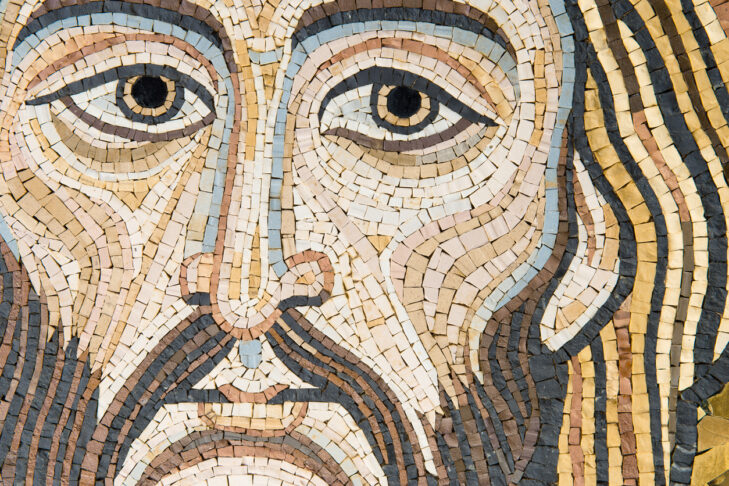
Mosaico de estilo bizantino que representa el rostro de Cristo
La gente necesita a Jesús y lo busca. Hay algo en él que los atrae, pero todavía no saben exactamente por qué lo buscan ni para qué. El evangelio dice que en aquel tiempo muchos lo hacían porque el día anterior les ha distribuido pan para saciar su hambre. Vemos que el Señor comienza a conversar con ellos y que desea aclararles las cosas. El pan material es importante; Él mismo les ha enseñado a pedir a Dios «el pan de cada día» para todos, pero el ser humano necesita algo más y Jesús quiere ofrecerles un alimento que puede saciar para siempre su hambre de vida. La gente intuye que Jesús les está abriendo un horizonte nuevo, pero no saben qué hacer, ni por dónde empezar. El evangelista resume sus interrogantes con estas palabras: «y ¿qué obras tenemos que hacer para trabajar en lo que Dios quiere? ». Hay en ellos un deseo sincero de acertar. Quieren trabajar en lo que Dios quiere, pero, acostumbrados a pensarlo todo desde la Ley, preguntan a Jesús qué obras prácticas hay que hacer. La respuesta de Jesús toca el corazón del cristianismo: «la obra (¡en singular!) que Dios quiere es ésta: que creáis en el que él ha enviado». Dios quiere que creaamos en Jesus, él es el gran regalo que Él ha enviado al mundo. Ésta es la nueva exigencia. En esto han de trabajar. Lo demás es secundario. Después de veinte siglos de cristianismo, ¿no necesitamos descubrir de nuevo que toda la fuerza y la originalidad de la Iglesia está en creer en Jesucristo y seguirlo? ¿No necesitamos pasar de la actitud de realizar montones y montones de prácticas a vivir como discípulos de Jesús? La fe cristiana no consiste primordialmente en ir cumpliendo correctamente un código de observancias nuevas, superiores a las del antiguo testamento. No. La identidad cristiana está en aprender a vivir un estilo de vida que nace de la relación viva y confiada en Jesús el Cristo. Nos vamos haciendo cristianos en la medida en que aprendemos a pensar, sentir, amar, trabajar, sufrir y vivir como Jesús. Ser cristiano exige hoy una experiencia de Jesús, pero sobre todo una sincera identificación con su vida, con sus enseñanzas. Hoy más que nunca necesitamos de ésa adhesión y de contacto vital con el Señor, ¿cómo lo vamos a lograr? Hoy podríamos dedicarle un café -o dos- a pensar en esto • AE
Bartolomé Esteban Murillo, The Return of the Prodigal Son (1667), oil on canvas, Avalon Foundation.
Dear friends, in these weeks of transition I am adapting to the schedule of my new parish community, St. Dominic Catholic Church. Some weekends I don’t have an official Confession schedule, but that doesn’t mean I’m not available. I always am! Please, if you need the Sacrament of Reconciliation, send me an e-mail (agusestrada@gmail.com) and we will find the best time to celebrate the Sacrament of joy. This applies even to every weekday. There is always time for a spiritual talk. Currently I am our of town but I will be in my regular schedule on Saturday, July 31. Fr. Agustin
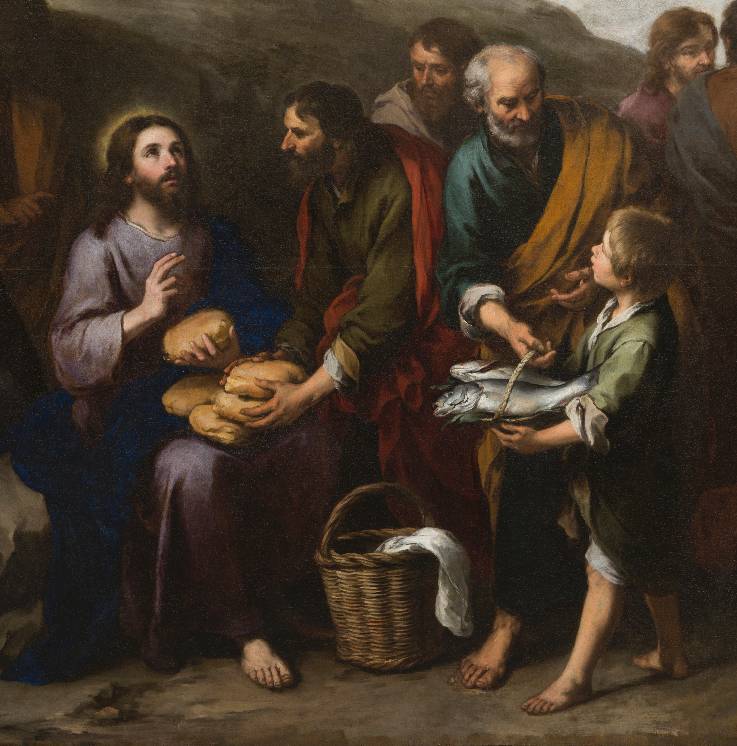
B. E. Murillo, The multiplication of fish and loaves (1669), oil on canvas, Hospital de la Caridad (Seville, Spain).
As every summer, this Sunday we begin a five week focus on the 6th chapter of the Gospel of John, the chapter on the Bread of Life. That the Church should spend five weeks on John 6 demonstrates that this is one of the most important sections of the Gospels. John 6 begins with the multiplications of the loaves and fish, our Gospel for this Sunday. Why is this miracle retold so often in the Gospels? There are two accounts of the multiplication in Matthew and Mark, one in Luke and one in John. In each passage phrases are used that are repeated at the Last Supper. «He took, He blessed, He broke.» Each passage refers to God’s continual gift of the one food we need, the Eucharist. Three elements are emphasized in John’s account of the multiplication to provide a deeper understanding of the Eucharist. Maybe you noticed them. These elements are the time of the multiplication, references to Psalm 23, and the gathering of the fragments that are left over. The time of the multiplication. The Gospel of John places the multiplication of the loaves and fish at the time of the Passover. This is not just a passing note. The Passover was the sacred meal of the Jews celebrating their freedom from slavery in Egypt and thanking God for His continual protection. In today’s Gospel Jesus provided a meal at the Passover time. He would provide another meal during another Passover. Holy Thursday took place at the time of the celebration of the Passover. The Last Supper was really the First Supper of the new People of God. The food would no longer be the Passover lamb, but the Lamb of God. The people would eat the Body and Blood of the Lord. It would be a meal of deliverance from slavery, slavery to the devil, slavery to sin. It would be a meal that would provide freedom. It would be a meal that would celebrate the New Life of the Lord. So, from the very start of today’s Gospel, we know that John is speaking about more than loaves and fish. He is speaking about the meal of the Christian Community, the Eucharist. Secondly, Psalm 23. You all know it: The Lord is my shepherd. In today’s Gospel Jesus sees the needs of the people. He has them recline on the green grass, green pastures if you will. He restores their strength with his food. This is not just about loaves and fish. Jesus is performing a prophetic action. He provides the banquet Psalm 23 spoke of, the Banquet of the Lord. Those who eat this food will continue to eat it in the House of the Lord forever. When we receive communion, we share in the meal of the Kingdom of God. We are united to people throughout the world and throughout time who also share in this meal. Picture yourself at table on Thanksgiving Day. Around the table are all your loved ones, including those who have passed on to the Lord many years ago. This is the Banquet of the Lord we share every time we receive communion. The third element that John 6 emphasizes in this account of the multiplication is the recovery of the fragments that are left over. Back in the days of the exodus from Egypt, the food that the people had brought with them ran out. They called upon Moses to give them food. He prayed to God, and God provided manna. When the people of Israel gathered the manna in the desert, they were told not to take more than they needed. And the left-over manna was not to be stored. Jesus does the opposite. He tells his disciples to gather up the remains. Enough is left over to fill twelve baskets. Twelve is not a random number. There were 12 patriarchs, the sons of Jacob[1]. There would be 12 apostles[2], the patriarchs of the New Testament. The Lord tells them to care for the food He provides. This does not just refer to not wasting the bread. The Eucharist which is not consumed during the Christian banquet is not to be thrown out. It is the Body of the Lord. It is to be saved for those who were not able to be present at His meal so they also can partake of his food. What we have here is the biblical basis for the preservation of the Eucharist in our tabernacles! The Eucharist is stored so those who cannot attend the feast might still receive the Lord’s Body. It is kept in our tabernacles for them. It is also kept in the tabernacle for all of us to reverence this special presence of the Lord. We do this every time we come into Church and genuflect and pray before the Blessed Sacrament. We do this when we pause after communion and reflect on the One inside us. So, these three elements emphasized by John in his account of the multiplication, the Passover, the fulfillment of Psalm 23, and the preservation of the fragments, remind us that God has provided a meal that is far greater than we could ever hope for, or even ever imagine. How great is our God? God is so great that he has found a way for all of us to attend the eternal Passover. How great is our God? God is so great that he leads us into his presence and feeds us his meal. How great is our God? He is so great that he has found a way for each of us to join the disciples at the Last Supper, or what is really the First Supper, the First Supper of the Kingdom. We need to ask ourselves at communion time: «What am I doing? Am I just following the crowd?” Hopefully not. “Am I receiving some sort of blessing?” Hopefully, we realize that communion is much more than a blessing. What is it that I am doing when I receive communion? I am receiving the Food that God provides. Today we pray for a deeper appreciation, a deeper reverence for the great gift of Love that is the Eucharist • AE
Fr. Agustin’s Schedule for the Seventeenth Sunday in Ordinary Time
Saturday, July 24, 2021
4.00 p.m. Sacrament of Confession
5.00 p.m. Vigil Mass (English) @ St. Dominic Catholic Church
Fr. Agustin will be out of the parish from Sunday July 25 to Friday July 30, resuming his usual schedule of confessions and masses on Saturday July 31, 2021.
XVII Domingo del Tiempo Ordinario (Ciclo B)
De todos los hechos realizados por Jesús durante su actividad profética, el más recordado por las primeras comunidades cristianas fue seguramente la multiplicación de los panes y los peces. Es el único episodio recogido en los cuatro evangelios. El contenido del relato es de una gran riqueza. Siguiendo su costumbre, el evangelio de Juan no lo llama «milagro» sino «signo». Con ello nos invita a no quedarnos en los hechos que se narran, sino a descubrir desde la fe un sentido más profundo. Jesús ocupa el lugar central. Nadie le pide que intervenga. Es él mismo quien intuye el hambre de aquella gente y plantea la necesidad de alimentarla. Es conmovedor saber que Jesús no solo alimentaba a la gente con la Buena Noticia de Dios, sino que le preocupaba también el hambre de sus hijos. ¿Cómo alimentar en medio del campo a una muchedumbre? Los discípulos no encuentran ninguna solución. Felipe dice que no se puede pensar en comprar pan, pues no tienen dinero. Andrés piensa que se podría compartir lo que haya, pero solo un muchacho tiene cinco panes y un par de peces. ¿Qué es eso para tantos? ¡Para Jesús es suficiente! Ese joven, sin nombre ni rostro, va hacer posible lo que parece imposible. Su disponibilidad para compartir todo lo que tiene es el camino para alimentar a aquellas gentes. Jesús hará lo demás. Toma en sus manos los panes del joven, da gracias a Dios y comienza a repartir entre todos. La escena es fascinante. Una muchedumbre, sentada sobre la hierba verde del campo, compartiendo una comida gratuita un día de primavera. No es un banquete de ricos. No hay vino ni carne. Es la comida sencilla de la gente que vive junto al lago: pan de cebada y pescado en salazón. Una comida fraterna servida por Jesús a todos gracias al gesto generoso de un joven. Esta comida compartida era para los primeros cristianos un símbolo atractivo de la comunidad nacida de Jesús para construir una humanidad nueva y fraterna. Les evocaba, al mismo tiempo, la eucaristía que celebraban el día del Señor para alimentarse del espíritu y la fuerza de Jesús, el Pan vivo venido de Dios. Pero nunca olvidaron el gesto de aquel muchacho. Si hay hambre en el mundo, no es por escasez de alimentos, sino por falta de solidaridad. Hay pan para todos, falta generosidad para compartirlo. Hemos dejado la marcha del mundo en manos del poder económico inhumano, nos da miedo compartir lo que tenemos, y la gente se muere de hambre por nuestro egoísmo irracional, ¿vamos a seguir así? • AE
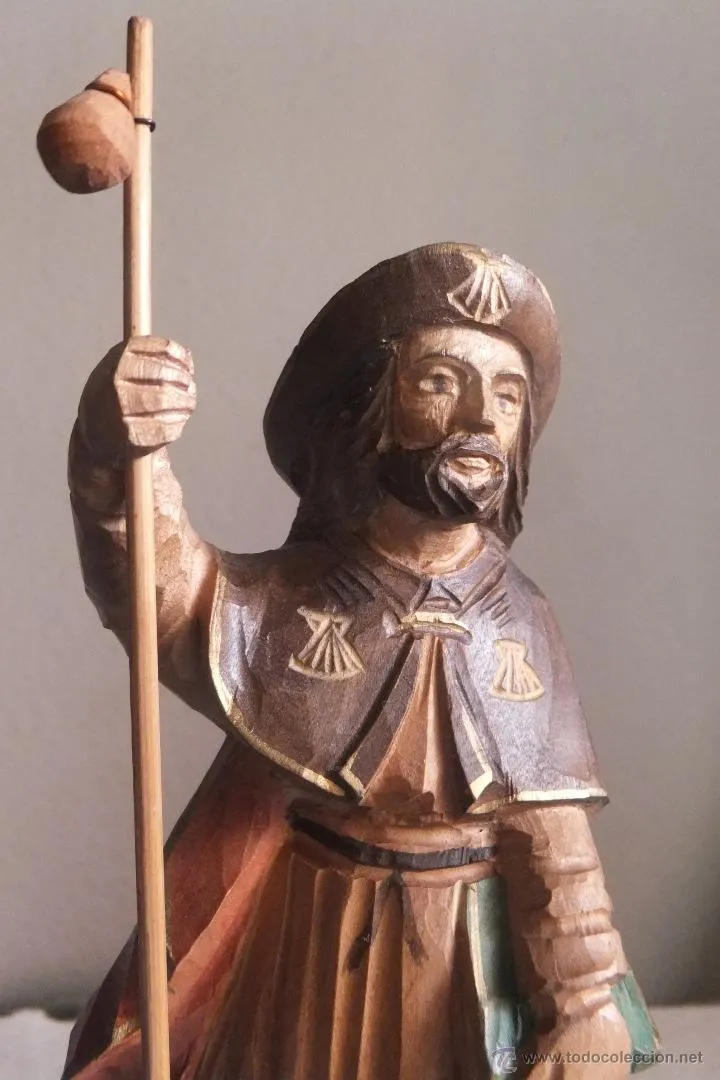
AÑO SANTO COMPOSTELANO
El Año Santo o Año Jubilar Compostelano es un tiempo en el que la Iglesia concede singulares gracias espirituales a los fieles, a imitación de lo que la Biblia dice del año jubilar de los israelitas: Cada 7 años era Año Sabático, en él recuperaba las tierras quien las había vendido por necesidad y los esclavos adquirían la libertad. Cada 50 años era Año Jubilar (Lv, 25). Jesús dice que Él viene a anunciar un año de gracia del Señor (Lc, 4,16). La Iglesia Compostelana, con su Año Santo, concede también un especial año de gracia.
Es Año Santo compostelano cuando el 25 de julio, Conmemoración del Martirio de Santiago, coincide en domingo. Se produce con la periodicidad 11, 6, 5, 6 años. Tiene su origen en 1122, con el Papa Calixto II, confirmado posteriormente por el Papa Alejandro III en la Bula “Regis aeterni” de 1179, confiriéndole perpetuidad. La Sede de Pedro alabó reiteradamente a lo largo de los siglos la peregrinación a Santiago y el Año Santo. “Nos exhortamos a todos amadísimos hijos a seguir esa vía de fidelidad evangélica, de autenticidad cristiana y de iluminada esperanza que, a través de los siglos, ha guiado a tantas almas hasta el Templo Compostelano”. (Pablo VI: A. St 1971). “Invito a los peregrinos a que hagan acopio de las sugestivas experiencias de fe, caridad y fraternidad que encuentren en su andadura, a que vivan el Camino sobre todo interiormente, dejándose interpelar por la llamada que el Señor hace a cada uno de ellos. Así podrán decir con gozo y firmeza en el Pórtico de la Gloria: «Creo»”. (Benedicto XVI: A St 2010).
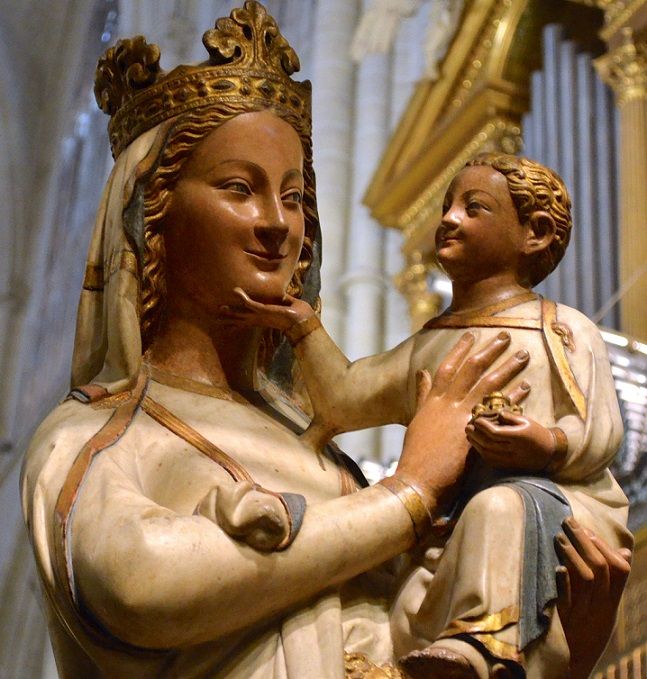
Anonymus artist, Virgen Blanca, Cathedral of Toledo (Spain)
The scene that the Gospel presents to us this Sunday is wonderful, it is full of tenderness. The disciples return tired from the apostolic work they did. The activity is so intense that they did not have time to eat, and then Jesus makes them this invitation: «Come to a quiet place to rest.» Too often today we Christians forget that a group of Christians is not only a community of prayer, reflection, and work, but also a community of rest and joy. But this has not always been the case. In the fourth century St. Augustine, Bishop of Hippo, put it wonderfully well: «A group of Christians is a group of people who pray together, but also talk together. They laugh together and exchange favors. They are joking together and together they are serious. They sometimes disagree, but without animosity, as one is sometimes with oneself, using that disagreement to always reinforce the usual agreement. They learn something from each other or teach it to each other. They miss, with pity, those who are absent. They welcome those who arrive with joy. They make manifestations of this or another type: sparks from the hearts of those who love each other, expressed on the face, on the tongue, in the eyes, in a thousand tender gestures»[1]. The point is that we shall be Christians who know how to pray but also know how to laugh, people who knows how to be serious and know how to joke. Sometimes I have the feeling that the Catholic Church sometimes appears as something so serious, formal, solemn. It seems to me that sometimes we Christians, we Catholics are afraid of laughter, as if laughter is always a sign of frivolity and lack of responsibility in the face of problems. But there is a humor and a knowing how to laugh that is a sign of maturity and wisdom. Let us not forget this! It is the laughter of the Christian who knows how to laugh because he knows how to relativize what is relative, without unnecessarily dramatizing problems. It is a laugh that is born of a deep faith, trust in God who looks at us with love and tenderness. A laugh that relaxes, frees, and gives strength to keep walking. This laugh unites. Those who laugh together do not attack or hurt each other because truly human laughter is born from a heart that knows how to understand and love. This Sunday’s Gospel invites us to reflect on this. We can look at the happiest and most joyous creature that has ever been the Blessed Virgin Mary. In the Catholic tradition we call her «Cause of our Joy». May she help us to reflect on this and to be cheerful Christians, men and women who know how to laugh! • AE
Fr. Agustin’s Schedule for the Sixteenth Sunday in Ordinary Time
Sunday, July 18, 2021
10.00 a.m. Mass (English) @ St. Dominic Catholic Church
12.30 a.m. Mass (English) @ St. Dominic Catholic Church
3.00 p.m. Mass (Spanish) @ St. Dominic Catholic Church
XVI Domingo del Tiempo Ordinario (Ciclo B)
Francisco de Goya, La gallina ciega (1789), oleo sobre tela, Museo del Prado (Madrid)
Es maravilloso encontrarnos con un Jesús que sabe comprender las necesidades más hondas del ser humano. Por eso se nos llena el alma de alegría al oir su voz que nos dice en el evangelio de este domingo: «Vengan conmigo a un lugar solitario, para que descansen un poco»[1]. Si: Los cristianos de hoy necesitamos descansar. Sometidos a un ritmo de trabajo inflexible, esclavos de ocupaciones y tareas a veces agotadoras, necesitamos ese descanso que nos ayude a liberarnos de la tensión, el desgaste y la fatiga acumulada a lo largo de los días. Hemos terminado por ser un esclavos de la productividad y hemos llegado a creer verdaderamente que el valor de la vida se reduce a la producción, eficacia y rendimiento laboral. Asi corremos el riesgo de olvidar el valor último de la vida y terminamos ahogandonos en el activismo, el trabajo y la producción. La sociedad industrial nos ha hecho a todos más laboriosos, mejor organizados, más eficaces, pero , ay, la vida se nos escapa de entre las manos. Por eso el descanso no puede ser solamente la pausa necesaria para reponer nuestras energías agotadas, o una válvula de escape que nos libere de las tensiones acumuladas, para volver al trabajo de siempre. El descanso deberia ayudarnos a regenerar todo nuestro ser, descubriéndonos dimensiones nuevas de nuestra existencia. El tiempo de descanso nos debe recordar que la vida no es sólo esfuerzo y trabajo agotador, que estamos hechos también para disfrutar, para jugar, para gozar de la amistad, para orar, para agradecer, para adorar. No podemos olvidar que estamos llamados a disfrutar como hermanos de una fiesta y un descanso que un día serán definitivos. En otras palabras: tendriamos que aprender a hacer vacaciones de otra manera. No se trata de obsesionarnos con pasarlo bien cueste lo que cueste, sino de saber disfrutar con sencillez y agradecimiento de los amigos, la familia, la naturaleza, el silencio, el juego, la música, el amor, la belleza, la convivencia. No se trata de vaciarse en la superficialidad de unos días vividos de manera alocada, sino de recuperar la armonía interior, Volver a las raices de nuestra existencia, encontrarnos con nosotros mismos, disfrutar de la amistad y el amor de las personas, gozar de Dios a través de la creación entera, de la musica, del arte, sin olvidar, naturalmente, que solo tendriamos derecho al descanso y la fiesta si nos cansamos diariamente en el esfuerzo por construir una sociedad más humana y feliz • AE
Dear friends, in these weeks of transition I am adapting to the schedule of my new parish community, St. Dominic Catholic Church. Some weekends I don’t have an official Confession schedule, but that doesn’t mean I’m not available. I always am! Please, if you need the Sacrament of Reconciliation, send me an e-mail (agusestrada@gmail.com) and we will find the best time to celebrate the Sacrament of joy. This applies even to every weekday. There is always time for a spiritual talk! Fr. Agustin










 LA MEDITACION DE LA ESPOSA