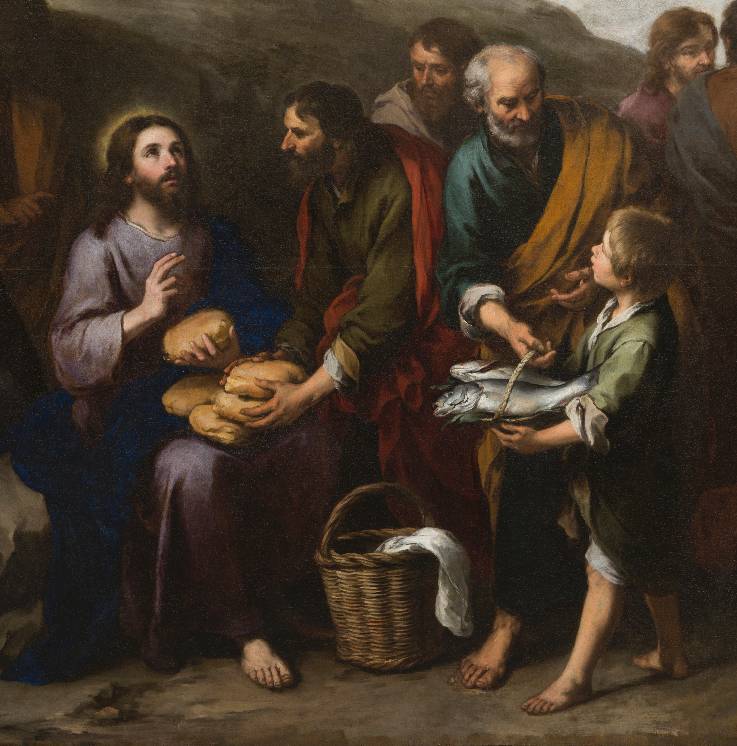
As every summer, this Sunday we begin a five week focus on the 6th chapter of the Gospel of John, the chapter on the Bread of Life. That the Church should spend five weeks on John 6 demonstrates that this is one of the most important sections of the Gospels. John 6 begins with the multiplications of the loaves and fish, our Gospel for this Sunday. Why is this miracle retold so often in the Gospels? There are two accounts of the multiplication in Matthew and Mark, one in Luke and one in John. In each passage phrases are used that are repeated at the Last Supper. «He took, He blessed, He broke.» Each passage refers to God’s continual gift of the one food we need, the Eucharist. Three elements are emphasized in John’s account of the multiplication to provide a deeper understanding of the Eucharist. Maybe you noticed them. These elements are the time of the multiplication, references to Psalm 23, and the gathering of the fragments that are left over. The time of the multiplication. The Gospel of John places the multiplication of the loaves and fish at the time of the Passover. This is not just a passing note. The Passover was the sacred meal of the Jews celebrating their freedom from slavery in Egypt and thanking God for His continual protection. In today’s Gospel Jesus provided a meal at the Passover time. He would provide another meal during another Passover. Holy Thursday took place at the time of the celebration of the Passover. The Last Supper was really the First Supper of the new People of God. The food would no longer be the Passover lamb, but the Lamb of God. The people would eat the Body and Blood of the Lord. It would be a meal of deliverance from slavery, slavery to the devil, slavery to sin. It would be a meal that would provide freedom. It would be a meal that would celebrate the New Life of the Lord. So, from the very start of today’s Gospel, we know that John is speaking about more than loaves and fish. He is speaking about the meal of the Christian Community, the Eucharist. Secondly, Psalm 23. You all know it: The Lord is my shepherd. In today’s Gospel Jesus sees the needs of the people. He has them recline on the green grass, green pastures if you will. He restores their strength with his food. This is not just about loaves and fish. Jesus is performing a prophetic action. He provides the banquet Psalm 23 spoke of, the Banquet of the Lord. Those who eat this food will continue to eat it in the House of the Lord forever. When we receive communion, we share in the meal of the Kingdom of God. We are united to people throughout the world and throughout time who also share in this meal. Picture yourself at table on Thanksgiving Day. Around the table are all your loved ones, including those who have passed on to the Lord many years ago. This is the Banquet of the Lord we share every time we receive communion. The third element that John 6 emphasizes in this account of the multiplication is the recovery of the fragments that are left over. Back in the days of the exodus from Egypt, the food that the people had brought with them ran out. They called upon Moses to give them food. He prayed to God, and God provided manna. When the people of Israel gathered the manna in the desert, they were told not to take more than they needed. And the left-over manna was not to be stored. Jesus does the opposite. He tells his disciples to gather up the remains. Enough is left over to fill twelve baskets. Twelve is not a random number. There were 12 patriarchs, the sons of Jacob[1]. There would be 12 apostles[2], the patriarchs of the New Testament. The Lord tells them to care for the food He provides. This does not just refer to not wasting the bread. The Eucharist which is not consumed during the Christian banquet is not to be thrown out. It is the Body of the Lord. It is to be saved for those who were not able to be present at His meal so they also can partake of his food. What we have here is the biblical basis for the preservation of the Eucharist in our tabernacles! The Eucharist is stored so those who cannot attend the feast might still receive the Lord’s Body. It is kept in our tabernacles for them. It is also kept in the tabernacle for all of us to reverence this special presence of the Lord. We do this every time we come into Church and genuflect and pray before the Blessed Sacrament. We do this when we pause after communion and reflect on the One inside us. So, these three elements emphasized by John in his account of the multiplication, the Passover, the fulfillment of Psalm 23, and the preservation of the fragments, remind us that God has provided a meal that is far greater than we could ever hope for, or even ever imagine. How great is our God? God is so great that he has found a way for all of us to attend the eternal Passover. How great is our God? God is so great that he leads us into his presence and feeds us his meal. How great is our God? He is so great that he has found a way for each of us to join the disciples at the Last Supper, or what is really the First Supper, the First Supper of the Kingdom. We need to ask ourselves at communion time: «What am I doing? Am I just following the crowd?” Hopefully not. “Am I receiving some sort of blessing?” Hopefully, we realize that communion is much more than a blessing. What is it that I am doing when I receive communion? I am receiving the Food that God provides. Today we pray for a deeper appreciation, a deeper reverence for the great gift of Love that is the Eucharist • AE
[1] ACTS 7:8-9 [2] Cf Luke 6:13

Fr. Agustin’s Schedule for the Seventeenth Sunday in Ordinary Time

Saturday, July 24, 2021
4.00 p.m. Sacrament of Confession
5.00 p.m. Vigil Mass (English) @ St. Dominic Catholic Church
Fr. Agustin will be out of the parish from Sunday July 25 to Friday July 30, resuming his usual schedule of confessions and masses on Saturday July 31, 2021.
XVII Domingo del Tiempo Ordinario (Ciclo B)

De todos los hechos realizados por Jesús durante su actividad profética, el más recordado por las primeras comunidades cristianas fue seguramente la multiplicación de los panes y los peces. Es el único episodio recogido en los cuatro evangelios. El contenido del relato es de una gran riqueza. Siguiendo su costumbre, el evangelio de Juan no lo llama «milagro» sino «signo». Con ello nos invita a no quedarnos en los hechos que se narran, sino a descubrir desde la fe un sentido más profundo. Jesús ocupa el lugar central. Nadie le pide que intervenga. Es él mismo quien intuye el hambre de aquella gente y plantea la necesidad de alimentarla. Es conmovedor saber que Jesús no solo alimentaba a la gente con la Buena Noticia de Dios, sino que le preocupaba también el hambre de sus hijos. ¿Cómo alimentar en medio del campo a una muchedumbre? Los discípulos no encuentran ninguna solución. Felipe dice que no se puede pensar en comprar pan, pues no tienen dinero. Andrés piensa que se podría compartir lo que haya, pero solo un muchacho tiene cinco panes y un par de peces. ¿Qué es eso para tantos? ¡Para Jesús es suficiente! Ese joven, sin nombre ni rostro, va hacer posible lo que parece imposible. Su disponibilidad para compartir todo lo que tiene es el camino para alimentar a aquellas gentes. Jesús hará lo demás. Toma en sus manos los panes del joven, da gracias a Dios y comienza a repartir entre todos. La escena es fascinante. Una muchedumbre, sentada sobre la hierba verde del campo, compartiendo una comida gratuita un día de primavera. No es un banquete de ricos. No hay vino ni carne. Es la comida sencilla de la gente que vive junto al lago: pan de cebada y pescado en salazón. Una comida fraterna servida por Jesús a todos gracias al gesto generoso de un joven. Esta comida compartida era para los primeros cristianos un símbolo atractivo de la comunidad nacida de Jesús para construir una humanidad nueva y fraterna. Les evocaba, al mismo tiempo, la eucaristía que celebraban el día del Señor para alimentarse del espíritu y la fuerza de Jesús, el Pan vivo venido de Dios. Pero nunca olvidaron el gesto de aquel muchacho. Si hay hambre en el mundo, no es por escasez de alimentos, sino por falta de solidaridad. Hay pan para todos, falta generosidad para compartirlo. Hemos dejado la marcha del mundo en manos del poder económico inhumano, nos da miedo compartir lo que tenemos, y la gente se muere de hambre por nuestro egoísmo irracional, ¿vamos a seguir así? • AE

AÑO SANTO COMPOSTELANO
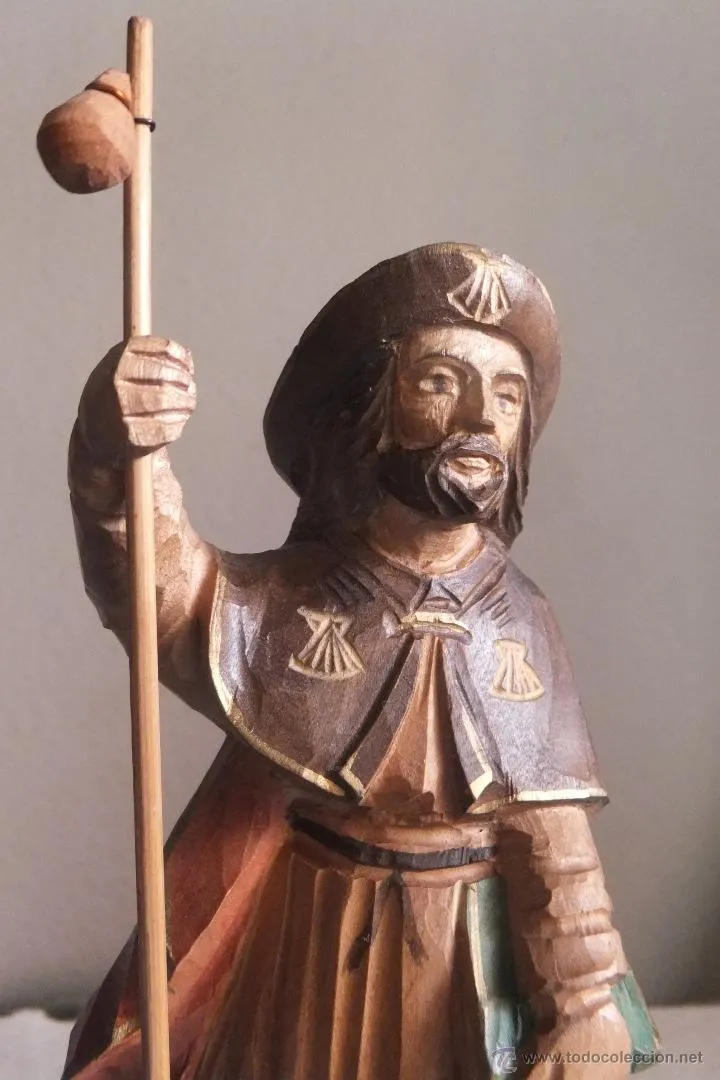
El Año Santo o Año Jubilar Compostelano es un tiempo en el que la Iglesia concede singulares gracias espirituales a los fieles, a imitación de lo que la Biblia dice del año jubilar de los israelitas: Cada 7 años era Año Sabático, en él recuperaba las tierras quien las había vendido por necesidad y los esclavos adquirían la libertad. Cada 50 años era Año Jubilar (Lv, 25). Jesús dice que Él viene a anunciar un año de gracia del Señor (Lc, 4,16). La Iglesia Compostelana, con su Año Santo, concede también un especial año de gracia.
Es Año Santo compostelano cuando el 25 de julio, Conmemoración del Martirio de Santiago, coincide en domingo. Se produce con la periodicidad 11, 6, 5, 6 años. Tiene su origen en 1122, con el Papa Calixto II, confirmado posteriormente por el Papa Alejandro III en la Bula “Regis aeterni” de 1179, confiriéndole perpetuidad. La Sede de Pedro alabó reiteradamente a lo largo de los siglos la peregrinación a Santiago y el Año Santo. “Nos exhortamos a todos amadísimos hijos a seguir esa vía de fidelidad evangélica, de autenticidad cristiana y de iluminada esperanza que, a través de los siglos, ha guiado a tantas almas hasta el Templo Compostelano”. (Pablo VI: A. St 1971). “Invito a los peregrinos a que hagan acopio de las sugestivas experiencias de fe, caridad y fraternidad que encuentren en su andadura, a que vivan el Camino sobre todo interiormente, dejándose interpelar por la llamada que el Señor hace a cada uno de ellos. Así podrán decir con gozo y firmeza en el Pórtico de la Gloria: «Creo»”. (Benedicto XVI: A St 2010).
 LA MEDITACION DE LA ESPOSA