Twenty-seventh Sunday in Ordinary Time.

Hieronymus Bosch, The Garden of Earthly Delights, oil on oak panels, 205.5 cm × 384.9 cm (81 in × 152 in), Museo del Prado, Madrid

So, the Pharisees ask a question to Jesus to put him to the test. Actually, it is a fact that makes the women of Galilee suffer a lot, a topic of heating discussions among rabbinical schools: «Is it lawful for a man to divorce his wife?» It is not about the modern divorce that we know today, but about the situation in which the Jewish woman lived within the marriage, controlled absolutely by the man. According to the law of Moses, the husband could break the marriage contract and expel his wife from home. The woman, on the other hand, subject in everything to the man, could not do the same. Jesus’ response surprises everyone. He does not enter into the discussions. He invites them to discover God’s original project, which is above laws and norms. This «macho» law, in particular, has been imposed on the Jewish people because of the «hardness of heart» of the men who control women and submit them to their will. Jesus goes back into the original mystery of the human being. God «created them male and female.» The two have been created equal. God has not created the male with power over the female. He has not created the woman subject to the man. Between men and women there must be no domination by anyone. From this original structure of the human being, Jesus offers a vision of marriage that goes beyond everything established by the Law. Women and men will unite to «be one flesh» and begin a shared life in mutual surrender without imposition or submission. This marriage project is for Jesus the supreme expression of human love. The man has no right to control the woman as if he were the owner of her. The woman does not have to accept living subject to the man. It is God himself who draws them to live united by a free and gratuitous love. Jesus emphatically concludes: «What God has joined, man must not separate.» With this he is destroying the foundation of patriarchy under all its forms of control, subjugation and imposition of the man on the woman. Not only in marriage but in any civil or religious institution. So, we are to listen to the message of Jesus. It is not possible to open paths to the kingdom of God and his justice without actively fighting against patriarchy. And of course, another important question arises: when will we react in our society, in the Church with energy against so much abuse, violence and aggression by men on women? When will we defend women from the «hardness of heart» of men? Hopefully the Spirit of God will fill us with light so we can take a moment to meditate on the words of the Lord in today’s Gospel • AE


Fr. Agustin’s Schedule for Twenty-seventh Sunday in Ordinary Time

Sunday, October 3, 2021.

12.30 p.m.  English Mass @ St. Dominic Catholic Church

3.00 p.m. Misa en Español @ St. Dominic Catholic Church


XXVII Domingo del Tiempo Ordinario (Ciclo B)

En nuestras comunidades parroquiales cada vez encontramos más y más personas que, una vez fracasado su primer matrimonio, han vuelto a unirse de manera civilmente o han formado una pareja de hecho. La realidad es compleja y delicada. Separación y divorcio son experiencias que generan casi siempre un profundo sufrimiento interior, muchas veces, soledad e incomprensión. La realidad es que muchos de ellos no se sienten queridos ni comprendidos por la comunidad, no obstante, los esfuerzos de algunos pastores. No es sólo la disciplina canónica la que les hace sufrir sino también esa actitud que a veces perciben en su entorno ¿Qué decir? A la luz de las palabras del Señor en el evangelio de hoy podríamos recordar que ser fieles a su enseñanza el amor conyugal único, fiel e indisoluble no significa dejar de tener una actitud de comprensión y misericordia hacia todos, de manera particular, hacia aquellos que más sufren. En el caso que nos ocupa, un sufrimiento interior, callado. La primera actitud del cristianismo ante estas parejas ha de ser de respeto, cercanía y amistad. En realidad, no hay razón alguna -ni religiosa ni moral- para adoptar otra postura diferente contraria al amor compasivo. No deberíamos marginarlos ni excluirlos sino intentar que no se consideren separados de la Iglesia, pues no lo están; de hecho, pueden y deben, en cuanto bautizados, participar la vida eclesial[1]. No puede ser otra la postura de una Iglesia que proclama y al mismo tiempo se sabe ella misma aceptada por su Señor a pesar de sus errores, pecados, caídas e infidelidades. Cristianos como somos, hemos de comprender el desgarro interior de quienes por la razón que fuere no pueden salir, de manera razonable, de la situación en que se encuentran. Nosotros podríamos encerrarnos en nuestros juicios y condenas; podríamos seguir sin comprender los errores y las culpas que los han conducido hasta el divorcio, pero una cosa es segura: Dios sigue escribiendo su propia historia de amor con ellos por caminos que a nosotros se nos escapan • AE

[1] Cfr. San Juan Pablo II, Familiaris Consortio, n. 84


Twenty-sixth Sunday in Ordinary Time (Cycle B)

Today’s readings lead us to a discussion of a topic that is pertinent to our present times in our country. The plurality of various faith traditions leads us to a deeper consideration of the first reading and the first part of today’s Gospel[1]. Moses was told to summon 70 leaders to the Meeting tent to receive a portion of the Spirit he had been given. 68 did go to that Tent, received the Spirit, and began prophesying.  However, the other two leaders, Eldad and Medad, had remained in the camp and were not in the tent. Still, they also received the Spirit and began to prophesy. So, they were not among those with Moses in the Tent but still received the Spirit of prophecy. When this was brought to Joshua’s attention, he wanted Moses to stop them. Moses wouldn’t because he could see that their preaching was authentic, they had the power, the authority of the Spirit of God. Well, in the same way in our own times, there are many people of many faiths whose preaching is authentic.  They may not be part of the Catholic Church, they may not even be Christian, but they still have a share of the Holy Spirit. “Hold on father! There is a dogma or article of faith that says that salvation comes through Jesus Christ.  How can those who do not recognize the seven sacraments or those who are not Christian receive the Spirit of God? What about the words of Jesus “Unless you eat my body and drink by blood you will not have life within you?”[2]. well, God the Father saw the condition of mankind after the fall and sent His Son to offer the eternal sacrifice for the redemption of mankind. Jesus became one of us and allowed our world to do its worst to Him, sacrificing Himself to the Father for us. After his death and resurrection, the Lord was united to his Father in heaven. Together the Father and the Son sent their Spirit, the Holy Spirit, upon people of good will. Some of these people of good will are Catholic. Some people of good will are Christians but not Catholic. Some people of good will are not even Christian such as Jews, Hindus, Muslims and Buddhists.  They all have a share of the Spirit of the Father and the Son and are all in their own way doing the work of God. They should be respected and supported in their work. So then, the question arises quickly: is it acceptable for a Catholic to leave the Catholic faith and join a non-Catholic religion since that religion also has a share in the Spirit of God?  When I am asked that question, I respond, “I need Jesus Christ, and I find Him in the words and sacraments of the Catholic church.”  For any of us to leave the Catholic Church would be for us to leave the Eucharist, to leave the seven sacraments. With the exception of our Orthodox brothers and sisters, no other faith believes that Jesus is really and truly present in the Eucharist as well as the other sacraments. For us to turn from Catholicism to another faith would be for us to turn from a truth we have been called to, the truth of the Eucharist, the truth of the sacraments. We recognize that people of other faiths share in the Spirit of the Father and the Son and proclaim His Truth. We celebrate their proclamation and join them in works of charity.  We pray with them and for them.  But at the same time, we also recognize that we have been given a share in the Spirit of the Father and the Son which includes the Presence of the Son nourishing us in the Eucharist, forgiving us in the sacrament of Confession, binding His Love to that of the husband and wife in the Sacrament of Matrimony, etc.  So, for us to leave the Catholic Church would entail our leaving the sacraments. It is said that millennials and others have done just that, left the Catholic Church to worship in various evangelical Churches. I do not hazard to assume to know why each person who leaves the Church does so, but I do think that our teaching on the Eucharist and the other sacraments need to be strengthened so that those in the Catholic Church have a deeper understanding of the great gifts we have been given. We need to pray together and work together, but we cannot sacrifice our Catholic identity. We join people of good will, people who have received a portion of the Spirit, as who we are. We are Catholic. Eldad and Medad were not in the Meeting Tent. But the Spirit of prophecy would not be confined by the institutional structure of the time.  Nor can it be contained by institutional structures of our time. Eldad and Medad proclaimed God’s Truth. We also need to proclaim God’s truth through our Catholic Church and with those who are not part of the Catholic Church. So, this morning we can pray for a deeper understanding and respect for the Spirit of Truth wherever it may assert itself • AE

[1] Cf Nm 11:25-29; Mk 9:38-43, 45, 47-48 [2] Cf John 6.


Fr. Agustin’s Schedule for Twenty-sixth Sunday in Ordinary Time

Saturday, September 25, 2021.

3.30 p.m. to 4.55 p.m. Sacrament of Reconciliation

5.00 p.m. English Mass @ St. Dominic Catholic Church

Sunday, September 26, 2021.

7.30 a.m. English Mass @ St. Dominic Catholic Church

10.00 a.m. English Mass @ St. Dominic Catholic Church


Domingo XXVI del Tiempo Ordinario (Ciclo B)

La Envidia (1810), caricatura de Timothy Bobbin publicada en Londres

Los cristianos no terminamos de superar esa mentalidad de -digámoslo así- casta privilegiada que nos impide apreciar todo el bien que se realiza en ámbitos alejados de la fe. Con frecuencia tendemos a pensar que somos los únicos portadores de la verdad, y que el Espíritu de Dios sólo actúa a través de nosotros. Una falsa interpretación del mensaje de Jesús nos ha conducido a veces a identificar el reino de Dios con la Iglesia. Según esta concepción, el reino de Dios se realizaría dentro de la Iglesia, y crecería y se extendería en la medida en que crece y se extiende la Iglesia. Pero no es asín. El reino de Dios se extiende más allá de la institución eclesial. No crece sólo entre los cristianos sino entre todos los hombres de buena voluntad que hacen crecer en el mundo la fraternidad. Según Jesús, todo aquél que arroja demonios en su nombre, está evangelizando. Es verdad: todo hombre, grupo u organización capaz de arrojar lejos a los demonios de nuestra sociedad y de colaborar en la construcción de un mundo mejor, está, de alguna manera, abriendo camino al reino de Dios. También a nosotros como a los discípulos, podría parecernos que no son de los nuestros aquellos que no vienen a nuestras parroquias, sin embargo, según Jesús «el que no está contra nosotros, está a favor nuestro»[1]. Todos los que, de alguna manera, luchan por la causa del hombre, están con nosotros. Allí donde se lucha por los humillados, los aplastados, los débiles, los abandonados, allí se combate en realidad con Dios por su reino, se sepa o no, él lo sabe» (G. Crespy). En menos palabras: los cristianos deberíamos valorar con gozo los logros humanos, grandes o pequeños, y los triunfos de la justicia que se alcanzan en el campo político, económico o social, por pequeños que puedan parecer. Lejos de creernos en posesión del monopolio de la salvación, los cristianos deberíamos acoger con alegría y gratitud esa corriente de salvación que se abre camino en la historia de los hombres, no sólo en la Iglesia, sino también junto a ella y más allá de sus instituciones. A esto nos invita la liturgia de la Palabra esta mañana • AE

[1] Cfr. Mk 9:38-43, 45, 47-48


Twenty-fifth Sunday in Ordinary Time (Cycle B)

Who would be the greatest among the disciples?  Who would make it to the top? Would it be James, John, Peter, or Andrew?  They did not know what greatness was. They would learn though. Jesus would show them greatness from a cross. That was the message that Jesus was trying to get across to his disciples after he heard them arguing about who should be first in the Kingdom of God[1]. He said that the first shall be last and servant to all. He put his arms around a child as an example of work, childcare, that might seem to be beneath the dignity of the great men they thought they would become.  For Jesus to be great was to serve. This is the point. Jesus calls us to be his disciples, His true followers.  He calls us to set aside our own desires for the sake of others.  He calls us to seek the greatness of humble generosity, to «rank first» among our families, friends and communities by taking on the spirit and role of being their servant. «If anyone wishes to be first, he shall be last of all and the servant of all.»[2]  The jealousy and selfish ambition that attacks the just man in the Book of Wisdom in our first reading this Sunday[3], and that James berates in the second reading[4] are the sad marks of the identification of the godless, people who have rejected God and His Son. The sign of the Christian is seen in his or her setting another’s needs over his or her wants. And we are all called to do this, continually.  Every day, every moment of the day you and I are called to consider others over ourselves.  The needs of the children, the sick, the poor and the elderly call us away from ourselves and call us into Jesus. Every day we have to resist the temptation to selfishness, the temptation to put ourselves before others. Every day we are called to greatness by conquering a mountain much more difficult than Everest.  We have to conquer ourselves.  Every day we are called to be the Presence of Jesus for others. And the infant cries.  And the girl with the MBA gets up to nurse him and change him. Her education was worth it. Someday she may go back to the office, but she has learned greatness through sacrifice. And the retired man spends at least eight hours a day making sure his wife suffering from dementia has care and company. He had learned a lot in his life. Now he is a teacher. He is teaching the rest of us what greatness is.  And the young single walks away from the bar scene, the wild scene, and becomes an AIDS buddy. He is a great person, using his time to provide care for the dying. In short: the goal of our lives is union with God.  The strength to achieve this union comes from Jesus Christ on the cross. He made Himself weak so we could be strong. Let us ask the Holy Spirit today for the gift of strength, the strength to reach out to others in charity, the strength to ascend the Mountain of God • AE

[1] Cf Mk 9:30-37 [2] Id. [3] Wis 2:12, 17-20 [4] Jas 3:16—4:3


Fr. Agustin’s Schedule for Twenty-fifth Sunday in Ordinary Time

Sunday, September 19, 2021.

12.30 a.m. English Mass @ St. Dominic Catholic Church

3.00 p.m. Misa en Español @ St. Dominic Catholic Church


XXV Domingo del Tiempo Ordinario (Ciclo B)

Ciertamente nuestros criterios no coinciden con los de Jesús. ¿A quién de nosotros se le hubiera ocurrido hoy pensar que los hombres y mujeres más importantes son aquéllos que parecen los últimos porque viven al servicio de los demás? Para nosotros, importante es el hombre de prestigio, seguro de sí mismo, que ha alcanzado el éxito en algún campo de la vida, que ha logrado sobresalir sobre los demás y ser aplaudido por las gentes. Todos esos cuyo rostro podemos ver constantemente en la televisión o en las redes sociales: Líderes políticos, premios Nobel, cantantes de moda, atletas excepcionales, influencers (¡el término es tan ridículo el pobre!) ¿Quién puede haber más importante que ellos? Según el criterio de Jesús, miles y miles de hombres y mujeres anónimos, de rostro desconocido, a quienes nadie hará homenaje alguno, pero que se desviven en el servicio sencillo y desinteresado a los demás. Hombres y mujeres que no viven para su éxito y egoísmo personal. Gentes que no actúan sólo para arrancarle a la vida todas las satisfacciones posibles para sí mismo, sino que se preocupan de la felicidad de los otros. Ciertamente hay una grandeza en la vida de estas personas que no aciertan a ser felices sin la felicidad de los demás. Su vida es un misterio de entrega y desinterés. Saben vivir más allá de sus propios intereses. Sin hacer cálculos. Sin medir mucho los riesgos. Hombres y mujeres que saben poner su vida a disposición de otros. No se imponen ni existen para sí mismos. Actúan movidos por su bondad. Una ternura grande envuelve su trabajo, su quehacer diario, sus relaciones, su convivencia. No viven sólo para trabajar ni para disfrutar. Su vida no se reduce simplemente a cumplir sus obligaciones profesionales y ejecutar diligentemente sus tareas. En su vida se encierra algo más. Viven de manera creativa. Cada persona que encuentran en su camino, cada dolor que perciben a su alrededor, cada problema que surge junto a ellos es una llamada que les invita a actuar, servir y ayudar. Podrían parecer los últimos, pero su vida es verdaderamente grande. Enorme. Luminosa. Todos sabemos que una vida de amor y servicio desinteresado merece la pena. Hoy podríamos orar humildemente tomando prestadas aquellas palabras del padre de Chardin: «Señor, responderé a tu inspiración profunda que me ordena existir, teniendo cuidado de nunca ahogar ni desviar ni desperdiciar mi fuerza de amar y hacer» • AE


Twenty-fourth Sunday in Ordinary Time (Cycle B)

Andrea di Bartolo, Way to Calvary (c.1400), oil on canvas, Thissen-Bornhemisza Museum (Madrid)

The first reading for today is taken from the second part of the Book of Isaiah. This part of the book was written for people in exile.  The People of Israel suffered because they had been taken away from their homeland by the Babylonians. Yet, they knew that this was God’s punishment for their turning to pagan ways. This second part of Isaiah is the Book of Consolation. The prophet says that a day will come when the sins of the people will be expiated, and God will lead them back home. Today’s reading is the third Song of the Suffering Servant[1]. A prophet shall come who will willing take upon himself the guilt of the people so that he can suffer for them. He is not a masochist.  He does not want to suffer, but he does want to sacrifice himself out of love for God and his people. This same thought is carried in the second part of today’s gospel[2].  Jesus announces that he is ready to sacrifice himself for God’s people.  He loves deep enough to sacrifice. This concept is completely against the mind set of Jesus’s world, as well as our world. A little sacrifice might be acceptable, but total sacrifice seems unreasonable. That was the reason why Peter protested.  And that is also the reason why Jesus tells him that he is giving the argument of the people of the world. He calls him Satan. Peter is doing the work of the devil. A mindset that is basically self-centered cannot understand sacrifice.  It also cannot understand love.  The person whose concept of love is as a means of his or her fulfilling needs cannot understand that real love demands sacrifice.  In fact, the deeper the love, the greater the sacrifice. The shallower the love, the more insignificant the sacrifice. Couples whose marriages have grown so that they can say that they are far more in love now than when they first married, recognize that they each sacrifice more now than when they were first married. They understand each other better because they are willing to accept each other more than ever before. The lady whose life revolves around taken care of her sick husband, loves him more now than on their honeymoon.  The man who supports his wife when she is having a bad day, or week, is loving her.  On the opposite side, the guy looking to pick up a girl for the evening knows nothing of love. The girl who views a guy as a means to an end will see the end of her ability to enter into a real marriage. Consider the sacrifices that you make for your children. There is nothing that you would not do for them no matter what it costs you.  That includes setting your faces like flint, like the Servant of the first reading, and putting up with your children’s complaints and even their anger when you decide that something happening in other homes will not happen in yours.  For example, you say to your children, “I don’t care what happens in other places, here there will be no phones when we are eating, and all devices will be in the kitchen and plugged in for the night by 8:00 pm. If you need them after that for homework, you can do your homework on the kitchen table.” You have that rule to protect the children from pornography and from midnight texting. But it results in your children saying, “Everybody else can do this.” or you say, “We are a family that puts Christ first. We worship on Sundays and receive Communion.  If something happens that forces us to miss Sunday morning Mass, then we go to Church Saturday or Sunday night.  This is what we do because this is who we are.  We are Catholic.”  And your children respond, “Nobody else has to do what we have to do.”  But you refuse to back down because you love your children more than yourself and are willing to risk dealing with your own upset at your children’s reactions than neglect raising them to be strong Catholics. Your faces are set like flint. So, we have to keep our faces set like flint and grow stronger in faith every day we have left in this world. Christ’s love for us was unrestricted. He would do anything for us. He would make any sacrifice for us. Peter couldn’t understand.  He protested because he wanted to put a limit on the Lord’s sacrifice, and thus on his love. He thought in the way of the world. It would take time for Peter to learn the demands of Christianity, the demands of true love. He would be among the first of many martyrs who would be witnesses to love. None of us want to suffer. If we did there would be something wrong with us. But if we really love, then we are willing to accept suffering, and deny ourselves so that our love might grow deeper.  Acknowledging that this is completely opposed to the mindset of a self-centered society, we ask God to give us all the ability to love and love well.  We ask our Lord to give us the courage to live with sacrificial love, to help us courageously live the Gospel • AE

[1] Cf Is 50:5-9a [2] Mk 8:27-35


Fr. Agustin’s Schedule for Twenty-fourth Sunday in Ordinary Time

Saturday, September 11, 2021.

Sunday, September 12, 2021.

Fr. Agustin will be away from the parish this weekend. The mass schedule and the time for the celebration of the Sacrament of Confession remains the same.


XXIV Domingo del Tiempo Ordinario (Ciclo B)

Tiziano, Cristo con la cruz a cuestas (1565), óleo sobre tela, Museo Nacional del Prado (Madrid)

Quién dice la gente que soy yo?” Es la pregunta que hizo Jesús a sus discípulos mientras recorría las aldeas de Cesarea de Filipo. Después de veinte siglos esa pregunta… no la sabemos responder. ¿Quién es Jesús para nosotros? Su persona nos llega a través de muchos siglos de imágenes, fórmulas, dogmas, explicaciones teológicas e interpretaciones culturales que van desvelando y, a veces, también velando su misterio. Para responder a la pregunta de Jesús podemos acudir a lo que han dicho los Concilios, sí, o escuchar el Magisterio de la Iglesia, o leer las reflexiones de los teólogos o repetir cosas que hemos oído a otros, pero ¿no se nos está pidiendo una respuesta más personal y comprometida? Afirmamos rápidamente que Jesús es Dios, pero, luego, no sabemos qué hacer con su divinidad. ¿Amamos a Jesús sobre todas las cosas o está nuestro corazón ocupado por otros dioses en los que buscamos seguridad, bienestar o prestigio? ¿Para qué sirve confesar la divinidad de Jesús si, luego, apenas significa algo en nuestras vidas? También decimos de él que es Señor, pero ¿es él quien dirige nuestra vida? Doblamos distraídamente la rodilla al pasar ante el sagrario, pero ¿le rendimos alguna vez nuestro ser? ¿De qué nos sirve llamarlo tantas veces Señor si no nos preocupa hacer su voluntad? Confesamos que Jesús es el Cristo, es decir, el Mesías enviado por Dios para salvar al ser humano, pero ¿qué hacemos para construir un mundo más humano siguiendo sus pasos? Nos llamamos cristianos, pero ¿qué hacemos para sembrar libertad, dignidad y esperanza para los últimos de la Tierra? Proclamamos que Jesús es la Palabra de Dios encarnada, es decir, Dios hablándonos en los gestos, las palabras y la vida entera de Jesús. Si es así, ¿por qué dedicamos tan poco tiempo a leer, meditar y practicar el Evangelio? ¿Por qué escuchamos tantos mensajes, consignas y magisterios antes que la palabra sencilla e inconfundible de Jesús? ¡Hay tanto qué pensar! Hoy podríamos empezar, quizá meditando, además de en el evangelio, en aquellas palabras de Soren Kierkegaard: «Señor Jesús, tú no viniste para ser servido, ni tampoco para ser admirado o, simplemente, adorado. Tú has deseado, solamente, imitadores. Por eso, despiértanos, si estamos adormecidos en este engaño de querer admirarte o adorarte, en vez de imitarte y parecernos a ti» • AE


Twenty-third Sunday in Ordinary Time (Cycle B)

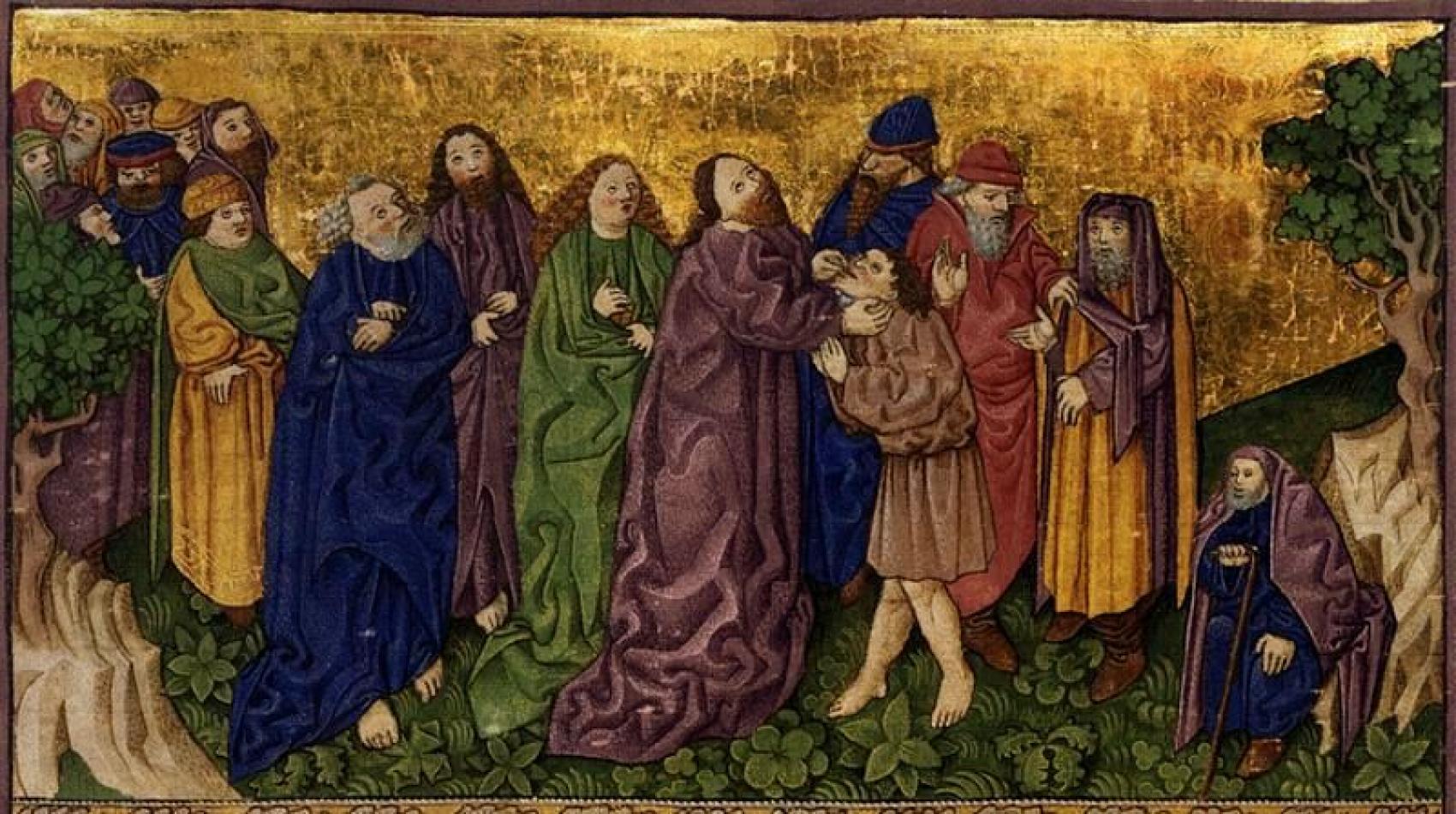
German illuminated manuscript from the 17th century, Christ healing the deaf man, Berlin Public Library (Germany)

He took him away from the crowd. He touched his ears and his mouth and said, «Be open». This is a miracle story. This is a story about our lives with the Lord. There is a great deal of noise in our lives. Interesting word: noise.  It even sounds bad. NOISE. There is much noise in our lives, but not just in the sense of sound. There is noise in the sense of disturbance, you know, like static on the phone line.  TV, computer, the phone, the kids, the neighbors, those driving down the street with their radios on overkill, are all audio noises, but there is also noise, disturbance, created by the continual worrying about tomorrow, the hanging on to the battle stories of the past.  Noise. Noise. Noise. Noise in our lives:  «Did you see what she was wearing?  Guess who just broke up?  Noise Noise Noise.  Mom, Dad, can I have……? Would you buy me……?” The phone rings, «You have a tremendous opportunity to save money now by having your driveway resurfaced this week instead…» NOISE. And Jesus took the man away from the crowd, away from the noise. He took him to have a personal encounter with. He calls us away from the crowd, away from the noise to his quiet. Quiet before the Lord is so important: A few moments before and after Mass, out of respect for the presence of the Lord in the Blessed Sacrament, out of respect for the needs of others to get away from the noise, out of respect for our own need to listen to the Lord in the quiet. Quiet in our homes. Fifteen minutes of quiet, before the morning gets going, or after the kids are in bed, or together as a family, just a little quiet time. A little time to get away from the noise. A little time with the Lord so he can touch us. He touched the man’s ears and he said, “Ephphatha! Be opened!”[1]. so, He calls us to hear. To hear the still small voice Elijah heard, whispering that God loves us and has a plan for each of us[2].  To hear the whisper of Christ on the cross, telling us in the darkest moments of our lives that we will get through this together[3]. To hear the beautiful voice of the Holy Spirit singing the Love Song of God in our hearts. To hear the voice of Mary, reassuring the concerned wine steward at the wedding feast of Cana, and reassuring us, saying, «Do whatever he tells you[4].» To hear the voice of our conscience within, calling us to holiness. To hear the Word of God alive in the Bible, proclaimed in the Church, proclaimed by the Church, proclaimed by the loving husband and wife in their continual gifts of themselves to each other, proclaimed by parents and grandparents, aunts and uncles. Jesus touches our ears in the same way he touched the man’s mouth and said, «Be opened», telling He tells us not to be afraid to stand up for our beliefs and our lifestyle, even if we are told that we are not in concert with modern society. He needs our voices.  He needs us to proclaim that he is indeed alive. The Resurrection continues. We celebrate his resurrection on Sundays so we can have the spiritual strength to proclaim his life. He opens our mouths to proclaim his praise to the world. He drew the man away from the crowd.  He touched his ears and his mouth, and he said, «Be opened.» And the man left proclaiming the love of God. He touched him. He touches us. Now we know what exactly we have to do • AE

[1] Mk 7:31-37. [2] Cf 1 Kings 19:11. [3] Cf Luke 23:34. [4] Cf John 2:5.


Fr. Agustin’s Schedule for Twenty-third Sunday in Ordinary Time

Sunday, September 5, 2021.

12.30 a.m. English Mass @ St. Dominic Catholic Church

3.00 p.m. Misa en Español @ St. Dominic Catholic Church


XXXIII Domingo del Tiempo Ordinario (Ciclo B)

Son muchos los hombres y mujeres que se sienten incapaces de hablar con Dios. No saben escucharlo y no saben hablarle; podríamos decir que son como sordomudos ante Él, y es que han olvidado los caminos que los podrían ayudar a entrar en sí mismos y en el encuentro con Dios: el silencio, la meditación, etc. Otros siguen cumpliendo algunas prácticas religiosas: predicaciones, liturgias; sus labios se mueven para entonar cantos o recitar oraciones, pero sin ningún dialogado en el fondo del corazón. Justo lo que decía el Señor el domingo pasado en el evangelio. Incapaces de comunicarnos con Dios, ¿cómo escuchar hoy esta llamada de Jesús al sordomudo? ¿Cómo abrir nuestros oídos y nuestros labios para dialogar con Dios? Cuenta Tony de Mello en uno de sus escritos ese delicioso relato. Un pez joven acudió a otro más viejo y le preguntó: «Dime: ¿dónde puedo encontrar eso que llaman Océano? He andado buscándolo por todas partes sin resultado». El viejo pez le respondió: «El Océano es precisamente donde estás tú ahora mismo”. El joven pez se marchó decepcionado: «¿Esto? Pero si esto no es más que agua… Lo que yo busco es el Océano». Para encontrar a Dios no hay que recorrer largos caminos. Basta detenerse, cerrar los ojos, entrar en nuestro corazón y escuchar la vida que hay en nosotros mismos. Ahí, donde estamos ahora mismo, está Dios rodeándonos y penetrándonos de vida. Yo no hago absolutamente nada y, sin embargo, mi corazón palpita, la sangre corre por mis arterias, mi organismo respira. Una fuerza oculta recorre todo mi ser. No soy yo quien hace algo para vivir. Segundo a segundo voy recibiendo la vida como un regalo misterioso. Solemos decir: «Estoy respirando» pero, en realidad, no es así. Yo no estoy respirando. La respiración está sucediendo en mí. Cuando un niño recién nacido respira por vez primera ni siquiera sabe que existe el mecanismo de la respiración, sus pulmones jamás han funcionado hasta entonces. Y sin embargo la respiración llega y el milagro comienza. Desafortunadamente también entre nosotros hay quienes sólo ven agua y no descubren jamás el Océano. Viven sin escuchar el misterio de la vida que los rodea y los sostiene. Hoy podríamos pedirle al Espíritu de Dios que nos inunde con su luz para que podamos recuperar esa capacidad de dialogar con Dios, de escucharlo, de hacerle preguntas. El punto de partida podría ser el silencio • AE