What I have written, I have written[1]. This passage follows the dialogue between Pilate and Jesus presented in today’s Gospel. Pilate asked Jesus if he were a king. Jesus replied, “You yourself say so.” So, Pilate had the inscription put on the cross. He was being sarcastic. At some point Jesus said, “My Kingdom is not of this world.” What was, what is his Kingdom? Up until a few centuries ago, no one could imagine a government that was not ruled by a king, queen, or some sort of emperor. Some people have a difficult time understanding today’s celebration because they see it as seeking an end of democracy and a return to monarchy. That is not the case. When we say Thy Kingdom Come, we are not concerned with any form of government. When we say Thy Kingdom Come, we are focusing on God having absolute power in our world. So, we say Thy Kingdom come. We say this so often that we skim through the words. We hardly notice them. Nor do we reflect on what we are asking for when we say it. What do we mean by this phrase? Do we really want this prayer answered? What are we doing to bring about the Kingdom of God? What do we mean by Thy Kingdom Come? The prayer is calling on God to transform the world into His Kingdom. That would mean an end to hatred, an end to greed, an end to materialism. In the Kingdom of God, all that would matter would be our union with God. The value system of the secular world would be scrapped. In the Kingdom of God, the goal of hard work would be to have more to give to those who have less. In the Kingdom of God, justice and charity would reign. All people would be good to each other. All would enjoy union with the King, union with God. When we say Thy Kingdom Come, we are being eschatological. There is a word you do not hear that often. Eschatology is the study of the last things, the end of time. When we say Thy Kingdom Come, we are praying for the second coming of the Lord at the end of time. At the end of the Church year, we pray for the end of time. This brings the prayers of the Church full circle, for at the beginning of Advent, as we will see next week, we pray, Maranatha, the most ancient prayer of the Church. Maranatha, come Lord Jesus! Do we want all this? Do we want Thy Kingdom Come in the full meaning of the prayer? Union with God. Peace in the world. Of course, we want that. But are we willing to pay the price? Do we want Christ to come again and bring the world to its conclusion? If we want Thy Kingdom Come, then what are we doing about it? How are we working for the Kingdom? Do we work hard to keep a union with God? Do we fight against all forms of hatred, bigotry, and prejudice? Do we look for ways that we can reach out to those who have less than we have? Do we live in such a way that others can say, “He, she, is certainly a Christian?” Jesus stood before Pilate and said, “My Kingdom is not of this world.” We want Jesus! And so, we pray, Thy Kingdom Come! • AE
[1] John 19:19-22

Fr. Agustin Schedule for the Solemnity of Our Lord Jesus Christ, King of the Universe (Thirty-fourth Sunday in Ordinary Time)

Saturday, November 13, 2021.
3.00 p.m. Sacrament of Reconciliation
5.00 p.m. English Mass @ St. Dominic Catholic Church
Sunday, November 14, 2021.
7.30 a.m. English Mass @ St. Dominic Catholic Church
10.00 a.m. @ St. Dominic Catholic Church
Solemnidad de Nuestro Señor Jesucristo, Rey del Universo (2021)
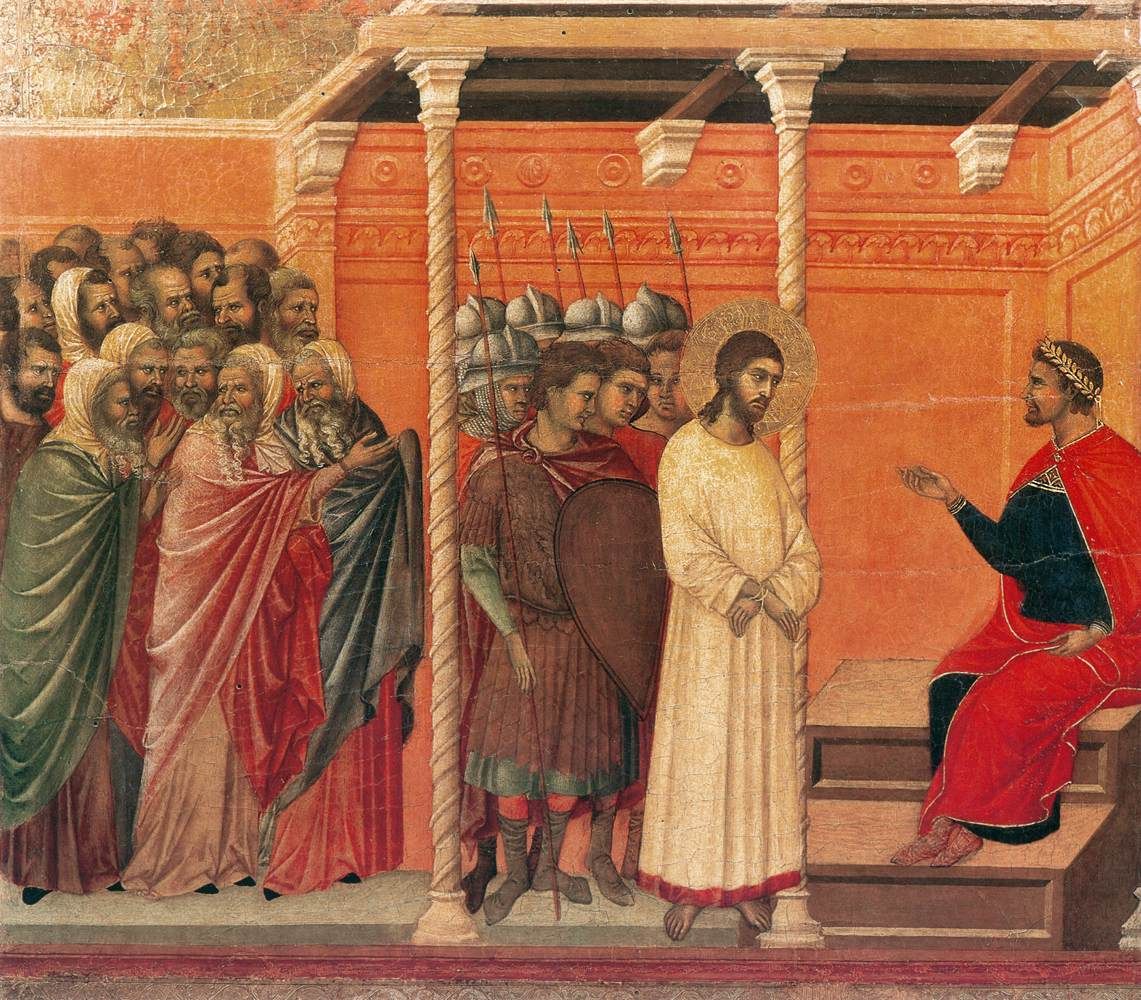
El juicio tiene lugar en el palacio donde reside el prefecto romano cuando viene a Jerusalén. Acaba de amanecer. Pilato ocupa la sede desde la que dicta sus sentencias. Jesús comparece maniatado, como un delincuente. Allí están frente a frente: el representante del imperio más poderoso, y el profeta del reino de Dios. A Pilato le resulta increíble que aquel hombre intente desafiar a Roma: « ¿Con que tú eres rey?». Jesús es muy claro: «Mi reino no es de este mundo». No pertenece a ningún sistema injusto de este mundo. No pretende ocupar ningún trono. No busca poder ni dinero. Pero no le oculta la verdad: «Soy Rey». Jesús vino a introducir verdad. Si su reino fuera de este mundo tendría guardias que lucharían por él con armas. Pero sus seguidores no son legionarios, sino discípulos que escuchan su mensaje y se dedican a poner verdad, justicia y amor en el mundo. El reino de Jesús no es el de Pilato, que vive para extraer las riquezas y cosechas de los pueblos y conducirlas a Roma. Jesús vive para ser testigo de la verdad. Su vida es todo un desafío: «todo el que es de la verdad, escucha mi voz». Pilato no es de la verdad. No escucha la voz de Jesús. Dentro de unas horas, intentará apagarla para siempre. Nosotros, los que seguimos al Señor, no somos guardianes de la verdad, sino testigos. Gran diferencia. No somos legionarios sino discípulos. No buscamos disputar, combatir y derrotar a los adversarios, sino vivir la verdad del evangelio y comunicar la experiencia de Jesús que cambia nuestra vida. Una vez más: no somos propietarios de la verdad, sino testigos. No imponemos nuestra doctrina, ni controlamos la fe de los demás, no pretendemos tener razón en todo. Los cristianos hemos de vivir convirtiéndonos a Jesús constantemente, contagiando la atracción que sentimos por él, ayudando a mirar en dirección del evangelio. En menos palabras: los cristianos atraeremos a la gente cuando vean que nuestro rostro se parece al de Jesús, y que nuestra vida recuerda a la suya • AE
 LA MEDITACION DE LA ESPOSA