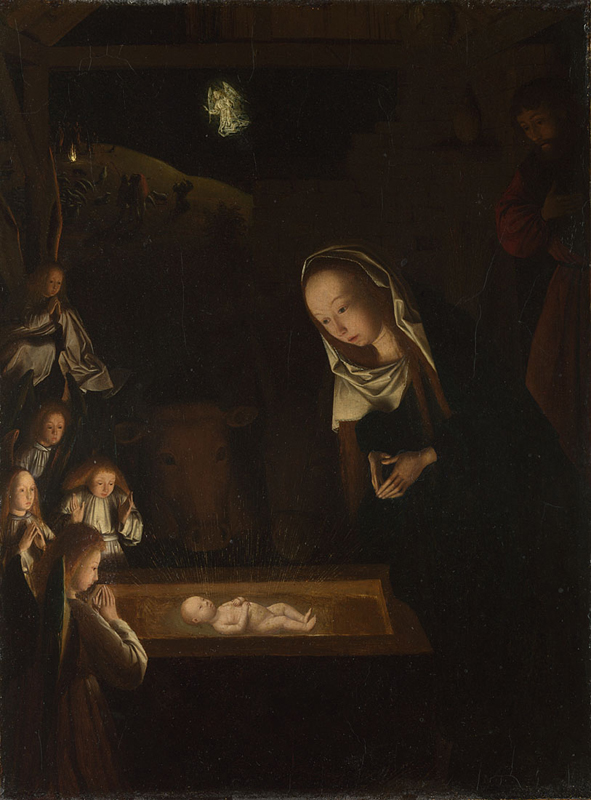
G. Sint Jans, The Nativity at Night (c. 1490), oil on oak, National Gallery (London)
Every year brings with it unexpected blessings, and unexpected challenges. This year has been no different than any other. No matter what life has brought us, there is something extremely beautiful that at the end of the year we are celebrating our reason for hope. Jesus the Christ has been born! The eternal Second Person of the Holy Trinity, the Word of God, has become flesh and dwelt among us. What does this birth in a stable mean to me, to you, to the world? That is the question; the big one. It means that mankind’s reality is being drastically changed. Before Jesus, man was merely a physical being. He was created to be physical and spiritual, but he forfeited his capacity for the spiritual to the power of evil. The grasp of evil is still experienced in many people turning to the secular values of life to find hope, fulfillment, and salvation. Glamour, fame, power, prestige, and money preoccupy much of their attention and energy. Many people, and perhaps, to some degree all of us, look for hope in the wrong places. Jesus Christ is the source of hope. His life is the antithesis of those secular values that so many grasp and that lead so many to despair. He is the King of Kings, yet He is born in a stable. Our nativity scenes often whitewash the fact that stables are dirty places, stinky places. We contemplate Jesus in a manger for his throne, but we forget that a manger is a place for animals to get their food. The One who is the source of hope makes it clear from the first moments of his life outside of his mother that hope is found in God, not in materialism of any sort. Isn’t it sad that many have transformed the day we celebrate the birth of a child in a stable into a celebration of materialism? When St. Francis of Assisi built the first nativity scene in Italy[1], he called upon people to celebrate the life of the Poor One who was in fact our Savior. Jesus Christ is our Savior. His name, Jesus, means God saves. We needed to have our capacity for the spiritual restored. We needed to be saved from eternal death. We needed to be saved from the power of evil, the dominance of Satan. How? How is it that He saves us? Jesus responded to the hatred of the devil with the Love of God. He let evil do its worst to Him, out of obedience to the Father and love for those creatures made in God’s image and likeness. He was born and placed in a manger so He could die on a cross. Satan wanted to be like God. He told Adam, mankind, Eve, mother of the living, and the rest of us that if we immerse ourselves in the material we could be like God, gods ourselves[2]. But the result of our pushing God out of our lives was radically different than expected. It did not make us gods. Instead, our world was filled with hatred, and death. The birth of the child in the manger, Jesus, the Savior, resulted in the Triumph of God. Love conquers all. A child is born for us today. A Savior is given to us. He restores our spiritual life. He gives our lives meaning and purpose and fulfillment. May we view every challenge and every joy from the perspective of the One who is the Center of all Creation. It is here for us. It is here for you. It is here for me. He is here for us. He is here for you. He is here for me. We can have peace. If we keep God in the center of our lives, we will have peace, a peace infinitely greater than any the world could provide. May the Peace of Christ be with you! • AE
[1] 1223, in Grecio. [2] Cf Genesis 3:5

Christmas celebrations 2021 • St. Dominic Catholic Church
Saturday December 25, 2021
12.00 a.m. English Mass (Yes: this mass begins at midnight)
Saturday December 25, 2021
10.00 a.m. English Mass
Sunday, December 26, 2021
(Feast of the Holy Family of Jesus, Mary and Joseph)
7.30 a.m. English Mass @ St. Dominic Catholic Church
10.00 a.m. English Mass @ St. Dominic Catholic Church
Solemnidad de la Natividad del Señor (Navidad)

G. de La Tour, Le Nouveau-né (1648), óleo sobre tela, Museo de Bellas Artes de Rennes (Francia)
La Navidad es mucho más que todo ese ambiente superficial y tan manipulado que se respira estos días en nuestras calles. Una fiesta mucho más honda y gozosa que todos los que podemos tener entre las manos en esta ¡ay! sociedad de consumo. Los creyentes tenemos que recuperar de nuevo el corazón de esta fiesta, descubrir detrás de tanto ruido el misterio que da origen a nuestra alegría. En otras palabras: tenemos que aprender a celebrar la Navidad. No todos saben lo que es celebrar. No todos saben lo que es abrir el corazón a la alegría. Y, sin embargo, no entenderemos la Navidad si no sabemos hacer silencio en nuestro corazón, abrir nuestra alma al misterio de un Dios que se nos acerca, reconciliamos con la vida que se nos ofrece, y saborear la fiesta de la llegada de un Dios Amigo, el Dios con nosotros. En medio de nuestro vivir diario, a veces tan aburrido, apagado y triste, se nos invita a la alegría. No puede haber tristeza cuando nace la vida, decía san León Magno. No se trata de una alegría insulsa y superficial. La alegría de quienes están alegres sin saber por qué. Nosotros tenemos motivos para el júbilo radiante, para la alegría plena y para la fiesta solemne: Dios se ha hecho hombre, y ha venido a habitar entre nosotros, como nos dice el evangelio de hoy[1]. Hay una alegría que sólo la pueden disfrutar quienes se abren a la cercanía de Dios, y se dejan coger por su ternura. Una alegría que nos libera de miedos y desconfianzas delante Dios. ¿Cómo temer a un Dios que se nos acerca como niño? ¿Cómo huir ante quien se nos ofrece como un pequeño frágil e indefenso? Dios no ha venido armado de poder para imponerse a los hombres. Se nos ha acercado en la ternura de un niño a quien podemos hacer sonreír o llorar. Dios no puede ser ya el Ser Omnipotente y Poderoso encerrado en la seriedad y el misterio de un mundo inaccesible. Dios es este niño entregado a la humanidad, este pequeño que busca nuestra mirada, nuestra atención. El hecho de que Dios se haya hecho carne dice mucho más de cómo es Dios, que todas nuestras cavilaciones y especulaciones sobre su misterio. Si supiéramos detenernos en silencio ante este Niño y acoger desde el fondo de nuestro ser toda la cercanía y la ternura de Dios, quizás entenderíamos por que el corazón de un creyente debe estar transido de una alegría diferente estos días de Navidad • AE
[1] Cfr. Jn 1, 1-18 o 1, 1-5. 9-14.

La Virgen Gitana (Villancico Andaluz)
La Virgen como es gitana
A los gitanos camela
San José como es gachón
Se rebela, se rebela
La Virgen lavaba
San José tendía
La Virgen lavaba
San José tendía
Ay, curricuti
Ay curricuti curricutin
Agua le traía, agua le traía, agua le traía
Madroños al niño no le demos más
Que con los madroños se pué emborrachar
Que sí, que no, Rocío se llama la madre de Dios
La Virgen vendió la mula
Porque le daba coraje
San José como es gachon
Atrincó su correaje
La Virgen lavaba
San José tendía
La Virgen lavaba
San José tendía
Ay, curricuti
Ay curricuti curricutin
Agua le traía, agua le traía, agua le traía
Madroños al niño no le demos más
Que con los madroños se pué emborrachar
Que sí, que no, Rocío se llama la madre de Dios
 LA MEDITACION DE LA ESPOSA