
So, how can Mary, a human being, be the mother of the Infinite One? This mystery is best understood when we focus on Jesus Christ. He is the Eternal Second Person of the Trinity, and a human nature, He took on humanity through the Blessed Virgin Mary. Mary is the mother of his human nature, not his divine nature. Mary is not a goddess. She is a human being who was prepared to be the vessel through which the Word would become flesh.
That is why we say Mary is the Mother of God. This is what we are celebrating today. What must it have been like for the Eternal Word, to take on the nature of a human within the Blessed Virgin? He had to feel her heart beating. He had to be aware of the experience of being a human when he was only a microscopic zygote, then an embryo, then a fetus. When during her pregnancy Mary prayed to God, the child within her heard and answered her prayers. The Incarnation began at the Annunciation. Life outside of His Mother began on Christmas. There is a Christmas hymn that explains the mystery Jesus and Mary in a very simple way.
The baker woman in her humble lodge received a grain of wheat from God. For nine whole months the grain she stored. Behold the handmaid of the Lord. Make us the bread, Mary, Mary. Make us the bread, we need to be fed. The baker woman took the road which led to Bethlehem, the house of bread. To knead the bread she labored through the night, and brought it forth about midnight. Bake us the bread, Mary, Mary. Bake us the bread, we need to be fed.
She baked the bread for thirty years by the fire of her love and the salt of her tears, by the warmth of a heart so tender and bright, and the bread was golden brown and white. Bring us the bread, Mary, Mary. Bring us the bread, we need to be fed.
After thirty years the bread was done. It was taken to town by her only son; the soft white bread to be given free to the hungry people of Galilee. Give us the bread, Mary, Mary. Give us the bread, we need to be fed.
For thirty coins the bread was sold, and a thousand teeth so cold, so cold, tore it to pieces on Friday noon when the sun turned black and red the moon. Break us the bread, Mary, Mary, Break us the bread, we need to be fed.
And when she saw the bread so white, the living bread she had made at night, devoured as wolves might devour a sheep, the baker woman began to weep. Weep for the bread, Mary, Mary. Weep for the bread, we need to be fed.
But the bakerwoman’s only son appeared to his friends when three days had run on the road which to Emmaus led, and they knew him in the breaking of bread. Lift up your head, Mary, Mary. Lift up your head, for now we’ve been fed.
How beautifully this captures today’s Solemnity. Mary, Mother of God, baked the Bread of God within her, delivered this bread in Bethlehem, the city that means House of Bread, and watches as we are fed by the Bread. She is the Mother of Jesus, the Son of God. She is the Mother of God. So, Oh Holy Mary, Mother of God, pray for us sinners, now and at the hour of our death, Amen • AE
Fr. Agustin Schedule for
The Octave Day of Christmas: Solemnity of the Blessed Virgin Mary, the Mother of God (2022)
The Solemnity of the Epiphany of the Lord (2022)

Friday, December 31, 2021.
Saturday, January 1, 2022.
Sunday, January 2, 2022
TBD
ALMA REDEMPTORIS MATER
Alma Redemptoris Mater (Loving Mother of our Redeemer in English) is a Marian hymn, written in Latin hexameter, and one of four seasonal liturgical Marian antiphons sung at the end of the office of Compline (the other three being Ave Regina Caelorum, Regina Caeli and Salve Regina)
Alma Redemptoris Mater (Madre del Redentor) es un himno Mariano, escrito en latín, y una de las cuatro Antífonas Marianas que se cantan al final de la liturgia de las horas. Las otras tres son: Ave Regina Caelorum, Regina cœli y Salve Regina. Se cree que su autor fue Hermannus Contractus (“Herman el Cojo”; 1013–1054) quien se basaría en los escritos de los santos Fulgencio, Epifanio, e Irineo de Lyon.1Este himno se menciona en «el cuento de la priora», uno de los relatos de Geoffrey Chaucer en los (preciosos) Cuentos de Canterbury. Antiguamente se recitaba en las completas sólo desde el primer domingo de Adviento hasta la Fiesta de la Candelaria o fiesta de la purificación de la Virgen (2 de febrero) •
Solemnidad de María Santísima, Madre de Dios (2021)
LA VISITADORA
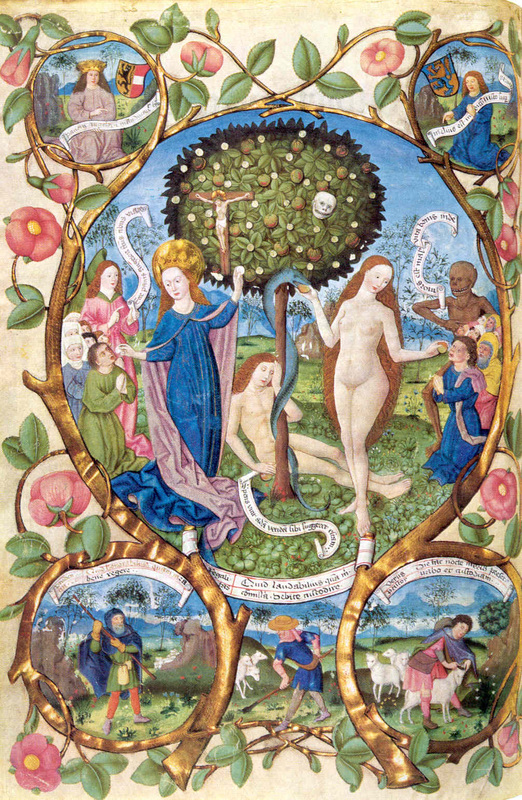
Era Belén y era Nochebuena la noche. Apenas si la puerta crujiera cuando entrara. Era una mujer seca, harapienta y oscura con la frente de arrugas y la espalda curvada. Venía sucia de barro, de polvo de caminos. La iluminó la luna, y no tenía sombra. Tembló María al verla; la mula no, ni el buey, rumiando paja y heno igual que si tal cosa. Tenía los cabellos largos color ceniza, color de mucho tiempo, color de viento antiguo. En sus ojos se abría la primera mirada, y cada paso era tan lento como un siglo. Temió María al verla acercarse a la cuna. En sus manos de tierra, ¡oh Dios!, ¿qué llevaría…? Se dobló sobre el Niño, lloró infinitamente y le ofreció la cosa que llevaba escondida. La Virgen, asombrada, la vio al fin levantarse. ¡Era una mujer bella, esbelta y luminosa! El Niño la miraba. También la mula. El buey mirábala y rumiaba igual que si tal cosa. Era en Belén y era Nochebuena la noche. Apenas si la puerta crujió cuando se iba. María al conocerla gritó y la llamó: «¡Madre!» Eva miró a la Virgen y la llamó: «¡Bendita!». ¡Qué clamor, qué alborozo por la piedra y la estrella! Afuera aún era pura, dura la nieve y fría. Dentro, al fin, Dios dormido sonreía teniendo, entre sus dedos niños, la manzana mordida • A. Murciano
 LA MEDITACION DE LA ESPOSA