So, what does it mean to be a Catholic? Today is the perfect day to ask ourselves this big question! Let us consider our participation in three of the many fundamental elements of Catholicism: The Church, the Eucharist and Easter. Being Catholic means that we are part of a Church with a huge number of devoted worshipers, 1.285 billion people or more. We are all part of this, this worldwide assemblage of devoted worshipers who today come together to proclaim our belief in the resurrection of the Lord. We are all part of this, this massive and wonderful Catholic Church. What else does being a Catholic mean? It means that we receive the Body and Blood of the Lord in the Eucharist. We take Jesus inside of us. We are united to him in His death on the Cross and in His Resurrection. Being Catholic means sharing in the Eucharist, not as a meal of solidarity or fellowship, but as a real union with the Second Person of the Holy Trinity. The Eucharistic Presence of the Lord is infinitely more valuable than the most expensive works of art kept in the finest museums. And we have been given the gift of taking this Presence of the Lord within us, this Sunday and every Sunday, every day for that matter. Whether it is at a large Mass such as this, or whether it is in a hospital room with only a priest, deacon or Extraordinary Minister of the Eucharist and a person confined to bed, Jesus is present in the same way, the way of the Eucharist, the Real Presence. The Eucharist is a treasure so valuable that we realize that to receive Communion we need to be better Christians, better followers of the Lord. We realize that we need to reach out to others in humble service, just as the Lord reaches out to us in humble service. We realize that we need to do all we can to be pure, to be free from sin. We value the Eucharist to such an extent that we would deny ourselves the reception of the Eucharist if we knew that serious sin has made us unworthy recipients of communion. We experience Catholicism as part of the body of worshipers; we experience Catholicism as people who receive the Real Presence of the Lord in the Eucharist; and we experience Catholicism in our continual celebration of Easter. The central celebration of our Church year is Easter Sunday, but every Sunday, including those in Lent, is a renewal of Easter. Catholics are Easter People. That is why so many come to Mass on Easter Sunday.
Easter is a celebration of whom they are, of whom we are. Jesus Christ died on the Cross to free us from the grip of the devil. He bargained his life for our lives. He redeemed us. But it was not enough for Him, the Tremendous Lover, to free us from evil. He gave us a new life. He gave us his Resurrected Life. Through Jesus Christ we are more than the physical. We are more than that which meets the eye. Through Jesus Christ, we are spiritual. Our baptism is our reception of the Life of the Lord. Our loved ones who have passed away have only lost their physical lives. Their spiritual lives remain. Because of Easter, we look forward to full union with those whom we miss so much and whom we long for so dearly. For me, for you, being a Catholic means that we are naturally, fundamentally, optimists. No matter what horrors this world imposes on us, or on anyone, we know that our citizenship is in heaven. We have reason for joy. We are an Easter people! We luxuriate in the Life of Christ we have received, a Life that can never be taken from us. Yes, we can deny this life. We can abandon it. But the Love of God is so powerful, that He is always ready to restore His Life to us when we seek forgiveness particularly through the sacrament of penance. Many people have expressed to me, and I am sure to you, their fear for the world. They are upset by news reports be they on the war in Ukraine, politics, terrorism, mass shootings, environmental concerns, etc. Well, God bless them and God bless us all for being upset with evil in the world. When the Lord said, “Blessed are those who mourn,” he was referring exactly to that, “Blessed are those people, blessed are we who mourn the effect of evil upon the world.” We have to work hard to fight against evil. We join groups and support those under attack. We must fight against injustice. We call upon St. Michael to help us defeat the devil and all other evil spirits who prowl the world seeking the ruin of souls. But we must always keep in mind our certainty that evil will not win the final battle. Jesus Christ has won the victory over the worst that evil could do, the victory over death. He has given us His Life.
We are His. He is ours. We are people of the Resurrected Life of the Lord. We are an Easter people. This is what it means to be a Catholic. «Do not be afraid,» Pope St. John Paul II asserted. There is great reason to hope. Jesus Christ, our hope, has risen from the dead. The tomb is empty, Mary. But the world is full. The Savior Lives. May his life change the world. May we let his life change our worlds • AE

Sequence (Victimae paschali laudes)

Christians, to the Paschal Victim
Offer your thankful praises!
A Lamb the sheep redeems;
Christ, who only is sinless,
Reconciles sinners to the Father.
Death and life have contended in that combat stupendous:
The Prince of life, who died, reigns immortal.
Speak, Mary, declaring
What you saw, wayfaring.
“The tomb of Christ, who is living,
The glory of Jesus’ resurrection;
bright angels attesting,
The shroud and napkin resting.
Yes, Christ my hope is arisen;
to Galilee he goes before you.”
Christ indeed from death is risen, our new life obtaining.
Have mercy, victor King, ever reigning!
Amen. Alleluia.
Fr. Agustin Schedule for Easter Sunday 2022
7.30 a.m. Holy Mass (English Mass @ Main Church)
10.30 a.m. Holy Mass (English Mass @ Main Church)
Domingo de Pascua de la Resurrección del Señor
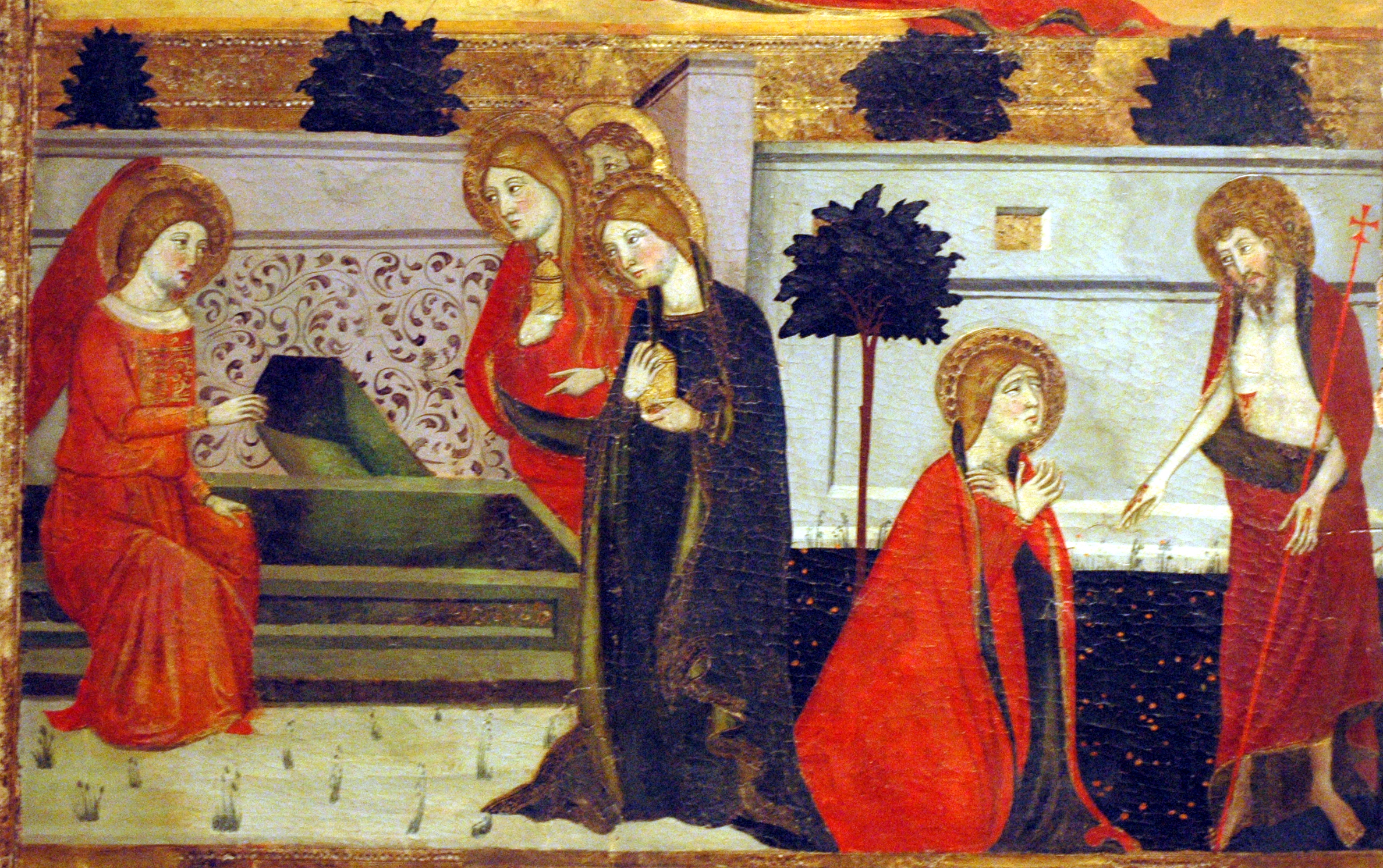
Autor anónimo, Sepulcro vacío y Noli me tangere, Retablo de San Juan (s. XIV), Museo del Prado (Madrid)
Según el relato de Juan, María de Magdala es la primera que va al sepulcro, cuando todavía está oscuro, y descubre desconsolada que está vacío. Le falta Jesús. El Maestro que la había comprendido y curado. El Profeta al que había seguido fielmente hasta el final. ¿A quién seguirá ahora? Así se lamenta ante los discípulos: «Se han llevado del sepulcro al Señor y no sabemos dónde lo han puesto». Estas palabras de María podrían expresar la experiencia que viven hoy no pocos cristianos: ¿Qué hemos hecho de Jesús resucitado? ¿Quién se lo ha llevado? ¿Dónde lo hemos puesto? El Señor en quien creemos, ¿es un Cristo lleno de vida o un Cristo cuyo recuerdo se va apagando poco a poco en los corazones? Es un error que busquemos «pruebas» para creer con más firmeza. No basta acudir al magisterio de la Iglesia. Es inútil indagar en las exposiciones de los teólogos. Para encontrarnos con el Resucitado es necesario, ante todo, hacer un recorrido interior. Si no lo encontramos dentro de nosotros, no lo encontraremos en ninguna parte. Juan describe, un poco más tarde, a María corriendo de una parte a otra para buscar alguna información. Y, cuando ve a Jesús, cegada por el dolor y las lágrimas, no logra reconocerlo. Piensa que es el encargado del huerto. Jesús solo le hace una pregunta: «Mujer, ¿por qué lloras? ¿a quién buscas?». Tal vez hemos de preguntarnos también nosotros algo semejante. ¿Por qué nuestra fe es a veces tan triste? ¿Cuál es la causa última de esa falta de alegría entre nosotros? ¿Qué buscamos los cristianos de hoy? ¿Qué añoramos? ¿Andamos buscando a un Jesús al que necesitamos sentir lleno de vida en nuestras comunidades? Según el relato, Jesús está hablando con María, pero ella no sabe que es Jesús. Es entonces cuando Jesús la llama por su nombre, con la misma ternura que ponía en su voz cuando caminaban por Galilea: «¡María!». Ella se vuelve rápida: «Rabbuní, Maestro». María se encuentra con el Resucitado cuando se siente llamada personalmente por él. Es así. Jesús se nos muestra lleno de vida, cuando nos sentimos llamados por nuestro propio nombre, y escuchamos la invitación que nos hace a cada uno. Es entonces cuando nuestra fe crece. No reavivaremos nuestra fe en Cristo resucitado alimentándola solo desde fuera. No nos encontraremos con él, si no buscamos el contacto vivo con su persona. Probablemente, es el amor a Jesús conocido por los evangelios y buscado personalmente en el fondo de nuestro corazón, el que mejor puede conducirnos al encuentro con el Resucitado • AE
Exultate, iubilate!
Exultate, iubílate (K 165/158ª) es un motete religioso de Wolfgang Amadeus Mozart escrito en 1773. Fue compuesto durante la visita del compositor austríaco a Milán, en la época en la que viajó a Italia. Fue escrito para el castrato Venanzio Rauzzini, el favorito de Mozart para sus óperas. En las representaciones modernas, es interpretado normalmente por una soprano. Es muy apropiado para escucharlo en este tiempo de Pascua • AE
 LA MEDITACION DE LA ESPOSA