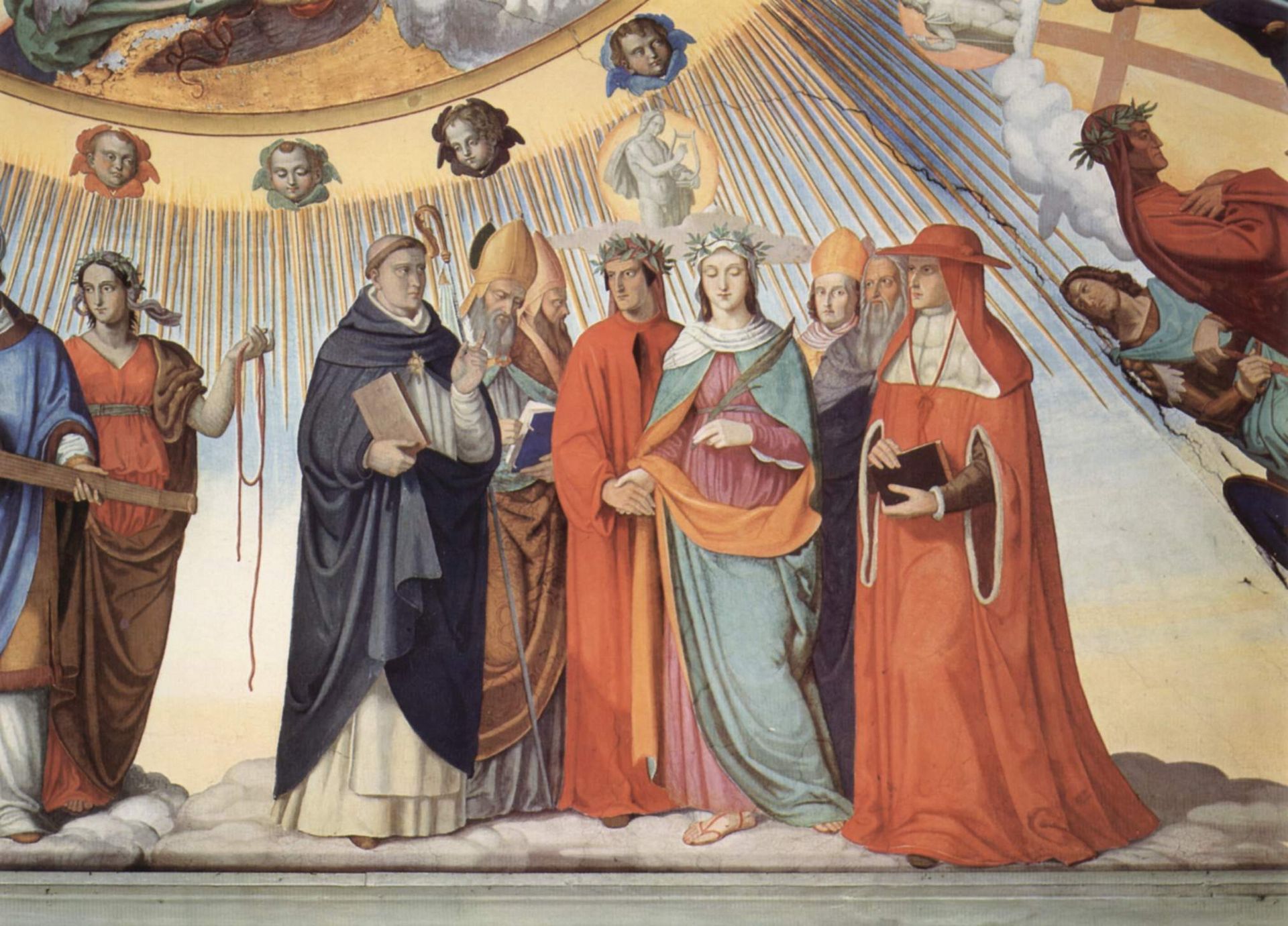
Heaven is a reality that Jesus also speaks about in today’s Gospel when he is confronted by the Sadducees who refuse to accept the possibility of life after death. Basically he told them that their question was rather infantile. He said that the reality of life after death is beyond human comprehension. “They are like angels and are children of God.” Many of us view heaven as though it were earth done right. This is due to our staying on the concrete level of thinking of the little child, where everything needs to be seen and experienced. We consider those who have gone before us, and are looking forward to once more having a good laugh with them. But the spiritual is so much more, infinitely more, than our minds can grasp. We do not know what it is like to be “like the angels,” because we cannot comprehend angelic life, but we do know that it will be better than our fondest imagination. In the third book of Dante’s Divine Comedy, the Paradisio, Dante ascends through the ten spheres of heaven. He comes upon various souls who inhabit each sphere. The inhabitants are able to tolerate deeper and deeper am ounts of God’s love than those of the sphere below them. This is all still envisioning heaven in very concrete terms, but then Dante changes the level of thinking. He is led by St. Bernard to Mary, Queen of Heaven. St. Bernard asks her to pray to God that Dante may look upon Him. She does, and Dante looks into the Eternal Light. He sees the image of the Holy Trinity and ponders the mysteries of God. All of a sudden there is a brilliant flash of light as God bestows all the answers to all questions upon Dante. At that point Dante’s soul is at one with God. Now, this is merely Dante’s explanation of heaven. I see its value in the way it ends. There are times in our lives when we feel a deep peace. These are the times that we are one with God. We were created to know, love and serve God in this life and to be happy with Him forever in the next. Heaven is that place, that state of being, where we are happily united with God forever. St. Paul tells the Corinthians that if our hope is in this world only we are the most pitiable of men (1 Cor 15:19). There is far more to life than the physical. There are wonders beyond our imagination waiting for us! The Almighty Creator of the universe loves us so much that he sent his son to become one of us and die for us. Now when we love someone, we want to give him or her everything we can to express our love. God gave us His Son in this life. What must he have in store for us in the next life? The answer to that question can merely be summarized in the term, heaven. We are only on this world for a brief time. We have to make the most of the period of our lives that is both physical and spiritual. We do this by leading the physical to the spiritual. That is why we are called to nurture the Presence of Christ within ourselves. That is why we are called to make Christ present to others. We only have one life. We pray today for the courage to allow God to perfect this life. May we always be united to Him, here and hereafter • AE

Fr. Agustin’s Schedule for the
Thirty-second Sunday in Ordinary Time

St Dominic Catholic Church
Saturday November 4, 2022
3.30 p.m. Sacrament of Reconciliation (Confessional)
5.00 p.m. (English Mass @ Main Church)
Sunday November 5, 2022
7.30 a.m. Holy Mass (English Mass @ Main Church)
10.00 a.m. Holy Mass (English Mass @ Main Church)
3.00 p.m. Santa Misa en Español (iglesia principal)
XXXII Domingo del Tiempo Ordinario (Ciclo C)
Hay muchas formas de imaginar el cielo. A veces se ha considerado el paraíso como una especie de país de las maravillas situado más allá de las estrellas, el happy end de la película terrestre, olvidando prácticamente a Dios como fuente del cumplimiento definitivo del ser humano. Otras veces, por el contrario, se ha insistido casi exclusivamente en la visión beatífica de Dios, como si la contemplación de la esencia divina excluyera o hiciera superflua toda otra felicidad o experiencia placentera que no fuera la comunión de Dios con las almas. Se habla también con frecuencia de la paz eterna que expresa bien el fin de las fatigas de esta vida, pero que quizá lleva a pensar en el cielo como algo inerte, monótono y desde luego poco atractivo. La teología es sobria al hablar del cielo. Los teólogos se cuidan mucho de describirlo con representaciones ingenuas. Nuestra plenitud final está más allá de cualquier experiencia terrestre aunque la podemos evocar, esperar y anhelar como el fascinante cumplimiento en Dios de esta vida que hoy alienta en nosotros. Lo mejor es acudir al lenguaje del amor y de la fiesta. El amor es la experiencia más honda y plenificante del ser humano. Poder amar y poder ser amado de manera íntima, plena, libre y total: ésa es la aspiración más radical que espera cumplimiento pleno. Si el cielo es algo, ha de ser experiencia plena de amor: amar y ser amados, conocer la comunión gozosa con Dios y con las criaturas, experimentar el gusto de la amistad y el éxtasis del amor en todas sus dimensiones. Pero, «donde se goza el amor, nace la fiesta». Sólo en el cielo se cumplirán plenamente esas palabras de san Ambrosio de Milán. Allí será «la fiesta del amor reconciliador de Dios». La fiesta de una creación sin muerte, rupturas ni dolor; la fiesta de la amistad entre todos los pueblos, razas, religiones y culturas; la fiesta de las almas y de los cuerpos; la plenitud de la creatividad y de la belleza; el gozo de la libertad total. Los cristianos de hoy miramos poco al cielo. No sabemos levantar nuestra mirada más allá de lo inmediato de cada día. No nos atrevemos a esperar mucho de nada ni de nadie, ni siquiera de ese Dios revelado como Amor infinito y salvador en Cristo resucitado. Se nos olvida que Dios, como nos dice hoy el Señor en el evangelio, «no es un Dios de muertos, sino de vivos». Un Dios que sólo quiere una vida dichosa y plena para todos y por toda la eternidad • AE
 LA MEDITACION DE LA ESPOSA