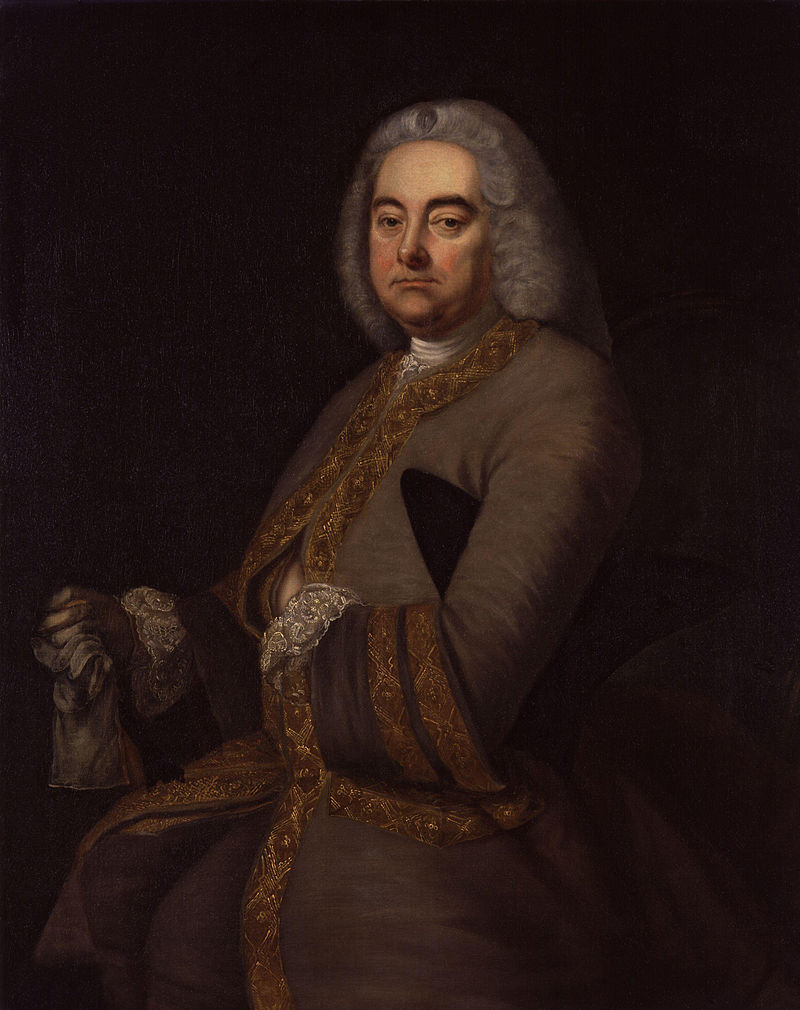
Thomas Hudson, George Frideric Handel, oil on canvas, National Gallery of Art (London)
In today’s Gospel reading John the Baptist confronted people who thought they were entitled. The Sadducees and Pharisees and many of the people He spoke to thought they were entitled to the Kingdom of God simply because they were Jewish. He called them a brood of vipers. They thought that they had a right to salvation simply because they were sons of Abraham, Hebrews. “God can raise up sons of Abraham from these rocks,” the Baptist yelled. «Stop making presumptions,» the Baptist warns them….and us. The message for the Second Sunday of Advent is «prepare» or, more precisely, «Don’t presume; instead prepare.» We have been brought into the sacred through the merciful gift of God that is our baptism. When we refuse to live our faith, we are treating our baptism as a mere ritual act. We are entitled to nothing other than the fruit of our Christian life. George Frederick Handel understood this. He lived during the first half of the 18th century. All of us, even if we have only a smattering of knowledge of classical music, are well aware of his greatest work, the Messiah Oratorio. Christmastime brings innumerable performances this masterpiece and its rousing conclusion, the Hallelujah Chorus. Did you know that Handel never received a penny for this his greatest work? Whatever money the work made in his lifetime went to the London Foundling Hospital, a poor orphanage. It was not that Handel was a rich man at that time. In fact he was very poor. He had gone bankrupt. And then he suffered a paralyzing stroke. Handel had been rich and famous. There was a day when he was the most important composer in Europe. He was lured to England to direct the London Royal Academy of Music. But 25 years later, his operas lost their appeal. By age 52 he was deeply in debt. And then he had the stroke. A few years later, in 1742, Handel was asked to write an oratorio based on meditations on the Life of Christ written by one his close friends, Charles Jennen. Handel felt inspired by God. He completed the work in 24 days. He refused any commission for the initial performances because he said that this was God’s work. He had received the gift of music from the Lord and was paying Him back by giving the gift of loving God through music to the Lord’s people. Although the Oratorio was acclaimed, the London clergy was vehemently against it. It was too modern for them. Some called it a sacrilege and even blasphemy. The Anglican Church influenced what would be performed in the concert halls of London, so The Messiah would not be performed there. This made no difference to Handel. He gave the piece to the London Foundling Hospital for its fund raising. Every year for the next 20 years, Handel rehearsed and directed the Oratorio at sites determined by the hospital. And he did this for free. Handel did not feel entitled to anything other than that which the Lord gives to His faithful servants. Handel did not presume. He prepared. Entitlement is the way of the selfish. Sacrifice is the way of the Christian. «Prepare the way to the Lord,» John the Baptist enjoins us. Live in such a way that others will welcome the Lord into their lives. «Stay awake,» we heard last week. «Prepare,» we hear this week. Stay awake for the opportunities to serve the Lord. Prepare to find Him • AE

Readings for the Season of Advent
Fr. Agustin’s Schedule for The Second Sunday of Advent (2022)
St Dominic Catholic Church
Saturday November 3, 2022
10.00 a.m. Sacrament of Baptism for Aiden Arguello.
11.00 a.m. Sacrament of Baptism for Humberto Celis.
1.30 p.m. Funeral Mass for Deacon Harry Flavin (Our Lady of Grace Catholic Church)
3.30 p.m. Sacrament of Reconciliation (Confessional)
5.00 p.m. Holy Mass (English @ Main Church)
Sunday November 4, 2022
7.30 a.m. Holy Mass (English @ Main Church)
10.00 a.m. Holy Mass (English @ Main Church)
Segundo Domingo de Adviento (Ciclo A)

Francesco Solimena, San Juan Bautista (1730), óleo sobre tela, Museo Nacional del Prado (Madrid)
La figura del Bautista resulta a veces un tanto sombría. Su predicación gira en torno al juicio inminente de Dios. Llega ya el Juez Supremo. Nadie se librará de su terrible juicio. «Ya está el hacha puesta a la raíz de los árboles» (Mt 3, 10). Lo único que nos queda es hacer penitencia, volver al cumplimiento de la ley para evitar el castigo. No son sólo palabras. El Bautista se convierte con su vida en símbolo de este mensaje amenazador. Se retira al desierto y hace vida de ayuno y penitencia. El Bautista no acoge a los que sufren, no se acerca a los leprosos, no cura a los enfermos, no perdona a los pecadores, no bendice a los niños. Lo suyo es predicar el juicio de Dios, bautizar y llamar a hacer penitencia. El Bautista introduce en los corazones un poco de miedo, entiende la religión como espera y preparación de su juicio terrible. Pero he aqui que la aparición de Jesús representa algo nuevo y sorprendente. Su predicación ya no se centra en el juicio de Dios. El que llega no es un Juez airado, sino un Padre que quiere reinar y ser acogido y que busca una vida más digna y dichosa para todos. Desde luego que Jesús no oculta el riesgo de quedarse fuera, pero Dios ofrece su perdón gratuito a todos, incluso a los paganos y pecadores. El mismo Jesús se convierte en el mejor símbolo de ese Dios bueno. No vive ayunando en el desierto, sino comiendo con pecadores. No le llaman bautizador, sino «amigo de publicanos y pecadores». Jesús defiende a los débiles, cura a los enfermos, perdona a los pecadores, bendice a los niños. Jesús introduce en los corazones confianza en un Dios bueno porque entiende la religión no como la preparación de un juicio, sino como la acogida de un Dios Padre que quiere vernos convivir como hermanos. Juan fue un gran hombre. Según Jesús, «el mayor entre los nacidos de mujer». Pero entre Juan y Jesús no hay confusión posible. «La Ley y los Profetas llegaron hasta Juan; a partir de entonces se anuncia la Buena Noticia del Reinado de Dios». No nos podemos quedarnos solamente en Juan. Los cristianos seguimos a Jesús, no al Bautista. La nuestra no es una religión fincada en el miedo, sino de la confianza en Dios. La penitencia es una parte del camino, y la actitud es ser misericordiosos como el Padre es misericordioso • AE

Lecturas para el Tiempo de Adviento

 LA MEDITACION DE LA ESPOSA