
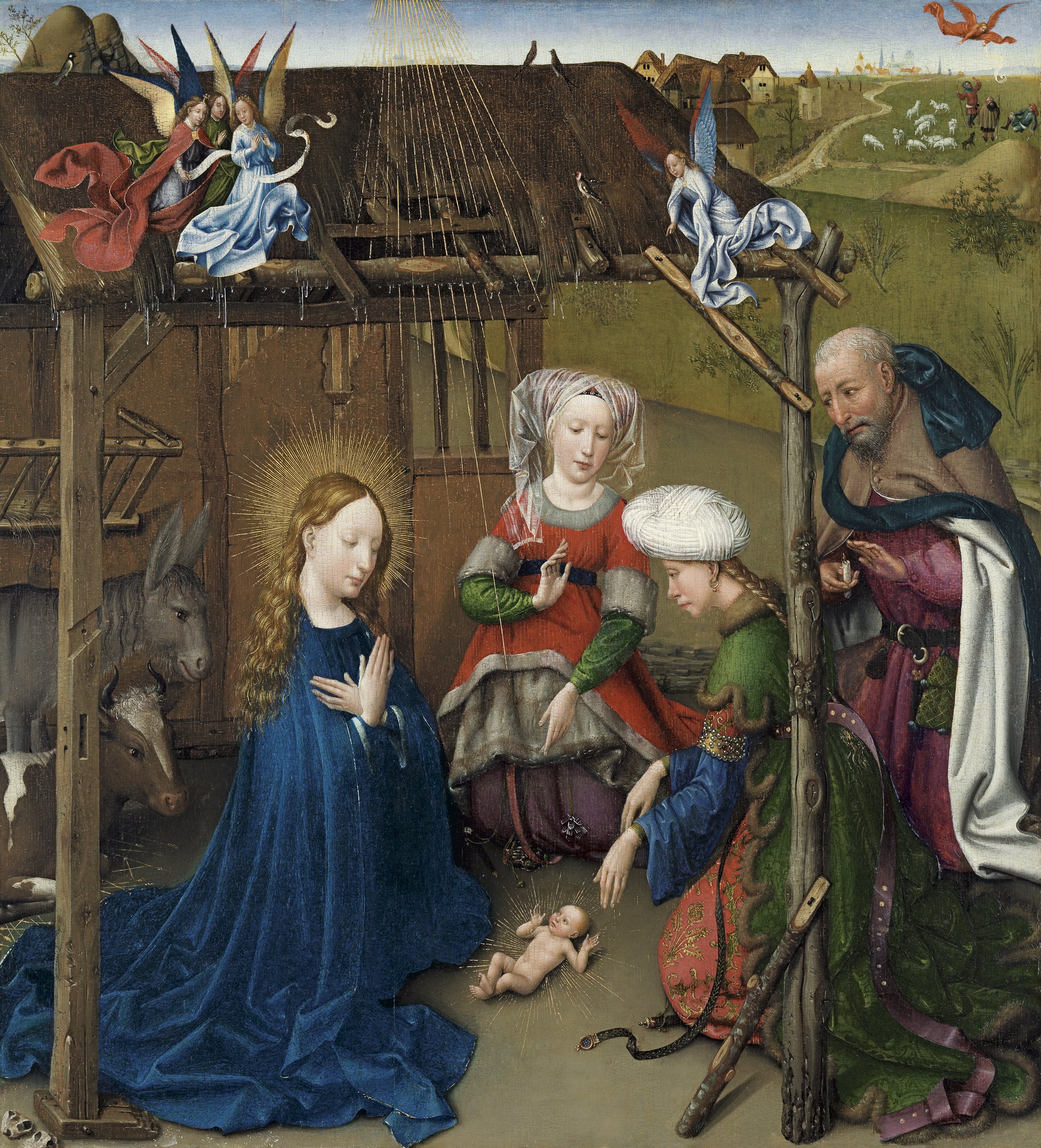
J. Daret, The Nativity (1434) oil on canvas, Museo Nacional Thyssen-Bornemisza (Madrid)
Why do we decorate at Christmas? We do this as an expression of our Christmas joy. Joy. Joy to world. We sing that there is joy because the Savior has come. The world waited for its Savior for ages and then the center of humanity, Jesus the Christ, was born. And the world entered a new age, an age of joy. Joy is real in our lives, even when we are saddened by the loss of those who are very close to us. Christmas is a wonderful time, but it can also be a difficult time. We all carry the memory of loved ones who will never again be at Christmas dinner. We tell stories about Grandma and Grandpa, Mom or Dad, husband or wife, or, and, this is the greatest sadness, the antics of a beautiful child. And we are grieved. But we do not allow grief to determine the course of our lives. We are people of faith. We are convinced that there is infinitely more to the reality of our loved ones who have died than simply our memory of them. We have faith that through the mercy of God they are still alive. We believe that we will once more be fully united with them. Our acceptance of Jesus Christ has given us eternal life. Nothing, not even death, can destroy the joy of the Lord. People need to hear, feel and know the joy of the Gospel. Perhaps it would be good to remember Pope Francis’ first Apostolic Exhortation, Evangelii Gaudium, the Joy of the Gospel. This exhortation promoted the mission of the Church. He called us to communicate the joy of the Gospel to the world. No longer should the leaders of the Church be perceived as unapproachable guardians of the faith. He counseled the hierarchy to refrain from insulating itself from the realities of daily life. He said that the Church must at times get messy. By that he meant that the Church needs to be present to all, even in the mud of those who have no floors in their home. Deeper, than that, the Church needs to be involved in the messiness of all people’s lives. He told us that the main concern of the Church must be to bring the joy of Jesus Christ to the entire world. Our beautiful Catholic Church continues to renew itself.Jesus Christ is the same, yesterday, today and forever. Like the Beauty that St. Augustine finally found in his Confessions, the Church is ever ancient, ever new. Perhaps you remember that passage in Augustine’s Confessions: «Late have I loved you, O Beauty ever ancient, ever new, late have I loved you! You were within me, but I was outside, and it was there that I searched for you. In my unloveliness I plunged into the lovely things which you created. You were with me, but I was not with you. Created things kept me from you; yet if they had not been in you, they would have not been at all. You called, you shouted, and you broke through my deafness. You flashed, you shone, and you dispelled my blindness. You breathed your fragrance on me; I drew in breath and now I pant for you. I have tasted you, now I hunger and thirst for more. You touched me, and I burned for your peace». This is the joy that Christ brings to the world. And we are called to be instruments of His joy • AE

Fr. Agustin´s Schedule for the celebration of the Nativity of the Lord (Christmas)
St Dominic Catholic Church
Saturday, December 24, 2022
6.00 p.m. Holy Mass (English @ Main Church)
Sunday December 25, 2022
Midnight Mass (12.00 a.m. English @ Main Church)
7.30 a.m. Holy Mass (Bilingual Mass @ Main Church)
10.00 a.m. Holy Mass (English @ Main Church)

Os anunciamos un gozo inmenso,
hoy ha nacido el Salvador
en un pesebre sobre las pajas
y entre pañales lo encontrarán
Duerme y no llores, Jesús del alma
Duerme y no llores, mi dulce amor
Duerme y no llores, que esas tus lagrimas
Parten el alma ce compasión
Tus lagrimitas, perlas del cielo
son mi tesoro, prendas de amor
mas calma el llanto, dulce bien mío
de lo contrario me harás llorar
Solemnidad de la Natividad del Señor (Navidad)

La Navidad encierra un secreto profundo que, desgraciadamente, se les escapa a muchos de los que hoy celebrarán algo, sin saber exactamente qué. Muchos no pueden ni siquiera sospechar que la Navidad nos ofrece la clave para descifrar el misterio último de nuestra existencia. Generación tras generación, los hombres han gritado angustiados sus preguntas más hondas. ¿Por qué tenemos que sufrir, si desde lo más íntimo de nuestro ser todo nos llama a la felicidad? ¿Por qué tanta humillación? ¿Por qué la muerte si hemos nacido para la vida? ¿por qué las guerras y el hambre? Los hombres preguntaban y preguntamos hoy a Dios porque, de alguna manera, cuando estamos buscando el sentido último de nuestro ser, estamos apuntando hacia él. Pero Dios parece guardar un silencio impenetrable. Con la Navidad, Dios habla. Tenemos ya su respuesta, que no consiste en palabras hermosas acerca del sufrimiento o profundas lecciones de teología sobre nuestra existencia. Dios no nos ofrece palabras. No. La Palabra de Dios se ha hecho carne. Es decir, Dios más que darnos explicaciones, ha querido sufrir en nuestra propia carne nuestros interrogantes, sufrimientos e impotencia. Dios no da explicaciones sobre el sufrimiento, sino que sufre con nosotros. No responde al porqué de tanto dolor y humillación, sino que él mismo se humilla. Dios no responde con palabras al misterio de nuestra existencia, sino que nace para vivir él mismo nuestra aventura humana. Ya no estamos perdidos en nuestra inmensa soledad. Ya no estamos sumergidos en pura tiniebla. Él está con nosotros. Hay una luz. Dios comparte nuestra existencia. Así todo cambia. Dios mismo ha entrado en nuestra vida. Es posible vivir con esperanza. Merece la pena ser hombre. Dios mismo comparte nuestra vida y con él podemos caminar hacia la plenitud. Por eso, la Navidad es siempre para los creyentes una llamada a renacer. Una invitación a reavivar la alegría, la esperanza, la solidaridad, la fraternidad y la confianza total en el Padre. Recordemos hoy las palabras del poeta: «Aunque Cristo nazca mil veces en Belén, mientras no nazca en tu corazón, estarás perdido para el más allá: habrás nacido en vano» • AE
 LA MEDITACION DE LA ESPOSA