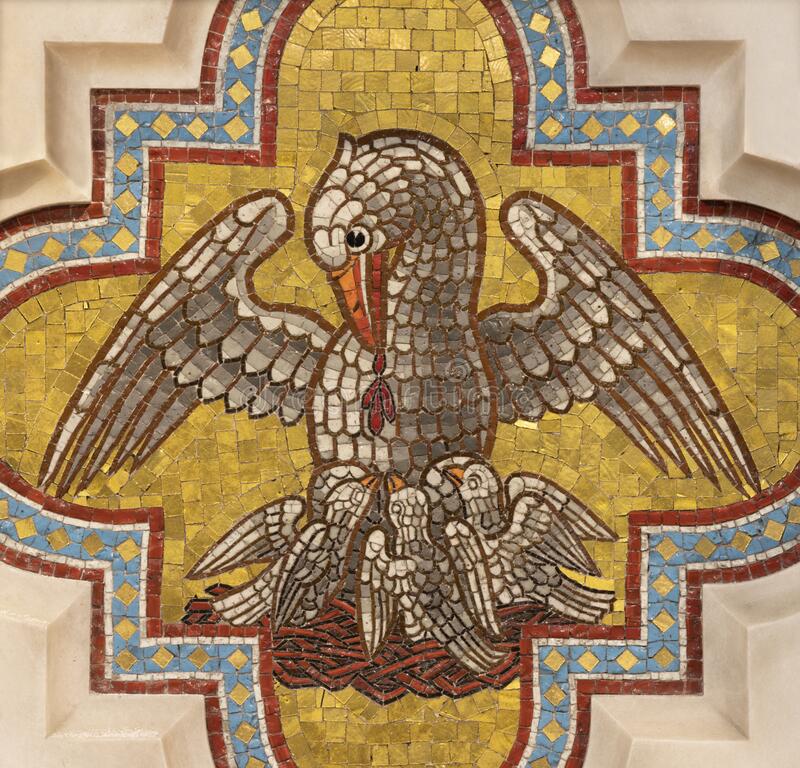
Anonymous artist, Eucharistic Pelican, mosaic, sidealtar of Votivkirche cathedral (Vienna)
The lesson of the Transfiguration on this second Sunday of lent is quite simple: we have to follow the Lord without fear, weariness and regret. As what the three disciples ultimately realized, there is definitely a certain assurance that everything eventually turns out fine. It is like reading a novel where the happy ending is already known to us. No matter how difficult the problems that the main character encounters, we are not disheartened and continue reading because we know the story is sure to have a happy ending. At the Last Supper, Jesus left us an indelible memorial: the Eucharist. It is the sacrament of his Real Presence, thereby fulfilling His promise: “I am with you always until the end of the age.” No matter what happens, he is always with us, especially in the Eucharist. Should we open our eyes of faith, just as what the three disciples on the mountain did, we, too, will experience what Pope St. Gregory the Great proclaims, “The Liturgy is primarily a sacred act before God, which means that “at the hour of Sacrifice, in response to the priest’s acclamation, the heavens open up; the choirs of angels are witnessing this Mystery; what is above and what is below unite; heaven and earth are united, matters visible and invisible become united”. Is this not a Transfiguration experience? True, our senses do not perceive any change. The bread looks the same bread to us. The wine, too. But the change is not in the appearance, but in the substance. The bread still looks like bread; the wine still looks like wine. But at the Consecration, it has become the Body and Blood of Christ. Our Catholic Theology calls this “Transubstantiation.” St. Francis de Sales explains, “But when the Blessed Sacrament of the Altar is there, then this Presence is no longer imaginary, but most real; and the sacred species are but a veil from behind which the present Savior beholds and considers us, although we cannot see him as he is.” That’s why the holy Mass is accurately called “Heaven on Earth.” Heaven is the state of being in union with God. If we believe that Jesus is truly present in the Eucharist, it means, therefore, that the Mass is the experience of heaven on earth. How deeply do we cherish and appreciate those priceless moments while we are present in Holy Mass? Jesus is truly present. He is with us. Heaven begins right here. Today we could repeat those words of Thomas Aquinas in that precious hymn, Adoro te Devote; a hymn he himself composed for the celebration of the Corpus Christi solemnity in 1264, and which goes like this:
I devoutly adore you, hidden deity,
Who are truly hidden beneath these appearances.
My whole heart submits to You,
because in contemplating You, it is fully deficient.
Sight, touch, taste all fail in their judgment of you,
But hearing suffices firmly to believe.
I believe all that the Son of God has spoken;
There is nothing truer than this word of Truth.
On the cross only the divinity was hidden,
But here the humanity is also hidden.
Yet believing and confessing both,
I ask for what the penitent thief asked.
I do not see wounds as Thomas did,
But I confess that You are my God.
Make me believe much more in You,
Hope in you, and love You.
O memorial of our Lord’s death,
Living Bread that gives life to man,
Grant my soul to live on You,
And always to savor your sweetness.
Lord Jesus, Good Pelican,
clean me, the unclean, with Your Blood,
One drop of which can heal
the entire world of all its sins.
Jesus, whom now I see hidden,
I ask You to fulfill what I so desire:
That the sight of Your Face being unveiled
I may have the happiness of seeing Your glory. Amen • AE
Fr. Agustin´s Schedule for the Second Sunday of Lent (2023)

Saturday March 4, 2023
2.30 p.m. 50 Wedding Anniversary for Alicia and Manuel (Main church)
3.30 p.m. Sacrament of Reconciliation (Confessional)
Sunday March 5, 2023
7.30 a.m. Holy Mass
10.00 a.m. Holy Mass
Segundo Domingo de Cuaresma (Ciclo A)
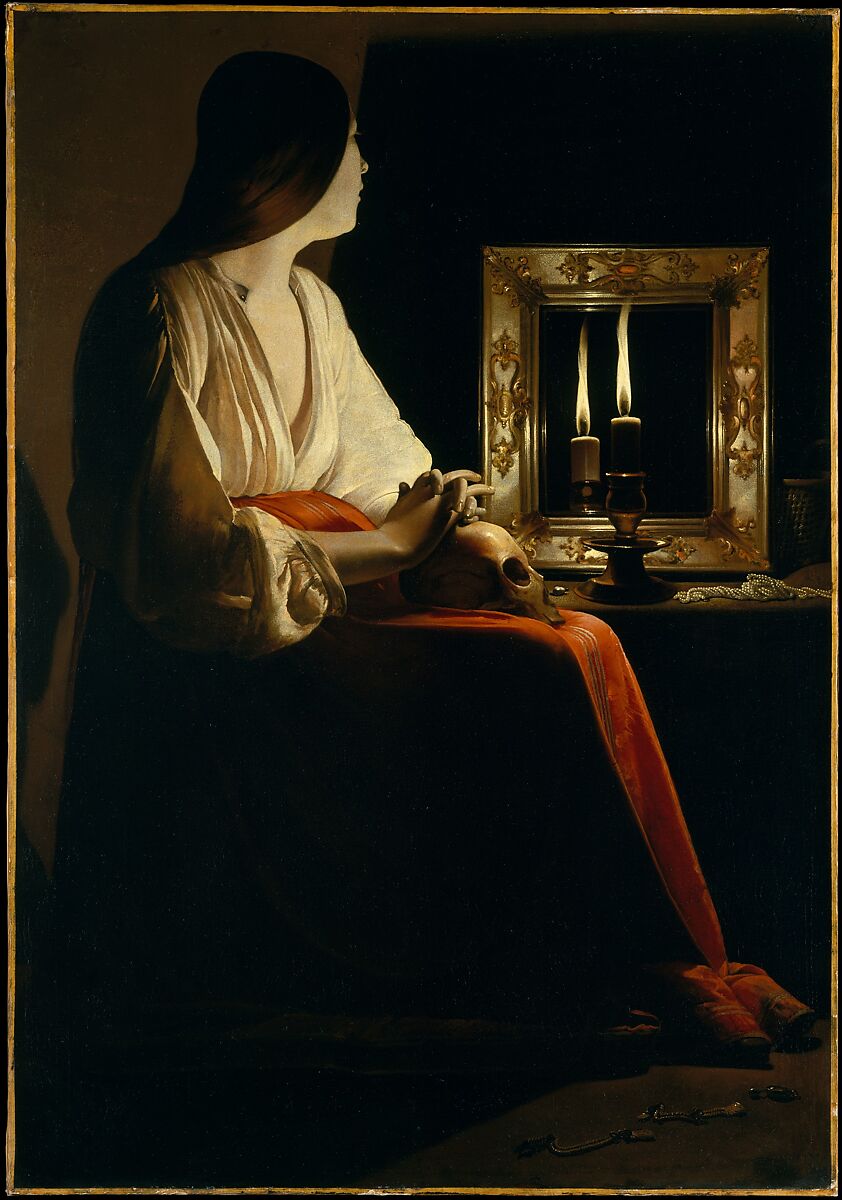
G. De La Tour, Magdalena Penitente (1640), óleo sobre tela, Metropolitan Museum of Art (New York)
Hasta hace unos pocos años la religión la que ofrecía a la mayoría de las personas criterios para comprender la realidad y principios para orientar la vida con sentido y responsabilidad. Hoy son muchos los que prescinden de toda religión para enfrentarse solos y sin guía alguna a su vida, sus deseos, miedos y expectativas. No es fácil. Probablemente nunca le ha resultado al ser humano, tan difícil y problemático, pararse a pensar, reflexionar y elaborar decisiones sobre sí mismo y sobre qué es importante en la vida. Vivimos sumergidos en una cultura de la intrascendencia, que ata a las personas al aquí y al ahora, haciéndoles vivir sólo para lo inmediato, sin apertura alguna al misterio último de la vida. Nos movemos en una cultura del goce y la diversión que empuja al hombre a vivir olvidado de las grandes cuestiones que lleva en su corazón. El hombre y la mujer de hoy han aprendido muchas cosas, están verdaderamente informados de lo que acontece alrededor del mundo, pero no saben el camino para conocerse a sí mismos y construir su libertad. Muchos suscribirían la oscura descripción que hacía el G. Hourdin, hace algunos años: «El hombre se está haciendo incapaz de querer; de ser libre, de juzgar por sí mismo, de cambiar su modo de vida. Se está convirtiendo en el robot disciplinado que trabaja para ganar el dinero que después disfrutará en unas vacaciones colectivas. Lee las revistas de moda, interactúa en las redes sociales en las que están todos. Aprende así lo que es, lo que quiere y cómo debe pensar y vivir.» Por eso necesitamos más que nunca atender a la voz de Dios, la misma que escuchamos en el evangelio de este segundo domingo del tiempo de Cuaresma: «Este es mi Hijo, el amado, mi predilecto. Escuchadlo». Necesitamos detenernos, guardar silencio y escuchar más a Dios. Esa escucha interior ayuda a vivir en la verdad, a saborear la vida en sus raíces, a no malgastarla de cualquier manera, a no pasar superficialmente ante lo esencial. Escuchando a Dios, descubrimos nuestra pequeñez y pobreza, pero también nuestra grandeza de seres amados infinitamente por Dios. Cada uno es libre para caminar por la vida escuchando a Dios o dándole la espalda. Pero, en cualquier caso, hay algo que hemos de recordar todos, aunque resulte escandaloso y contracultural: vivir sin un sentido último es vivir de manera insensata; actuar sin escuchar la voz interior de la conciencia es ser un inconsciente • AE
Si tienes tiempo, y a propósito de la obra de arte que ilustra ésta texto, echale un vistazo a este maravilloso podcast:
 LA MEDITACION DE LA ESPOSA