

The Woman at the Well, from a 1684 Arabic manuscript of the Gospels, copied in Egypt by Ilyas Basim Khuri Bazzi Rahib (Coptic monk), The Walters Art Museum (Baltimore)
A woman came. She is a symbol of the Church not yet made righteous. Righteousness follows from the conversation. She came in ignorance, she found Christ, and he enters into conversation with her. Let us see what it is about, let us see why a Samaritan woman came to draw water. The Samaritans did not form part of the Jewish people: they were foreigners. The fact that she came from a foreign people is part of the symbolic meaning, for she is a symbol of the Church. The Church was to come from the Gentiles, of a different race from the Jews. We must then recognize ourselves in her words and in her person, and with her give our own thanks to God. She was a symbol, not the reality; she foreshadowed the reality, and the reality came to be. She found faith in Christ, who was using her as a symbol to teach us what was to come. She came then to draw water. She had simply come to draw water; in the normal way of man or woman. Jesus says to her: Give me water to drink. For his disciples had gone to the city to buy food. The Samaritan woman therefore says to him: How is it that you, though a Jew, ask me for water to drink, though I am a Samaritan woman? For Jews have nothing to do with Samaritans. The Samaritans were foreigners; Jews never used their utensils. The woman was carrying a bucket for drawing water. She was astonished that a Jew should ask her for a drink of water, a thing that Jews would not do. But the one who was asking for a drink of water was thirsting for her faith.
Listen now and learn who it is that asks for a drink. Jesus answered her and said: If you knew the gift of God, and who it is that is saying to you, “Give me a drink”, perhaps you might have asked him and he would have given you living water. He asks for a drink, and he promises a drink. He is in need, as one hoping to receive, yet he is rich, as one about to satisfy the thirst of others. He says: If you knew the gift of God. The gift of God is the Holy Spirit. But he is still using veiled language as he speaks to the woman and gradually enters into her heart. Or is he already teaching her? What could be gentler and kinder than the encouragement he gives? If you knew the gift of God, and who it is that is saying to you, “Give me a drink,” perhaps you might ask, and he would give you living water. What is this water that he will give if not the water spoken of in Scripture: With you is the fountain of life? How can those feel thirst who will drink deeply from the abundance in your house? He was promising the Holy Spirit in satisfying abundance. She did not yet understand. In her failure to grasp his meaning, what was her reply? The woman says to him: Master, give me this drink, so that I may feel no thirst or come here to draw water. Her need forced her to this labor, her weakness shrank from it. If only she could hear those words: Come to me, all who labor and are burdened, and I will refresh you. Jesus was saying this to her, so that her labors might be at an end; but she was not yet able to understand •
(This reflection on the conversation between Jesus and the Samaritan Woman at the Well (John 4:7-42) is used in the Roman Office of Readings for Sunday of the third week in Lent. It is taken from Augustine’s Treatise on the Gospel of John (Tract. 15, 10-12, 16-17: CCL 36, 154-156) written by St. Augustine in the early 5th Century)

Fr. Agustin´s Schedule for the Third Sunday of Lent (Cycle A)

Saturday March 11, 2023
3.30 p.m. Sacrament of Reconciliation (Confessional)
5.00 p.m. Holy Mass (Main Church)
Sunday March 12, 2023
12.30 p.m. Holy Mass.
3.00 p.m. Santa Misa
III Domingo de Cuaresma (Ciclo A)
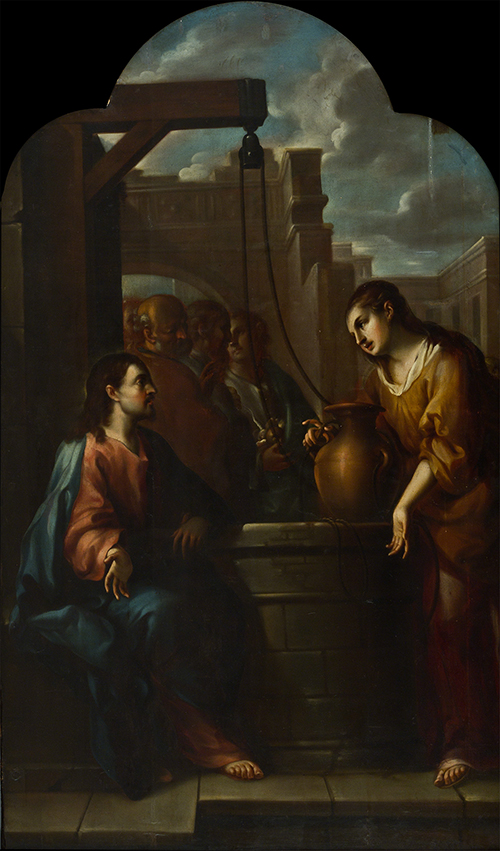
J. de Ibarra, Jesús con la Samaritana (c. 1680), óleo sobre tela, Museo Nacional de Arte (Ciudad de México)
Cansado del camino, Jesús se sienta junto al manantial de Jacob, en las cercanías de la aldea de Sicar. Pronto llega una mujer samaritana a apagar su sed. Espontáneamente, Jesús comienza a hablar con ella de lo que lleva en su corazón. En un momento de la conversación, la mujer le plantea los conflictos que enfrentan a judíos y samaritanos. Los judíos peregrinan a Jerusalén para adorar a Dios. Los samaritanos suben al monte Garizim desde donse se ve el pozo de Jacob. ¿Dónde hay que adorar a Dios? ¿Cuál es la verdadera religión? ¿Qué piensa el profeta de Galilea? Jesús comienza por aclarar que el verdadero culto no depende de un lugar determinado, por muy venerable que pueda ser. El Padre del cielo no está atado a ningún lugar, no es propiedad de ninguna religión. No pertenece a ningún pueblo concreto. No lo hemos de olvidar. Para encontrarnos con Dios, no es necesario ir a Roma o peregrinar a Jerusalén. Es más, ni siquiera hace falta entrar en una capilla o visitar una catedral. Desde la cárcel más secreta, desde la sala de cuidados intensivos de un hospital, desde cualquier cocina o lugar de trabajo podemos elevar nuestro corazón hacia Dios y encontrarnos con Él. Jesús no habla a la samaritana de adorar a Dios. Su lenguaje es nuevo. Hasta por tres veces le habla de «adorar al Padre». Por eso, no es necesario subir a una montaña para acercarnos un poco a un Dios lejano, desentendido de nuestros problemas, indiferente a nuestros sufrimientos. El verdadero culto empieza por reconocer a Dios como Padre cercano, que nos acompaña de cerca a lo largo de nuestra vida. Jesús le dice algo más. El Padre está buscando verdaderos adoradores. No está esperando de sus hijos grandes ceremonias, celebraciones solemnes, inciensos y procesiones, aun cuando sean bonitas o vistosas. Lo que desea son corazones sencillos que le adoren en espíritu y en verdad. Adorar al Padre en espíritu es seguir los pasos de Jesús, es dejarnos conducir como él por el Espíritu del Padre que lo envía siempre hacia los últimos a los que nadie presta atención, siendo compasivos como es el Padre. Lo dice Jesús de manera clara: «Dios es espíritu, y quienes le adoran deben hacerlo en espíritu». Dios es amor, perdón, ternura, aliento vivificador…, y quienes lo adoran deben parecerse a él. Adorar al Padre en verdad es, pues, vivir en la verdad. Volver una y otra vez a la verdad del Evangelio. Ser fieles a la verdad de Jesús sin encerrarnos en nuestras propias mentiras. Después de veinte siglos de cristianismo, ¿hemos aprendido a dar culto verdadero a Dios? ¿Somos los verdaderos adoradores que busca el Padre? ¡Tanto qué preguntarnos en este tercer domingo de Cuaresma, fascinados por la conversación entre el Señor y la Samaritana • AE

 LA MEDITACION DE LA ESPOSA