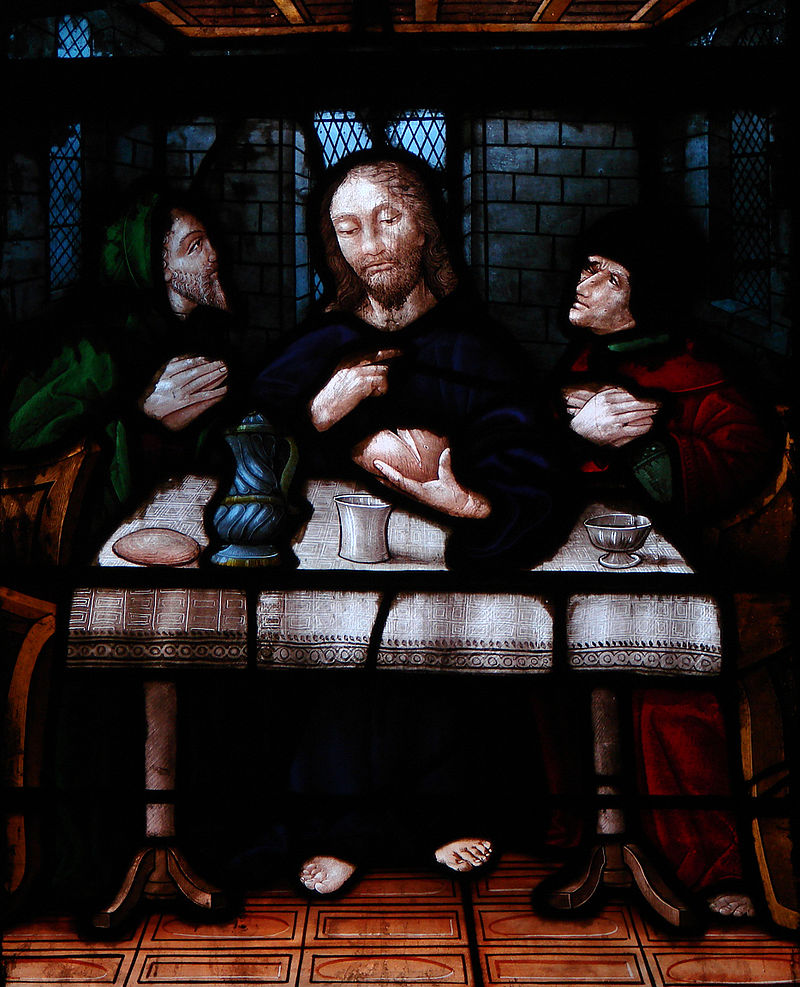
Anonymous artist, The Supper at Emmaus, stained glass window in the Auch cathedral (France)
As Cleopas and his friend so often, we walk along the road of our lives confused. We have difficulty solving our problems. We doubt our own ability to come up with the answers we need. Some people tell us to look into ourselves for the answers, as though we had a secret chamber someplace within us, or as early heretics would call it, a hidden gnosis, where all the answers to our questions can be found. This early heresy of the Church still continues in those who think they have all the answers within themselves. It is true that through baptism God dwells within us. It is also true that we need the gifts He gives us to find direction in our lives and, eventually, to help us understand His Life and His Kingdom. We need the gifts of Word and Sacrament. Sometimes we act as though we have all the answers to life. We do not! In fact, we don’t even know the correct questions to ask. So many people spend their lives seeking the answers to the wrong questions. For example, most people try to answer these questions: How can I become prosperous? How can I become rich? Their whole lives are spent chasing the illusion that happiness can be bought. If they are among the few who do become rich, what do they have to show for their lives? A bank account? A lot of stuff? Does that make a life successful? There is a reason why they do not put a luggage rack on a hearse. Another question that so many people spend their lives trying to answer is: How can I become better than everyone else? Again this is not a question that our lives should revolve around. We want to be the best person we can be, and that is very good, but when we start comparing ourselves to other people we can easily become arrogant and proud. «Look at that tax collector,» said the Pharisee in the Temple. «You know, Lord, that I am a lot better than him. I do lots of good things. Let me remind you in case your forgot.» But the tax collector merely beat his breast and said, «Have mercy on me a sinner.» Only he left justified.
When we devote our lives to answering the question “How can I be better than others?” whether it is better than others before God, a better parent than my neighbors, a better teacher than the guy or girl in the next classroom, a better priest than another man, etc., we are simply asking the wrong question, one that leads to arrogance. The question we need to ask is, How can I be a better person than I am? We think we have all the answers. We do not even know the right questions. Another questions we should be asking ourselves is one that we are secretly afraid to ask: How can I be different than what contemporary society claims is the norm? The norm of society tells Teens that drinking, taking drugs and doing things that belong in a marriage is all part of high school and college. The norm of society tells adults that cheating on their jobs, and in their marriages is part of life. The norm of society tells people not to get carried away and sacrifice too much of themselves to help others. It is difficult to ask, “How can I be different?” because none of us want to be different from everyone else. We want to fit in. It is a difficult question to ask, “How can I be different?” and, yet, that is what holiness is. To be holy is to be different, set apart for the Lord. There are many other questions we all need to ask ourselves, questions about how to be a good husband, wife, father, mother, Teen, child, priest, deacon, etc. We are not given the answers to our questions today, on Confused Sunday (I love this name!) But we are told where the answers can be found. Jesus led the disciples on the road to Emmaus to the Truth through Sacred Scripture. The Bible is not just the Good Book. It is the living and effective Word of God. We go to Scripture to seek the answers to our problems. We need to quietly meditate on Scripture and let the Word of God work on us.
Peace can be found in the middle of confusion when we are open to the second great gift presented in today’s Gospel, the Eucharist. Those disciples finally recognized Jesus in the Breaking of the Bread. They said to each other, «Were not our hearts on fire?» We may not have the answers to the profound questions of life, or even to the daily concerns of life, but we do know where peace is found. We cannot understand our world or even our lives, but as long as we have the Peace of Christ, our hearts and our minds will be guarded from all that can destroy our happiness. In Him alone we find our joy. If we stay united to the Lord in Word and Sacrament, we will never go wrong. We need to trust God and let that Peace which is beyond our understanding guide our lives. Then we will no longer be confused • AE

Fr Agustin´s Schedule for the Third Sunday of Easter

Saturday April 22, 2023
8.30 a.m. – 12.00 p.m. Sacrament of Reconciliation for CCD Children (Main church)
3.30 p.m. Sacrament of Reconciliation (Confessional)
5.00 p.m. Holy Mass
Sunday April 23, 2023
10.00 a.m. Holy Mass
12.30 p.m. Holy Mass
3.00 p.m. Sana Misa
Quédate Con Nosotros
Quédate con nosotros,
la tarde está cayendo.
¿Cómo te encontraremos
al declinar el día,
si tu camino no es nuestro camino?
Detente con nosotros;
la mesa está servida,
caliente el pan y envejecido el vino.
¿Cómo sabremos que eres
un hombre entre los hombres,
si no compartes nuestra mesa humilde?
Repártenos tu cuerpo,
y el gozo irá alejando
la oscuridad que pesa sobre el hombre.
Vimos romper el día
sobre tu hermoso rostro,
y al sol abrirse paso por tu frente.
Que el viento de la noche
no apague el fuego vivo
que nos dejó tu paso en la mañana.
Arroja en nuestras manos,
tendidas en tu busca,
las ascuas encendidas del Espíritu;
y limpia, en lo más hondo
del corazón del hombre,
tu imagen empañada por la culpa •
III Domingo de Pascua (Ciclo A)
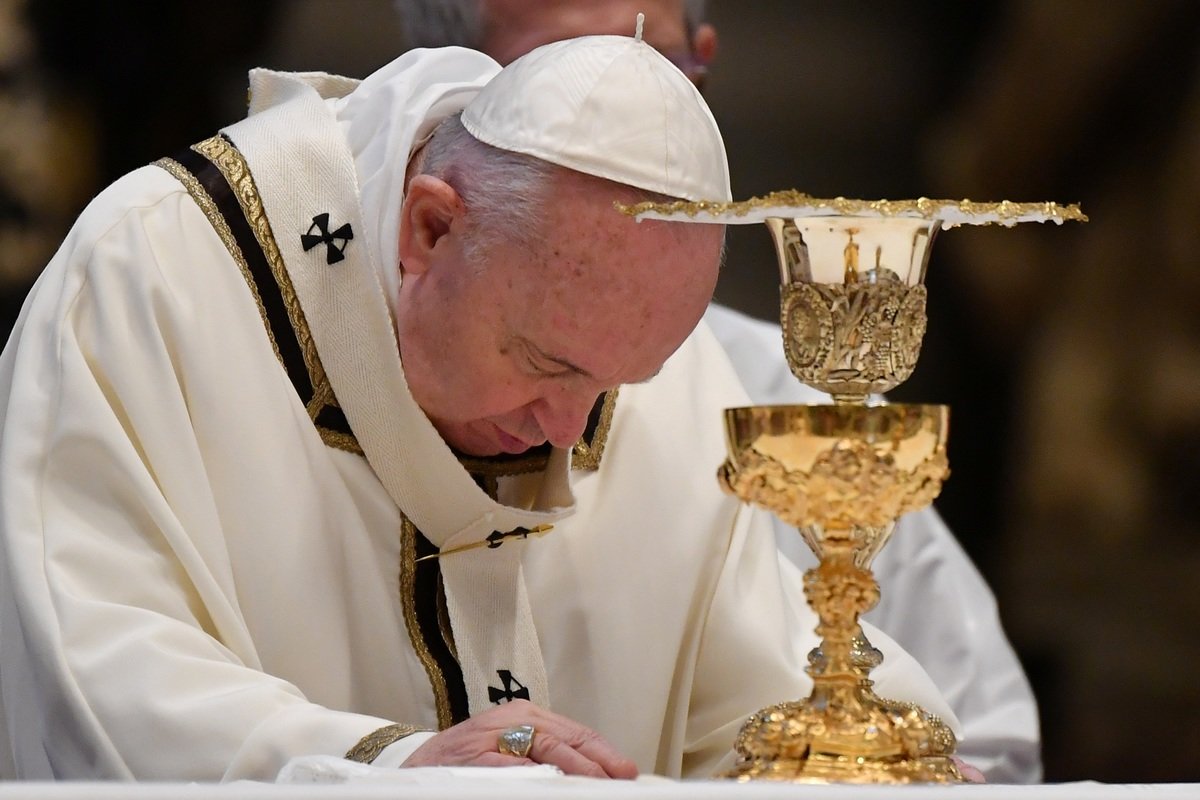
La eucaristía no es sólo el centro de la liturgia cristiana. Es además la experiencia que vivida domingo tras domingo alimenta la vida del cristiano. El que come y bebe en esa cena, alimenta su vida de discípulo fiel de Cristo. En primer lugar, la eucaristía es acción de gracias a Dios por la vida y por la salvación que nos ofrece en su Hijo Jesucristo. Las palabras de acción de gracias, la estructura de todo el conjunto y el tono de toda la celebración contribuyen a vivir una experiencia intensa de alabanza y agradecimiento a Dios que no debe reducirse a ese momento cultual. La vida cotidiana de un cristiano ha de estar marcada por la acción de gracias. La eucaristía es, además, comunión con Cristo resucitado. Jesús no es una figura del pasado, alguien cada vez más lejano en el tiempo, sino el Señor de todos los tiempos que permanece vivo entre los suyos. Los cristianos no somos seguidores de un gran líder del pasado. La eucaristía nos enseña a vivir en comunión con un Cristo actual, acogiendo realmente hoy su espíritu y fuerza renovadora. La eucaristía es también escucha de las palabras de Jesús que son «espíritu y vida». Para un discípulo de Cristo, el evangelio no es un mero testamento literario o un texto fundacional. En la eucaristía nos reunimos para escuchar la palabra viva de Jesús que ilumina nuestra experiencia humana de hoy. Esa acción dominical nos invita a no vivir como ciegos, sin evangelio ni luz alguna. El cristiano vive alimentado por la Palabra de Jesús. La eucaristía es un acto comunitario por excelencia. Todos los domingos, los cristianos dejan sus hogares, se reúnen en una iglesia y forman comunidad visible de seguidores de Jesús. Todas las oraciones de la eucaristía se dicen en plural: invocamos, pedimos perdón, ofrecemos, damos gracias… siempre juntos. Los textos dicen que somos «familia», «pueblo» «Iglesia». No se nos debería olvidar. Los cristianos no somos individuos aislados que, cada uno por su cuenta, tratan de vivir el evangelio. Formamos una comunidad que quiere ser en el mundo testimonio e invitación a vivir de manera fraterna y solidaria. La cena de Jesús resucitado con sus discípulos en la aldea de Emaús es una invitación a reavivar nuestras eucaristías dominicales • AE
 LA MEDITACION DE LA ESPOSA