
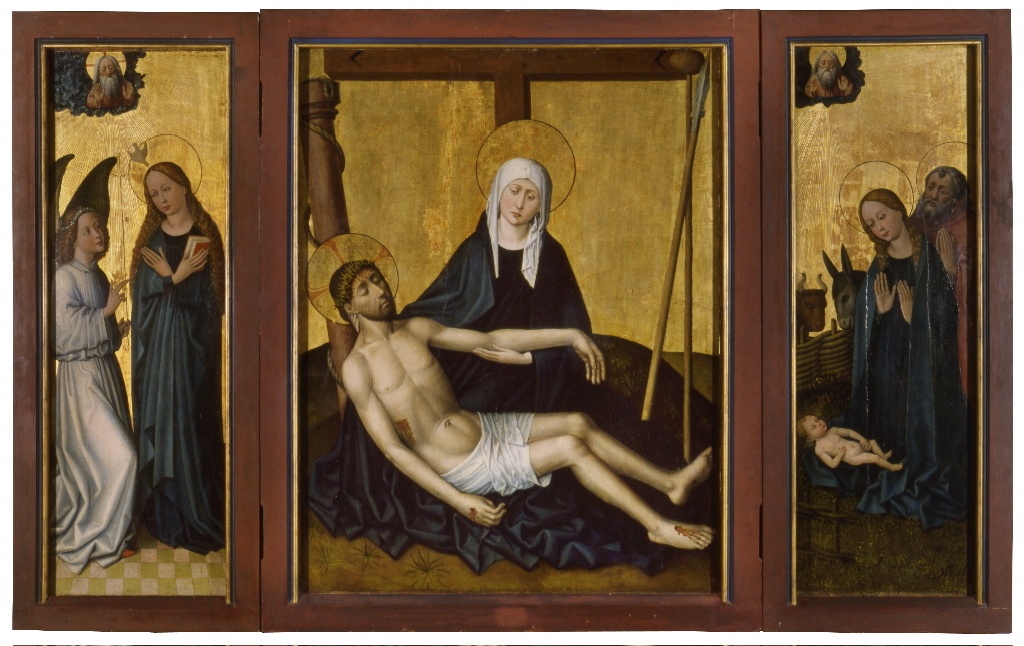
Anonymous Flemish artist, The Descent from the Cross (Stauffenberg Altarpiece) (1454), oil on wood, Unterländer Museum (France)
The best we can do after the proclamation of the Passion of the Lord is to be quiet for a moment[1]. Is there something else to say in the presence such an event with so much pain and physical and moral suffering? Probably not. The Passion of the Lord, is the revelation1 of the love that God has for all humanity and for each one of us and sooner or later we have to respond to that revelation, that’s why we need to be quiet. As Cardinal Sarah says: « If we want to grow and to be filled with the love of God, it is necessary to plant our life firmly on three great realities: The Cross, the Host, and the Virgin: crux, hostia, et virgo… These are three mysteries that God gave to the world in order to structure, fructify, and sanctify our interior life and to lead us to Jesus. These three mysteries are to be contemplated in silence»[2]. That’s why the Church is constantly inviting us to slow down and to take some time to ask ourselves… some good questions: What is God trying to tell me through the Passion of his Son? At this moment in my life, how am I embracing my cross? Gladly? with enthusiasm? Bitterly? If we contemplate the Passion of Jesus from a distance, and we are not really engaged, it is the same as leaving Jesus on the cross and washing our hands, as Pilate did. Or something even worse: It could be that we have the same frivolous attitude of the soldiers who stood at the foot of the cross, watching over the executed. The gospel says that «When the soldiers had crucified Jesus, (…) They also took his tunic from him, but the tunic was one-piece (…) So, they said to one another, «Let’s not tear it, but let us cast lots for it to see whose it will be»[3]. Christ is right there: hanging on the cross, bleeding to death, moaning in pain …dying! And they are there … casting lots! Casting lots! They were killing time…. Bored and yawning… Totally oblivious, insensible to what is happening there, over his head. Well, the same could happen to us, that in the middle of the celebration of the holy sacrifice of the altar at Sunday mass we are boring, full of tedious, looking at the clock because «this is going too slow» wanting to get out as soon as possible. This afternoon, with this eloquent and beautiful liturgy of Good Friday of the Passion of the Lord we have a great chance to remember how important it is to pay attention; how important it is our intention to be present in body, soul, spirit and to receive with gratitude the grace of the Lord. How important is to be on time, wearing our best outfit, participating on the prayers with our best voice, our best postures, our best gestures… our best everything. This is how we can begin to recover a little that sense of reverence that we have been losing and that is so important for the celebration of the mysteries of our faith. It’s Good Friday. the Liturgy of the Word and the tradition of the Church remind us in a liturgical way that the Lord has paid the price of our redemption, that we have salvation at hand. Jesus has climbed the Tree of the Cross out of love for each one of us. And this is not just a pretty phrase, but a reality, And the best way to respond and give thanks is by participating in this and all liturgical our celebrations, or whatever is related with our faith, with love, devotion, and attention. This is the point. The soldiers at the foot of the cross, casting lots are a reminder that, in front of the most sacred… we can be distracted! But we also have the example of the Virgin Mary who, full of pain, remained faithful and loyal to everything that was happening there. At the cross her station keeping, Stood the mournful Mother weeping, Close to Jesus to the last The Stabat Mater sings. So, let us ask the Lord this afternoon for the gift, huge gift, of recovering the sense of the Sacred, the gift of not being indifferent in His presence, the gift of celebrating the mysteries of our faith with devotion, with attention … with love. And today in particular, Good Friday of the Passion of the Lord, let us ask ourselves: What is God trying to tell me through the celebration of the Passion of his Son? At this moment in my life, how am I embracing the cross? gladly? with enthusiasm? bitterly? (Pause) With hearts full of gratitude let us remember that by his passion, death and resurrection our wounds have been healed, our sins have been forgiven, our mistakes have been fixed, and a new opportunity has been given to us5 . How can I repay the LORD for all the great good done for me? The Psalm says, I will raise the cup of salvation and call on the name of the LORD. Today we are invited to lift our hearts in thanksgiving; in silence, in reverence, in devotion and in love. It is Good Friday • AE
[1] 1 Cf. Mark 14-15, Matthew 26-27, Luke 22-23, and John 18-19. [2] Robert Cardinal Sarah, The Power of Silence: Against the Dictatorship of Noise. [3] Cf. Matthew 27:24 4 Cf Jn 18:1—19:42 4

To Christ Crucified

I am not moved to love you, God,
By hope for heav’n’s reward;
Nor am I moved by fear of hell
To turn from sin, my Lord.
What moves me, God, is seeing you,
Despised and nailed up high
Upon that cross with gaping wounds,
Rejected, left to die.
Your love so moves me, Lord, that if
There were no heav’n or hell,
I still would fear your holy name
And truly love you well.
And so I need no promises
To sway my love for you;
For even if I had no hope,
I’d love you as I do.
—Translated by Hugh Seay, Lent, 1978
Passio Domini Nostri Iesu Christi secundum Ioannem
The Passion of Our Lord Jesus Christ according to John
Oración al Cristo del Calvario (Gabriela Mistral)
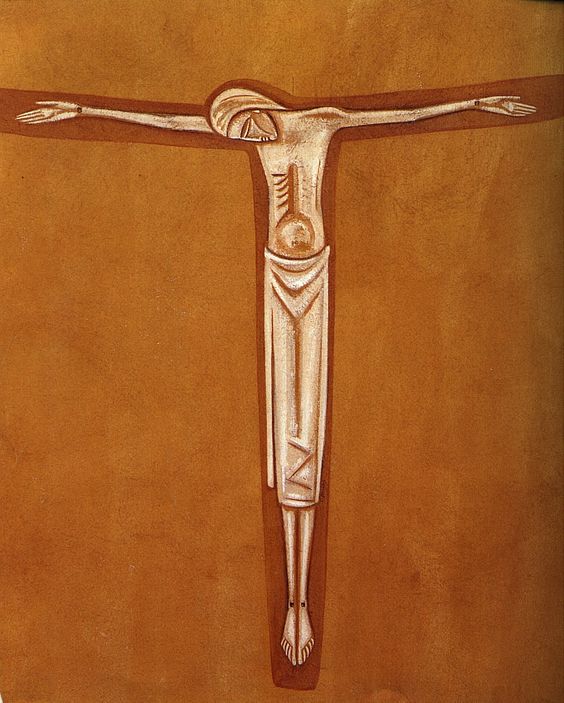
En esta tarde, Cristo del Calvario,
vine a rogarte por mi carne enferma;
pero, al verte, mis ojos van y vienen
de tu cuerpo a mi cuerpo con vergüenza.
¿Cómo quejarme de mis pies cansados,
cuando veo los tuyos destrozados?
¿Cómo mostrarte mis manos vacías,
cuando las tuyas están llenas de heridas?
¿Cómo explicarte a ti mi soledad,
cuando en la cruz alzado y solo estás?
¿Cómo explicarte que no tengo amor,
cuando tienes rasgado el corazón?
Ahora ya no me acuerdo de nada,
huyeron de mí todas mis dolencias.
El ímpetu del ruego que traía
se me ahoga en la boca pedigüeña.
Y sólo pido no pedirte nada,
estar aquí, junto a tu imagen muerta,
ir aprendiendo que el dolor es sólo
la llave santa de tu santa puerta.
Amén,
Viernes Santo de la Pasión del Señor (2023)
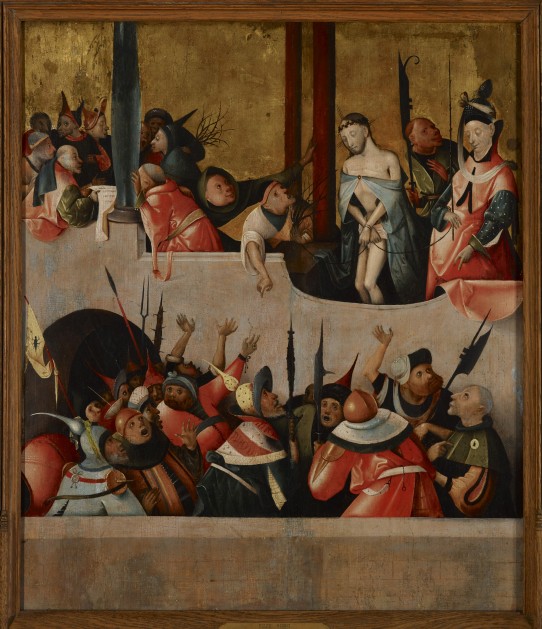
Autor anónimo, Ecce Homo (1510), óleo sobre tela, Museo de Arte de Indianapolis (EEUU)
Aquí tienen al Hombre». Esas fueron las palabras de Pilato en la mañana de aquel viernes cuando pone a Jesús a la vista de todos. Para nosotros Él es el hombre, y el cristianismo el verdadero humanismo. ¿Nos hallamos ante un ideal masoquista, de quien se complace en el sufrimiento por el sufrimiento? No: estamos ante un ideal de un hombre -el Hombre- que no pasa por alto la condición histórica y concreta que es la nuestra, y que además conoce la opresión, el abuso de los poderosos sobre los débiles, la violencia institucionalizada, el dolor. He aquí el hombre. Jesús no es el que triunfa a costa de los demás, el que se enriquece con su explotación, el que manda a su antojo y según sus conveniencias, o el que siempre está en la cresta de la ola, como la espuma. Jesús es el humillado, el explotado, el expoliado: El varón de dolores. El Señor soportó realmente nuestros sufrimientos y ha aguantó nuestros dolores. Y es que no es incapaz de compadecerse de nuestras flaquezas, él que, igual que nosotros, ha sido probado en todo. Así, la respuesta de Dios al problema del mal no es una respuesta intelectual a un problema intelectual: sino una respuesta práctica, realista, efectiva y afectiva a una cuestión existencial. Jesús, perfecto Dios y perfecto hombre, asume el mal en su propia carne. Pero el problema continúa problema; la rebelión, rebelión; el miedo, miedo. Pero lo vivimos acompañados: también Jesús ofreció «ruegos y súplicas, con poderoso clamor y lágrimas, al que podía salvarle de la muerte»[1]. Quizá la expresión más fuerte y sintética es aquella de san Pablo: “Al que no había pecado, Dios lo hizo expiar nuestros pecados, para que nosotros, unidos a él, recibamos la salvación de Dios»[2]. Esto es lo que silenciosamente celebramos en este viernes Santo de la Pasión del Señor • AE
[1] Cfr. Heb 4,14-16; 5,7-9. [2] Cfr. 2Co 5, 21.




 LA MEDITACION DE LA ESPOSA