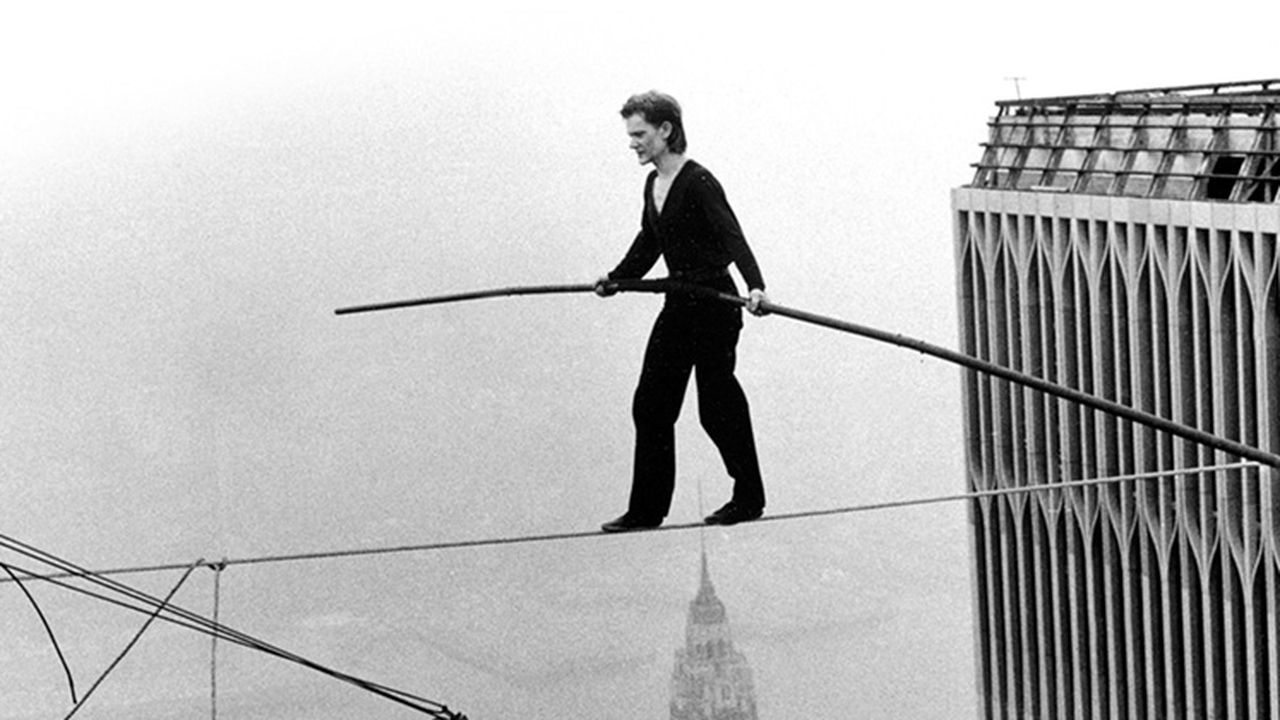
Phillipe Petit paralyzed New York in 1974 when he walked between the Twin Towers for 45 minutes.
At the end of today’s Gospel, Jesus says that: “Every scribe of the Kingdom is like the head of the household who brings out from his storeroom both the new and the old.” Jesus spoke to the Jewish people, well versed in Hebrew scripture. Jesus is not replacing what we call the Old Testament with the New Testament. He is combining the best of the Hebrew Scriptures with the New Way, the Kingdom of God. The wise one, the scribe of the Kingdom, therefore, knows how to use what is old and what is new. It takes wisdom to understand how to deal with the past and the present. There are many people who idealize the past and want to return to life as it was, for example, in the fifties. There are many others who want to reject the past and concentrate only on the advancements of modern life. So, how do we best deal with the past and the present? It was the Russian poet Yevtushenko the one who said that the trick to handling the past is to know what should be brought with us and what should be left behind. That is wisdom. Within the Church, we should bring with us from the past devotion to the sacraments, to the Blessed Virgin Mary, the importance of the Catholic Family, firm standards of morality, a determination to practice the faith. What should be left behind would include the subordination of the laity, the repression of the roles of women in the faith, the glorification of the clergy, and the diminishing of the study of Sacred Scripture. We should also apply this to our lives. All of us can look back on our lives and note numerous positive and multiple negative aspects of our lives. We have got to stop persecuting ourselves by dwelling on the negatives of our past. When we do this, we are bringing the past into the present. At the same time, it is not pride to recognize the gifts we have shown and to be sure that we utilize our potential or make our talents real in the present. In today’s first reading we just heard how Solomon prayed for wisdom. Great idea. It takes wisdom to combat the challenges of life. It takes wisdom to be a good parent, a good husband, a good wife, a good priest, and a good person. It takes wisdom to discern what needs to be brought into the present and what needs to be left in the past #Balance #Equilibrium Where do we get this wisdom? Well: the same place that Solomon received his: God! •

St. Dominic Catholic Church
Seventeenth Sunday in Ordinary Time

Saturday July 29, 2023
12.00 p.m. XV Años Celebration for Gianna Kristi Granado (Fr. Agustin)
3.00 p.m. Sacrament of Reconciliation (Confessional) Fr. Agustin
5. 00 p.m. Mass Fr. Agustin
Sunday July 30, 2023
7.30 a.m. Mass Fr. Agustin
10.00 a.m. Mass Fr. Agustin
12.30 p.m. Mass Fr. Agustin
3.00 p.m. Misa en Español Fr. Agustin
XVII Domingo del Tiempo Ordinario (Ciclo A)

Cornelis de Vos, La unción de Salomón (1630), óleo sobre tela, Kunsthistorisches Museum (Viena)
El relato que escuchamos en la primera de las lecturas este domingo es simplemente fascinante, pero hay que entenderlo también desde una perspectiva histórica. La realidad es que el reinado de Salomón estuvo lejos de ser admirable. El pueblo lo fue idealizando y presentándolo como un rey sabio, como el gran sucesor de David, como el organizador del comercio exterior, pero también hay muchas sombras en su vida. Para que pueda suceder a su padre en el trono, su madre hará todo tipo de trampas para ganarse una parte de la casta sacerdotal, incluido el sumo sacerdote. Por su parte Salomón impondrá grandes impuestos al pueblo para poder llevar a cabo sus empresas militares y las grandes construcciones de su reinado. Y del tema de la idolatría mejor ni hablar. Todo pareciera indicar que a Salomón le importaba más la gloria de su reinado que su pueblo. Pero – y aquí está lo maravilloso de la historia- a pesar de sus errores y sus caídas, el autor bíblico le atribuye un papel importante en la historia de la salvación, y hace notar que la magnificencia del reinado de Salomón es la prueba palpable, el testimonio más contundente, de la fidelidad divina a las promesas dinásticas que un día el Señor hizo a David. Dios se revela a Salomón en Gabaón a través de una visión que tiene en sueños y lo confirma en su cargo a pesar de sus errores y miserias, y además le da sabiduría para poder gobernar y dirigir a su pueblo, para administrar verdadera justicia. Esta petición de petición de Salomón que hoy nos presenta la liturgia podría ser un buen modelo oración. Salomón no pide victorias militares, ruega por algo simple y difícil a la vez: saber escuchar y saber discernir entre lo bueno y lo malo. Que el Señor en su misericordia nos regale esa claridad y aperturas interiores para saber ver la verdad allí donde esté, y no donde deseamos encontrarla, a veces caprichosamente •

Lecturas para el Verano









 LA MEDITACION DE LA ESPOSA