
In today’s second reading St. Paul warns us not to conform to this world but be transformed by the renewal of our mind so we might discern what the will of God is, what is good, pleasing and perfect.
It is easy to conform to the world. It is easy to just go along with what everyone is doing without even considering how our actions are devastating our spiritual life. Our spiritual radar should go up when we hear someone say, “It’s a new world now. Things have changed. Everyone is doing this or that.” We need to ask ourselves, “Am I willing to sacrifice my spiritual life to join what people say everyone is doing?” That is what sin is, isn’t it? Sin is pushing God aside for the sake of conforming to the world. In Jesus’ prayer to His Father, he says, «They are not of the world, even as I am not of the world.”[1] When we conform to that which is not the Christian way of life, we are going against our very being, our spiritual essence. Sin leaves us disjointed, at war with ourselves. It steals our identity from us. So, we do not have to conform. We can be transformed by the renewal of our mind, our soul. Our evangelical protestant brothers and sisters will often talk about being born again. We Catholics do not believe in a second baptism. We believe that our lives are a progression of coming to a fuller understanding of whom we are as sons and daughters of God. This understanding gives us a new determination to live the Christian life in its fullness. For us conversion is a process that begins with baptism and concludes with our final breath. C.S. Lewis wrote, “If you live for the next world, you will get this one in the deal. But if you live only for this one, you will lose them both.” Great idea!
Commitment to the Lord carries the cost of rejecting those elements of the world where He is not present. Like Jeremiah, we want God in our lives, but we will not fully understand the cost of Christianity until that cost becomes personal. Yet, like Jeremiah, we live for the fire burning within our bones, the fire of God’s love. We allow ourselves to be duped. We want God. «The problem with you is that you are thinking like the world does, not like God does,» Jesus told that disciple he had just called his rock. Peter wanted to prevent Jesus from dying. Jesus said that the devil would want to prevent God’s plan from taking place. We cannot allow this to happen. A world that is in darkness needs us to be its light. People are looking for hope. People are searching for a reason for living. As Christians, as Catholics we can give them that hope. We can give them that reason for life. We can be the Light of Christ for others. We do not have to conform to a world of darkness. We can be transformed by God. Then we will experience all that is good and pleasing and perfect • AE
[1] in John 17:16
‘The Water Has Been Agitated’
Francis in conversation with Jesuits in Portugal
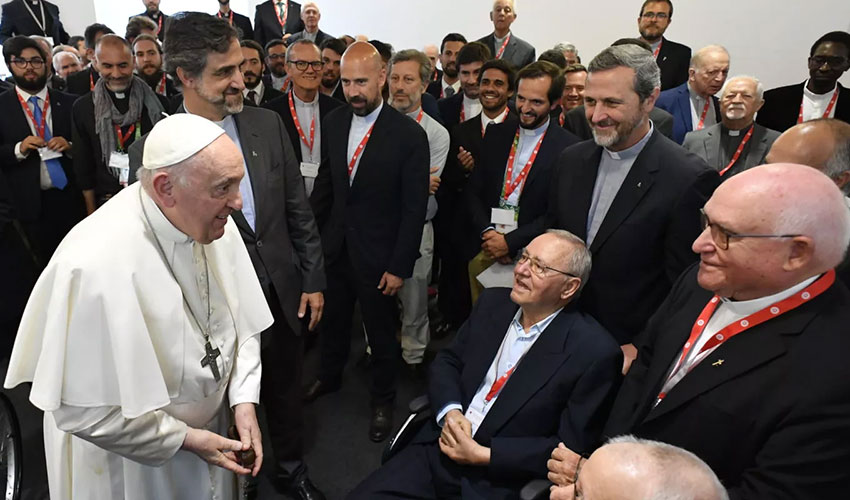
You can read the conversation here: https://www.laciviltacattolica.com/the-water-has-been-agitated/
Twenty-Second Sunday in Ordinary Time
St. Dominic Catholic Church

Saturday September 2, 2023.
3.00 p.m. Sacrament of Reconciliation (Confessional) Fr. Agustin
5. 00 p.m. Holy Mass – Fr. Agustin
Sunday September 3, 2023
7.30 a.m. Mass Fr. Agustin
10.00 a.m. Mass Fr. Agustin
12.30 p.m. Mass Fr. Jaime
3.00 p.m. Misa en Español Fr. Jaime
XXII Domingo del Tiempo Ordinario (Ciclo A)

El Bosco, Cristo con la Cruz a cuestas (1498), Monasterio de San Lorenzo de El Escorial (España)
Jesús pasó algún tiempo recorriendo las aldeas de Galilea. Allí vivió los mejores momentos de su vida. La gente sencilla se conmovía ante su mensaje de un Dios bueno y perdonador. Los pobres se sentían acogidos. Los enfermos y desvalidos agradecían a Dios su poder de curar y aliviar su sufrimiento. Y Jesús seguía su camino. En algún momento explicó a sus discípulos su decisión de subir a Jerusalén; era necesario anunciar la Buena Noticia de Dios en el centro mismo de la religión judía. Era peligroso. Sabía que allí iba a padecer a manos de los dirigentes religiosos y las autoridades del templo. Y desde luego Pedro se rebela ante lo que está oyendo. Le horroriza imaginar a Jesús clavado en una cruz. Pedro piensa en un Mesías triunfante. A Jesús todo le tiene que salir bien. Por eso, lo toma aparte para tratar de convencerlo de evitar aquel mal trago. Jesús reacciona con una dureza inesperada. Este Pedro le resulta desconocido y extraño. No es el que poco antes lo ha reconocido como «Hijo del Dios vivo». Es muy peligroso lo que está insinuando. Por eso lo rechaza con toda su energía: «Apártate de mí Satanás». El texto dice literalmente: «Ponte detrás de mí». Ocupa tu lugar de discípulo y aprende a seguirme. No te pongas delante de mí desviándonos a todos de la voluntad del Padre. Jesús quiere dejar las cosas muy claras. Ya no llama a Pedro piedra sobre la que edificará su Iglesia; ahora lo llama piedra que me hace tropezar y me obstaculiza el camino. Ya no le dice que habla así porque el Padre se lo ha revelado; le hace ver que su planteamiento viene de Satanás. La gran tentación de los cristianos es siempre imitar a Pedro: confesar solemnemente a Jesús como Hijo del Dios vivo pero luego querer seguirle sin cargar con la cruz. Vivir el Evangelio sin renuncia ni coste alguno. Colaborar en el proyecto del reino de Dios y su justicia sin sentir el rechazo o la persecución. Queremos seguir a Jesús sin que nos pase lo que a él le pasó. No es posible. Seguir los pasos de Jesús siempre es peligroso. Quien se decide a ir detrás de él, termina casi siempre envuelto en tensiones y conflictos. Será difícil que conozca la tranquilidad. Sin haberlo buscado, se encontrará cargando con su cruz. Pero se encontrará también con su paz y su amor inconfundible. Los cristianos no podemos ir delante de Jesús sino detrás de él • AE
+ (más) lEcTurAS pArA el vERanO

 LA MEDITACION DE LA ESPOSA