
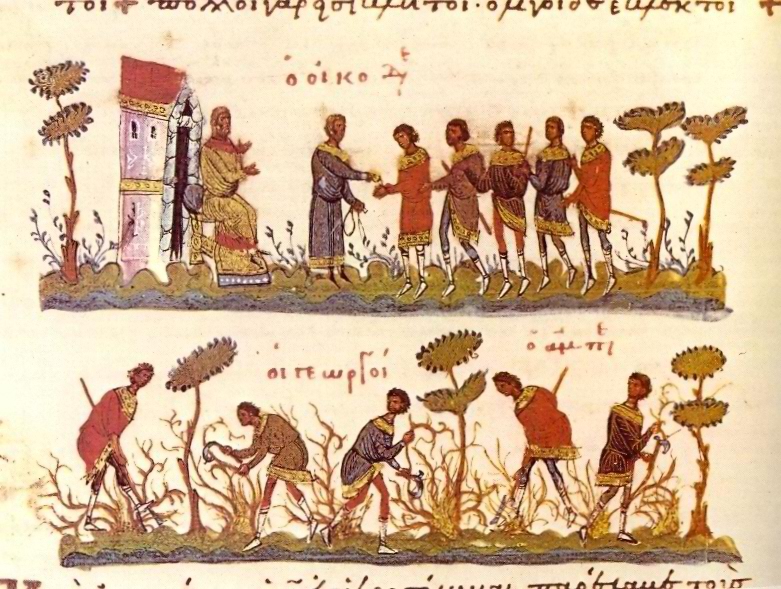
Parable of the Workers in the Vineyard, on the field (down) and pay time (up), Byzantine Gospel of 11th century, National Library of France (Paris)
After listening at today’s gospel is there anyone that feels that God had been unfair? Would any of us dare tell God that he was unjust? Or, would any of us say, “How about me, Lord? I have worked hard to serve you from the very beginning of my life. Surely, my reward will be greater than my brother or my sister or this or that guy.” No, we wouldn’t say that! We have all received Grace from God. We are not going to blame God for being so generous with all those around us, expecting Him to be even more generous to us. It is not up to us to determine how God rewards those who serve him. That is what the parable of the laborers in the vineyard is really about. God’s grace comes to different people at different times and in different ways!
Look at some of the amazing ways that God has changed people we know. So often we have all encountered a person who has done serious damage to his or her life and family through alcohol or other chemical dependency. Then we marvel how God’s Grace not only led that person to recovery, but made him or her a source of strength for others looking to recover. That is the amazing Grace of the Divine Employer!
St. John Paul II was very much aware of the working of God’s Mercy. He addressed women who had suffered through an abortion and now mourned the loss of the baby they had killed. He empowered them with the determination to work for life and protect other women from going through what they went through. This is the Amazing Grace of the Divine Employer. Sadly, many of us have given up on ourselves. But the Lord never gives up on us. Sometimes, we have the view that «it is just too late». We think that something we have done in our past is so terrible that God could never return us to a full share of His love. If this type of thought has come into your mind, let me tell you with the authority of the Gospel: You are wrong. You are judging by human standards, not by the standards of the Love and Mercy and Compassion of the Lord. God never gives up. He never gives up on us! So, we do not have the right to give up on ourselves. We can always start new, whether we have just been lukewarm Christians or whether we have been at war with God. Not only does God refuse to hold us to our pasts, He transforms us to become vehicles of conversion for others. The Lord does not want us wasting any more time. Even if we are well advanced in age, and the day is drawing to a close, He still has work for us to do. He wants us to work for Him, no matter what our pasts have been. Today we have a great chance to meditate on this, to say «What Mercy! What Grace!», because indeed its really Amazing. Amazing grace! • AE

What are you going to read when Autumn arrives?



St. Dominic Catholic Church
Week-End Schedule

Saturday September 24, 2023
10.00 a.m. Training Session for Altar Servers
3.00 p.m. Sacrament of Reconciliation (Confessional) Fr. Agustin
5. 00 p.m. Holy Mass – Fr. Agustin
Sunday September 25, 2023
7.30 a.m. Mass Fr. Agustin
10.00 a.m. Mass Fr. Agustin
12.30 p.m. Mass Fr. Jaime
3.00 p.m. Misa en Español Fr. Jaime
XXV Domingo del Tiempo Ordinario (Ciclo A)

Probablemente era otoño y en los pueblos de Galilea se llevaba a cabo la vendimia. Jesús veía en las plazas a quienes no tenían tierras propias, esperando a ser contratados para ganarse el sustento del día. ¿Cómo ayudar a esta pobre gente a intuir la bondad misteriosa de Dios hacia todos? Fue entonces que Jesús contó una parábola sorprendente. Les habló de un señor que contrató a todos los jornaleros que pudo. Él mismo vino a la plaza del pueblo una y otra vez, a horas diferentes. Al final de la jornada, aunque el trabajo había sido absolutamente desigual, a todos les dio un denario: lo que su familia necesitaba para vivir. El primer grupo protesta. No se quejan de recibir más o menos dinero. Lo que les ofende es que el aquel señor trató a los últimos igual que a los primeros. La respuesta del señor al que hace como de líder de los inconformes es realmente admirable: « Vas a tener tú envidia porque yo soy bueno?». La parábola es tan revolucionaria que, seguramente, después de veinte siglos, no nos atrevemos todavía a tomarla en serio. ¿Será verdad que Dios es bueno incluso con aquellos y aquellas que apenas pueden presentarse ante él con méritos y obras? ¿Será verdad que en su corazón de Padre no hay privilegios basados en el trabajo más o menos meritorio de quienes han trabajado en su viña? Todos nuestros esquemas se tambalean cuando hace su aparición el amor libre e insondable de Dios. Por eso nos resulta escandaloso que Jesús parezca olvidarse de aquellos cargados de méritos, y se acerque precisamente a los que no tienen derecho a recompensa alguna por parte de Dios: pecadores que no observan la Alianza, o prostitutas que no tienen acceso al templo, porque no están limpias, porque viven de manera desordenada. Nosotros seguimos muchas veces con nuestros cálculos, sin dejarle a Dios ser bueno con todos. No toleramos su bondad infinita hacia todos. Hay personas que no se lo merecen, pensamos. Nos parece que Dios tendría que dar a cada uno su merecido, y sólo su merecido. ¡Menos mal que Dios no es como nosotros; menos mal que desde su corazón de Padre, Dios sabe acercarse para atraer a Si mismo a aquellos a quien nosotros rechazamos pero que también son Sus hijos! ¡Ay si el Señor nos regalara un corazón como el de su Padre y con ese corazón empezáramos a amar a aquellos con quienes nos relacionamos más frecuentemente! • AE
lEctURas pArA eL oTOño


 LA MEDITACION DE LA ESPOSA