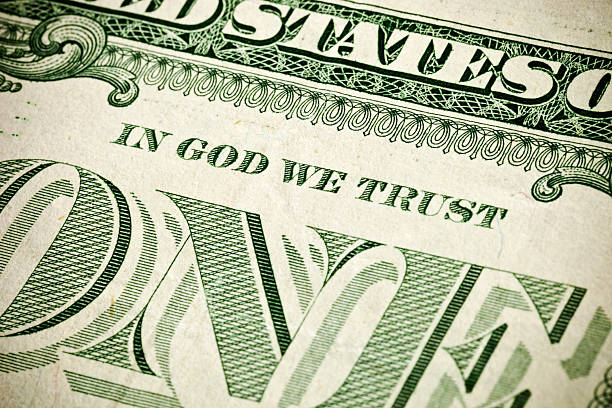
Close Up An American One Dollar Bill Featuring The Saying «In God We Trust».
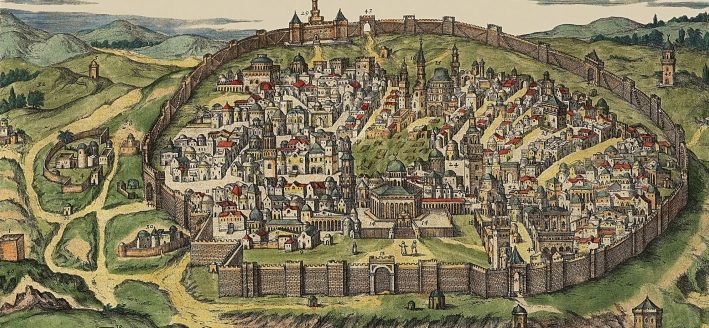
In today’s gospel Jesus was not going to let the Herodians declare that he was an enemy to Caesar by refusing to pay taxes, nor was he going to let the Pharisees declare that he was an enemy to the Hebrew people by paying taxes. The phrase “Render to Caesar what is Caesar’s and to God what is God’s,” has deeper implications, particularly to us here in the United States.
First of all, “render to Caesar what is Caesar’s.” We have a responsibility to be good citizens of our country. That means participating in protecting our country from those who would destroy it by joining the military and by supporting those in the military. If we, as Catholics, want the laws of our country to be based on principals of Catholic morality and social justice, we have to take part in the government, not be bystanders. Yes, we need to vote, but more than vote, we need to be actively engaged in the working of our government. This is how we can lead our country to develop and expand our democracy. Of course, the least we can do is vote, not just in presidential elections but in every election. Our voice needs to be heard. Finally, we need to support our government by each of us paying our fair share in taxes. No one likes taxes, but all of us want to know that our country is going to protect us and, when we are sick and or elderly, care for us. We need to pay our soldiers and sailors and fund our department of defense. We need to be sure that our towns, cities, counties and states have the resources they need to govern us correctly. We need to pay our first responders, police and fire, and all who work in our school system, water department, motor vehicle system, etc. etc. All of us who pay taxes, from local to federal, are invested in our government, and are proud of our government.
Infinitely more important is the second dictate of the Lord, “Render to God what is God’s.” Our citizenship is in heaven. The main goal of each of our lives must be to spread the Kingdom of God. We must spread the Good News, the Gospel, that Jesus Christ has reunited us to our Heavenly Father. When we live his life in our own lives, he gives beauty and purpose and meaning to our lives. We were not created for the material world. We were created for love. To serve Him. God is greater than us. He created us and sustains us in being. In serving Him, we serve ourselves as well, in the sense that each of us becomes that unique person that God wishes us to be. We are meant to live for God. That is service. And to be Happy with Him forever.
When God made me and you and everyone else, He intended for us to be drawn into the very life of the Trinity and to enjoy eternal happiness. But He gave us the freedom to make that choice. This is what love is. Love is a choice. We choose to be with Him forever. We choose to reject all that is not Him. We fight against sin. Our reward is union with God. We can have a glimpse of this union in our life while we are in the physical world. There are times, sometimes just fleeting moments, when we feel completely at peace with ourselves and with God. How wonderful life will be when we are completely united to God. That is heaven. Render unto God what is God’s. What is God’s? “The world is the Lord’s and its fullness thereof,” we hear in Psalm 24. Other people are the Lord’s. We are the Lord’s. He has given Himself to us so that we can live for Him. We belong to Him. When we care for others, particularly those who reach out to us in their need, we care for his Presence within them. So can an American be a good Catholic? Can a good Catholic be an American? Of course, on both counts. A good Catholic cares for his country because he loves God and wants his country to continue to reflect the love of God in every aspect of national life. By serving his country properly, as a committed Catholic, he will be serving God. Our prayer today is for God to help us render unto Caesar what is Caesar’s and unto God what is God’s • AE

St. Dominic Catholic Church
Weekend Schedule

Saturday October 21, 2023
7.00 a.m. Mass for ACTS Retreat (Cordi Marian Retreat Center) – Fr. Agustin E.
2.30 p.m. Sacrament of Matrimony for Ezequiel & Mayra – Fr. Agustin E.
3.30 p.m. Sacrament of Reconciliation (Confessional) – Fr. Agustin E.
5.00 p.m. Holy Mass – Fr. Agustin E.
Sunday October 22, 2023
7.30 a.m. Holy Mass – Fr. Agustin E
10.00 a.m. Holy Mass – Fr. Agustin E.
12.30 p.m. Holy Mass – Fr. Jaime P.
3.00 p.m. Santa Misa – Fr. Jaime P.
XIX Domingo del Tiempo Ordinario (Ciclo A)
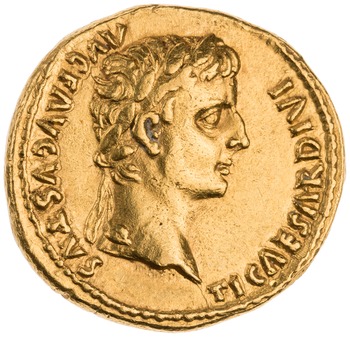
La trampa que tienden al Señor está bien pensada: «¿Es lícito pagar tributos al César o no?». Si responde negativamente, lo podrán acusar de rebelión contra Roma. Si acepta la tributación, quedará desacreditado delante de quienes viven en la miseria, exprimidos por los impuestos; esos a los que él tanto quiere y defiende. Jesús les pide que le enseñen una moneda. Él no la tiene, vive como un vagabundo itinerante, sin tierras ni trabajo fijo; hace tiempo que no tiene problemas con los recaudadores. Después les pregunta por la imagen que aparece en aquel denario de plata. Representa a Tiberio y la leyenda decía: «Tiberius Caesar, Divi Augusti Filius Augustus». En el reverso se podía leer: «Pontifex Maximus». El gesto de Jesús es ya clarificador. Sus adversarios viven esclavos de un sistema pues al utilizar aquella moneda acuñada con símbolos políticos y religiosos, están reconociendo la soberanía del emperador. No es el caso de Jesús, que vive de manera pobre pero libre, dedicado a los pobres y excluidos del imperio. Jesús añade entonces algo que nadie le ha planteado. Le preguntan por los derechos del César, y él responde recordando los derechos de Dios: «Den al César lo que es del César, y a Dios lo que es de Dios». La moneda lleva la imagen del emperador, pero el ser humano, como lo recuerda el libro del Génesis, es imagen de Dios. Por eso, nunca ha de ser sometido a ningún emperador. Jesús lo había recordado muchas veces. Los pobres son de Dios. Los pequeños son sus hijos predilectos. El reino de Dios les pertenece. Nadie ha de abusar de ellos. Jesús no dice que una mitad de la vida, la material y económica, pertenece a la esfera del César, y la otra mitad, la espiritual y religiosa, a la esfera de Dios. Su mensaje es otro y es muy concreto: si entramos en el reino, no hemos de consentir que ningún César sacrifique lo que sólo le pertenece a Dios: los hambrientos del mundo, los abandonados, los inmigrantes. Que ningún César cuente con nosotros • AE

A propósito del Evangelio
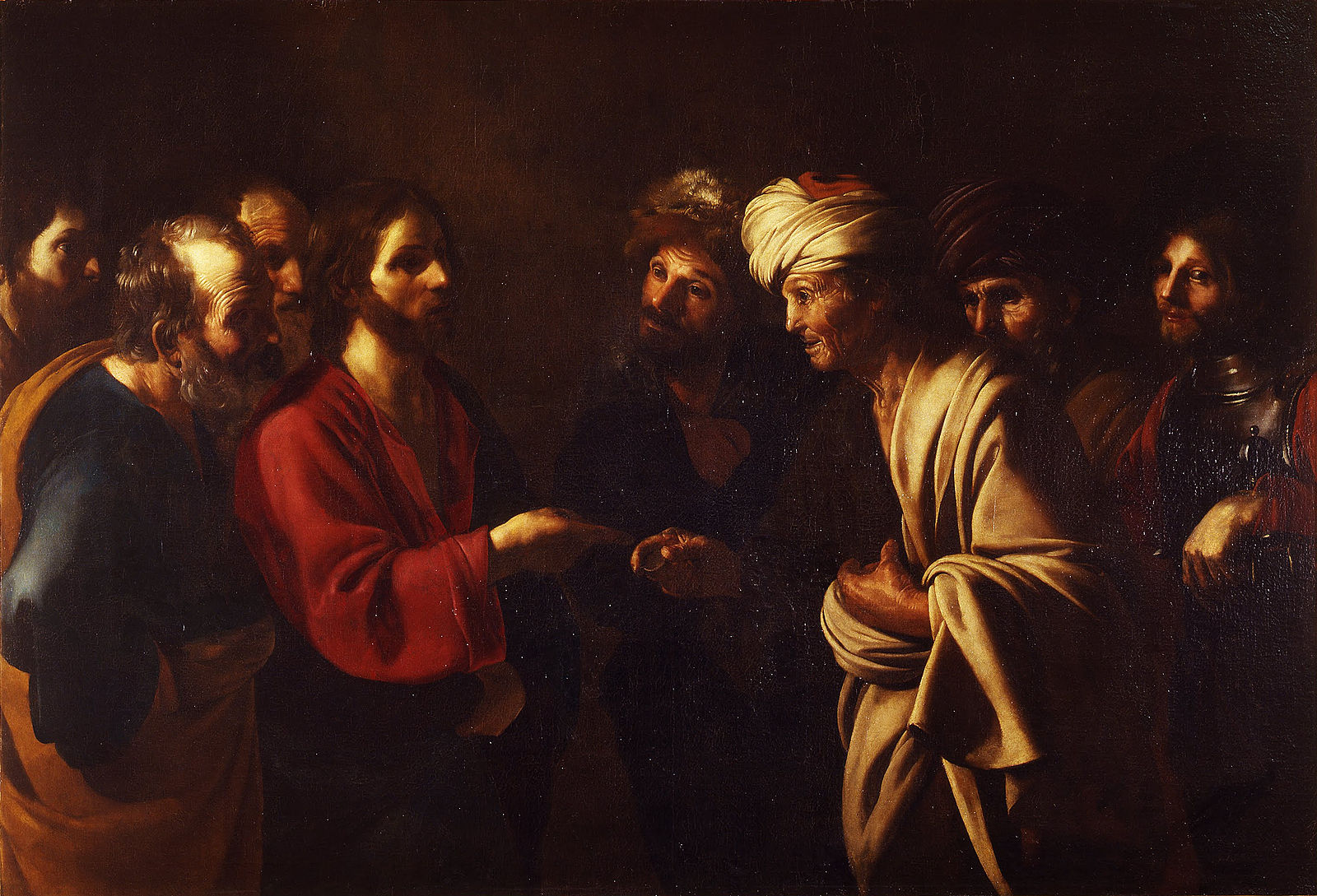
B. Manfredi, El Tributo a César (1610), óleo sobre tela, Galería de los Uffizi (Florencia)
Bartolomeo Manfredi (Ostiano, 1582-Roma, 1622) fue un pintor italiano y alumno de Cristoforo Roncalli Pomarancio que debió de llegar a Roma en los primeros años del siglo XVII, y pudo encontrarse en 1603 al lado de Caravaggio. Fue uno de los más cercanos seguidores del pintor lombardo, poblando sus obras de personajes populares que se mueven en escenarios interiores de fondos oscuros, incidiendo en el estudio de los fuertes contrastes lumínicos que aplica a las figuras y objetos. Su estilo obtuvo un gran éxito y fue muy imitado, llegando a ser denominado, un tanto frívolamente, «Manfrediana Methodus», como si se tratase de una divulgación un poco superficial del primer Caravaggio romano, y que utilizaron numerosos artistas, tales como Tournier, Regnier o Valentin.
 LA MEDITACION DE LA ESPOSA