
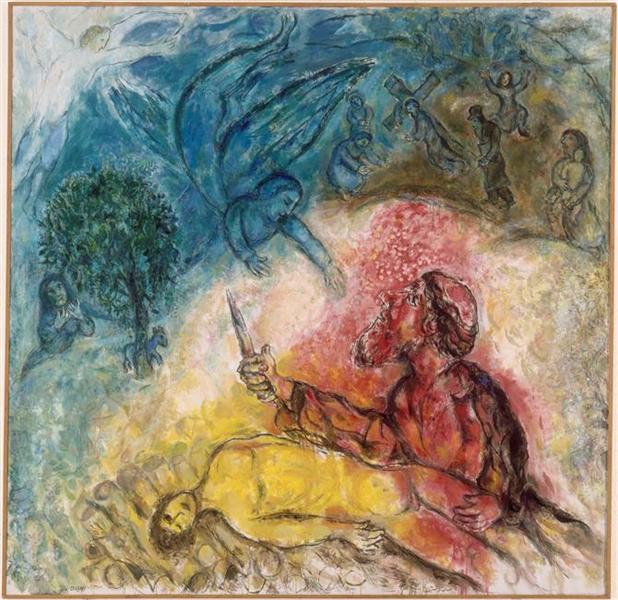
M. Chagall, The Sacrifice of Isaac (1966), oil on canvas, Particular Collection.
Why was Abraham called to kill Isaac? The Jewish people never practiced human sacrifice, so it appears only as a demonstration of how deep his faith in God needed to be. Well, as we know, he did have faith. He had faith in God’s promise that he would build him into a nation even though the only way that would happen would be through his son Isaac, the very son he was asked to sacrifice. As you know, God did not allow him to kill his son, and his faith was rewarded by a covenant with him saying that his descendants would be as countless as the stars of the sky and the sands of the seashore.
The point for us today is that God is aware of our faith. He knows the struggles we have to believe. Abraham did not want to sacrifice his son, but trusted in God. Jesus cried during the agony in the garden for his Father to free him from the terrible suffering he was going to endure, but he still trusted in God. How about us? God sees us praying to him. He knows we want to grow closer to him. At the same time he sees how our faith is continually tested by the turmoil of our lives. It is easy for us to believe and be people of faith when all is going well and we are happy. It is easy to believe, be people of faith, when we are enjoying our family, our children, our lives. It’s easy to believe, be people of faith, when we leave Church feeling warm and deeply moved. But faith is difficult when we are in turmoil. When relationships meant to be growing and nurturing, such as marriage, become bitter and end up destructive, when jobs that we don’t even like are in jeopardy, then faith is difficult. It is difficult to believe in God when we or a loved one is sick, or worse, when a loved one has passed away. God knows how often we are just plain angry, angry with him for the difficulties of our lives. He knows that sometimes we become so angry that we even doubt his existence. He knows that sometimes we wonder if he really cares. God knows how often we feel weak in our faith, but he also knows that we do want to have faith. God sees us as people of faith who are begging him to help us grow in faith. When times of turmoil take over our lives, we have to focus in on the covenant with Abraham, the covenant of faith. Abraham trusted that God would find a way to reward him for his faith. And God did reward him. And he does reward us for our faith. When the disciples, Peter, James, and John saw Jesus transfigured on the Mountain and Elijah and Moses with him, they wanted to stay there. We all feel the same way when we have a religious experience. We no not want it to end. But glory comes only after we understand what to rise from the dead means. We cannot fully celebrate the Glory of the Lord until we share in his passion, his death, his sacrifice. Our faith is tested like Abraham’s faith and like Jesus’ faith. We are called to give our best to the Lord and trust him to transform the sacrifice into a new covenant far greater than we could ever imagine. If God is for us, St. Paul tells the Romans and us, who can be against us? He who did not spare his own son for us, will prevent the forces of evil from attacking us. This includes those forces within us tearing at our psyche, leading us away from the Lord. God is for us. God is with us. May we have the faith of Abraham to trust in God even in the most difficult situations • AE

St. Dominic Catholic Church Weekend Schedule

Saturday, February 24, 2024
3.00 p.m. Sacrament of Reconciliation – Fr. Agustin E.
5.00 p.m. Holy Mass (English) – Fr. Agustin. E.
Sunday, February 25, 2024
7.30 a.m. Holy Mass (English) – Fr. Agustin E.
10.00 a.m. Holy Mass (English) – Fr. Agustin E.
12.30 p.m. Holy Mass (English) – Fr. Jaime P.
3.00 p.m. Santa Misa – Fr. Jaime P.
II Domingo de Cuaresma (Ciclo B)
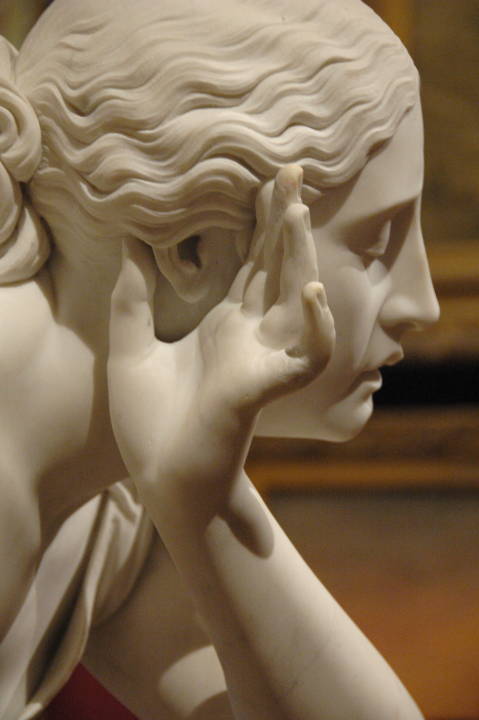
Randolph Rogers, Nydia (1856), mármol, Museo de Bellas Artes de Boston (EEUU)
Cada vez tenemos menos tiempo para escuchar. No sabemos acercamos con calma y sin prejuicios al corazón del otro. No acertamos a escuchar el mensaje que todo ser humano nos puede comunicar. Encerrados en nuestros propios problemas, pasamos junto a las personas, sin apenas detenemos a escuchar realmente a nadie. Se nos está olvidando el arte de escuchar.
A los cristianos se nos ha ido olvidando que en buena parte ser creyente es vivir escuchando a Jesús. Más aún. Sólo desde esta escucha nace la verdadera fe cristiana. Cuando en la montaña los apóstoles se asustan al sentirse envueltos por las sombras de una nube, sólo escuchan estas palabras: Este es mi Hijo amado: escúchenlo.
La experiencia de escuchar a Jesús hasta el fondo puede ser dolorosa, pero apasionante. No es el que nosotros habíamos imaginado desde nuestros esquemas piadosos. Su misterio se nos escapa. Casi sin damos cuenta, nos va arrancando de seguridades que nos son muy queridas, para atraernos hacia una vida más auténtica. Nos encontramos, por fin, con alguien que dice la verdad última. Alguien que sabe por qué vivir y por qué morir. Algo nos dice desde dentro que tiene razón. En su vida y en su mensaje hay verdad. Si perseveramos en una escucha paciente y sincera, nuestra vida empieza a iluminarse con una luz nueva. Comenzamos a verlo todo con más claridad. Vamos descubriendo cuál es la manera más humana de enfrentarnos a los problemas de la vida y al misterio de la muerte. Nos damos cuenta de los grandes errores que podemos cometer los humanos, y de las grandes infidelidades de los cristianos.
Quizá deberíamos de cuidar más en nuestras parroquias la escucha fiel a Jesús. Escucharle a él nos puede curar de cegueras, nos puede liberar de desalientos y cobardías, puede infundir nuevo vigor a nuestra fe. Vale la pena intentarlo. Estamos en Cuaresma, qué mejor tiempo para comenzar • AE
 LA MEDITACION DE LA ESPOSA