Easter Sunday (2024)

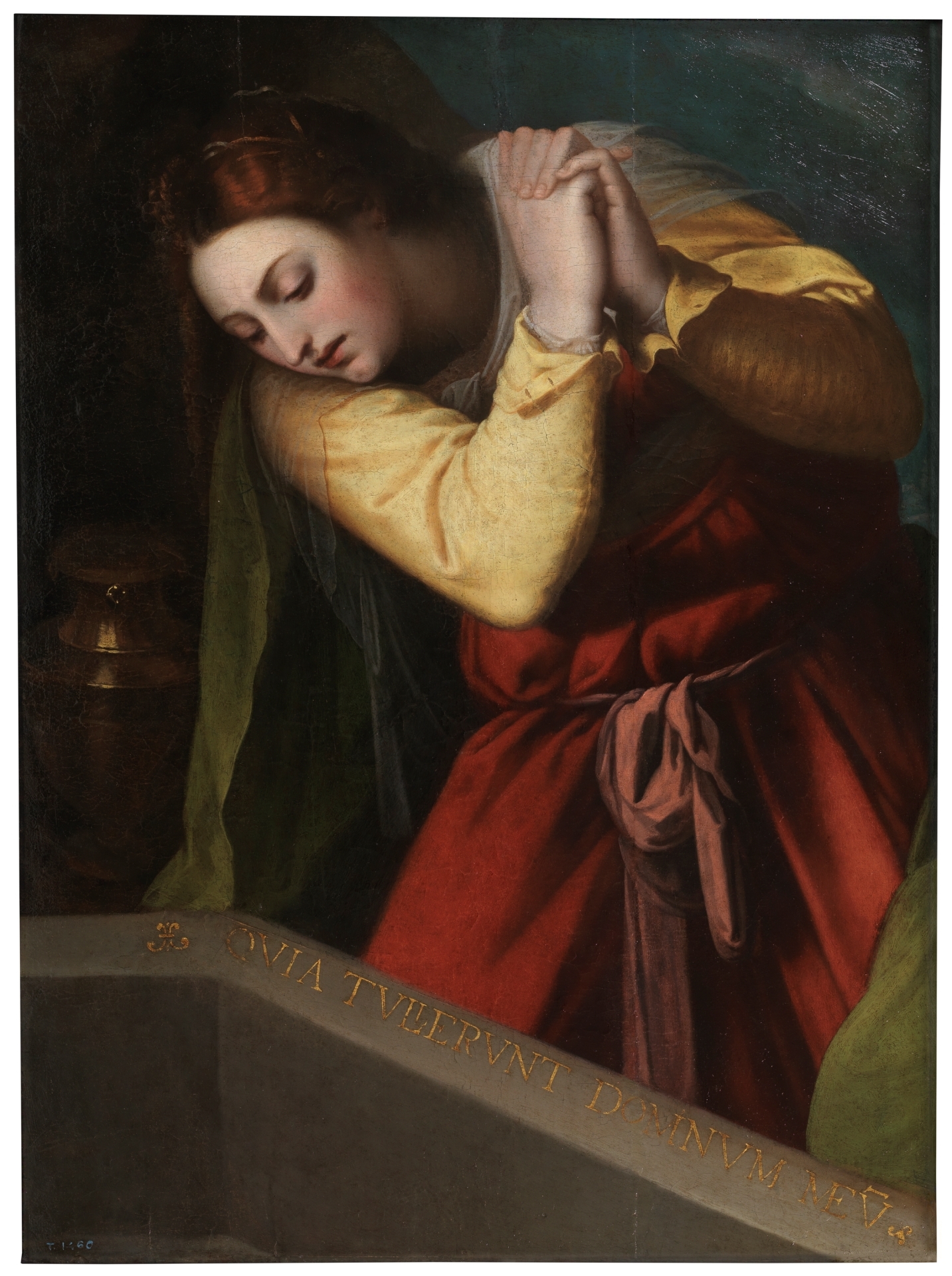
F. de Ribalta, Mary Magdalene before Christ´s Tomb (1612), oil on canvas, Museo Nacional del Prado (Madrid)

According to the gospel this morning Mary Magdalen is the first to discovers that the tomb is empty. She is missing Jesus. She really wants to see again her Master whom she had faithfully followed to the end. Who will she follow now? So, she cries: «They have taken the Lord from the tomb, and we do not know where they have put him» . We do not know where they have put him. These words of Mary Magdalen express so well our feelings in our time: What have we done with Jesus? Who has taken him?  Where have we put him? The Lord in whom we believe… is He a Christ full of life, or a Christ whose memory is disappearing from hearts?

Today is more urgent than ever to seek Jesus And, you know, we cannot look for more «evidence» to believe more firmly. We cannot rely only into the Magisterium of the Church to find answers. It is useless to look only into the lectures of scholars, or Bible experts. To meet the Risen Lord, it is necessary to have a daily up close and personal communication with Him. This morning, we only hear the first part of the narrative of resurrection, I invite you to read the second part, because there you will see how Mary Magdalen is from one place to another looking for her Master.  That is what we should do: That’s what we should do: Search without rest. Maybe it happens that we do not see Him, or we do not recognize Him, but we can be sure that he will be shown. At some point Mary thinks he is the landscape gardener. And then Jesus asks two questions. Only two. «Woman, why are you crying? Who are you looking for? ».

Well, today is the right time to ask ourselves same questions: What is it that I am looking for so anxiously? Where is the origin of my sadness? What does my heart really want? Mary Magdalene does not recognize Jesus. She is very focused on her own pain, on her own problems.  It is then that Jesus calls her by name, He does it with tenderness and affection, «Mary! », he says, and she responded quickly: «Rabbuni, Teacher».  Mary Magdalen recognizes Jesus when she feels personally called by him.

This is the point! Two thousand years later, the Lord continues doing exactly the same:  calling each of us personally. Calling us by name. He did it at the day of our Baptism.  He does it at the Sacrament of Confession. And he keeps calling us by name at Holy Communion.

It is easter Sunday.  Today we have a wonderful opportunity to renew our faith; to revive our commitment; to restore our covenant of love with Him. Today is a great chance to tell the Lord that despite our fatigue, boredom, our sins… we want to keep walking; we want to keep trying; we want to do our best to be with Him. So, today let us ask the Lord for one gift. Only one: A brave, passionate heart like the one of Mary Magdalen.  She searched and searched for Jesus, until she found him, and then she announced him to the others. That is the model of the Christian:  a man, a woman, who constantly seeks Christ, and when he or she finds Him, he speaks of Him to others. We are invited to do the same. We have already found the Lord here, in the celebration of the Eucharist, in listening to His Word.  What else should we do? We must continue to seek him in ordinary life; in the tasks of each day; in the stuff what we usually do, and for this we need a passionate, burning heart, and clear eyes.  So, let us ask for this exactly:  May ay the Lord Jesus give us a heart on fire, full of determination, full of love, so like Mary Magdalen, we can recognize Him every day of our lives and in all situations:  in joy, in pain, in sadness, in success, in family life. In everything and always. And let us not forget the other Mary.  The Mother of the Lord. Mary was the only light that remained lit in the Passion. That is why we call her: «Our Life, our sweetness and our hope». May she also intercede for us today. Happy Easter to each and every one •


Secuencia (Victimae paschali laudes)
Ofrezcan los cristianos
ofrendas de alabanza
a gloria de la Víctima
propicia de la Pascua.

Cordero sin pecado
que a las ovejas salva,
a Dios y a los culpables
unió con nueva alianza.

Lucharon vida y muerte
en singular batalla
y, muerto el que es la Vida,
triunfante se levanta.

¿Qué has visto de camino,
María, en la mañana?
A mi Señor glorioso,
la tumba abandonada,
los ángeles testigos,
sudarios y mortaja.

¡Resucitó de veras
mi amor y mi esperanza!

Venid a Galilea,
allí el Señor aguarda;
allí veréis los suyos
la gloria de la Pascua.

Primicia de los muertos,
sabemos por tu gracia
que estás resucitado;
la muerte en ti no manda.

Rey vencedor, apiádate
de la miseria humana
y da a tus fieles parte
en tu victoria santa.


Domingo de Pascua de la Resurrección del Señor (2024)
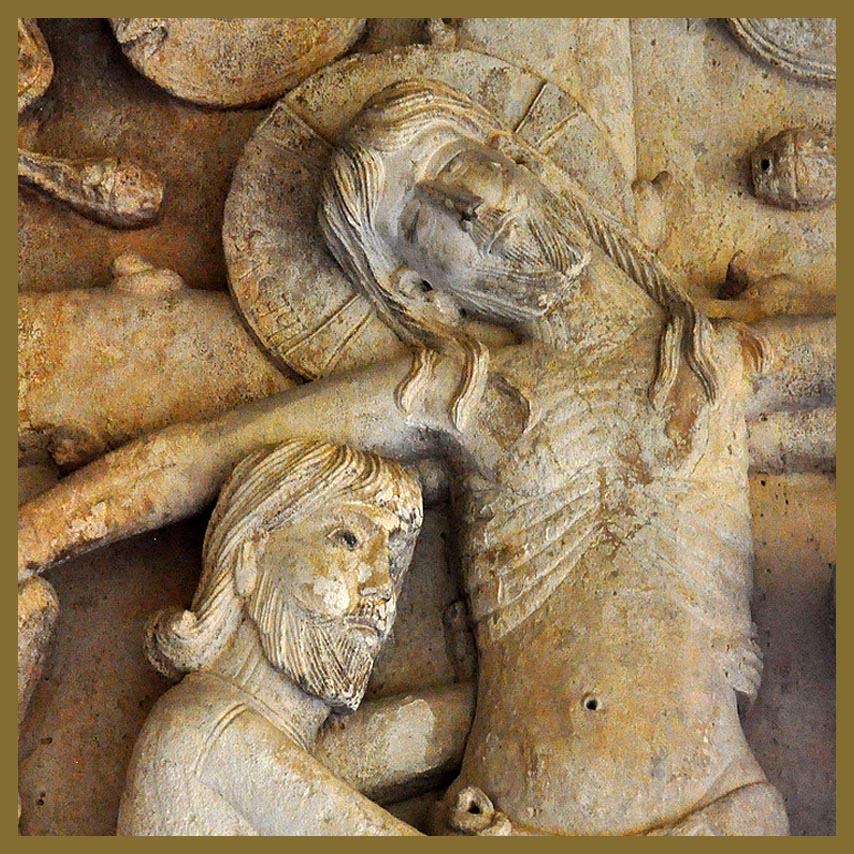
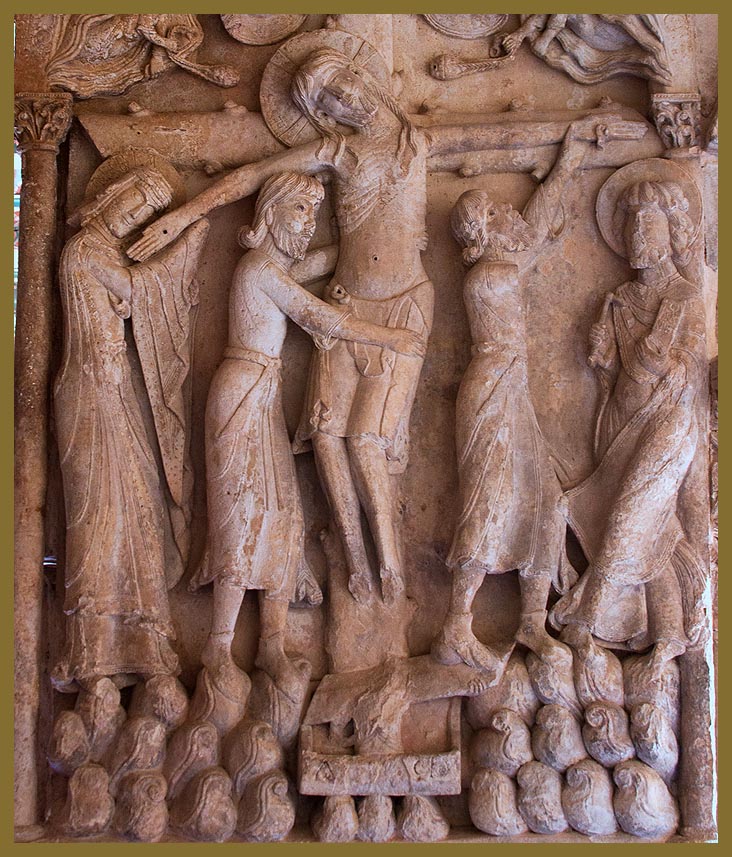
Artista anónimo, Descendimiento de la Cruz (s. XI) Monasterio de Santo Domingo de Silos (Burgos)

«Ustedes lo mataron, pero Dios lo resucitó». Esto es lo que predican con fe los discípulos de Jesús por las calles de Jerusalén a los pocos días de la muerte del Señor. Para ellos, la resurrección es la respuesta de Dios a la acción injusta y criminal de quienes han querido callar para siempre su voz y anular de raíz su proyecto de un mundo más justo. No lo hemos de olvidar jamás. En el corazón de nuestra fe hay un crucificado al que Dios le ha dado la razón. En el centro mismo de la Iglesia hay una víctima a la que Dios ha hecho justicia. Por tanto, una vida crucificada, pero motivada y vivida con el espíritu de Jesús, no terminará en fracaso sino en resurrección.

Esto cambia totalmente el sentido de nuestros esfuerzos, penas, trabajos y sufrimientos por un mundo más humano y una vida más dichosa para todos. Vivir pensando en los que sufren, estar cerca de los más desvalidos, echar una mano a los indefensos.., seguir los pasos de Jesús no es algo absurdo. Es caminar hacia el Misterio de un Dios que resucitará para siempre nuestras vidas.

Los pequeños abusos que podamos padecer, las injusticias, rechazos o incomprensiones que podamos sufrir, son heridas que un día cicatrizarán para siempre. Hemos de aprender a mirar con más fe las cicatrices del resucitado. Así serán un día nuestras heridas de hoy. Cicatrices curadas por Dios para siempre. Esta fe nos sostiene por dentro y nos hace más fuertes para seguir corriendo riesgos. Poco a poco hemos de ir aprendiendo a no quejamos tanto, a no vivir siempre lamentándonos del mal que hay en el mundo y en la Iglesia, a no sentirnos siempre víctimas de los demás. ¿Por qué no podemos vivir como Jesús diciendo: «Nadie me quita la vida, sino que soy yo quien la doy»? Seguir a Jesús crucificado hasta compartir con él la resurrección es, en definitiva, aprender a dar la vida, el tiempo, nuestras fuerzas y tal vez nuestra salud por amor. No nos faltarán heridas, cansancio y fatigas. Una esperanza nos sostiene: Un día Dios enjugará las lágrimas de nuestros ojos, y no habrá ya muerte ni habrá llanto, ni gritos ni fatigas porque todo este mundo viejo habrá pasado •

Exultate, Jubiulate (W.A. Mozart)

Exultate, jubílate (K 165/158ª) es un motete religioso de Wolfgang Amadeus Mozart escrito en 1773. Fue compuesto durante la visita del compositor austríaco a Milán, en la época en la que viajó a Italia y fue escrito para el castrato Venanzio Rauzzini, el favorito de Mozart para sus óperas. En las representaciones modernas, es interpretado normalmente por una soprano. Está dividido en tres partes: Allegro, Andante Allegro; el allegro final es un destacado y alegre Alleluia •
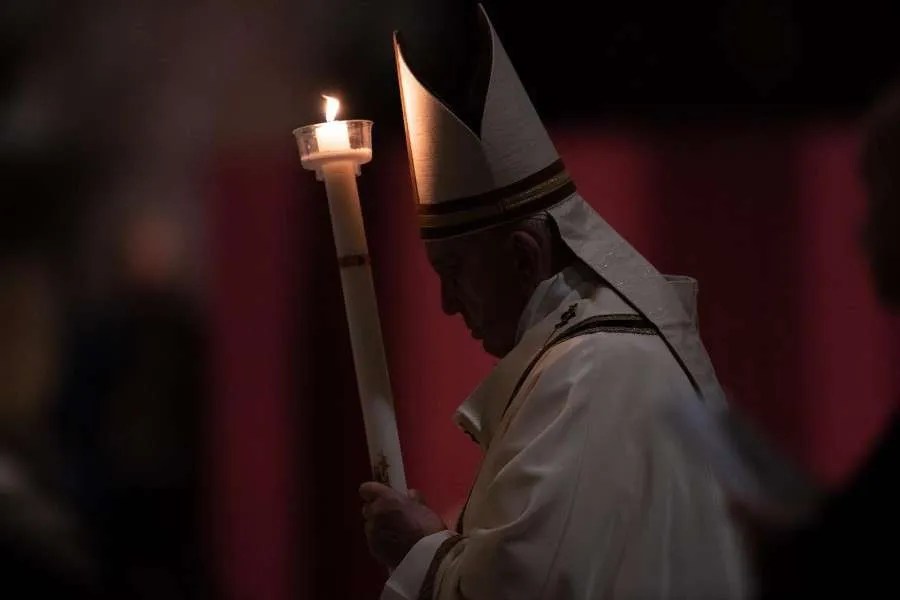

Easter Vigil in the Holy Night of Easter (2024)

Exult, let them exult, the hosts of heaven,
exult, let Angel ministers of God exult,
let the trumpet of salvation
sound aloud our mighty King’s triumph!

Be glad, let earth be glad, as glory floods her,
ablaze with light from her eternal King,
let all corners of the earth be glad,
knowing an end to gloom and darkness.

Rejoice, let Mother Church also rejoice,
arrayed with the lightning of his glory,
let this holy building shake with joy,
filled with the mighty voices of the peoples.

(Therefore, dearest friends,
standing in the awesome glory of this holy light,
invoke with me, I ask you,
the mercy of God almighty,
that he, who has been pleased to number me,
though unworthy, among the Levites,
may pour into me his light unshadowed,
that I may sing this candle’s perfect praises.)

(V. The Lord be with you.
R. And with your spirit.)
V. Lift up your hearts.
R. We lift them up to the Lord.
V. Let us give thanks to the Lord our God.
R. It is right and just.

It is truly right and just, with ardent love of mind and heart
and with devoted service of our voice,
to acclaim our God invisible, the almighty Father,
and Jesus Christ, our Lord, his Son, his Only Begotten.

Who for our sake paid Adam’s debt to the eternal Father,
and, pouring out his own dear Blood,
wiped clean the record of our ancient sinfulness.

These, then, are the feasts of Passover,
in which is slain the Lamb, the one true Lamb,
whose Blood anoints the doorposts of believers.

This is the night,
when once you led our forebears, Israel’s children,
from slavery in Egypt
and made them pass dry-shod through the Red Sea.

This is the night
that with a pillar of fire
banished the darkness of sin.

This is the night
that even now, throughout the world,
sets Christian believers apart from worldly vices
and from the gloom of sin,
leading them to grace
and joining them to his holy ones.

This is the night,
when Christ broke the prison-bars of death
and rose victorious from the underworld.

Our birth would have been no gain,
had we not been redeemed.

O wonder of your humble care for us!
O love, O charity beyond all telling,
to ransom a slave you gave away your Son!
O truly necessary sin of Adam,
destroyed completely by the Death of Christ!
O happy fault
that earned so great, so glorious a Redeemer!

O truly blessed night,
worthy alone to know the time and hour
when Christ rose from the underworld!

This is the night
of which it is written:
The night shall be as bright as day,
dazzling is the night for me,
and full of gladness.

The sanctifying power of this night
dispels wickedness, washes faults away,
restores innocence to the fallen, and joy to mourners,
drives out hatred, fosters concord, and brings down the mighty.  
On this, your night of grace, O holy Father,
accept this candle, a solemn offering,
the work of bees and of your servants’ hands,
an evening sacrifice of praise,
this gift from your most holy Church.

But now we know the praises of this pillar,
which glowing fire ignites for God’s honor,
a fire into many flames divided,
yet never dimmed by sharing of its light,
for it is fed by melting wax,
drawn out by mother bees
to build a torch so precious.

O truly blessed night,
when things of heaven are wed to those of earth,
and divine to the human.

Therefore, O Lord,
we pray you that this candle,
hallowed to the honor of your name,
may persevere undimmed,
to overcome the darkness of this night.

Receive it as a pleasing fragrance,
and let it mingle with the lights of heaven.

May this flame be found still burning
by the Morning Star:
the one Morning Star who never sets,
Christ your Son,
who, coming back from death’s domain,
has shed his peaceful light on humanity,
and lives and reigns for ever and ever.

R. Amen.


Easter Sunday 2024

The Resurrection of the Lord

Anonymous artist, Greek Icon with Myrrhbearers Women (XVIII century). particular collection.

The main protagonists of tonight are… women!  Brave woman. Wonderful woman. Of course, that Jesus is the main Protagonist, the real hero of everything and always. The central character of the whole story. But today the gospel tells us something else. The gospel narrative tonight it is simply fascinating.  We just heard about three ladies: Mary Magdalene, Mary, the mother of James, and Salome[1]. Theology has called them the Myrrh carriers[2], those that get the myrrh,   myrrh is the ointment to embalm the dead body of the Lord Jesus…

These women we could say are crazy … yes, crazy. Totally crazy. But crazy with love, crazy with passion, crazy with courage. These three women are doing something that no one had arranged: the embalming of the body of the Lord. Those were their initial thoughts, but the angel changes what was planned: “You seek Jesus of Nazareth, the crucified. He has been raised; he is not here», he says.  And the moral is very simple: It is a mistake to look for Him in the world of the dead. Jesus is not just another deceased. It is not necessary to mourn and cry, in fact, it is a waste of time. He is risen. He is alive forever!  And this is exactly what we are celebrating tonight, This is why we are gathered together tonight, doing the same thing that Christians have done for over two thousand years on Easter night.

We can celebrate with joy because the tomb is empty; because death was not more powerful, and because we can expect exactly the same. Yes: in the same way that He resurrected, so, we are going to resurrect each one of us, but for that there is still a long way.

Jesus is not in the tomb, so…. where can he be seen?  Where can we meet him? Again, that angel gives us a clue: “He is going before you to Galilee; there you will see him, as he told you»[3].Jesus cannot be seen without making a journey. We all must do a journey; Actually, we are all doing that trip right now; Our Christian life is that journey. All of us must go to Galilee! For what exactly? To see the Lord, as the gospel says [4], to experience the presence, company and friendship of Jesus.

Tonight, is the perfect time to renew our faith, to return to our commitment of love to Him; to resolve that we must keep walking, trying, doing our best. When we stop, when we give up, when we stop asking questions, … that’s when our faith starts to grow cold and die, and then the Resurrection is just a sublime doctrine, a sacred dogma… but nothing else! So, let us ask Jesus tonight to give us a gift. Only one. That same courage, passion and determination of those three women who were looking for him on the morning of the resurrection. Mary Magdalene, Mary, the mother of James, and Salome.  They went to the tomb to anoint the body Jesus, and they ended up being anointed by the Resurrection. If we are open, the same thing could happen to us: that we go on the road looking for Jesus and suddenly we realize that, before, he was looking for us, anxious to fill our hearts, our life, our families, our projects… our everything with his love, his joy and his peace

[1] Cf. Mark 16:1-7 [2] In Orthodox Christian tradition the Myrrh bearers (Greek: Μυροφόροι, Latin: Myrophorae;) are the individuals who were directly involved in the burial or who discovered the empty tomb following the resurrection of Jesus. The term traditionally refers to the women with myrrh who came to the tomb of Christ early in the morning to find it empty. In Western Christianity, the two women at the tomb, the Three Marys or other variants are the terms normally used. Also included are Joseph of Arimathea and Nicodemus, who took the body of Jesus down from the cross, embalmed it with myrrh and aloes, wrapped it in clean linen, and placed it in a new tomb. (Matthew 27:55–61, Matthew 28:1–10, Mark 15:40–16:11, Luke 23:50–24:10, John 19:38–20:18). [3] Cf. Mark 16:1-7 [4] Ídem.


This is one of four Marian antiphons, with following versicles and prayers, traditionally said or sung after night prayer, immediately before going to sleep. It is said throughout Eastertide. (That is, from Easter Day through Pentecost, the seventh Sunday after Easter. The Regina caeli is also said in place of the Angelus during Eastertide.

Queen of Heaven

V. Queen of Heaven, rejoice, alleluia. 
R. For He whom you did merit to bear, alleluia. 
V. Has risen, as he said, alleluia. 
R. Pray for us to God, alleluia.
V. Rejoice and be glad, O Virgin Mary, alleluia. 
R. For the Lord has truly risen, alleluia.

Let us pray. O God, who gave joy to the world through the resurrection of Thy Son, our Lord Jesus Christ, grant we beseech Thee, that through the intercession of the Virgin Mary, His Mother, we may obtain the joys of everlasting life. Through the same Christ our Lord. Amen.

Regina caeli

V. Regina caeli, laetare, alleluia. 
R. Quia quem meruisti portare, alleluia. 
V. Resurrexit, sicut dixit, alleluia. 
R. Ora pro nobis Deum, alleluia.

V. Gaude et laetare, Virgo Maria, alleluia. 
R. Quia surrexit Dominus vere, alleluia.

Oremus. Deus, qui per resurrectionem Filii tui, Domini nostri Iesu Christi, mundum laetificare dignatus es: praesta, quaesumus; ut per eius Genetricem Virginem Mariam, perpetuae capiamus gaudia vitae. Per eundem Christum Dominum nostrum. Amen.


Sábado Santo de la Pasión del Señor (2024)

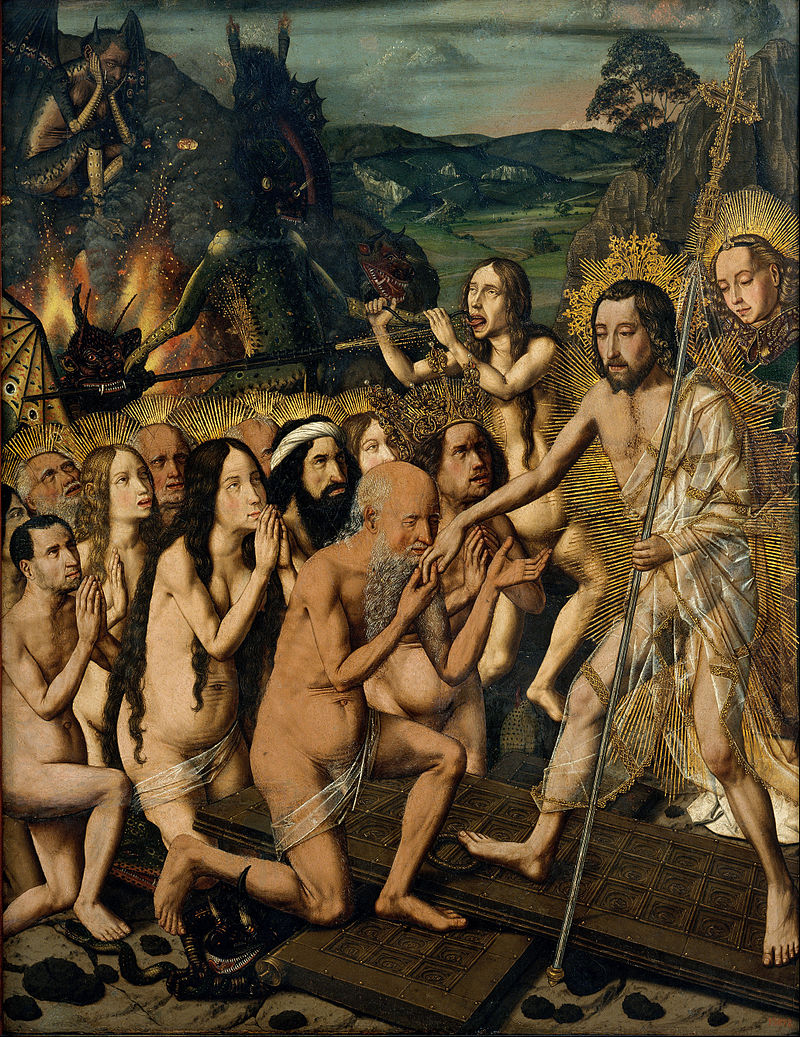
B. Bermejo, Descenso de Cristo a los infiernos (1474), óleo sobre tabla, Museo Nacional de Arte de Cataluña (España)

Qué es lo que hoy sucede? Un gran silencio envuelve la tierra; un gran silencio porque el Rey duerme. «La tierra temió sobrecogida» porque Dios se durmió en la carne y ha despertado a los que dormían desde antiguo. Dios en la carne ha muerto y el Abismo ha despertado.

Va a buscar a nuestro primer padre como si fuera la oveja perdida. Quiere absolutamente visitar «a los que viven en tinieblas y en sombra de muerte». El, que es al mismo tiempo Hijo de Dios, hijo de Eva, va a librar de su prisión y de sus dolores a Adán y a Eva. El Señor, teniendo en sus manos las armas vencedoras de la cruz, se acerca a ellos. Al verlo nuestro primer padre Adán, asombrado por tan gran acontecimiento, exclama y dice a todos: Mi Señor esté con todos. Y Cristo, respondiendo, dice a Adán: Y con tu espíritu. Y tomándolo por la mano le añade: «Despierta tú que duermes, levántate de entre los muertos y Cristo será tu luz».

Yo soy tu Dios que por ti y por todos los que han de nacer de ti me he hecho tu hijo; y ahora te digo: tengo el poder de anunciar a los que están encadenados: Salid; y a los que se encuentran en las tinieblas: iluminaos; y a los que dormís: levantaos.

A ti te mando: «despierta tú que duermes», pues no te creé para que permanezcas cautivo en el Abismo; «levántate de entre los muertos», pues yo soy la vida de los muertos. Levántate, obra de mis manos; levántate, imagen mía, creado a mi semejanza. Levántate, salgamos de aquí porque tú en mí, y yo en ti, formamos una sola e indivisible persona.

Por ti yo, tu Dios, me he hecho tu hijo; por ti yo, tu Señor, he revestido tu condición servil; por ti yo, que estoy sobre los cielos, he venido a la tierra y he bajado al Abismo; por ti me he hecho hombre, «semejante a un inválido que tiene su cama entre los muertos»; por ti que fuiste expulsado del huerto he sido entregado a los judíos en el huerto, y en el huerto he sido crucificado. Contempla los salivazos de mi cara que he soportado para devolverte tu primer aliento de vida; contempla los golpes de mis mejillas que he soportado para reformar de acuerdo con mi imagen tu imagen deformada.

Contempla los azotes en mis espaldas que he aceptado para aliviarte del peso de los pecados que habían sido cargados sobre tu espalda. Contempla los clavos que me han sujetado fuertemente al madero; por ti los he aceptado, que maliciosamente extendiste una mano al árbol.

Dormí en la cruz y la lanza atravesó mi costado por ti, que en el paraíso dormiste y de tu costado diste origen a Eva. Mi costado ha curado el dolor del costado. Mi sueño te saca del sueño del Abismo. Mi lanza eliminó aquella espada que te amenazaba en el paraíso.

Levántate, salgamos de aquí. El enemigo te sacó del paraíso; yo te coloco no ya en el paraíso, sino en el trono celeste. Te prohibí que comieras del árbol de la vida, que no era sino imagen del verdadero árbol; yo soy el verdadero árbol, yo que soy la vida y que estoy unido a ti. Coloqué un querubín que fielmente te vigilará; ahora te concedo que el querubín, reconociendo tu dignidad, te sirva. El trono de los querubines está preparado, los portadores atentos y preparados, el tálamo construido, los alimentos prestos, se han embellecido los eternos tabernáculos y las moradas, los tesoros abiertos y el reino de los cielos que existe antes de los siglos está preparado.» • De una homilía antigua sobre el grande y santo Sábado (PG 43, 439. 451. 462-463)


Good Friday of the Lord’s Passion (2024)

A. Mantegna, The Crucifixion (1458), Tempera on panel, The Louvre Museum (Paris)

The best we can do after the proclamation of the Passion of the Lord is to be quiet for a moment… Is there something else to say in the presence such an event with so much pain and physical and moral suffering? Probably not. The Passion of the Lord is the revelation [1] of the love that God has for all humanity and for each one of us and sooner or later we have to respond to that revelation, that’s why we need to be quiet. As Cardinal Sarah says: « If we want to grow and to be filled with the love of God, it is necessary to plant our life firmly on three great realities: the Cross, the Host, and the Virgin: crux, hostia, et virgo… These are three mysteries that God gave to the world in order to structure, fructify, and sanctify our interior life and to lead us to Jesus. These three mysteries are to be contemplated in silence» [2]. That’s why the Church is constantly inviting us to slow down and to take some time to ask ourselves… some good questions: What is God trying to tell me through the Passion of his Son? At this moment in my life, how am I embracing my cross? Gladly? with enthusiasm? Bitterly? If we contemplate the Passion of Jesus from a distance, and we are not really engaged, it is the same as leaving Jesus on the cross and washing our hands, as Pilate did [3].  Or something even worse: It could be that we have the same frivolous attitude of the soldiers who stood at the foot of the cross, watching over the executed. The gospel says that «When the soldiers had crucified Jesus,  (…) They also took his tunic from him, but the tunic was one-piece (…) So, they said to one another, «Let’s not tear it, but let us cast lots for it to see whose it will be» [4].Christ is right there: hanging on the cross, bleeding to death, moaning in pain …dying!…  And they are there … casting lots! Casting lots!  They were killing time…. Bored and yawning… Totally oblivious, insensible to what is happening there, over his head. Well, the same could happen to us,  that in the middle of the celebration of the holy sacrifice of the altar at Sunday mass we are boring, full of tedious,  looking at the clock because «this is going too slow» wanting to get out as soon as possible …This afternoon, with this eloquent and beautiful liturgy of Good Friday of the Passion of the Lord we have a great chance to remember how important it is to pay attention; how important it is our intention to be present in body, soul, spirit  and to receive with gratitude the grace of the Lord. How important is to be on time, wearing our best outfit, participating on the prayers with our best voice, our best postures, our best gestures… our best everything. This is how we can begin to recover a little that sense of reverence that we have been losing and that is so important for the celebration of the mysteries of our faith…

It’s Good Friday. the Liturgy of the Word and the tradition of the Church remind us in a liturgical way that the Lord has paid the price of our redemption, that we have salvation at hand. Jesus has climbed the Tree of the Cross out of love for each one of us. And this is not just a pretty phrase, but a reality, And the best way to respond and give thanks is by participating in this and all liturgical our celebrations, or whatever is related with our faith, with love, devotion, and attention. This is the point. The soldiers who are at the foot of the cross casting lots are a reminder that, in front of the most sacred, we can be distracted. But we also have the example of the Virgin Mary who, full of pain, remained faithful and loyal to everything that was happening there.

At the cross her station keeping,

Stood the mournful Mother weeping,

Close to Jesus to the last

The Stabat Mater sings, so let us ask the Lord this afternoon for the gift, huge gift, of recovering the sense of the Sacred, the gift of not being indifferent in His presence, the gift of celebrating the mysteries of our faith with devotion, with attention … with love. And today in particular, Good Friday of the Passion of the Lord, let us ask ourselves: What is God trying to tell me through the celebration of the Passion of his Son? At this moment in my life, how am I embracing the cross? gladly? with enthusiasm? bitterly? With hearts full of gratitude let us remember that by his passion, death and resurrection our wounds have been healed, our sins has been forgiven, our mistakes has been fixed, and a new opportunity has been given to us [5].

So, how can I repay the LORD for all the great good done for me?  The Psalm says, I will raise the cup of salvation and call on the name of the LORD [6]. Today we are invited to lift our hearts in thanksgiving, in silence, in reverence, in devotion and in love. It is Good Friday!

Heaven that you have promised me, my God,

Does not move me to love you.

Nor does hell so dreadful move me

To leave all that offends you.

You move me, Lord. It moves me to see you

Mocked, nailed to that cross.

It moves me to see your body so wounded.

Your dishonour moves me, and your death.

You move me to your love in such a way

That —even if there were no heaven— I would love you;

And —even if there were no hell— I would fear you.

You do not have to give to gain my love;

For —even if what I hope for becomes hopeless—

In the same way I love you, I would love you still [7]

[1] Cf. Mark 14-15, Matthew 26-27, Luke 22-23, and John 18-19. [2] Robert Cardinal Sarah, The Power of Silence: Against the Dictatorship of Noise. [3] Cf. Matthew 27:24 [4] Cf Jn 18:1—19:42 [5] Cf. 1 Peter 2:24; Isaiah 53:5 [6] Cf 116: 12-13 [7] English translation of the anonymous Spanish poem Soneto a Cristo crucificado (“No me mueve mi Dios, para quererte”), by Stacy Shoop (1996).


El Diario de María


Los Improperios del Viernes Santo

Gaspar de Figueroa, Ecce Homo (c. 1658), óleo sobre tela, Iglesia de Santa Bárbara, Bogotá (Colombia)

Los Improperios, en latín Improperia, son los versículos que se cantan en el oficio de la tarde del Viernes Santo en la liturgia católica durante la ceremonia llamada Adoración de la Cruz. La palabra latina improperium significa «reproche».​ Los Improperios son, de hecho, los reproches de Cristo a su pueblo que lo ha rechazado. Puesto que a cambio de todos los favores concedidas por Dios, y en particular de haberlo librado de la servidumbre en Egipto y haberlo conducido sano y salvo a la Tierra Prometida, le ha infligido las ignominias de la Pasión. Es durante La Adoración de la cruz, después de las diecisiete oraciones, que estos improperios se decían por el coro en el rito romano. A cada favor de Dios en el libro del Éxodo se oponía un episodio de la Pasión de Cristo. El coro repetía como estribillo la aclamación griega Hagios o Theós (Ἅγιος ὁ Θεός), de forma más precisa alternando el griego y el latín, en doble coro. Esta versión es compuesta por Giovanni Pierluigi da Palestrina hacia 1580 •


Viernes Santo de la Pasión del Señor (2024)

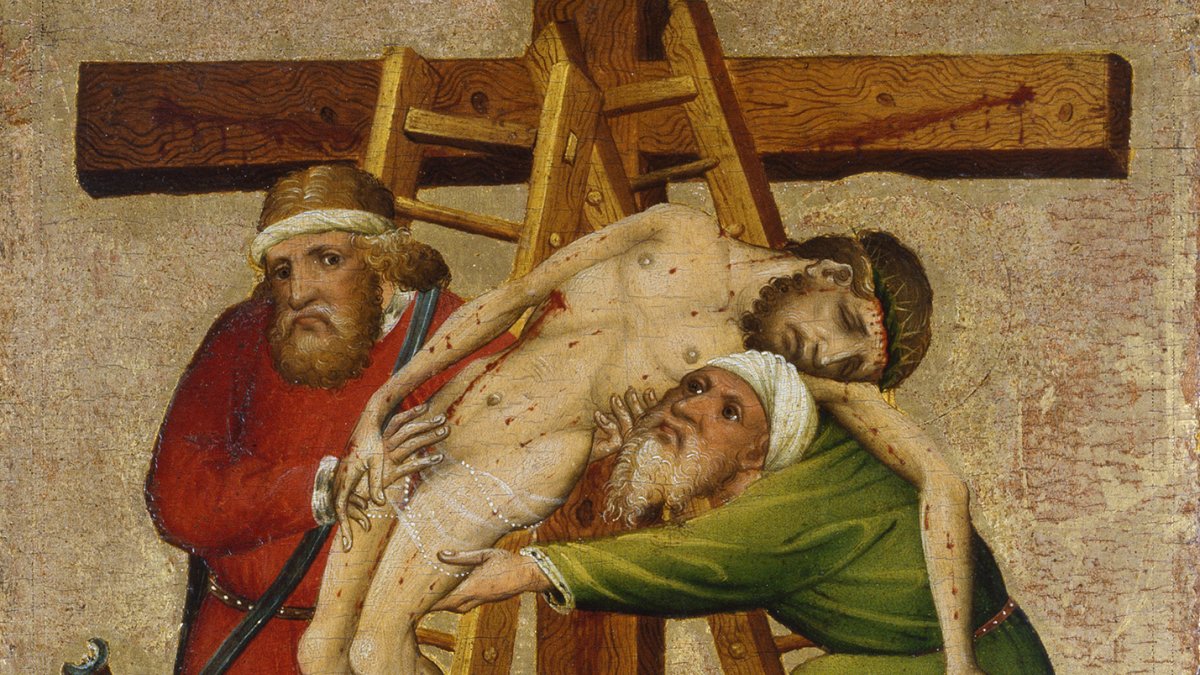
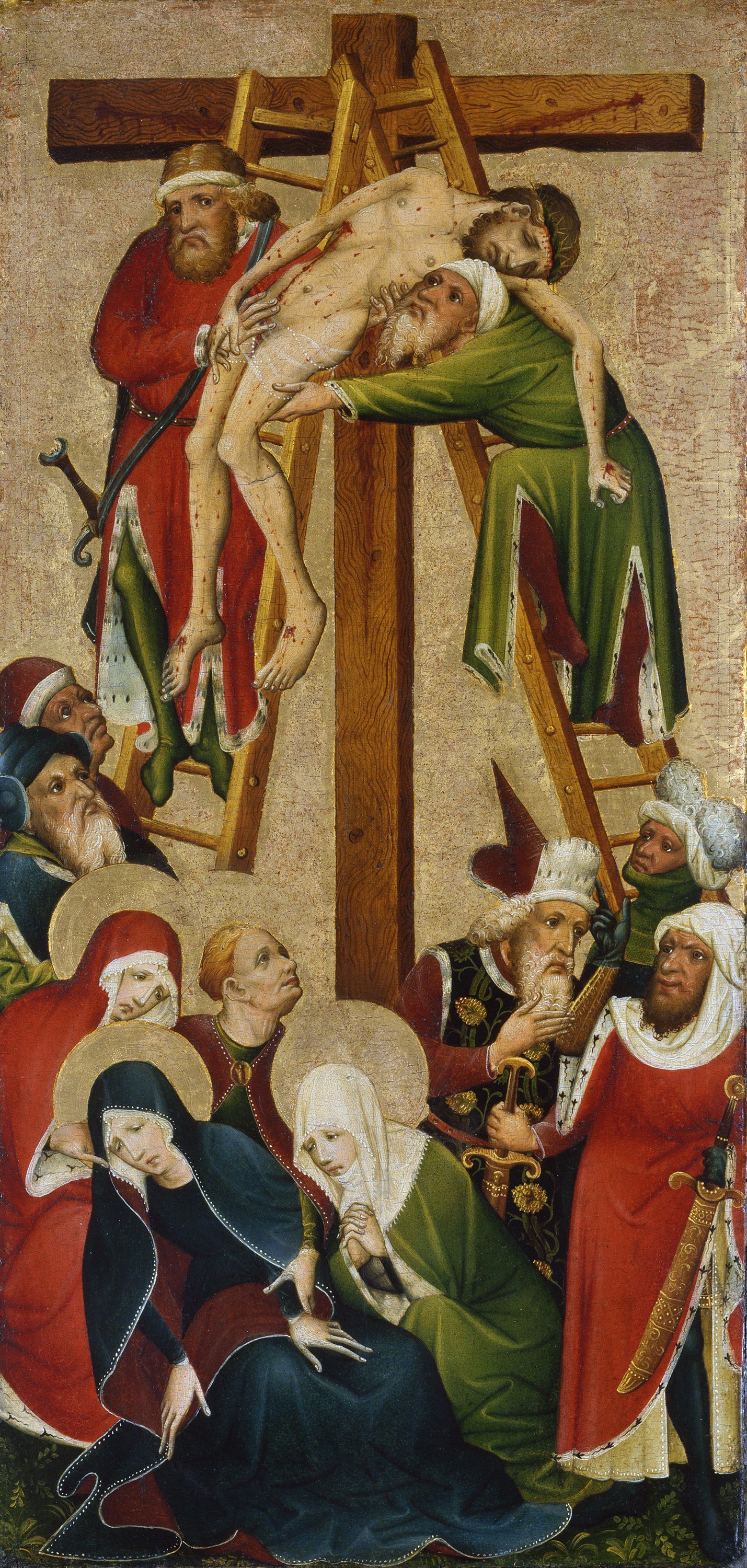
Anónimo alemán, El Descendimiento de la cruz (hacia 1420), Óleo sobre tabla, Museo Nacional Thyssen-Bornemisza (Madrid)

La muerte del Señor en la Cruz no fue algo casual, fruto de un malentendido de las  autoridades religiosas y políticas de Israel. Tampoco podemos considerar la cruz como algo permitido por Dios por motivos enigmáticos pero que luego se resolvió con el triunfo glorioso de la resurrección. La resurrección no elimina el escándalo de la cruz, sino que lo eleva a misterio, Porque, aún después de la resurrección, nos tenemos que preguntar: ¿por qué y  para qué la cruz? ¿qué hace Dios en una cruz?

Un Dios crucificado constituye una auténtica revolución y nos obliga a cuestionar todas  nuestras imágenes humanas de Dios. La cruz rompe todos nuestros esquemas sobre un  Dios al que suponemos conocer ya de antemano. El crucificado no tiene el rostro que nosotros atribuimos a la divinidad. En la cruz no hay  belleza, poder, fuerza, sabiduría, majestad.

Dios no aparece como el que tiene poder sobre la muerte, sino como alguien que se ve  sumergido dentro de ella. Con la cruz, o se termina toda nuestra fe en Dios o se abre a una comprensión nueva y  sorprendente de un Dios que nos ama de manera insospechada. Contra todas nuestras concepciones sobre la divinidad, en la cruz descubrimos  sorprendidos que Dios es alguien que sufre con nuestros sufrimientos. Nuestra miseria le  afecta. Nuestro sufrimiento le «salpica». Dios no puede amarnos sin sufrir. Como ha dicho D.  Bonhoeffer, «sólo un Dios que sufre puede salvarnos».

A este Dios crucificado no lo podemos entender desde categorías filosóficas. Es un  escándalo y una necedad. A este Dios crucificado sólo se le entiende cuando sabemos  amar a los que sufren y descubrimos por propia experiencia que el amor verdadero a los  crucificados hace sufrir. Este Dios crucificado no permite una fe ingenua y egoísta en cualquier Dios poderoso  puesto al servicio de nuestros propios intereses. Este Dios nos pone mirando hacia el  sufrimiento, el abandono y los gritos de los demás. A este Dios nos  acercamos, cuando sabemos acercarnos al sufrimiento de cualquier abandonado. Los cristianos seguimos dando muchos rodeos para no encontrarnos con el Dios  crucificado. Esta preciosa liturgia del Viernes Santo podría pues recordarnos que la originalidad del cristiano, como decía Bonhoeffer, está en  permanecer con Dios en la pasión de los que sufren, Sin esto, no hay fe  en el Dios verdadero sino manipulación •


Were You There


Holy Thursday – Evening Mass of the Lord’s Supper (2024)

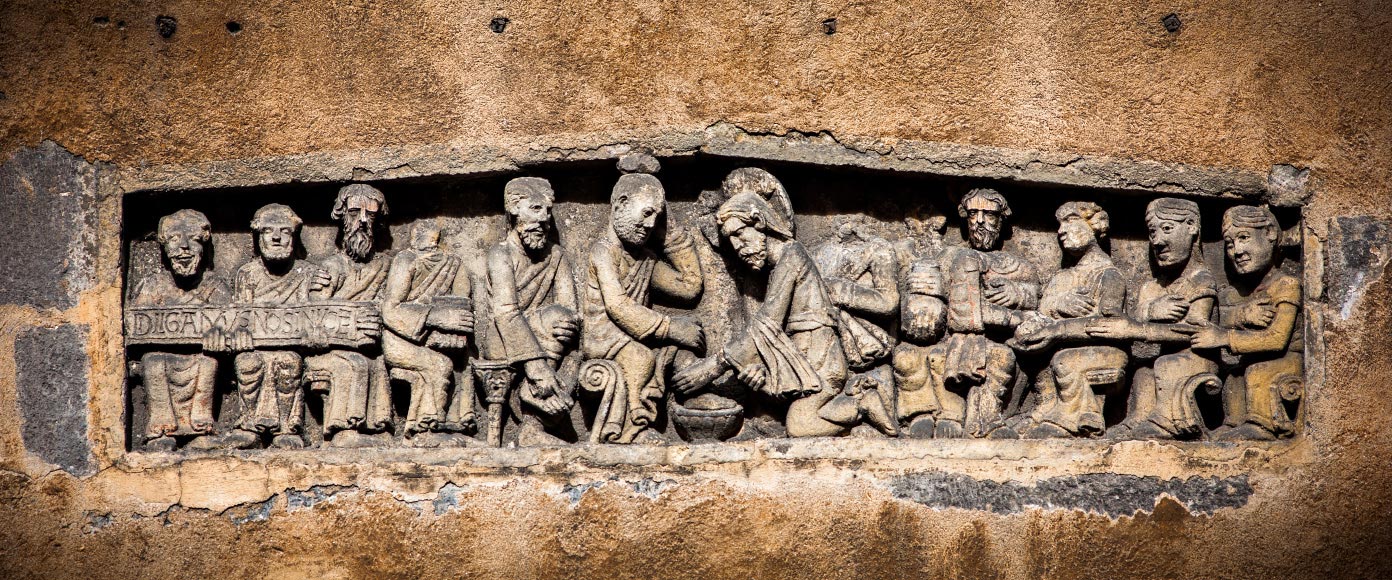
Anonymous artis, Lintel of the Washing of the Apostles’ Feet by Christ, Parochial church at Puy-de-Dôme (France)

Today we celebrate the redemptive presence of the Lord in the Blessed Sacrament. Jesus’ Eucharistic presence is the renewal of His presence in the Upper Room and on the cross, offering Himself for us. Do this in memory of me, he said. This evening we begin a three day remembrance of all that Jesus Christ did for us. The Mass, the cross, the empty tomb.

The Blood of the Covenant. We have been talking a bit on the concept of covenant. We heard about the covenant the Lord made with Noah, the covenant of the rainbow, the covenant that reminds us that God will never give up on his people. We heard about the covenant God made with Abraham, the covenant of faith, and we were reminded that if we put our faith in God he will care for us even if our lives are full of turmoil. We heard about the covenant made with Moses, the covenant of the ten commandments. The Covenant of Sinai was a call to holiness, a call to be separate from a world that looks towards satisfying itself instead of living for God and for others. It was called the holiness code because to be holy means to be set aside for the Lord. Moses then took the blood of sacrificed lambs and sprinkled it on the people, and said, «See this is the blood of the covenant that the LORD has made with you in accordance with all these words.» This was the first blood of the covenant. Two weeks ago we heard about another covenant. This was the prophesy of Jeremiah, the prophecy that there would be a new covenant which would be written in the hearts of the people. This evening, we celebrate the blood of the new covenant. When we celebrate the Eucharist, we celebrate the one action of Jesus dying and rising for us, sealing us with the Blood of the Covenant.

When we receive communion, we accept the new covenant written in our hearts. The Blood of the New Covenant is far deeper, infinitely more profound than any of the previous covenants. Within our hearts we celebrate the presence of Jesus Christ. We consecrate ourselves to making the presence of Christ real in the world. Each time we receive communion, we proclaim our commitment to the Blood of the New Covenant. The gift of the Eucharist necessitates the ministry of select individuals who have been called to make God present for his community. The Lord told his disciples to do this in memory of me. Bishops and priests proclaim the living memory of Jesus Christ every time they act in the person of the Lord and celebrate the Eucharist. Deacons make the Lord present in their service as well as their proclamation of the Word. Therefore, this evening’s liturgy celebrates not only the gift of the Eucharist but also gift of the sacrament of Holy Orders. These are the days of a living memory. We can never forget what Jesus did for us. As we kneel tonight before the Most Holy Sacrament, we remember. We are the people of the Blood of the New Covenant written in our hearts, keeping alive the mystery of the Lord’s presence in the world. We remember. We remember, and the Lord is present • AE


Ave Verum Corpus (Mozart)

Ave verum corpus is a short Eucharistic chant that has been set to music by many composers. It dates to the 13th century, first recorded in a central Italian Franciscan manuscript (Chicago, Newberry Library, 24). A Reichenau manuscript of the 14th century attributes it to Pope Innocent III. During the Middle Ages it was sung at the elevation of the Eucharist during the consecration at Mass. It was also used frequently during Benediction of the Blessed Sacrament. The prayer is a meditation on Jesus’s Real Presence in the Blessed Sacrament, and ties it to the redemptive meaning of suffering in the life of all believers •


Jueves Santo de la Cena del Señor (2024)

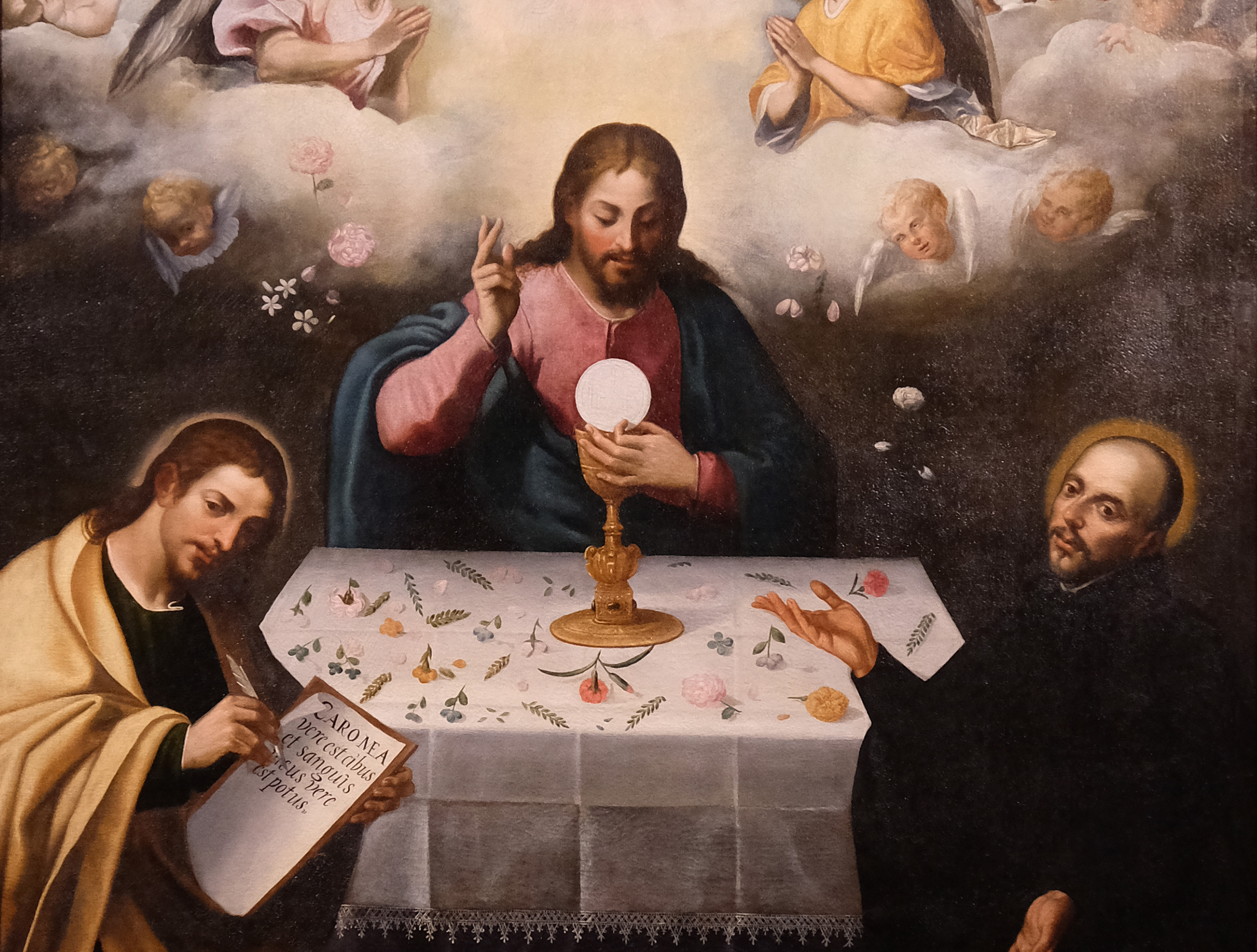
Juan del Castillo, Alegoría de la Eucaristía (1612), óleo sobre tela, Universidad de Sevilla (España)

La Misa de la Cena del Señor que celebramos en la tarde del Jueves Santo no difiere de la eucaristía de los demás días del año, pero tiene un valor ejemplar. Cada vez que la Iglesia celebra la Eucaristía y los otros sacramentos, de los que es fuente, se renueva para nosotros, hoy y por obra del Espíritu, la obra de Dios, que Cristo realizó de una vez para siempre. Lo que Jesús hizo un día es siempre actual y nuevo, aunque se repita indefinidamente. En cada celebración litúrgica, especialmente en cada eucaristía, sucede para nosotros el hic et nunc, el aquí y ahora, la salvación que Dios realiza desde el principio. Cristo está realmente presente. Actúa por medio de signos eficaces y por el poder del Espíritu. La noche del Jueves Santo marca el inicio del triduo pascual y un maravilloso vistazo a la vida del Señor: sus palabras, sus signos, su enseñanza, su consuelo, su esperanza, su oración… todo condensado en una misma celebración. Son muchos los elementos que se hacen presentes en cada uno de los días, en cada una de las celebraciones. En la noche del Jueves Santo recordamos la institución de la eucaristía, el mandato del amor fraterno y la institución del ministerio sacerdotal. Pero no debemos perder la perspectiva de la entrega en la cruz, la muerte de Cristo y el triunfo de la vida en su resurrección que celebramos los otros días, y completan el sentido del día de hoy. El Jueves Santo sabe a testamento. Nos trae gestos y palabras de Jesús que llevan a lo esencial, a una invitación a hacer memoria de lo vivido, pero, sobre todo, a vivir cada día haciendo memoria, realizando cada cristiano la entrega que Jesús hizo por nosotros • AE


De rodillas, Señor, ante el Sagrario

De rodillas, Señor ante el sagrario,

que guarda cuanto queda de amor y de unidad.

Venimos con las flores de un deseo,

para que nos las cambies en frutos de verdad.

Cristo en todas las almas, y en el mundo la paz.

Cristo en todas las almas, y en el mundo la paz.

Como ciervos sedientos que van hacia la fuente,

vamos hacia tu encuentro, sabiendo que vendrás;

porque el que la busca es porque ya en la frente

lleva un beso de paz, lleva un beso de paz.

Como estás, mi Señor, en la custodia

igual que la palmera que alegra el arenal,

queremos que en el centro de la vida

reine sobre las cosas tu ardiente caridad.

Cristo en todas las almas, y en el mundo la paz.

Cristo en todas las almas, y en el mundo la paz.