
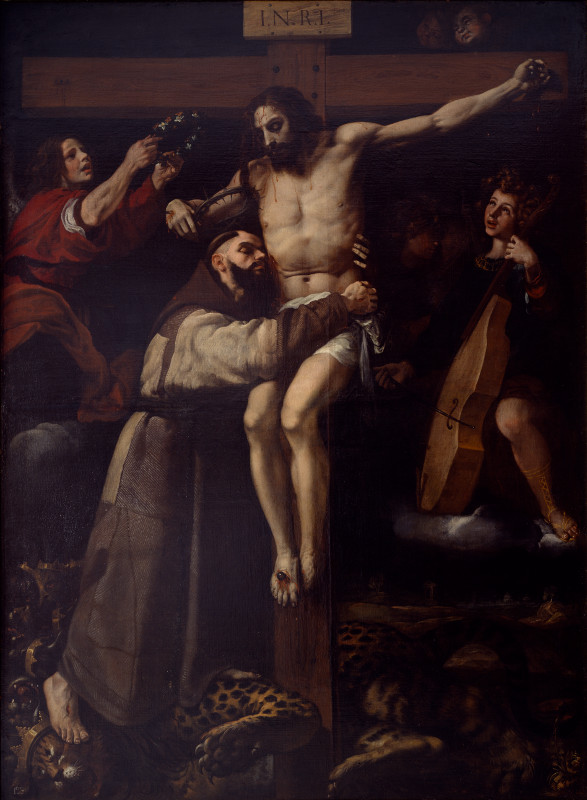
F. de Ribalta, Embrace of Saint Francis of Assisi to the Crucified (1620), oil on canvas, Convent of the Blood of Christ (Valencia, Spain)
Jesus spoke about time in today’s Gospel. He called it His Hour and he did not run from it. He embraced it. This was His Time. It was what He was put on earth to do. He would stand against evil. We all have hours, and we have our hour. We have many times in our lives when we have to stand up for God and be whom we are. All during Lent we have been asking ourselves, «Am I the person that God wants me to be? Do I try to reflect the image of God within me, or am I untrue to my very self? There are many temptations, many ways that we are tempted to hedge on our commitment to Christ. The cost of being true to the law written within our hearts can sometimes be quite heavy. We might find ourselves excluded from that society, that sport, or those people with whom we really want to belong. It hurts to have someone say, «What, are you too good to join us?» But the peace of Christ surpasses all things. Nothing is more important than living in this peace, then living united to the Lord. We all have our hours, and we have our hour. There are continual choices for God that we make throughout our lives. Those are our hours. There is also that one choice that is the reason why God placed us one earth. That is our hour. Our hour is the action that expresses whom we are deep within ourselves. It is the fundamental expression of our Christian life.
When we read about the saints, we learn about people who chose to suffer rather than deny Christ. But these are people about whom we read or heard. There are others whom we do not know. There is that girl with the unexpected pregnancy. It is her hour. Does she stand for Christ and bring this baby into the world regardless of what would happen to the plans she had for her future, or does she walk away from her hour and walk into that abortion clinic? There is that elderly man who chooses to care for his slowly dying wife because he could and because she wanted to stay at home. It is his hour. We know many others who are confronted with the choice of their lives, their hour, and embrace the law written within their hearts.
Maybe something so radical will not happen to us. Perhaps our hour will only be the sum total of the choices we have made in our lives which we present to the Lord when this life is over. The big question is: Are we ready? Are we ready to embrace the moment of our lives when all of our existence proclaims our union with Christ? Are we ready at all times to embrace all that we can be? All the little yeses we make to Christ, all those times that we deny ourselves what others say we should have or do, all these affirmations of our Christianity strengthen us for the total affirmation of our life, strengthen us for our hour. So, we are called to live and die for Christ. This is our time. This is our hour • AE

Soul of Christ, sanctify me.
Body of Christ, save me.
Blood of Christ, inebriate me.
Water from the side of Christ, wash me.
Passion of Christ, strengthen me.
O Good Jesus, hear me.
Within your wounds hide me.
Permit me not to be separated from you.
From the wicked foe, defend me.
At the hour of my death, call me
and bid me come to you
That with your saints I may praise you
For ever and ever. Amen.
St. Dominic Catholic Church • Weekend Schedule

Saturday, March 16, 2024
3.00 p.m. Sacrament of Reconciliation – Fr. Agustin E.
5.00 p.m. Holy Mass (English) – Fr. Agustin. E.
Sunday, March 17, 2024
7.30 a.m. Holy Mass (English) – Fr. Agustin E.
10.00 a.m. Holy Mass (English) and 3rd Scrutiny for RCIA – Fr. Agustin E.
12.30 p.m. Holy Mass (English) – Fr. Jaime P.
3.00 p.m. Santa Misa – Fr. Jaime P.
V Domingo de Cuaresma (Ciclo B)

Nos cuenta san Juan en su evangelio que unos peregrinos griegos que vinieron a celebrar la Pascua judía se acercaron a Felipe con una petición muy concreta: «Queremos ver a Jesús». Quizá es curiosidad. Quizá es un deseo sincero de conocer qué hay de aquel hombre. A Jesús se le ve preocupado. Dentro de unos días será crucificado. Cuando le hablan de aquellos hombres dice algo más bien desconcertante: «Llega la hora de que sea glorificado el Hijo del Hombre». Y es que cuando sea crucificado, todos podrán ver con claridad dónde está su verdadera grandeza y su gloria.
Probablemente nadie comprendió bien. Pero Jesús, pensando en la forma de muerte que le espera, insiste: «Cuando yo sea elevado sobre la tierra, atraeré a todos hacia mí». ¿Qué es lo que se esconde en el crucificado para que tenga ese poder de atracción? Sólo una cosa: su amor increíble a todos.
El amor es invisible. Sólo lo podemos ver en los gestos, los signos y la entrega de quien nos quiere bien. Por eso, en Jesús crucificado, en su vida entregada hasta la muerte, podemos percibir el amor insondable de Dios. En realidad, sólo empezamos a ser cristianos cuando nos sentimos atraídos por Jesús. Sólo empezamos a entender algo de la fe cuando nos sentimos amados por Dios. Para explicar la fuerza que se encierra en su muerte en la cruz, Jesús emplea una imagen sencilla que todos podemos entender: «Si el grano de trigo no cae en tierra y muere, queda infecundo; pero si muere, da mucho fruto». Si el grano muere, germina y hace brotar la vida, pero si se encierra en su pequeña envoltura y guarda para sí su energía vital, permanece estéril. Esta imagen nos descubre una ley que atraviesa misteriosamente la vida entera. No es una norma moral. No es una ley impuesta por la religión. Es la dinámica que hace fecunda la vida de quien sufre movido por el amor. Es una idea repetida por Jesús en diversas ocasiones: Quien se agarra egoístamente a su vida, la echa a perder; quien sabe entregarla con generosidad genera más vida. No es difícil comprobarlo. Quien vive exclusivamente para su bienestar, su dinero, su éxito o seguridad, termina viviendo una vida mediocre y estéril: su paso por este mundo no hace la vida más humana. Quien se arriesga a vivir en actitud abierta y generosa, difunde vida, irradia alegría, ayuda a vivir. No hay una manera más apasionante de vivir que hacer la vida de los demás más humana y llevadera. ¿Cómo podremos seguir a Jesús si no nos sentimos atraídos por su estilo de vida? • AE

Lecturas para la Semana Santa y el Triduo Pascual


 LA MEDITACION DE LA ESPOSA