
A. Mantegna, The Crucifixion (1458), Tempera on panel, The Louvre Museum (Paris)
The best we can do after the proclamation of the Passion of the Lord is to be quiet for a moment… Is there something else to say in the presence such an event with so much pain and physical and moral suffering? Probably not. The Passion of the Lord is the revelation [1] of the love that God has for all humanity and for each one of us and sooner or later we have to respond to that revelation, that’s why we need to be quiet. As Cardinal Sarah says: « If we want to grow and to be filled with the love of God, it is necessary to plant our life firmly on three great realities: the Cross, the Host, and the Virgin: crux, hostia, et virgo… These are three mysteries that God gave to the world in order to structure, fructify, and sanctify our interior life and to lead us to Jesus. These three mysteries are to be contemplated in silence» [2]. That’s why the Church is constantly inviting us to slow down and to take some time to ask ourselves… some good questions: What is God trying to tell me through the Passion of his Son? At this moment in my life, how am I embracing my cross? Gladly? with enthusiasm? Bitterly? If we contemplate the Passion of Jesus from a distance, and we are not really engaged, it is the same as leaving Jesus on the cross and washing our hands, as Pilate did [3]. Or something even worse: It could be that we have the same frivolous attitude of the soldiers who stood at the foot of the cross, watching over the executed. The gospel says that «When the soldiers had crucified Jesus, (…) They also took his tunic from him, but the tunic was one-piece (…) So, they said to one another, «Let’s not tear it, but let us cast lots for it to see whose it will be» [4].Christ is right there: hanging on the cross, bleeding to death, moaning in pain …dying!… And they are there … casting lots! Casting lots! They were killing time…. Bored and yawning… Totally oblivious, insensible to what is happening there, over his head. Well, the same could happen to us, that in the middle of the celebration of the holy sacrifice of the altar at Sunday mass we are boring, full of tedious, looking at the clock because «this is going too slow» wanting to get out as soon as possible …This afternoon, with this eloquent and beautiful liturgy of Good Friday of the Passion of the Lord we have a great chance to remember how important it is to pay attention; how important it is our intention to be present in body, soul, spirit and to receive with gratitude the grace of the Lord. How important is to be on time, wearing our best outfit, participating on the prayers with our best voice, our best postures, our best gestures… our best everything. This is how we can begin to recover a little that sense of reverence that we have been losing and that is so important for the celebration of the mysteries of our faith…
It’s Good Friday. the Liturgy of the Word and the tradition of the Church remind us in a liturgical way that the Lord has paid the price of our redemption, that we have salvation at hand. Jesus has climbed the Tree of the Cross out of love for each one of us. And this is not just a pretty phrase, but a reality, And the best way to respond and give thanks is by participating in this and all liturgical our celebrations, or whatever is related with our faith, with love, devotion, and attention. This is the point. The soldiers who are at the foot of the cross casting lots are a reminder that, in front of the most sacred, we can be distracted. But we also have the example of the Virgin Mary who, full of pain, remained faithful and loyal to everything that was happening there.
At the cross her station keeping,
Stood the mournful Mother weeping,
Close to Jesus to the last
The Stabat Mater sings, so let us ask the Lord this afternoon for the gift, huge gift, of recovering the sense of the Sacred, the gift of not being indifferent in His presence, the gift of celebrating the mysteries of our faith with devotion, with attention … with love. And today in particular, Good Friday of the Passion of the Lord, let us ask ourselves: What is God trying to tell me through the celebration of the Passion of his Son? At this moment in my life, how am I embracing the cross? gladly? with enthusiasm? bitterly? With hearts full of gratitude let us remember that by his passion, death and resurrection our wounds have been healed, our sins has been forgiven, our mistakes has been fixed, and a new opportunity has been given to us [5].
So, how can I repay the LORD for all the great good done for me? The Psalm says, I will raise the cup of salvation and call on the name of the LORD [6]. Today we are invited to lift our hearts in thanksgiving, in silence, in reverence, in devotion and in love. It is Good Friday!
Heaven that you have promised me, my God,
Does not move me to love you.
Nor does hell so dreadful move me
To leave all that offends you.
You move me, Lord. It moves me to see you
Mocked, nailed to that cross.
It moves me to see your body so wounded.
Your dishonour moves me, and your death.
You move me to your love in such a way
That —even if there were no heaven— I would love you;
And —even if there were no hell— I would fear you.
You do not have to give to gain my love;
For —even if what I hope for becomes hopeless—
In the same way I love you, I would love you still [7] •
[1] Cf. Mark 14-15, Matthew 26-27, Luke 22-23, and John 18-19. [2] Robert Cardinal Sarah, The Power of Silence: Against the Dictatorship of Noise. [3] Cf. Matthew 27:24 [4] Cf Jn 18:1—19:42 [5] Cf. 1 Peter 2:24; Isaiah 53:5 [6] Cf 116: 12-13 [7] English translation of the anonymous Spanish poem Soneto a Cristo crucificado (“No me mueve mi Dios, para quererte”), by Stacy Shoop (1996).


El Diario de María

Los Improperios del Viernes Santo

Gaspar de Figueroa, Ecce Homo (c. 1658), óleo sobre tela, Iglesia de Santa Bárbara, Bogotá (Colombia)
Los Improperios, en latín Improperia, son los versículos que se cantan en el oficio de la tarde del Viernes Santo en la liturgia católica durante la ceremonia llamada Adoración de la Cruz. La palabra latina improperium significa «reproche». Los Improperios son, de hecho, los reproches de Cristo a su pueblo que lo ha rechazado. Puesto que a cambio de todos los favores concedidas por Dios, y en particular de haberlo librado de la servidumbre en Egipto y haberlo conducido sano y salvo a la Tierra Prometida, le ha infligido las ignominias de la Pasión. Es durante La Adoración de la cruz, después de las diecisiete oraciones, que estos improperios se decían por el coro en el rito romano. A cada favor de Dios en el libro del Éxodo se oponía un episodio de la Pasión de Cristo. El coro repetía como estribillo la aclamación griega Hagios o Theós (Ἅγιος ὁ Θεός), de forma más precisa alternando el griego y el latín, en doble coro. Esta versión es compuesta por Giovanni Pierluigi da Palestrina hacia 1580 •
Viernes Santo de la Pasión del Señor (2024)
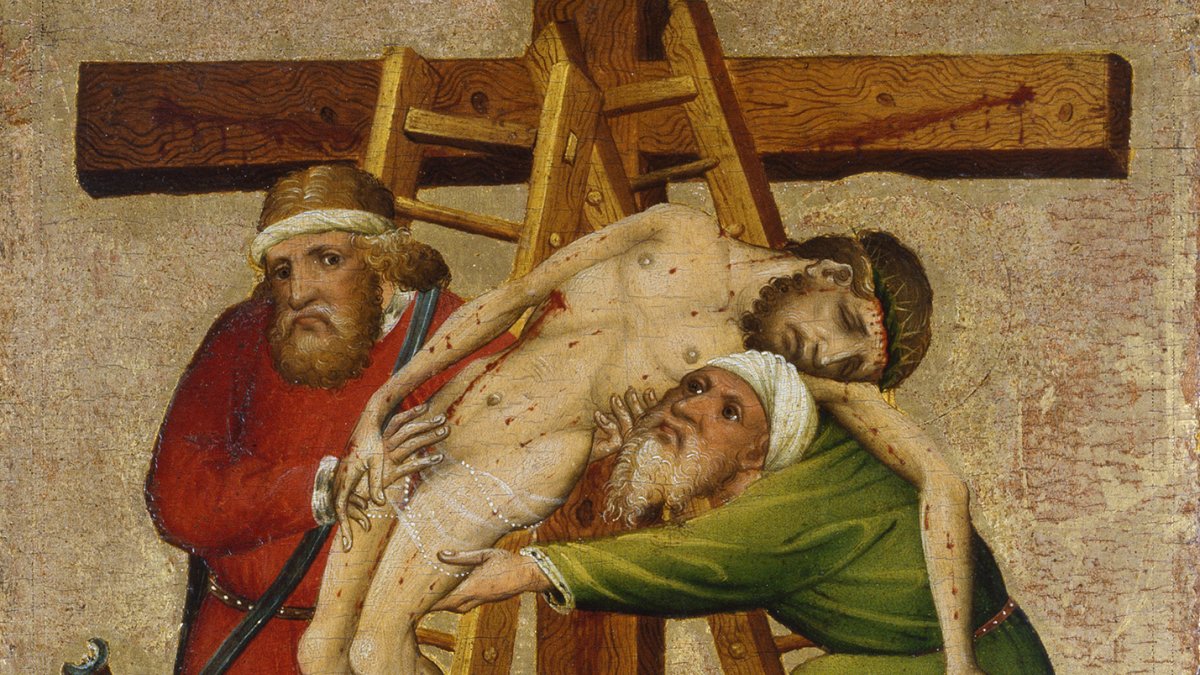
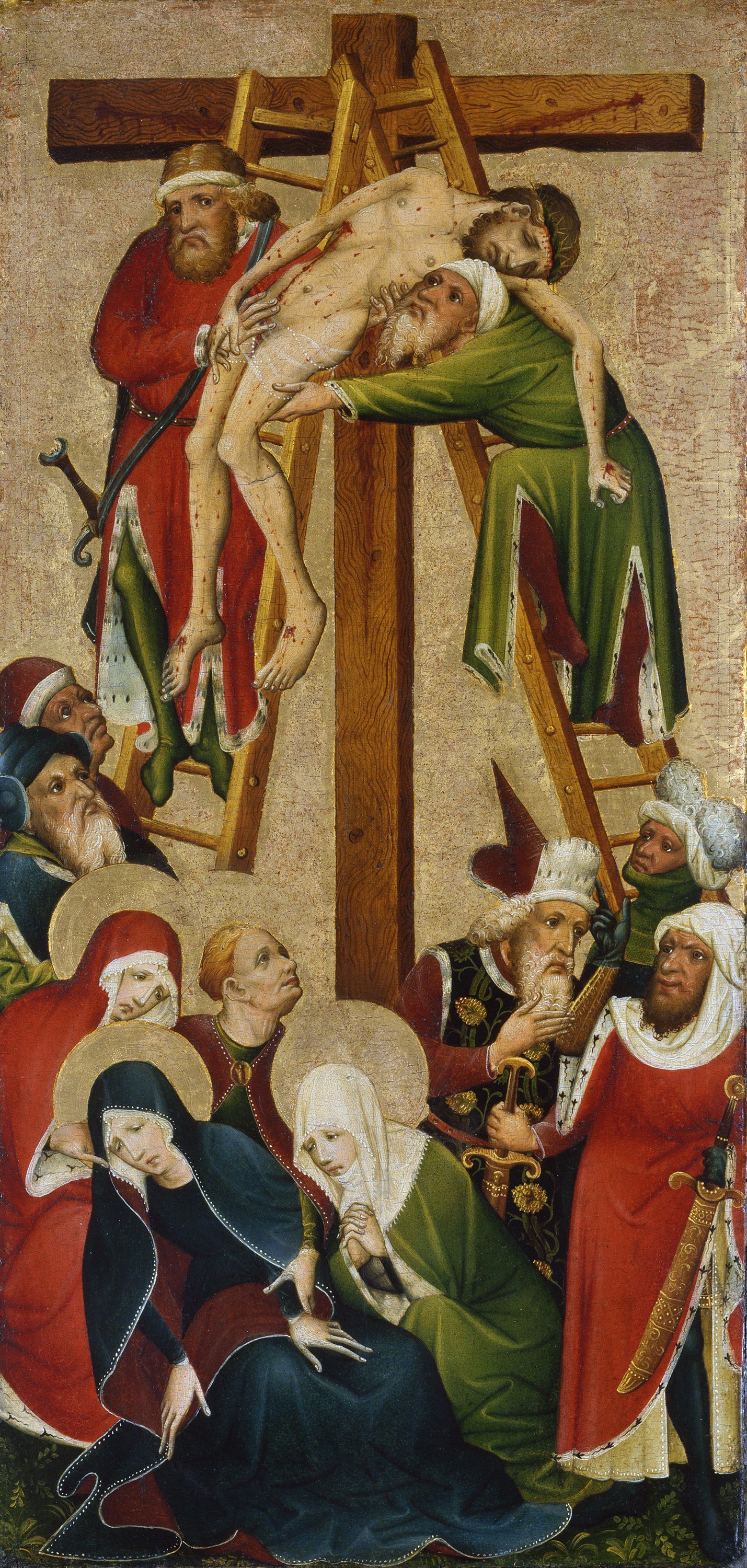
Anónimo alemán, El Descendimiento de la cruz (hacia 1420), Óleo sobre tabla, Museo Nacional Thyssen-Bornemisza (Madrid)
La muerte del Señor en la Cruz no fue algo casual, fruto de un malentendido de las autoridades religiosas y políticas de Israel. Tampoco podemos considerar la cruz como algo permitido por Dios por motivos enigmáticos pero que luego se resolvió con el triunfo glorioso de la resurrección. La resurrección no elimina el escándalo de la cruz, sino que lo eleva a misterio, Porque, aún después de la resurrección, nos tenemos que preguntar: ¿por qué y para qué la cruz? ¿qué hace Dios en una cruz?
Un Dios crucificado constituye una auténtica revolución y nos obliga a cuestionar todas nuestras imágenes humanas de Dios. La cruz rompe todos nuestros esquemas sobre un Dios al que suponemos conocer ya de antemano. El crucificado no tiene el rostro que nosotros atribuimos a la divinidad. En la cruz no hay belleza, poder, fuerza, sabiduría, majestad.
Dios no aparece como el que tiene poder sobre la muerte, sino como alguien que se ve sumergido dentro de ella. Con la cruz, o se termina toda nuestra fe en Dios o se abre a una comprensión nueva y sorprendente de un Dios que nos ama de manera insospechada. Contra todas nuestras concepciones sobre la divinidad, en la cruz descubrimos sorprendidos que Dios es alguien que sufre con nuestros sufrimientos. Nuestra miseria le afecta. Nuestro sufrimiento le «salpica». Dios no puede amarnos sin sufrir. Como ha dicho D. Bonhoeffer, «sólo un Dios que sufre puede salvarnos».
A este Dios crucificado no lo podemos entender desde categorías filosóficas. Es un escándalo y una necedad. A este Dios crucificado sólo se le entiende cuando sabemos amar a los que sufren y descubrimos por propia experiencia que el amor verdadero a los crucificados hace sufrir. Este Dios crucificado no permite una fe ingenua y egoísta en cualquier Dios poderoso puesto al servicio de nuestros propios intereses. Este Dios nos pone mirando hacia el sufrimiento, el abandono y los gritos de los demás. A este Dios nos acercamos, cuando sabemos acercarnos al sufrimiento de cualquier abandonado. Los cristianos seguimos dando muchos rodeos para no encontrarnos con el Dios crucificado. Esta preciosa liturgia del Viernes Santo podría pues recordarnos que la originalidad del cristiano, como decía Bonhoeffer, está en permanecer con Dios en la pasión de los que sufren, Sin esto, no hay fe en el Dios verdadero sino manipulación •
 LA MEDITACION DE LA ESPOSA