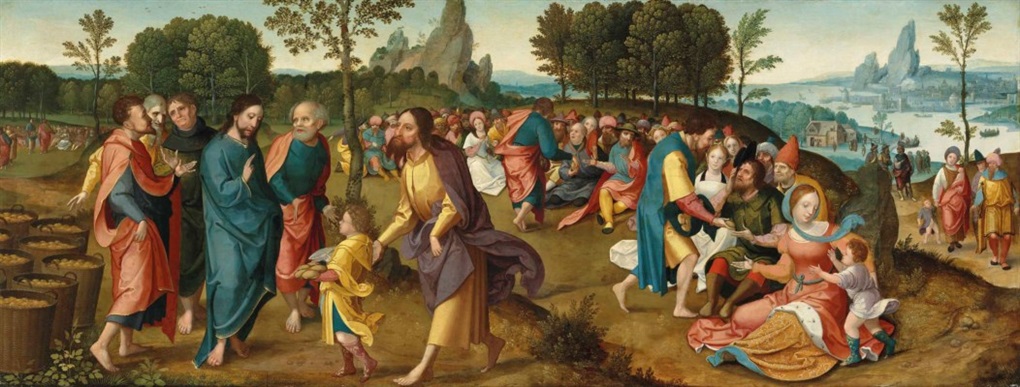
Master of the Antwerp Adoration, The Multiplication of the Loaves and Fishes, oil on panel, Particular collection.
This Sunday we begin the deep dive into the Sixth chapter of the Gospel of John. This is the chapter on the Eucharist. John 6 begins with the multiplication of the loaves and fish. What again? The multiplication of loaves and fish is the only Gospel miracle found in all four gospels and is actually found twice in the Gospels of Mark and Matthew. So, we come upon it quite frequently in our liturgies. Anyway, I would like to focus on the gathering of the fragments.
Unlike the manna, the fragments were not to be thrown away. They came from God. This happens in our churches every time we celebrate Mass. Bread and wine are consecrated, not blessed, but consecrated. They become the Eucharist, the Body and the Blood of the Lord. Once the physical elements are transformed, they remain the Body and Blood of the Lord. We place the consecrated hosts in our tabernacles because this is still the Lord. We bring the Body of Christ to those who cannot join us at Mass. We pray before the Body of Christ in our tabernacles. The Eucharist is not merely a liturgical action during the Mass. It is Jesus. He is really present in the consecrated species, the bread and wine. We believe that this is really and truly the Body and Blood of Christ. To leave the Catholic Church for another faith is to reject the gift of the real presence of Jesus Christ as Eucharist. Once a person is brought into the mystery of the Eucharist, that person cannot leave this mystery. It would a rejection of a great Grace given when that person became Catholic or entered that stage of life when he or she could come to an understanding of what we Catholic believe about the Eucharist. How great is our God? God is so great that he has found a way for all of us to attend the eternal Passover. How great is our God? God is so great that he leads us into his presence and feeds us his meal. How great is our God? He is so great that he has found a way for each of us to join the disciples at the Last Supper, or what is really the First Supper, the First Supper of the Kingdom. How great is our God? He is so great that He has created billions and billions of people in the world, and, yet, has found a way to treat each person as an only child. How great is our God? He is so great that He loves every person as though each of us were the only person He ever created.
When we receive communion, we are present at the Last Supper, the First Supper, the Banquet of the Lord. When we receive holy Communion, we enter into the intimate union with God that Jesus came to earth to provide. How much our God cares for us! He has found a way to nourish our spiritual lives. His very Body and Blood keeps us strong. He gives us the strength to proclaim his Kingdom.
So, we need to ask ourselves at communion time: «What am I doing?» Am I just following the crowd? Hopefully not. Am I receiving some sort of blessing? Hopefully, we realize that holy Communion is much more than a blessing. What is it that I am doing when I receive holy Communion? I am receiving the Food that God provides. I am being nourished with the Body and Blood of Christ. Let us ask the Holy Spirit for a deeper appreciation and a deeper reverence for the Great Gift of Love that is the Eucharist • AE

St. Joseph Catholic Church (Dilley, TX) • Weekend Schedule

Fr. Agustin E. (Parish Administrator)
Saturday July 27, 2024.
5.00 p.m. Sacrament of Reconciliation
6.00 p.m. Santa Misa.
Sunday, July 28, 2024
8.00 a.m. Sacrament of Reconciliation
8.30 a.m. Holy Mass.
10.30 a.m. Sacrament of Reconciliation.
11.00 a.m. Holy Mass
XVII Domingo del Tiempo Ordinario (Ciclo B)
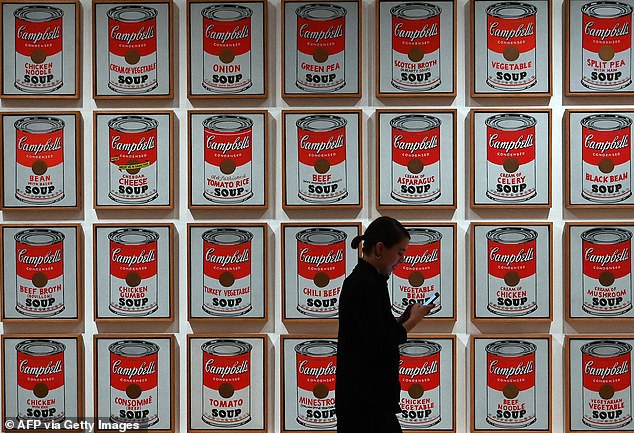
Campbells Soup Cans (1962) del norteamericano Andy Warhol en el Museo Tate Modern de Londres
Criticamos con facilidad y rapidez al mundo contemporáneo porque pensamos que son otros los que tienen la culpa de todo. Los verdaderos culpables se encuentran ocultos tras el sistema, son las multinacionales, los políticos de ciertas naciones poderosas. Si ellos son los culpables, nosotros somos inocentes. Sin duda, hay culpables y hay, sobre todo, causas de los males e injusticias, pero hay también una culpa que está como diluida en toda la sociedad y que nos toca a todos. Hemos interiorizado personalmente un tipo de cultura que nos lleva a pensar, sentir y tener comportamientos que sostienen y facilitan el funcionamiento de una sociedad poco humana. Pensemos, por ejemplo, en esta sociedad de consumo en la que vivimos. Podemos estudiar lo que significa objetivamente una economía de mercado, la producción masiva de productos, el funcionamiento de la publicidad y tantos otros factores, pero podemos también analizar nuestra actuación, la de cada uno de nosotros. Si yo me dejo modelar por la sociedad de consumo, esto significa que valoro más mi propia felicidad que la solidaridad; que pienso que esta felicidad se obtiene, sobre todo, teniendo cosas más que mejorando mi modo de ser; que tengo como meta secreta ganar siempre más y, para ello, tener el mayor éxito profesional y económico. Esto me puede llevar fácilmente a considerar como algo normal una sociedad profundamente desigual donde cada uno tiene lo que se merece. Hay individuos eficientes y dinámicos que consiguen un nivel apropiado a sus esfuerzos, y un grupo numeroso de personas poco hábiles y nada trabajadoras que nunca conseguirán un nivel digno en esta sociedad.
A partir de aquí organizamos nuestra actividad y relaciones de manera inteligente. Naturalmente, valoramos la amistad y el compañerismo, la convivencia familiar y el círculo de amigos. Apreciamos, incluso, los gestos de generosidad y la ayuda al necesitado. Pero hay que saber calcular. No hemos de perder nunca de vista nuestro propio interés y provecho. Hay que saber dar de manera inteligente, ayudar a quien un día nos podrá corresponder. Olvidamos aquel “dar hasta que duela”, que solía repetir Madre Teresa.
Podemos seguir echando la culpa a otros, pero cada uno somos responsable de este estilo de vida poco humano. Por eso es bueno dejarnos sacudir de vez en cuando por las palabras y las obras de Jesús. El relato de la multiplicación de los panes que escuchamos este domingo en el evangelio -el décimi séptimo del tiempo ordinario- es un signo mesiánico que revela a Jesús como Aquel que viene a alimentar al pueblo, pero encierra también una llamada muy específica: una invitación a que cada uno pongamos nuestro esfuerzo, nuestro tiempo, nuestro talento, lo que cada uno pueda hacer y dar, aunque sólo sean cinco panes y dos peces • AE

¿Qué vamos a leer?












 LA MEDITACION DE LA ESPOSA