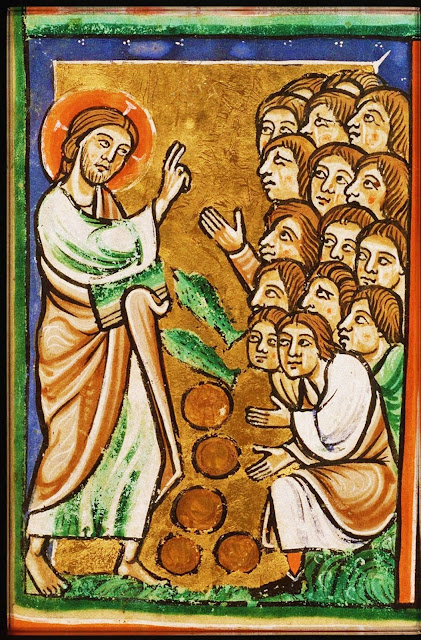
Anonymous artist, Multiplication of the Loaves and Fish, French (St. Omer), c. 1190-1200, Koninklijke Bibliotheek (The Hague)
This week we come to the climax of the Discourse on the Bread of Life. Todays gospel is about sustenance. It is about eating. It is about nourishment. It is about the Eucharist. We assimilate the food. But that is not what happens when we receive the Eucharist. When we receive the Eucharist, the food assimilates us. When we receive the Eucharist, Jesus transforms us. Instead of the food taking on our life, we take on the life of the Lord.
We just heard: “Just as the living Father sent me and I have life because of the Father, so also the one who feeds on me will have life because of me.” The attraction of the Eucharist is dynamic. Jesus is dynamic. When we receive communion or when we come to pray before the Blessed Sacrament, we don’t just kneel before a static object. It is not a crucifix or a statue that reminds us of something. This is Jesus. The One Who Is. When we receive communion or come to adoration, we come before the dynamic, powerful Presence who speaks to us through the life He has given us. How great is our God. He has found a way for each of us to have continual, intimate encounters with Him.
When Jesus gave us his Body and Blood the night before he died and when he gives us his Body and Blood every time we receive communion, the Lord gives us the total sacrifice of himself to his Father. When we receive the Eucharist, Jesus is present as the Servant of God who in his sacrificial death is saving us all. Right here, right now. Today’s Gospel states: ‘The one who feds on my flesh and drinks my blood has life eternal.” In the real presence of Jesus in the Eucharist we receive Jesus saving his people. When we receive communion, we receive Jesus saving us now. We receive Christ strengthening us and transforming our joys and sorrows into prayers to his Father. Our union with Christ in the Eucharist is union with Christ in passion, death and resurrection. Sometimes we are full of the joy of the Resurrection, sometimes the sorrow of the Passion, but always we are strengthened by the one who gives us his body and blood. The Lord is always in action. His Presence is dynamic.
We may come to Church with the attitude that we are winning our salvation, as though we were capable of usurping the power of God. We think that we decide what God can and cannot do to effect our salvation. That’s the beginning of today’s gospel. It is a Pelagian attitude. That was a heresy we all share a bit in that says “I can cause my own salvation.” No, it is not about me. It is about Jesus. Everything that matters is about Jesus. He saves me, and He does it for only one reason: He loves me.
The marvelous paradox of our Eucharistic relationship with Jesus is that the more we have Him, the hungrier we are for Him. Only, God in His Infinite Wisdom could find a way to satisfy our hungry hearts while leaving us hungry for Him. We can’t get enough of Him. We never will until we are fully united to Him in heaven. Today we pray for the Gift of the Holy Spirit called Reverence. May we revere the Dynamic Presence that assimilates Us into Himself every time we receive His Body and Blood • AE

St. Joseph Catholic Church (Dilley, TX) • Weekend Schedule

Fr. Agustin E. (Parish Administrator)
Saturday August 17, 2024.
5.00 p.m. Sacrament of Reconciliation.
6.00 p.m. Santa Misa.
Sunday, August 18, 2024
8.00 a.m. Sacrament of Reconciliation.
8.30 a.m. Holy Mass.
10.30 p.m. Sacrament of Reconciliation.
11.00 a.m. Holy Mass.
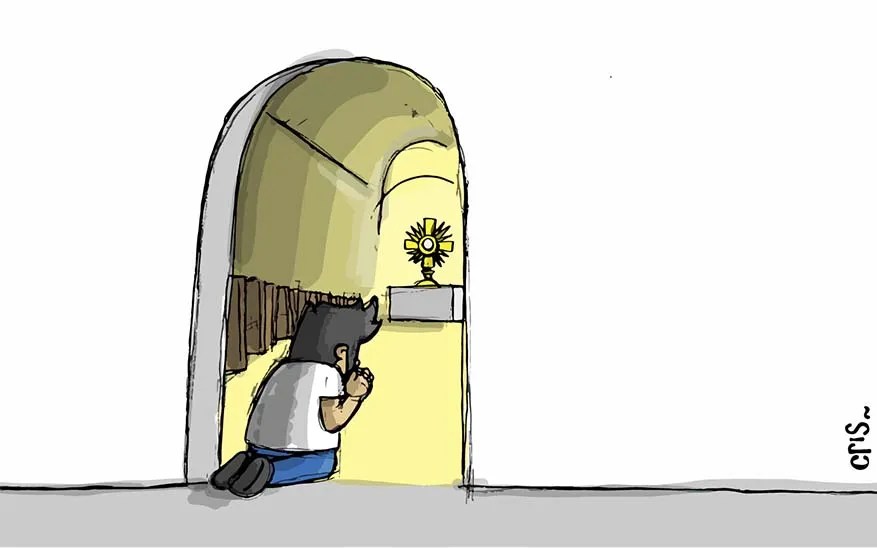
Our daily chapel is open Monday, Wednesday & Friday from 8.00 a.m. to 8.00 p.m. Stop by and pay a visit to the Most Holy Sacrament.
Nuestra capilla está abierta lunes, miércoles y viernes de las 8.00 a.m. a las 8.00 p.m. ¡Ven a visitar Jesús presente en el Santísimo Sacramento!
XX Domingo del Tiempo Ordinario (Ciclo B)

J. Espinosa, La misa de San Gregorio (1650), óleo sobre tela, Museo del Prado (Madrid)
Cuando la celebración de la eucaristía no nos dice mucho, puede haber varias razones: actuación rutinaria del celebrante, desconocimiento del significado de los gestos litúrgicos, lenguaje alejado de la realidad actual… Hay, sin embargo, otra razón fundamental: por muy cálida y viva que sea la celebración, si no participamos interiormente y nos abrimos a Dios en cada momento, la Eucaristía termina diciendo poco, o nada.
Hay cuatro etapas importantes en la celebración de la Eucaristía que es necesario vivir con la actitud apropiada. El primer momento es de encuentro. Llegamos a la parroquia, nos saludamos y vamos formando entre todos la asamblea litúrgica. Es el momento de preparar nuestro corazón para la celebración. Los ritos iniciales, con el precioso acto penitencial, nos ayudan a distanciarnos de nuestro ritmo de vida a veces tan agitado y tenso, a despertar nuestra fe, pedir perdón y disponemos para vivir un encuentro gozoso con Dios.
El segundo momento es de escucha. Nos mantenemos sentados para escuchar la Palabra de Dios. Después de haber oído durante la semana tantas palabras, noticias, comentarios e información, nos disponemos a escuchar ahora una Palabra diferente que puede iluminar y orientar nuestras vidas. Escuchamos la Palabra que pone sentido, verdad y esperanza en nuestra existencia. Ante el Evangelio nos ponemos de pie pues las palabras de Jesús tienen para nosotros un valor único. Son realmente espíritu y vida
El tercer momento es de acción de gracias. Estamos de pie unidos al celebrante que, en nombre de todos, pronuncia la plegaria eucarística. La actitud es clara desde el principio: los corazones levantados hacia el Señor, dando gracias y alabando su bondad. Aquí ya no se predica ni se enseña, no se analiza ni se medita. Estamos en el corazón de la Eucaristía. Aquí lo importante es la alabanza y el agradecimiento hondo a Dios por el regalo de su Hijo.
Y el último momento es de comunión y encuentro íntimo con el Señor. Todo nos conduce a participar en la mesa preparada para nosotros: el Padrenuestro que nos recuerda que somos hermanos, hijos de un mismo Padre; el gesto de la paz que nos reconcilia e invita al mutuo perdón; el Cordero de Dios nos recuerda nuestra indignidad y la enorme necesidad que tenemos de recibir al Señor. Y luego el breve camino hacia el altar para alimentarnos del Señor, recuerdo de que somos peregrinos, que vamos caminando, y que la Eucaristía no es un premio, sino una medicina. Alimento para el camino. Es el momento de comulgar con Cristo y con los hermanos • AE

 LA MEDITACION DE LA ESPOSA