

Anonymous Master, Multiplication of the Loaves and Fish (Late 12th Century), stainless window, Victoria and Albert Museum (London)
When they heard Jesus speak about His flesh as real food, when they heard Him say that they had to eat His flesh and drink His blood, they left. This teaching was too hard for them to accept. Jesus was not about to tone down the teaching. He was not about to make it more palatable. The teaching had to be accepted by those who wished to follow Him. So, many of them left. “Are you going too?” the Lord asked. Peter replied in a great confession of faith, “Lord to whom shall we go? You have the words of eternal life.”
People have always been tempted to compromise on the hard truths of the faith. Some have turned Jesus into a great man, but not divine. Others have said that He was divine, but did not really exist as a man, He just appeared that way. The truth of the Incarnation, of Jesus being both human and divine was too hard for them to accept, so they compromised and said he was one or the other, but not both. They wanted to do the same thing regarding the teaching on the Bread of Life. They wanted to call it symbolic, but not real. They ignored Jesus’ teaching. Or they left Him. Faith demands continual decisions to take steps beyond our minds’ ability into the vast richness of Divine revelation. Faith demands the humility to accept that we cannot understand all that is revealed. Faith demands that we set our minds free from the shackles of physical knowledge and take leaps into the wisdom of God. Faith means opening ourselves up to eternal life.
It is sad that throughout history many people have rejected the One who has the words of eternal life and have instead given themselves over to a blind following of those who can offer them no more than a political view of life. Demagogues appear everywhere and at every time. So they said, “Hail Caesar,” and sacrificed the Roman Republic. They said, “Heil Hitler,” and sacrificed their morality. Today, the Eucharist gives us the strength to be authentic, true, real Christians, authentic, true, real Catholics. It is Jesus Christ who is calling us to a living, a vital faith. If we refuse to follow Him, where exactly can we go? Whom can we follow? Who else has the words of eternal life? We are convinced that Jesus is the Holy One of God. We have no choice. Eternal Life can only be found in Him. The conclusion of John six is far more than a call to believe in the Eucharist. It is this, but it is more. It is a call to trust in the Lord. It is a call to dare to be different from those who have left him and who give lip service to their Christianity. We are called to be different. We are called to be holy, for, after all, that is what holiness is, being separate for the Lord. We have a choice…..Or do we? No, we really do not have a choice. Where else can we go? He alone has the words of eternal life! • AE

St. Joseph Catholic Church (Dilley, TX) • Weekend Schedule

Fr. Agustin E. (Parish Administrator)
Saturday August 24, 2024.
5.00 p.m. Sacrament of Reconciliation
6.00 p.m. Santa Misa.
Sunday, August 25, 2024
8.00 a.m. Sacrament of Reconciliation
8.30 a.m. Holy Mass.
10.30 p.m. Sacrament of Reconciliation. 11.00 a.m. Holy Mass
XXI Domingo del Tiempo Ordinario (Ciclo B)
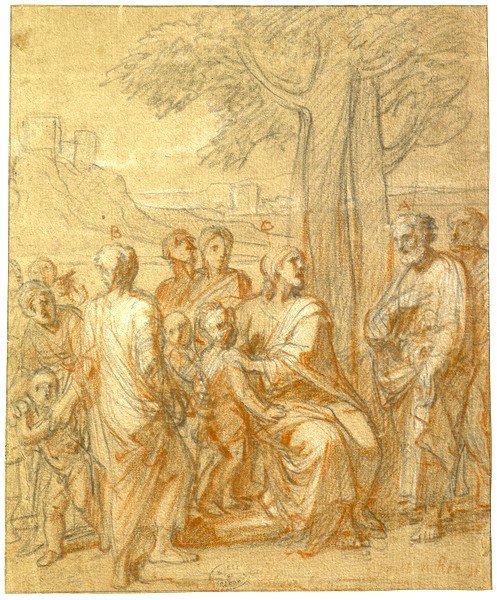
F. Verdier, Cristo, los apóstoles y los niños (1650), lápiz sobre papel, Museo de Grenoble (Francia)
Muchos cristianos sienten -sentimos- brotar en su interior dudas, no sobre tal o cual punto particular del mensaje de Jesús sino más sobre la totalidad de la fe cristiana. Lo que les preocupa no son los dogmas sino algo más fundamental y previo: ¿Por qué habría de orientar mi vida siguiendo las fórmulas ingenuas que encuentro en unos documentos tan arcaicos y, al parecer, tan legendarios? ¿Por qué mi anhelo por la vida, el placer y la libertad han de subordinarse a una moral rigurosa y casi imposible? Muchas veces, sin formularlo de manera precisa, experimentan en su interior una división profunda: “Quisiera creer pero me siento incapaz de adherirme con sinceridad total a la fe cristiana”. “Siento que no puedo o no debo abandonar mi fe pero al mismo tiempo me encuentro cada vez más lejano y extraño a todo eso”. Es fácil entonces sentirse culpable de algo, sin saber con seguridad de qué: ¿Qué me ha pasado? ¿Qué he hecho a lo largo de los años para llegar a esta situación? Es posible, ciertamente, que haya una parte de responsabilidad en todo ello, pero ahora lo importante es vivir esa experiencia de duda religiosa de manera, digamos, positiva.
Esa duda y falta de certeza interior puede ser precisamente una ocasión para superar la inmovilidad y la rutina, para liberarse de una religión excesivamente infantil y para descubrir a Jesús de manera nueva. Quizás, por vez primera, descubro que soy libre para creer o no creer. Ciertamente, es más cómodo no plantearse cuestión alguna y vivir tranquilo, pero es más digno enfrentarme a mi propia libertad y saber por qué abandono la fe o por qué me comprometo a seguir al Señor. Si sigo buscando la verdad, pronto sentiré que no soy yo sólo el que hago preguntas. Ahora es el mismo Cristo el que me interpela a mí: “¿También tú quieres marcharte?”. Y uno se ve obligado a introducir nuevas cuestiones en su planteamiento: ¿Por qué me resisto a reorientar mi vida y reorganizarlo todo desde la llamada de Cristo? ¿Puedo responder sinceramente por qué? Tarde o temprano llega el momento de tomar una decisión: o bien pongo a Jesús en el mismo plano que a otras grandes figuras de la humanidad, o bien me decido a experimentar personalmente qué hay de único en su persona y su mensaje. Al final, lo importante es la sinceridad del corazón. No hay que fiarse de las certidumbres y seguridades del pasado, ni desanimarse cuando comienzan las dudas. La verdadera fe no está en nuestras explicaciones bien fundadas, ni en nuestras dudas, sino en la sinceridad del corazón que busca a Dios. Y es que cuando uno busca con sinceridad, tal vez no encuentre respuesta inmediata a todos sus interrogantes, pero es fácil que en el fondo del corazón broten las palabras, maravillosas, entrañables, del buen Pedro -que también dudó- a Jesús: Señor, ¿a quién vamos a acudir? Tú tienes palabras de vida eterna • AE

¿qUE vAs a lEEr?

 LA MEDITACION DE LA ESPOSA