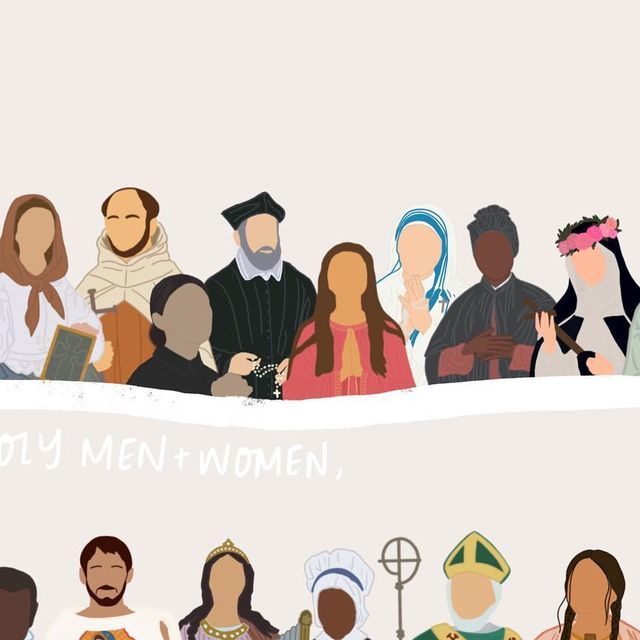
We celebrate the Solemnity of All Saints, a day to honor all the holy men and women who have gone before us, known and unknown. We remember that the saints were not superhuman; they were people just like us—ordinary people with families, jobs, and struggles. What made them different was that they allowed God to work in their lives in extraordinary ways. Each saint responded to God’s call and lived out the Gospel, and in that way, they show us a path to follow.
In today’s Gospel, Jesus gives us the Beatitudes—His vision of what it means to live a life blessed by God. The Beatitudes are more than just words; they are a roadmap for holiness. Jesus tells us, “Blessed are the poor in spirit, for theirs is the kingdom of heaven.” To be poor in spirit means we acknowledge our need for God, to be humble and to rely on His grace. This is the foundation of a saint’s life.
Pope Francis teaches us that “the Beatitudes are the portrait of Jesus, and consequently, of the Christian.” They are meant for each one of us, showing us that true happiness is not found in power, wealth, or fame, but in mercy, purity, and peace. Today, we can ask ourselves: *Am I following this path? Am I living out these blessings in my daily life?*
Let us consider the example of St. Teresa of Calcutta, or Mother Teresa, a saint of our time. She dedicated her life to serving the poorest of the poor, living out the Beatitude, “Blessed are the merciful, for they will be shown mercy.” She saw Jesus in every person she met, especially in the poor and sick, and she taught us to do the same. Her life reminds us that we, too, can be instruments of God’s love, mercy, and compassion, no matter our circumstances.
Pope Francis tells us that “holiness doesn’t mean doing extraordinary things but doing ordinary things with love and faith.” Saints like Mother Teresa, or others like St. Joseph, who was a humble worker, show us that holiness can be found in our daily tasks. We do not have to go far; we can begin in our homes, our workplaces, and our neighborhoods.
Let us remember that each one of us is called to be a saint. We may not be perfect, but God can use us just as we are. The Beatitudes challenge us to be peacemakers, to hunger for justice, and to show mercy. These are the virtues that build the Kingdom of God on earth.
As we celebrate All Saints today, let us ask for the intercession of these holy men and women who have gone before us. May they help us, inspire us, and remind us that we, too, are called to this same journey of love and holiness. And may we place ourselves in the hands of Mary, the Queen of all Saints, who shows us the way to her Son, Jesus. She, too, lived the Beatitudes and trusted in God’s plan with a humble heart. Like Mary, may we say “yes” to God each day, letting His love and grace transform us. Amen • AE

Conmemoración de Todos los Fieles Difuntos (2024)
Podemos ignorarla. No hablar de ella. Vivir intensamente cada día y olvidarnos de todo lo demás, sin embargo tarde o temprano, la muerte va visitando nuestros hogares, arrebatándonos a nuestros seres más queridos. ¿Cómo reaccionar ante ese accidente que se lleva para siempre a nuestro hijo? ¿Qué actitud adoptar ante la agonía del esposo o esposa? ¿Qué hacer ante el vacío que van dejando en nuestra vida tantos amigos y personas queridas que se han ido marchando?
La muerte es como una puerta que traspasa cada persona a solas. Una vez cerrada la puerta, el muerto se nos oculta para siempre. No sabemos qué ha sido de él. De ella. Ese ser tan querido y cercano se nos pierde ahora en el misterio. ¿Cómo vivir esa experiencia de impotencia, desconcierto y pena inmensa? No es fácil. Durante estos años hemos ido cambiando mucho por dentro. Nos hemos vuelto más críticos, pero también más vulnerables. Más escépticos, pero también más necesitados. Sabemos mejor que nunca que no podemos darnos a nosotros mismos todo lo que en el fondo anhela el ser humano. Por eso debemos recordar aquellas palabras del Señor, palabras de Jesús que sólo pueden resonar en nosotros, si somos capaces de abrirnos con humildad al misterio último que nos envuelve a todos: No se turbe vuestro corazón. Creed en Dios. Creed también en mí.
Creo que casi todos, creyentes, poco creyentes, menos creyentes o malos creyentes, podemos hacer dos cosas ante la muerte: llorar y rezar. Cada uno y cada una, desde su pequeña fe. Una fe convencida o una fe vacilante y casi apagada. Nosotros podríamos tener problemas con nuestra fe, pero Dios no tiene problema alguno para entender nuestra impotencia y conocer lo que hay en el fondo de nuestro corazón. Me gusta pensar que podemos dirigirnos a nuestros difuntos con palabras como estas: «Estamos aquí porque te seguimos queriendo, pero ahora no sabemos qué hacer por ti. Nuestra fe es pequeña y débil. Te confiamos al misterio de la Bondad de Dios. Él es para ti un lugar más seguro que todo lo que nosotros te podemos ofrecer. Sé feliz. Dios te quiere como nosotros no hemos sabido quererte. Te dejamos en sus manos»• AE

Requiem de Mozart
La Misa de Réquiem en re menor, K. 626, es una misa de Wolfgang Amadeus Mozart, basada en los textos latinos para el réquiem, es decir, el acto litúrgico católico celebrado tras el fallecimiento de una persona. Se trata de la decimonovena y última misa escrita por Mozart, que murió en 1791, antes de terminarla. El compositor F. X. Süssmayr la finalizó, y el propio autor, ya enfermo, le dio numerosas indicaciones para hacerlo. A pesar de que no pudo ser terminada en su totalidad por el maestro austríaco, es considerada como una de las obras más transcendentales de Mozart• AE
 LA MEDITACION DE LA ESPOSA