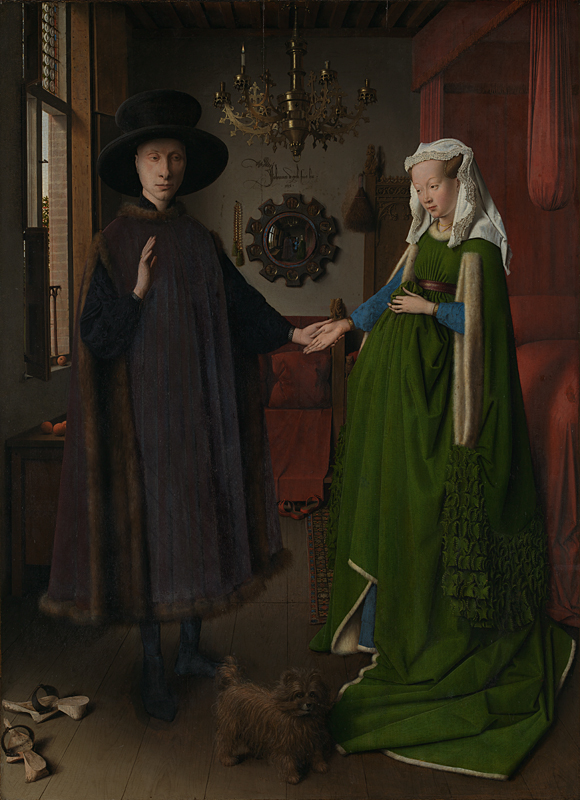
Jan van Eyck, The Arnolfini Portrait (1434), oil on oak, National Gallery (London)
We often refer to marriage preparation courses as Pre-Cana meetings. The name is an encouragement to the bride and groom to enter into a relationship where the Lord is present as He was at Cana. The sacrament of matrimony elevates marriage from a civil affair to one of great dignity. A couple who celebrates the sacrament of marriage celebrates the union of Jesus’ love to their love for each other. The more they grow in love, the closer they come to the Lord. The closer they come to the Lord, the closer they come to each other. God can and does show His Presence in their marriage. Others sense the presence of God in their relationship, so there is a great dignity in the sacrament of matrimony. It is the dignity of people of God making His Love real for others. We have all witnessed many wonderful examples of sacramental marriages. We all have witnessed husbands who have devoted their retired years to taking care of their wives, and wives their husbands. We have also seen so many young husband and wives who understand the hurt their spouse suffered as a child or a teen and who care for them often at the expense of their own desires and even needs. For all this, today we give thanks!
The essence of a sacramental marriage is forming a life of giving, a life of true love. The essence of a sacramental marriage is the very presence of Jesus Christ. It is a wonderful paradox in life that the more someone takes, the less he or she has and the more someone gives, the more he or she has. Those who are really married understand this. Having someone to give to is infinitely more important and infinitely more mature than having someone from whom a person can take.
The great gift of marriage is that the married are continually challenged with ways to love sacrificially. Occasions present themselves daily whether it is doing the shopping, changing the baby, getting the child to soccer or dance, working harder to provide better, taking the cars in for an oil change, or simply, getting off the couch to play with the kids. All are expressions of sacrificial love which are the routine of marriage. All are ways of living the sacrament of marriage. Let us not forget this, and also let us be so grateful for our parents. I was well loved because my parents loved each other with the love of Jesus Christ. Young men, you want to be a good father? Love your wife! Young women, you want to be a good mother? Love your husband! Those of us who are not married need you who are married to continue to be loving husbands and wives. We need to experience the Love of the Lord in your way of life, your sacrament of matrimony.
Today we celebrate the epiphany of Christ at the Wedding Feast of Cana and the Epiphanies of the Lord in your marriages • AE

St. Joseph Catholic Church (Dilley, TX) • Weekend Schedule

Fr. Agustin E. (Parish Administrator)
Saturday, January 18, 2025.
5.00 p.m. Sacramento de la Confesión
6.00 p.m. Santa Misa.
Sunday, January 19, 2025
8.00 a.m. Sacrament of Reconciliation
8.30 a.m. Holy Mass.
10.30 p.m. Sacrament of Reconciliation.
11.00 a.m. Holy Mass.
II Domingo del Tiempo Ordinario (Ciclo C)

Winifred Knights, Las Bodas de Caná (1923), óleo sobre tela, Te Papa Tongarewa (Museo Nacional de Nueva Zelanda).
En aquel tiempo hubo una boda en Galilea». Así comienza el evangelio de este domingo, el segundo del tiempo ordinario, que nos cuenta la primera intervención pública de Jesús, intervención que ¡ay! no tiene nada de religioso, de hecho ni siquiera sucede en un lugar sagrado. Jesús inicia su vida pública echando la mano una fiesta de bodas que podía haber terminado muy mal. El evangelio nos dice que fue en medio de una de estas bodas donde Jesús hizo su primer signo, el signo que nos ayudará a entender el sentido profundo de toda su misión salvadora. El evangelista no habla de milagros. A los gestos sorprendentes que realiza Jesús los llama simplemente signos. Quizá no quiere que sus lectores se queden en lo que puede haber de prodigioso en su actuación sino a que descubran -descubramos- su significado más profundo.
La madre de Jesús también está presente, y atenta a los detalles de la fiesta: se da cuente de que no les queda vino, y se lo indica a su hijo. Tal vez los novios, de condición humilde, se han visto desbordados por los invitados. María está preocupada. La fiesta está en peligro. ¿Cómo puede terminar una boda sin vino? Ella confía en Jesús. Entre los campesinos de Galilea el vino era un símbolo muy conocido de la alegría y del amor. Lo sabían todos. Si en la vida falta la alegría y falta el amor, ¿en qué puede terminar la convivencia? María no se equivoca. Jesús interviene para salvar la fiesta proporcionando vino abundante y de excelente calidad.
Este gesto de Jesús nos ayuda a captar la orientación de su vida entera y el contenido fundamental de su proyecto: extender el reino de Dios. Mientras los dirigentes religiosos y los maestros de la ley se preocupaban de la religión, Jesús se dedica a hacer más humana y llevadera la vida de la gente. Los evangelios presentan a Jesús concentrado no en el culto, ni en los preceptos ni en las normas del templo, sino en la vida de las personas. Jesús se dirige no solo a personas religiosas y piadosas, sino que especialmente se acerca a quienes se han quedado decepcionados o lejos, aquellos que sienten necesidad de vivir de manera más digna y dichosa pero no saben cómo hacerlo. ¿Por qué lo hace así? Porque Jesús tiene muy clara su misión, porque quiere que todos conozcan a su Padre, que se salven y lleguen al conocimiento de la verdad; que confíen en que se puede vivir con alegría y paz interiores. ¿Cómo podemos pretender seguir a Jesús sin cuidar más entre nosotros la alegría y el amor?, ¿qué puede haber más importante que esto en la Iglesia y en el mundo?, ¿hasta cuándo podremos conservar en tinajas de piedra una fe triste y aburrida?, ¿para qué sirven todos nuestros esfuerzos, si no somos capaces de introducir amor en nuestra religión? Nada puede ser más triste que decir de una comunidad cristiana: no les queda vino • AE

+ lEcTURaS

 LA MEDITACION DE LA ESPOSA