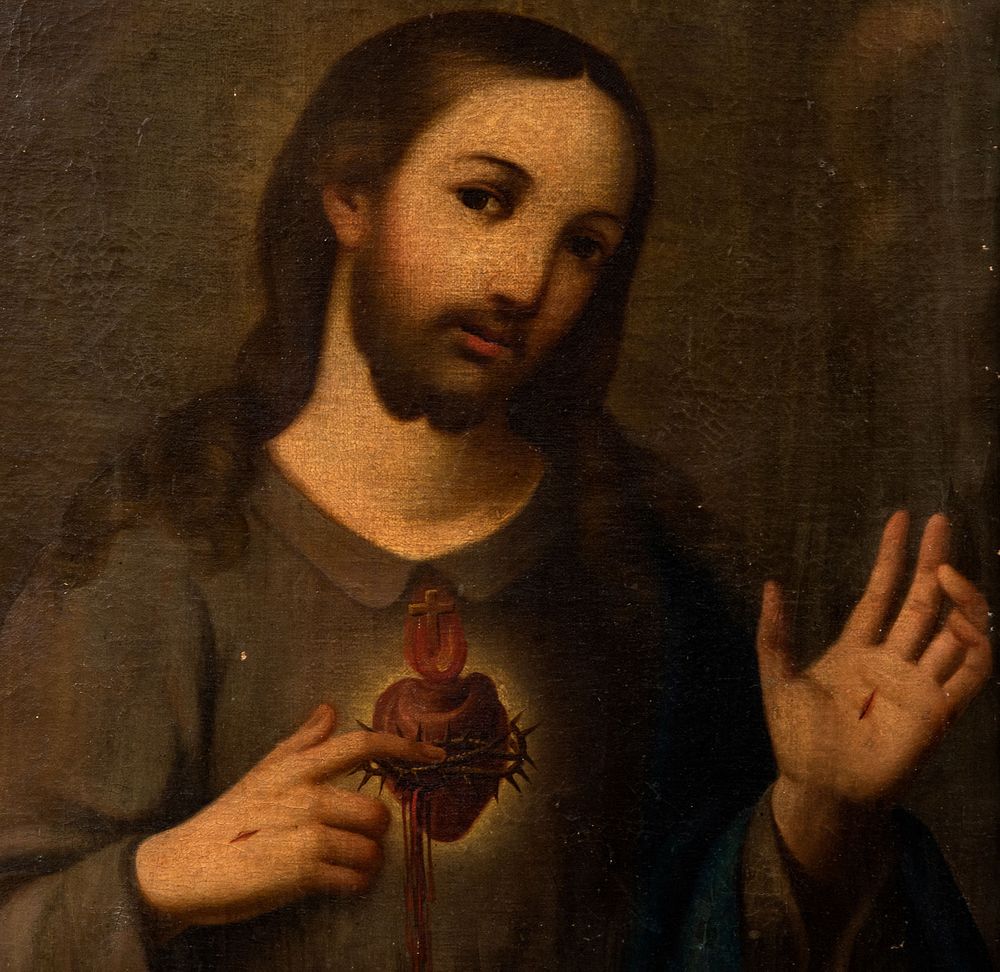
The Good Shepherd does not count efficiency. He counts hearts. In the parable we just heard at the gospel proclamation, Jesus reveals a God who is not content with percentages. Ninety-nine is not enough. One missing sheep is one too many. And so He leaves the safe, the counted, the settled—to seek the one who is wandering, wounded, or simply weary. He does not scold. He searches. And when He finds the sheep, He does not drag it back. He lifts it onto His shoulders, as if the burden were joy. This is the logic of the Sacred Heart—a heart that bleeds not only for humanity as a whole, but for each soul. A heart that is pierced, not to display suffering, but to pour out love. The image of the Sacred Heart is not sentimental. It is radical. It tells of a God who leaves behind the respectable to find the lost, not with shame but with song. “Rejoice with me,” He says—not when we get everything right, but when we let ourselves be found. There is more joy in heaven over one sinner who repents—because heaven is not a reward for the perfect, but the home of the beloved • AE
Corazón encendido, llama pura, de espinas coronado y fiel herido, en Ti reposa el mundo estremecido y el cielo canta en áurea hermosura.
Los ángeles te velan con ternura, y el aire se arrodilla agradecido. Tu sangre es luz, tu herida es el latido que salva al alma, y sana su amargura.
¡Oh llama eterna, amor que no se apaga! ¡Oh Cruz clavada en pecho tan divino! ¡Oh Rey que en vez de trono el pecho embriaga!
Que todo el corazón sea tu camino, y aun el perdido, al verte, se propaga de gozo, de perdón, de cielo y vino.
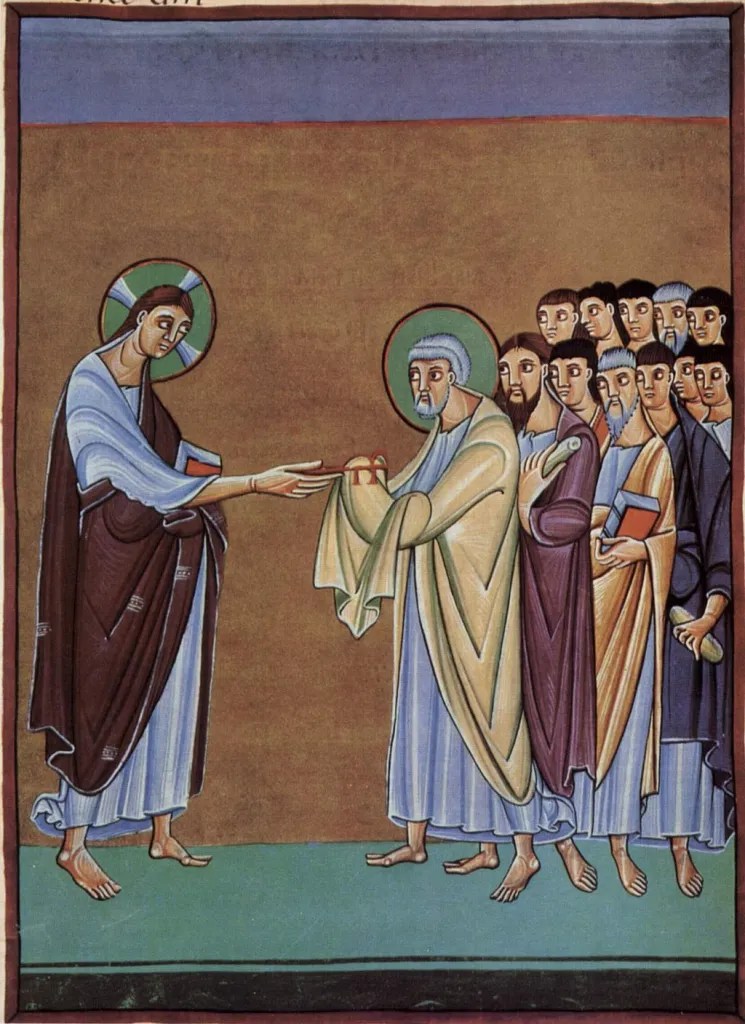
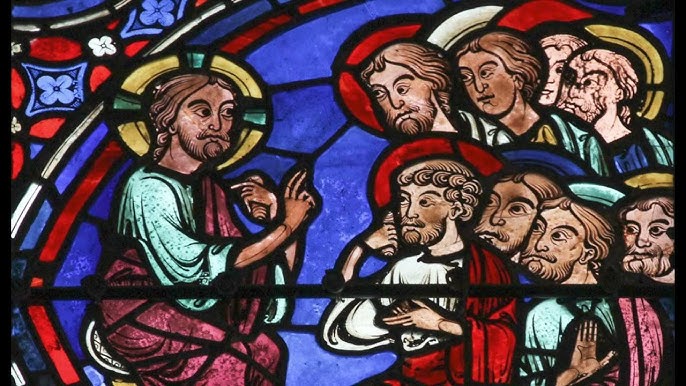
Master of the Pericopes, Book of Henry II, Saint Peter Receives the Keys (Early 11th century), Color on parchment, Bavarian State Library (Munich)
In the shadowed region of Caesarea Philippi, Jesus asks a question that reverberates through the ages: “Who do you say that I am?” Not addressed to crowds or scholars, but to his closest companions. It is not a question of opinion—it is a call to revelation. Peter, impulsive and imperfect, responds with startling clarity: “You are the Christ, the Son of the living God.” His answer does not emerge from human calculation but from divine inspiration. Jesus affirms it: “Flesh and blood has not revealed this to you, but my heavenly Father.” And with that confession, a fisherman becomes a cornerstone—not for his strength, but for his surrender. At the heart of this moment is Jesus Himself—Messiah and Son, revealer and foundation. He builds His Church not on perfection, but on grace; not on achievement, but on faith. The Solemnity of Saints Peter and Paul is not a celebration of human greatness, but of divine trust. These two apostles—one who denied Christ, the other who persecuted Him—are brought into union not by ideology, but by mercy. Their martyrdom in Rome is not a tragedy of failure but a testimony of transformation. In their very bodies, the Church was planted, watered, and made to grow.
This year, the feast bears a particular poignancy. It is the first since the death of Pope Francis, servant of the poor and herald of God’s tenderness. In the spirit of Peter, he reminded the Church that mercy is not weakness, but the deepest expression of divine strength. “The name of God is mercy,” he once said—echoing Peter’s own experience of being lifted from the waters of failure. Now the keys of Peter have been entrusted to Pope Leo XIV, whose early steps suggest a quiet strength, an interior clarity. In him, many hear echoes of Aeneas—that noble bearer of sacred fire through the ashes of Troy, carrying hope not only for survival but for rebirth. Leo XIV seems less interested in spectacle and more in substance; not a disruptor, but a re-rooter. His presence, like Peter’s, invites the Church to deepen her foundation in Christ. Among the treasures of sacred art that illumine this feast, Giovanni Pierluigi da Palestrina’s Tu es Petrus stands out. Composed not to impress, but to elevate, it reflects the serene majesty of the Church’s faith. Layer upon layer of polyphony offers not noise but clarity—the sonic icon of a Church built on confession, not control. It does not entertain; it enthrones. The promise endures: “Upon this rock I will build my Church, and the gates of the netherworld shall not prevail against it.” Not because of Peter’s brilliance, nor Paul’s eloquence, nor the pope’s popularity—but because Christ remains, speaking, guiding, forgiving. Even now, that question still lingers in the heart of the Church and in every disciple’s conscience: “Who do you say that I am?” The answer is not a slogan. It is a life, poured out like Peter’s, like Paul’s, like every saint who has stood where the world trembles and declared, “You are the Christ.” • AE
St. Joseph Catholic Church (Dilley, TX) • Weekend Schedule
Fr. Agustin E. (Parish Administrator)
Friday, June 27, 2025.
11.00 a.m. Sacrament of Marriage for Nancy & Isaac
5.00 p.m. Sacrament of Confession
6.00 p.m. Holy Mass (Solemnity of the Sacred Heart of Jesus)
7.00 p.m. Eucharistic Holy Hour.
Saturday, June 28, 2025.
10.00 a.m. Sacrament of Baptism
5.00 p.m. Sacramento de la Confesión
6.00 p.m. Santa Misa.
Sunday, June 29, 2025
8.00 a.m. Sacrament of Reconciliation
8.30 a.m. Holy Mass.
10.30 p.m. Sacrament of Reconciliation.
11.00 a.m. Holy Mass.
Solemnidad de san Pedro y san Pablo, Apóstoles (2025)
Tú eres el Cristo, el Hijo del Viviente, confiesa Pedro, y el silencio calla. No fue la carne, fue celeste sala quien puso luz de fe sobre su mente.
Y Pablo, en fuego ardiente y penitente, lleva la Cruz allí donde no hay ala. El cielo vence donde el mundo embala y Dios corona a mártir y a creyente.
Sobre esta roca, firme en tu promesa, se alza tu Iglesia, a veces vacilante, mas viva por tu amor, que no cesa.
Francisco duerme en paz, fiel caminante; y un nuevo Pedro vela la tristeza con ojos de esperanza palpitante.
Hay preguntas que definen una vida. Hay silencios que se llenan de eternidad. En Cesarea de Filipo, Jesús no da una lección. Hace una pregunta: “¿Quién dicen ustedes que soy yo?” No busca halagos, ni dogmas recitados de memoria. Busca el corazón. Pedro responde con una fe que le sobrepasa: “Tú eres el Cristo, el Hijo de Dios vivo.” Esa confesión no la aprendió en libros. Le fue revelada. Es un milagro. Y sobre esa fe temblorosa pero auténtica, Jesús promete edificar su Iglesia. Hoy celebramos a Pedro y a Pablo: dos hombres distintos, dos formas de amar a Cristo. Uno negó. Otro persiguió. Y sin embargo, ambos fueron elegidos. El primero para sostener, el segundo para anunciar. La Iglesia no nace de los mejores, sino de los transformados. No es una maquinaria perfecta, sino una comunidad tejida con gracia. Esta solemnidad, vivida en domingo, nos devuelve al centro: No celebramos a Pedro como símbolo de poder, ni a Pablo como genio teológico. Celebramos a Cristo que salva, que llama, que envía, y que nunca deja de confiar en nosotros. Este año, la memoria de San Pedro se mezcla con la de un pastor que llevó su nombre espiritual hasta el extremo: el Papa Francisco, ya en la paz de Dios. No fue un papa de equilibrio fácil. Fue, como Pedro, impulsivo, audaz, a veces incomprendido. Pero nunca dudó en señalar a Jesús, una y otra vez, como el único necesario. Nos recordó que la misericordia no es una concesión, sino el ADN del Evangelio. Que las periferias no son moda, sino lugar teológico. Que la Iglesia es madre, no aduana. Y en continuidad, no en ruptura, el Papa León XIV comienza su servicio con una voz más recogida, más contemplativa, pero no menos firme. Su primer mensaje ha sido claro: la roca sigue siendo Cristo. No se trata de inventar una nueva Iglesia, sino de redescubrir su rostro verdadero. Para esta fiesta, no resuena solo la voz de un apóstol. Resuena la voz de toda la Iglesia, que en cada Eucaristía proclama: “Credo in unum Deum.” Esa afirmación —a la vez teológica y visceral— ha sido cantada con fuego en muchas lenguas y estilos, pero pocas veces con tanta urgencia espiritual como en el Credo de la Misa en Do menor, K. 427 de Mozart. No es un credo tranquilo; es un credo atravesado por el asombro, por el vértigo de creer de verdad. Cuando el coro irrumpe con ese “Et incarnatus est…”, casi se detiene el tiempo: la fe no es solo afirmación, es adoración. La Iglesia, al decir “creo”, no cita un texto, se entrega. Y sobre esa entrega —como sobre la confesión de Pedro— Cristo sigue edificando su Iglesia.La pregunta sigue abierta, cada día: “¿Y tú, quién dices que soy yo?” La respuesta no se da con discursos. Se da con la vida. Pedro y Pablo la dieron hasta el martirio. Que nosotros, al menos, la demos con fidelidad • AE
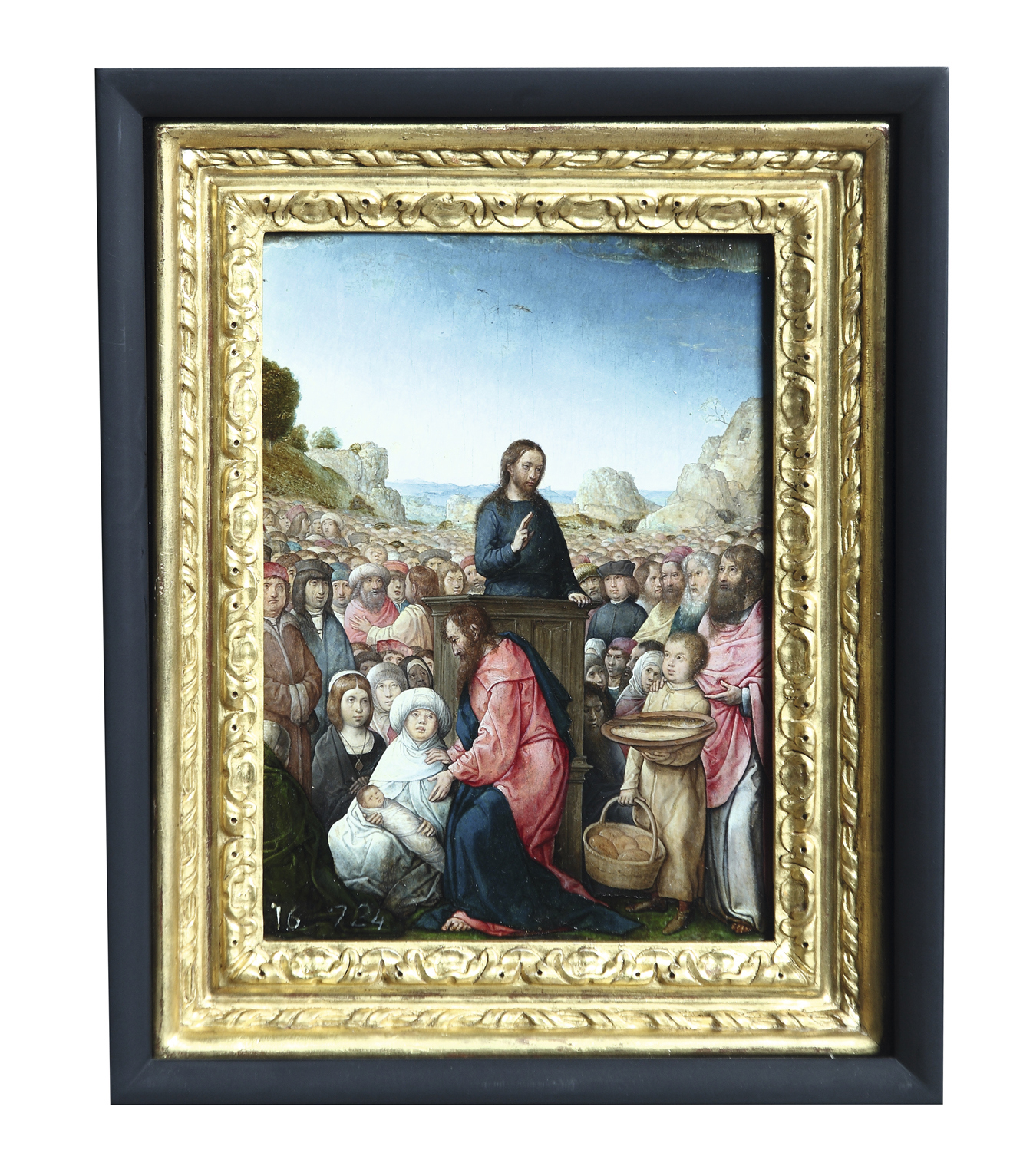
Juan de Flandes, The Multiplication of the Loaves and Fishes, ca. 1496–1504, Oil on panel, Gallery of the Royal Collections (Madrid)
There’s a quiet authority in the way Jesus speaks today. The disciples are overwhelmed: the crowd is too large, the place too remote, the food too little. Their solution is simple and reasonable: send them away. But Jesus is not in the business of sending people away. He is the Shepherd who makes them lie down in green pastures. He is the Host who won’t let them go hungry. “You give them something to eat,” He says. And then: “Make them sit down.” This is the beginning of the miracle — not the multiplication itself, but the invitation to sit. To wait. To receive. The Kingdom of God often begins not with action, but with surrender. Not with doing, but with sitting still in the presence of a Love that prepares the table. There is an echo here of George Herbert’s Love (III), where the soul hesitates at the door of the feast, ashamed and unworthy. But Love, who is Christ Himself, gently insists: “You must sit down,” says Love, “and taste my meat.” That line is not metaphor. It is Eucharist. It is today’s Gospel in verse. The miracle unfolds not through excess, but through trust. Jesus lifts the bread, blesses it, breaks it, gives it. This rhythm is familiar: it is the shape of every Mass. And what seemed too little becomes enough. More than enough. Twelve baskets of abundance. That is always the math of grace: when touched by Christ, scarcity turns to gift. If this moment had a sound, I imagine the voices of Tomás Luis de Victoria rising in polyphony. Perhaps his O Magnum Mysterium — a choral meditation on the humility of God made visible. Music that breathes reverence. That doesn’t rush, but surrounds. That helps us see, not with the eyes, but with the soul. Sacred polyphony does what words cannot: it gives structure to wonder. And so we sit. We, too, are part of the crowd. Hungry, unsure, often unworthy. But He sees us. He knows what we need. And He prepares the table. In every Eucharist, the same voice repeats: “You must sit down, and taste.” And there, in silence, we discover that the Bread is Him — and that He is enough • AE
St. Joseph Catholic Church (Dilley, TX) • Weekend Schedule
Fr. Agustin E. (Parish Administrator)
Saturday, June 21, 2025.
10.00 a.m. Sacrament of Baptism
5.00 p.m. Sacramento de la Confesión
6.00 p.m. Santa Misa con exposición y bendición del Santísimo Sacramento.
Sunday, June 22, 2025
8.00 a.m. Sacrament of Reconciliation
8.30 a.m. Holy Mass with exposition & benediction with the Most Holy Sacrament
10.30 p.m. Sacrament of Reconciliation.
11.00 a.m. Holy Mass with exposition & benediction with the Most Holy Sacrament
Solemnidad del Cuerpo y la Sangre de Cristo (2025)
Pan de los cielos, luz del alma herida, fuego escondido en blanca transparencia, paz que desborda toda resistencia, vida ofrecida por nuestra perdida.
Misterio fiel, presencia repartida, silencio ardiente, santa permanencia, manjar de amor, divina consistencia, Cristo total en forma comprimida.
¿Quién comprenderá tan hondo abismo? ¿Quién no caerá de gozo ante tal don, si el mismo Dios se queda por nosotros?
Ven, Eucaristía, dulce heroísmo: haz de mi pecho cáliz y rincón, y de mi vida, un pan partido a otros.
No hay urgencia en el gesto. No hay espectáculo. Jesús simplemente toma el pan, lo bendice, lo parte, lo reparte. Y todos comen. Y todos se sacian. Ningún otro signo habla tanto de Dios como este: un Dios que se parte para estar cerca. El milagro de la multiplicación es grande, sí. Pero más grande aún es el gesto oculto que lo precede: Jesús mira con compasión y confía en lo poco. No llama a los ángeles, no crea algo de la nada. Solo pide lo que hay. Y lo transforma. Así es Él. Esa misma lógica nos envuelve cada vez que celebramos la Eucaristía. Porque en el altar no solo se parte el pan: se parte el corazón de Cristo, y se nos da entero. Y si uno lo piensa, ¿cómo no temblar un poco antes de comulgar? ¿Cómo no arrodillarse por dentro? Mozart supo traducir ese temblor en música. Su Ave verum corpus —breve, casi tímido— no quiere impresionar, sino postrarse. Es música sin pretensión, sin artificio. Una plegaria hecha melodía. Parece escrita no para un público, sino para un altar. Cada nota cae como gota de luz, como si la música misma comulgara. No hay tensión, solo paz. No hay grandeza humana, solo el silencio de Dios que se deja tocar. “Ave, verdadero cuerpo, nacido de María Virgen”, canta el texto. Y uno entiende: esto no es solo música. Es adoración. Es teología que arde. Es música que acompaña al alma hasta ese umbral donde la fe deja de ser idea y se vuelve asombro. Pan que contiene al Rey. Sangre que lava. Presencia que sana. En la fiesta del Corpus Christi, el cristiano no explica. Contempla. Adora. Se deja invitar. Porque el que parte el pan sigue haciéndolo. Y sigue diciendo: “Denles ustedes de comer.” ¿Y qué podemos dar, si no es a Él mismo? ¿Qué puede saciar, si no es Su Cuerpo vivo entre nosotros? El milagro se repite. La mesa está servida. El Amor sigue siendo carne. Y basta con abrir las manos, como quien escucha en silencio el Ave verum, para descubrir que el cielo ya empezó • AE
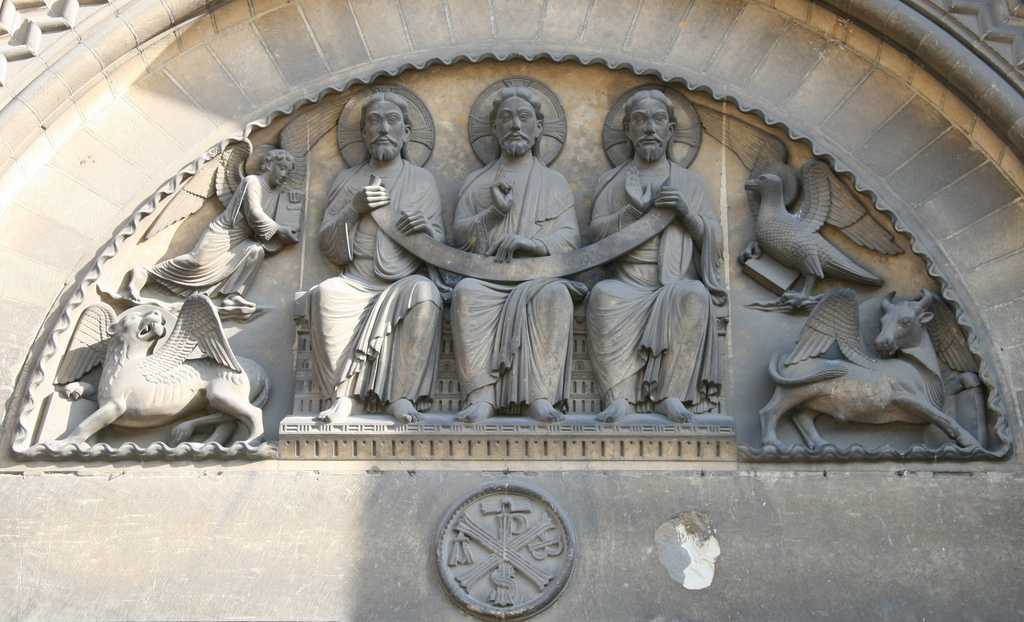
Anonymous artist, Neo-Romanesque relief from the former Church of the Trinity (1862), Caen (France)
On this Sunday, the Church dares to speak of mystery—not to reduce it, but to stand before it with reverent awe. The Gospel presents us not with a philosophical explanation of the Trinity, but with an intimate window into the heart of God: a relationship of love, truth, and self-giving between Father, Son, and Holy Spirit. Jesus tells his disciples that there is still much he wishes to reveal, but that they cannot bear it yet. This is not a failure of communication, but a mark of divine tenderness. Truth, like love, must be unfolded gently. The Holy Spirit—the Spirit of Truth—does not force open our minds, but accompanies us, whispering light into the darkened corners of our understanding, forming us into people who can bear and live the truth. One of the most powerful literary evocations of this mystery comes at the very end of Dante Alighieri’s Paradiso. After a long ascent through the celestial spheres, Dante beholds the divine light, and tries to describe what cannot be described:
“O Light Eternal, dwelling in Yourself, alone, self-knowing, and known unto Yourself, and knowing, loving, smiling on Yourself!” (Paradiso, Canto XXXIII)
Here, Dante’s Trinitarian vision is not abstract or systematic. It is contemplative and luminous. He does not «understand» the Trinity in a didactic way. Rather, he is caught up in its beauty, moved by the harmony of divine persons who are both distinct and perfectly one. Like Dante, we are not called to solve the Trinity, but to be drawn into it. To accompany this Gospel, I suggest Arvo Pärt’s minimalist piece Spiegel im Spiegel (“Mirror in the Mirror”). It is deceptively simple: a slow unfolding of piano and violin, repeating, mirroring, stretching toward silence. There is no climax—only presence. Like the Spirit, the music does not draw attention to itself, but quietly shapes space for reflection. Listening to it can feel like standing before a mystery: peaceful, yet charged with depth. As Pärt himself once said, “The more perfect the work, the more silent it is.” That silence is not emptiness, but fullness held in reverence—just as the Spirit does not speak on his own, but glorifies the Son, and in doing so, reveals the Father. This Sunday, we remember that the Trinity is not a riddle to be solved, but a reality to be inhabited. The Spirit of truth is already at work in the Church, in our hearts, and in history—not as noise, but as harmony; not as pressure, but as promise. The Spirit teaches us, not by novelty, but by drawing us ever deeper into the Word who was made flesh. And so, we pray: Come, Holy Spirit. Form in us the heart of the Son, that we may glorify the Father! • AE
St. Joseph Catholic Church (Dilley, TX) • Weekend Schedule
Fr. Agustin E. (Parish Administrator)
Saturday, June 14, 2025.
10.00 a.m. Sacrament of Baptism
5.00 p.m. Sacramento de la Confesión
6.00 p.m. Santa Misa.
Sunday, June 15, 2025
8.00 a.m. Sacrament of Reconciliation
8.30 a.m. Holy Mass.
10.30 p.m. Sacrament of Reconciliation.
11.00 a.m. Holy Mass.
Solemnidad de la Santísima Trinidad (2025)
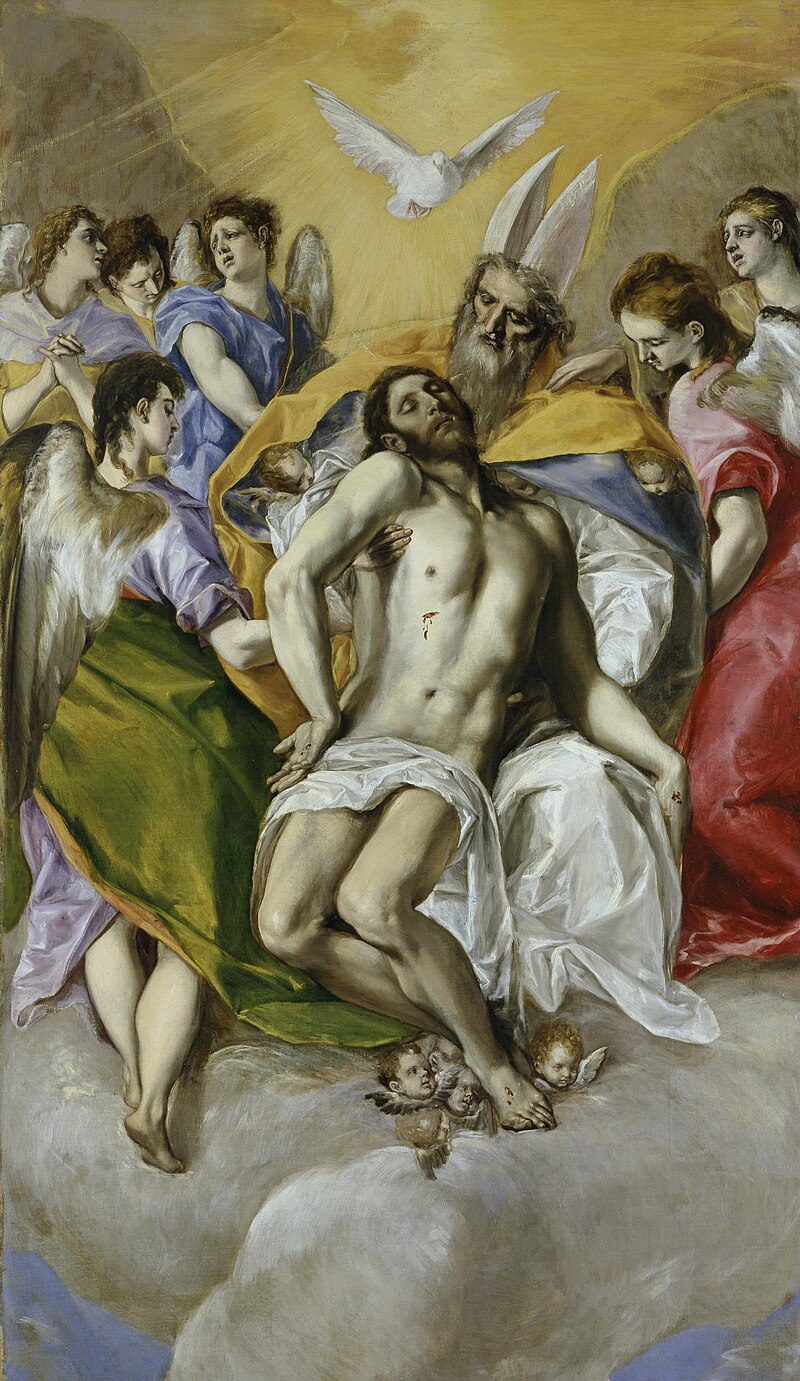
D. Theotokopuli, El Greco, La Trinidad (1577), óleo sobre tela, Museo Nacional del Prado (Madrid)
Jesús habla con ternura. No reprocha la lentitud de sus discípulos, ni se impacienta con su incapacidad para entender. Simplemente reconoce lo humano: hay verdades que necesitan tiempo, que solo el amor puede madurar en el corazón. La Verdad no se impone como un peso, se entrega como un don. El Espíritu Santo no irrumpe con violencia, sino que desciende como brisa, como susurro fiel, como guía paciente que nos conduce hacia toda la verdad. La Trinidad, ese misterio que hoy celebramos, no es un acertijo teológico, sino el origen y el destino del amor: un Dios que no es soledad, sino comunión. En la Trinidad descubrimos que decir “Dios es amor” no es metáfora, sino definición. El Padre ama al Hijo, el Hijo acoge y devuelve ese amor, y el Espíritu es ese amor hecho persona, hecho impulso, hecho vida derramada en nosotros.
Esta delicadeza divina recuerda a la manera en que Antoine de Saint-Exupéry, en El Principito, describe los lazos verdaderos: “Lo esencial es invisible a los ojos.Solo se ve bien con el corazón.” Así es la acción del Espíritu Santo: invisible a los ojos, pero muy visible en el corazón que ama, perdona, espera. No hace ruido, pero transforma. No da espectáculo, pero santifica. No habla por cuenta propia, sino que comunica lo que oye: la palabra eterna del Hijo, el deseo profundo del Padre. Y lo hace en nuestro idioma, en nuestra historia, con la voz concreta de nuestras luchas y esperanzas. ¿Y cómo suena esta voz? Quizá como laPavana para una infanta difunta del francés Maurice Ravel. Suave, pausada, melancólica y luminosa a la vez. Es una música que no exige atención, pero la recibe; que no explica nada, pero dice mucho. Como el Espíritu, no domina, pero transforma. En su fluir tranquilo, parece abrir espacio en el alma para que Dios hable sin palabras. Celebrar la Trinidad no es entenderla, sino dejarse habitar por ella. Dejar que el Padre nos ame, que el Hijo nos salve, que el Espíritu nos enseñe a vivir. A veces no entenderemos todo. No importa. Basta con seguir caminando, dejándonos guiar, como el Principito, por lo invisible que da sentido a todo • AE
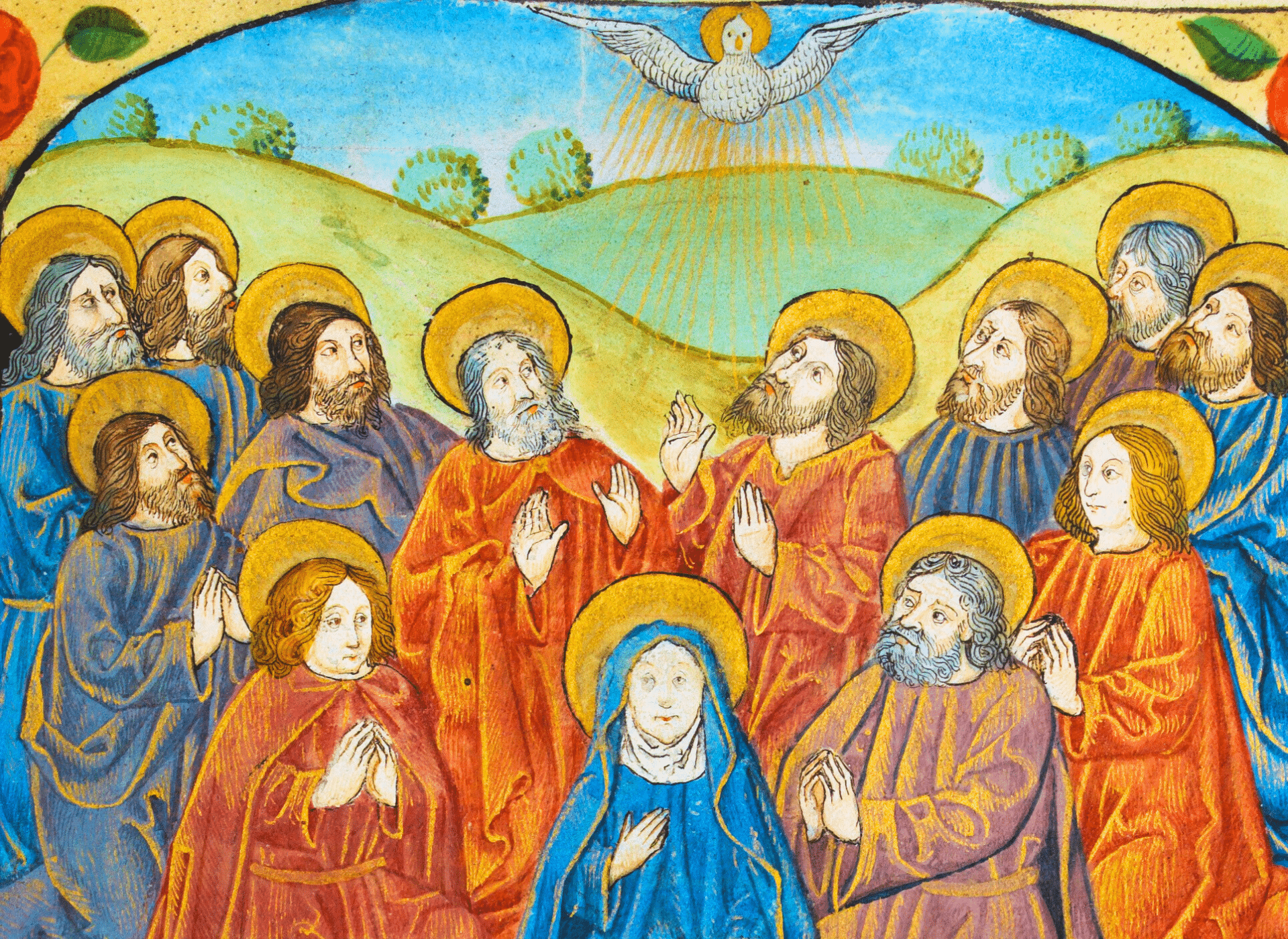
The disciples rejoiced when they saw the Lord.” That line is everything. Not: the disciples rejoiced because their problems were solved. Not: they rejoiced because the Romans were gone. Not: because they felt better. They rejoiced because they saw the Lord. It is the only joy that cannot be faked. This Sunday, the Easter season comes to its climax—not with fanfare, but with breath. With mission. With mercy. The Risen Christ enters into a room of fear and transforms it—not by changing the circumstances, but by revealing himself. And they rejoiced. That is Pentecost. It is not, first of all, about fire and wind. It is about seeing Him. Knowing He is alive. Letting His breath become ours. In the words of T.S. Eliot: “We had the experience but missed the meaning. And approach to the meaning restores the experience.” (Four Quartets)
The world offers us many distractions, many pleasures, even temporary happiness. But it does not offer joy. Because joy has a name. And his name is Jesus. The early disciples didn’t rejoice because their fear disappeared. They rejoiced because they saw Jesus—and from that moment on, they understood: the center of everything is not death, but love stronger than death. This joy is not fragile. It is born of scars and breath and mission. This is why the Paschal Candle is extinguished today—not because the light has gone out, but because it has moved inside us. The joy is not external anymore. It is Christ within us, breathing through us, sending us. To mark the solemnity, I turned again to Bach’s “Jesu, Joy of Man’s Desiring.” It doesn’t erupt; it flows. It doesn’t overwhelm; it carries. The melody walks gently, as if the soul were breathing through each note. There is discipline, yes—but also something almost tender, like reverence turned into sound. It feels like Pentecost: not loud, not theatrical, but quietly certain. A music born not of emotion, but of vision. Like the disciples’ joy when they saw Him. In a culture that markets happiness but dreads silence, the Church offers this: a quiet room, a locked door, and suddenly… Jesus. And we rejoice. Because He is here. Come, Holy Spirit. Come, true Joy. Come, Lord Jesus! • AE
St. Joseph Catholic Church (Dilley, TX) • Weekend Schedule
Fr. Agustin E. (Parish Administrator)
Saturday, June 7, 2025.
10.00 a.m. Sacrament of Baptism for Avery Garcia
5.00 p.m. Sacramento de la Confesión
6.00 p.m. Santa Misa.
Sunday, June 8, 2025
8.00 a.m. Sacrament of Reconciliation
8.30 a.m. Holy Mass.
10.30 p.m. Sacrament of Reconciliation.
11.00 a.m. Holy Mass.
Domingo de Pentecostés (2025)
Del cielo vino el Fuego sin medida, la llama que no quema, pero inflama. El Viento que despierta y que proclama la paz que da sentido a nuestra vida.
No temas, alma, ya no estás vencida: el Soplo de su amor todo lo llama. Y aunque el temor persista y el mundo exclama, el gozo del Señor será tu huida.
Nos unge con su Espíritu el Cordero, nos lanza a perdonar, sembrar, sanar… y arde el corazón, callado y verdadero.
Iglesia, no te canses de esperar: respira, canta, late el Dios sincero que en lenguas de unidad quiere habitar
“Los discípulos se llenaron de alegría al ver al Señor.” No porque el peligro hubiera pasado, ni porque todo estuviera claro, ni siquiera porque comprendieran lo que estaba sucediendo. Se llenaron de alegría porque lo vieron. Y en esa mirada se abrió una certeza nueva: que el mundo no está abandonado, que la muerte no tiene la última palabra, que el amor permanece herido pero vivo. Es una alegría distinta. No depende del estado de ánimo ni del clima ni de que todo salga bien. Es más bien la alegría que se enciende cuando uno se sabe habitado, alcanzado por una presencia que no necesita imponerse para ser real. En Pentecostés celebramos ese momento en que los ojos vencieron al miedo. El Resucitado no elimina la fragilidad de sus apóstoles, la habita. Se deja ver, muestra sus heridas, respira sobre ellos. Y ese aliento —más que viento, más que fuego— cambia el ritmo del mundo. Es el principio de algo que no termina. Hay alegrías más ruidosas, más visibles, más breves. Pero esta es una alegría que se sostiene incluso en la noche. La reconoce quien ha esperado mucho. Quien ha llorado sin dejar de creer. Quien alguna vez, en medio del encierro, lo ha visto entrar sin avisar, sin pedir permiso, solo para decir: “La paz esté con ustedes.”
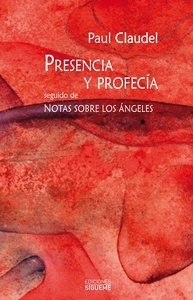
Pensaba en todo esto mientras volvía a escuchar el segundo movimiento del Concierto para piano n.º 2 de Rachmaninov. Hay en ese adagio sostenuto algo que parece venir desde lejos, como si la música saliera lentamente del encierro, de la sombra, hasta alcanzar una especie de claridad luminosa que no es euforia, sino consuelo. No es difícil imaginar a los discípulos así, como esa melodía que va levantándose desde el silencio, casi con pudor, hasta llenarse de vida. Y recordé tambien aquella frase de Paul Claudel, escrita después de una experiencia de conversión en Notre-Dame de París: “De pronto sentí en lo más profundo de mí mismo la presencia de alguien que me amaba.” Eso fue Pentecostés para los discípulos: no una idea, no una emoción, sino una Presencia. Alguien vivo. Alguien que los amaba. Y eso sigue siendo la raíz de nuestra fe. La alegría cristiana no es decorativa. Es una alegría de cicatrices. Pero precisamente por eso, es verdadera. Y porque es verdadera, dura. Pentecostés no es un recuerdo litúrgico. Es una manera de mirar el mundo. Una forma de saber que, por más cerradas que estén las puertas, Él puede entrar. Y cuando eso ocurre —cuando volvemos a verlo— el corazón se llena de una alegría que el mundo no puede fabricar… y que tampoco puede quitar • AE



























 LA MEDITACION DE LA ESPOSA