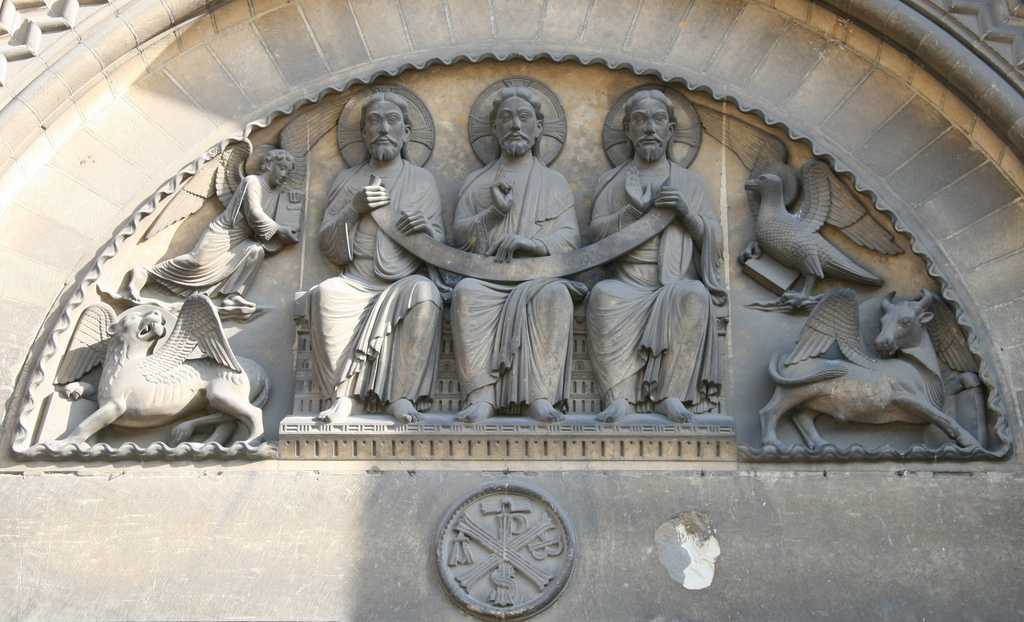
Anonymous artist, Neo-Romanesque relief from the former Church of the Trinity (1862), Caen (France)
On this Sunday, the Church dares to speak of mystery—not to reduce it, but to stand before it with reverent awe. The Gospel presents us not with a philosophical explanation of the Trinity, but with an intimate window into the heart of God: a relationship of love, truth, and self-giving between Father, Son, and Holy Spirit. Jesus tells his disciples that there is still much he wishes to reveal, but that they cannot bear it yet. This is not a failure of communication, but a mark of divine tenderness. Truth, like love, must be unfolded gently. The Holy Spirit—the Spirit of Truth—does not force open our minds, but accompanies us, whispering light into the darkened corners of our understanding, forming us into people who can bear and live the truth. One of the most powerful literary evocations of this mystery comes at the very end of Dante Alighieri’s Paradiso. After a long ascent through the celestial spheres, Dante beholds the divine light, and tries to describe what cannot be described:
“O Light Eternal, dwelling in Yourself, alone, self-knowing, and known unto Yourself, and knowing, loving, smiling on Yourself!” (Paradiso, Canto XXXIII)
Here, Dante’s Trinitarian vision is not abstract or systematic. It is contemplative and luminous. He does not «understand» the Trinity in a didactic way. Rather, he is caught up in its beauty, moved by the harmony of divine persons who are both distinct and perfectly one. Like Dante, we are not called to solve the Trinity, but to be drawn into it. To accompany this Gospel, I suggest Arvo Pärt’s minimalist piece Spiegel im Spiegel (“Mirror in the Mirror”). It is deceptively simple: a slow unfolding of piano and violin, repeating, mirroring, stretching toward silence. There is no climax—only presence. Like the Spirit, the music does not draw attention to itself, but quietly shapes space for reflection. Listening to it can feel like standing before a mystery: peaceful, yet charged with depth. As Pärt himself once said, “The more perfect the work, the more silent it is.” That silence is not emptiness, but fullness held in reverence—just as the Spirit does not speak on his own, but glorifies the Son, and in doing so, reveals the Father. This Sunday, we remember that the Trinity is not a riddle to be solved, but a reality to be inhabited. The Spirit of truth is already at work in the Church, in our hearts, and in history—not as noise, but as harmony; not as pressure, but as promise. The Spirit teaches us, not by novelty, but by drawing us ever deeper into the Word who was made flesh. And so, we pray: Come, Holy Spirit. Form in us the heart of the Son, that we may glorify the Father! • AE

St. Joseph Catholic Church (Dilley, TX) • Weekend Schedule

Fr. Agustin E. (Parish Administrator)
Saturday, June 14, 2025.
10.00 a.m. Sacrament of Baptism
5.00 p.m. Sacramento de la Confesión
6.00 p.m. Santa Misa.
Sunday, June 15, 2025
8.00 a.m. Sacrament of Reconciliation
8.30 a.m. Holy Mass.
10.30 p.m. Sacrament of Reconciliation.
11.00 a.m. Holy Mass.

Solemnidad de la Santísima Trinidad (2025)
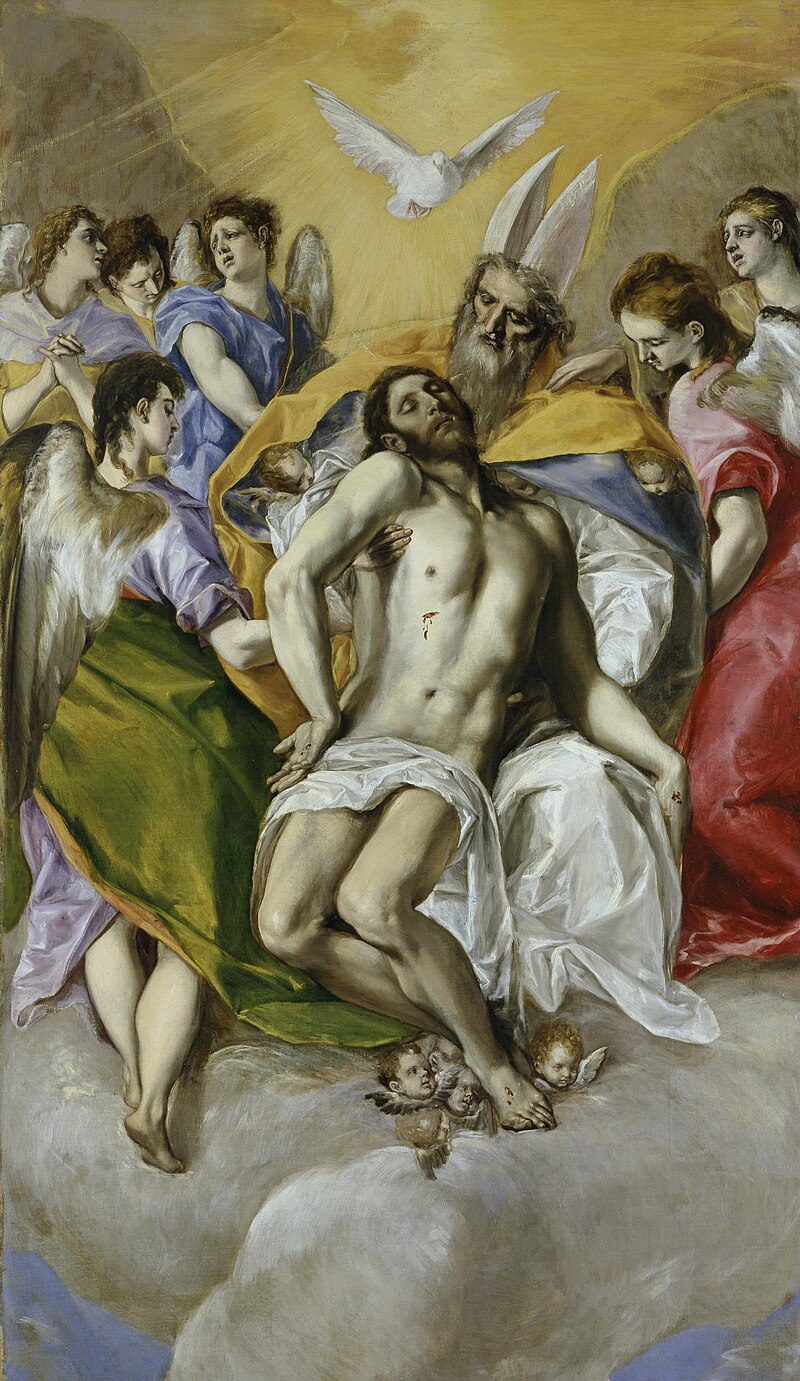
D. Theotokopuli, El Greco, La Trinidad (1577), óleo sobre tela, Museo Nacional del Prado (Madrid)
Jesús habla con ternura. No reprocha la lentitud de sus discípulos, ni se impacienta con su incapacidad para entender. Simplemente reconoce lo humano: hay verdades que necesitan tiempo, que solo el amor puede madurar en el corazón. La Verdad no se impone como un peso, se entrega como un don. El Espíritu Santo no irrumpe con violencia, sino que desciende como brisa, como susurro fiel, como guía paciente que nos conduce hacia toda la verdad. La Trinidad, ese misterio que hoy celebramos, no es un acertijo teológico, sino el origen y el destino del amor: un Dios que no es soledad, sino comunión. En la Trinidad descubrimos que decir “Dios es amor” no es metáfora, sino definición. El Padre ama al Hijo, el Hijo acoge y devuelve ese amor, y el Espíritu es ese amor hecho persona, hecho impulso, hecho vida derramada en nosotros.
Esta delicadeza divina recuerda a la manera en que Antoine de Saint-Exupéry, en El Principito, describe los lazos verdaderos: “Lo esencial es invisible a los ojos.Solo se ve bien con el corazón.” Así es la acción del Espíritu Santo: invisible a los ojos, pero muy visible en el corazón que ama, perdona, espera. No hace ruido, pero transforma. No da espectáculo, pero santifica. No habla por cuenta propia, sino que comunica lo que oye: la palabra eterna del Hijo, el deseo profundo del Padre. Y lo hace en nuestro idioma, en nuestra historia, con la voz concreta de nuestras luchas y esperanzas. ¿Y cómo suena esta voz? Quizá como la Pavana para una infanta difunta del francés Maurice Ravel. Suave, pausada, melancólica y luminosa a la vez. Es una música que no exige atención, pero la recibe; que no explica nada, pero dice mucho. Como el Espíritu, no domina, pero transforma. En su fluir tranquilo, parece abrir espacio en el alma para que Dios hable sin palabras. Celebrar la Trinidad no es entenderla, sino dejarse habitar por ella. Dejar que el Padre nos ame, que el Hijo nos salve, que el Espíritu nos enseñe a vivir. A veces no entenderemos todo. No importa. Basta con seguir caminando, dejándonos guiar, como el Principito, por lo invisible que da sentido a todo • AE

¿Quieres algo para leer?

 LA MEDITACION DE LA ESPOSA