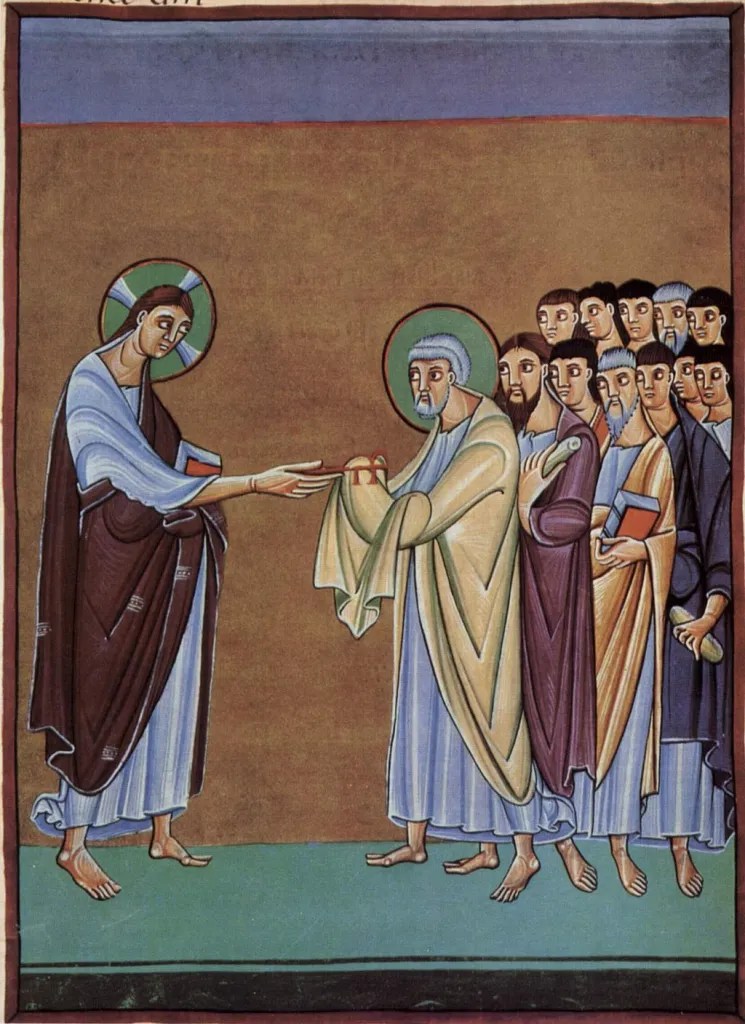
Master of the Pericopes, Book of Henry II, Saint Peter Receives the Keys (Early 11th century), Color on parchment, Bavarian State Library (Munich)
In the shadowed region of Caesarea Philippi, Jesus asks a question that reverberates through the ages: “Who do you say that I am?” Not addressed to crowds or scholars, but to his closest companions. It is not a question of opinion—it is a call to revelation. Peter, impulsive and imperfect, responds with startling clarity: “You are the Christ, the Son of the living God.” His answer does not emerge from human calculation but from divine inspiration. Jesus affirms it: “Flesh and blood has not revealed this to you, but my heavenly Father.” And with that confession, a fisherman becomes a cornerstone—not for his strength, but for his surrender. At the heart of this moment is Jesus Himself—Messiah and Son, revealer and foundation. He builds His Church not on perfection, but on grace; not on achievement, but on faith. The Solemnity of Saints Peter and Paul is not a celebration of human greatness, but of divine trust. These two apostles—one who denied Christ, the other who persecuted Him—are brought into union not by ideology, but by mercy. Their martyrdom in Rome is not a tragedy of failure but a testimony of transformation. In their very bodies, the Church was planted, watered, and made to grow.
This year, the feast bears a particular poignancy. It is the first since the death of Pope Francis, servant of the poor and herald of God’s tenderness. In the spirit of Peter, he reminded the Church that mercy is not weakness, but the deepest expression of divine strength. “The name of God is mercy,” he once said—echoing Peter’s own experience of being lifted from the waters of failure. Now the keys of Peter have been entrusted to Pope Leo XIV, whose early steps suggest a quiet strength, an interior clarity. In him, many hear echoes of Aeneas—that noble bearer of sacred fire through the ashes of Troy, carrying hope not only for survival but for rebirth. Leo XIV seems less interested in spectacle and more in substance; not a disruptor, but a re-rooter. His presence, like Peter’s, invites the Church to deepen her foundation in Christ. Among the treasures of sacred art that illumine this feast, Giovanni Pierluigi da Palestrina’s Tu es Petrus stands out. Composed not to impress, but to elevate, it reflects the serene majesty of the Church’s faith. Layer upon layer of polyphony offers not noise but clarity—the sonic icon of a Church built on confession, not control. It does not entertain; it enthrones. The promise endures: “Upon this rock I will build my Church, and the gates of the netherworld shall not prevail against it.” Not because of Peter’s brilliance, nor Paul’s eloquence, nor the pope’s popularity—but because Christ remains, speaking, guiding, forgiving. Even now, that question still lingers in the heart of the Church and in every disciple’s conscience: “Who do you say that I am?” The answer is not a slogan. It is a life, poured out like Peter’s, like Paul’s, like every saint who has stood where the world trembles and declared, “You are the Christ.” • AE

St. Joseph Catholic Church (Dilley, TX) • Weekend Schedule

Fr. Agustin E. (Parish Administrator)
Friday, June 27, 2025.
11.00 a.m. Sacrament of Marriage for Nancy & Isaac
5.00 p.m. Sacrament of Confession
6.00 p.m. Holy Mass (Solemnity of the Sacred Heart of Jesus)
7.00 p.m. Eucharistic Holy Hour.
Saturday, June 28, 2025.
10.00 a.m. Sacrament of Baptism
5.00 p.m. Sacramento de la Confesión
6.00 p.m. Santa Misa.
Sunday, June 29, 2025
8.00 a.m. Sacrament of Reconciliation
8.30 a.m. Holy Mass.
10.30 p.m. Sacrament of Reconciliation.
11.00 a.m. Holy Mass.
Solemnidad de san Pedro y san Pablo, Apóstoles (2025)

Tú eres el Cristo, el Hijo del Viviente,
confiesa Pedro, y el silencio calla.
No fue la carne, fue celeste sala
quien puso luz de fe sobre su mente.
Y Pablo, en fuego ardiente y penitente,
lleva la Cruz allí donde no hay ala.
El cielo vence donde el mundo embala
y Dios corona a mártir y a creyente.
Sobre esta roca, firme en tu promesa,
se alza tu Iglesia, a veces vacilante,
mas viva por tu amor, que no cesa.
Francisco duerme en paz, fiel caminante;
y un nuevo Pedro vela la tristeza
con ojos de esperanza palpitante.
Hay preguntas que definen una vida. Hay silencios que se llenan de eternidad. En Cesarea de Filipo, Jesús no da una lección. Hace una pregunta: “¿Quién dicen ustedes que soy yo?” No busca halagos, ni dogmas recitados de memoria. Busca el corazón. Pedro responde con una fe que le sobrepasa: “Tú eres el Cristo, el Hijo de Dios vivo.” Esa confesión no la aprendió en libros. Le fue revelada. Es un milagro. Y sobre esa fe temblorosa pero auténtica, Jesús promete edificar su Iglesia. Hoy celebramos a Pedro y a Pablo: dos hombres distintos, dos formas de amar a Cristo. Uno negó. Otro persiguió. Y sin embargo, ambos fueron elegidos. El primero para sostener, el segundo para anunciar. La Iglesia no nace de los mejores, sino de los transformados. No es una maquinaria perfecta, sino una comunidad tejida con gracia. Esta solemnidad, vivida en domingo, nos devuelve al centro: No celebramos a Pedro como símbolo de poder, ni a Pablo como genio teológico. Celebramos a Cristo que salva, que llama, que envía, y que nunca deja de confiar en nosotros. Este año, la memoria de San Pedro se mezcla con la de un pastor que llevó su nombre espiritual hasta el extremo: el Papa Francisco, ya en la paz de Dios. No fue un papa de equilibrio fácil. Fue, como Pedro, impulsivo, audaz, a veces incomprendido. Pero nunca dudó en señalar a Jesús, una y otra vez, como el único necesario. Nos recordó que la misericordia no es una concesión, sino el ADN del Evangelio. Que las periferias no son moda, sino lugar teológico. Que la Iglesia es madre, no aduana. Y en continuidad, no en ruptura, el Papa León XIV comienza su servicio con una voz más recogida, más contemplativa, pero no menos firme. Su primer mensaje ha sido claro: la roca sigue siendo Cristo. No se trata de inventar una nueva Iglesia, sino de redescubrir su rostro verdadero. Para esta fiesta, no resuena solo la voz de un apóstol. Resuena la voz de toda la Iglesia, que en cada Eucaristía proclama: “Credo in unum Deum.” Esa afirmación —a la vez teológica y visceral— ha sido cantada con fuego en muchas lenguas y estilos, pero pocas veces con tanta urgencia espiritual como en el Credo de la Misa en Do menor, K. 427 de Mozart. No es un credo tranquilo; es un credo atravesado por el asombro, por el vértigo de creer de verdad. Cuando el coro irrumpe con ese “Et incarnatus est…”, casi se detiene el tiempo: la fe no es solo afirmación, es adoración. La Iglesia, al decir “creo”, no cita un texto, se entrega. Y sobre esa entrega —como sobre la confesión de Pedro— Cristo sigue edificando su Iglesia.La pregunta sigue abierta, cada día: “¿Y tú, quién dices que soy yo?” La respuesta no se da con discursos. Se da con la vida. Pedro y Pablo la dieron hasta el martirio. Que nosotros, al menos, la demos con fidelidad • AE

¿quÉ aNDas LeYendo?



 LA MEDITACION DE LA ESPOSA