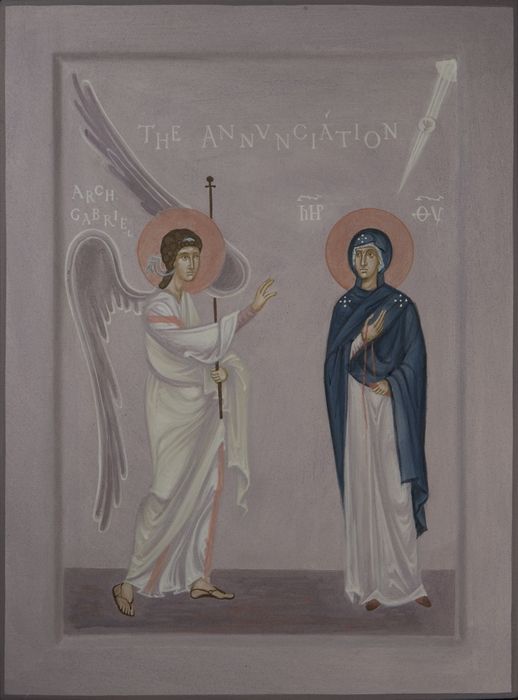
The Annunciation (2016), Contemporary sacred icon commissioned for a Christian church
Painted by Philip Davydov and Olga Shalamova as part of a series of icons of the Christian feasts.
On this final Sunday of Advent, everything quietly converges in Mary: the ancient promise given to a frightened king in Isaiah—“the virgin shall conceive and bear a son”—and the simple, trembling obedience that unfolds in the house of Joseph; what was once only a sign spoken into uncertainty now becomes flesh in her hidden life, and that is the beauty of today’s unity between the first reading and the Gospel—God speaks first through prophecy, and then He answers Himself through a woman who trusts Him without conditions, allowing Emmanuel, “God-with-us,” to truly enter our world; Joseph’s obedience protects the mystery, but Mary carries it, and in her the door of the Psalms finally opens—“Let the King of Glory enter”—not into a temple of stone, but into a human body and a human history; this is the Church’s last whispered joy before Christmas, and it sounds like the ancient Advent prayer of Alma Redemptoris Mater, where the world begs the Mother to help us receive what she alone first received, while her interior path is illuminated with rare tenderness in The Reed of God, where Mary is seen not as distant perfection but as the fragile reed through which God allows His breath to pass into the world; Isaiah announces the sign, Matthew reveals its fulfillment, but Mary is the living bridge between promise and presence—and through her quiet yes, the King of Glory finally finds His way inside • AE
Alma Redemptoris Mater is one of the four great Marian antiphons of the Church, traditionally sung from the beginning of Advent until the Feast of the Presentation in February; it emerged in the early Middle Ages (around the 11th century) as part of monastic night prayer, where it served as a tender plea to Mary at the threshold of the Incarnation. Its text calls her the “loving Mother of the Redeemer” and captures the heart of Advent itself: the world leaning toward Mary, asking her help as it waits for Christ to be born •

St. Joseph Catholic Church (Dilley, TX) • Weekend Schedule
Fr. Agustin E. (Parish Administrator)
Saturday, December 20, 2025.
10.00 a.m. Sacrament of Baptism
5.00 p.m. Sacramento de la Confesión
6.00 p.m. Santa Misa.
Sunday, December 21, 2025
8.00 a.m. Sacrament of Reconciliation
8.30 a.m. Holy Mass.
10.30 a.m. Sacrament of Reconciliation.
11.00 a.m. Holy Mass.
IV Domingo de Adviento (Ciclo A)
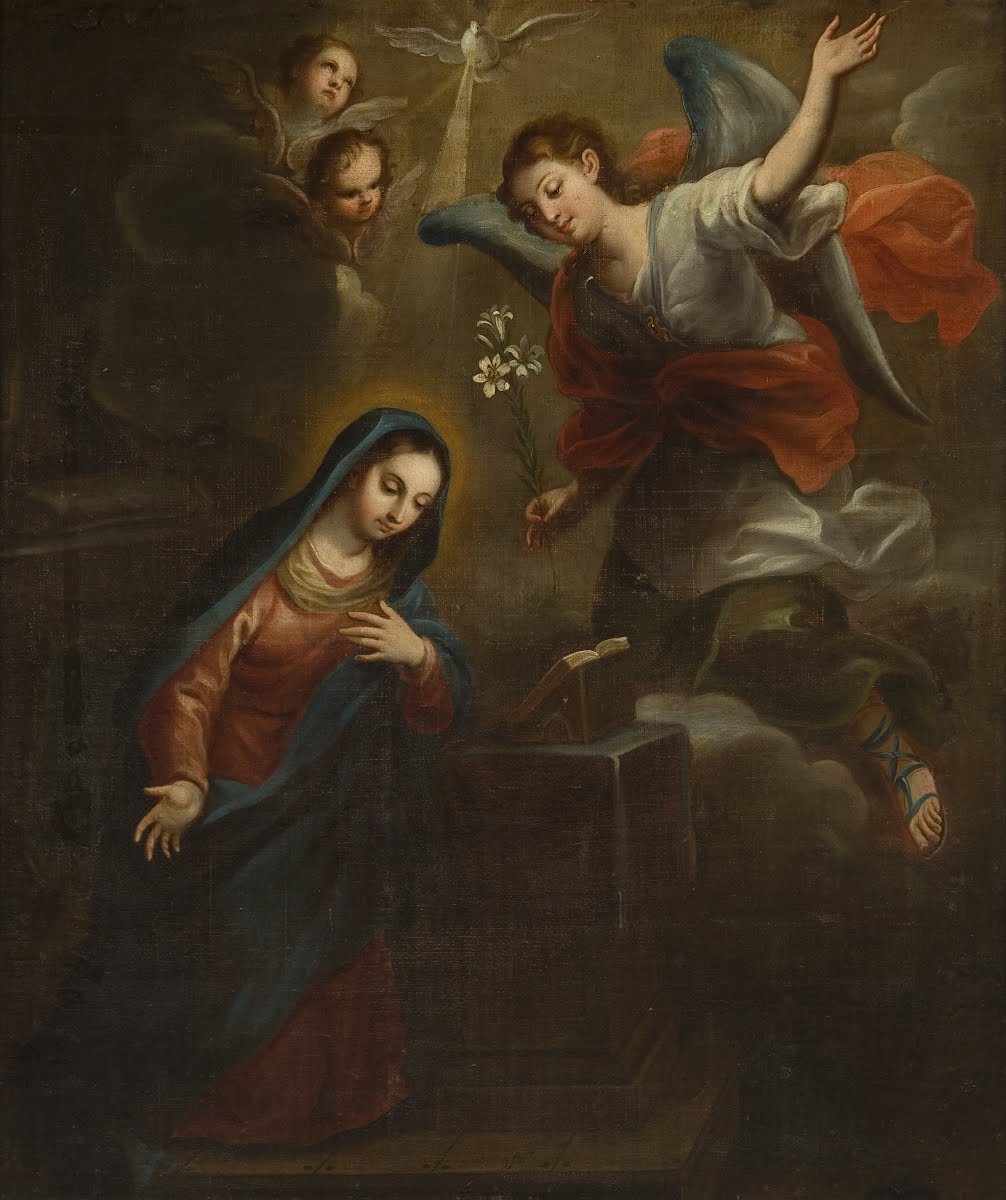
Miguel Cabrera, La Anunciación (1760), óleo sobre tela, Museo Arocena (Torreón, México)
En el umbral de la Navidad, la liturgia ya no nos habla de caminos que se enderezan ni de desiertos que florecen, sino de un hogar concreto donde Dios decide entrar sin estruendo: una casa sencilla, una mujer joven, un hombre justo; la antigua promesa hecha a la casa de David en Isaías deja de ser un eco lejano y se convierte en pulso real dentro del cuerpo de María, y el salmo —“Que entre el Rey de la gloria”— ya no suena como una consigna, sino como una confesión humilde: Dios no irrumpe, pide paso; san Pablo nos recuerda que este Jesús pertenece a nuestra historia, a nuestra sangre, a nuestra carne, y el evangelio nos enseña que ese descenso de Dios solo es posible porque alguien se fía sin entender del todo; María no controla el misterio, lo acoge, y José no lo explica, lo protege; en este último domingo de Adviento aprendemos que la fe verdadera no siempre tiene palabras claras, pero siempre tiene espacio disponible, y que Emmanuel no nace donde hay certezas perfectas, sino donde hay corazones que se atreven a abrir la puerta aun con miedo • AE
Missus est Gabriel nace en pleno Renacimiento, cuando la Iglesia vivía un gran florecimiento de la polifonía: música escrita para varias voces independientes que se entrelazan en perfecta armonía. Su compositor, Giovanni Pierluigi da Palestrina, fue la gran figura de este estilo en Roma durante el siglo XVI, y su música marcó el modelo de cómo debía sonar el canto sagrado después del Concilio de Trento: bello, claro y profundamente orante. En este motete, la Anunciación no se cuenta con dramatismo, sino con una serenidad luminosa que ayuda a escuchar el misterio desde dentro •

¿Qué lees?


 LA MEDITACION DE LA ESPOSA