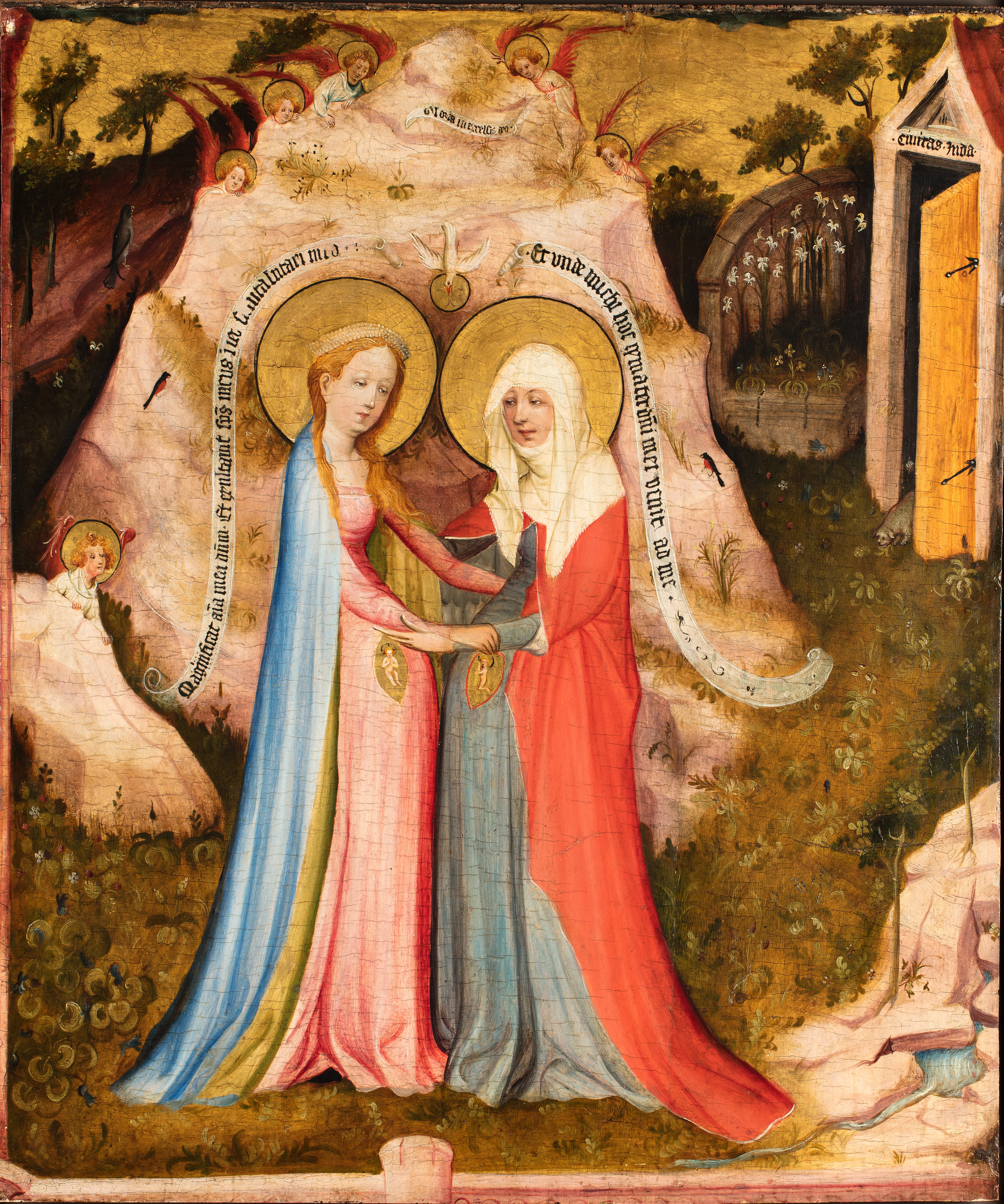
Unknown German artist, The Visitation (1414), Museum Catharijneconvent (Utrecht, Netherlands)
Today’s Gospel presents two pregnant women, Mary and Elizabeth, in that wonderful meeting we refer to as the Visitation. Mary knew that she had to go to Elizabeth. Why? To help Elizabeth with the childbirth? Probably not. After all, Elizabeth was the wife of the priest Zechariah who was high enough in rank to be chosen to offer the sacrifice in the Holy of Holies. There had to be plenty of women around Elizabeth to help her. Why then did Mary proceed with haste to the hill country of Judah to be with Elizabeth? Well, somehow Mary knew that it was part of God’s plan for the two pregnant women to allow the babies they were carrying to come close to each other. So, let us meditate on Mary and Elizabeth as women of prophecy.
The prophecy of Mary’s role began in Genesis. Immediately after the Fall, after Eve convinced Adam that they should eat the fruit of pride, arrogance and disobedience, and be like gods themselves, as the serpent said they would be, immediately God said that another woman would come whose child would destroy the power of evil in the world, the hold of the devil. This woman, of course, was Mary. As time went on the prophet Isaiah declared to King Ahaz that God would give a special sign to the House of David. A virgin would be with child. She will have a son. He will be named Immanuel. It was quite clear that she would be a virgin and yet would be pregnant. The mystery of how this could happen was solved in the fullness of time. I love that phrase fullness of time. It means when God, the One who was beyond time, says the time was right in the economy of salvation. The angel appeared to Mary, and Mary agreed to allow the prophecy to be fulfilled in her. The fact that Mary was a common, everyday Hebrew girl, not a princess in a palace, was significant. As Mary would tell Elizabeth, she, a lowly servant of God, would be raised up. All generations would call her blessed. Only God could do this. To this day we call her the Blessed Virgin Mary. The ancient prophets did not predict anything that referred directly to Elizabeth, but Elizabeth was firmly part of the Biblical tradition of very special women. Like Isaac’s mother, Sarah, like Samson’s mother, the wife of Manoah, like Samuel’s mother, Hanna, Elizabeth, a woman past child bearing years, would be chosen so that her child could demonstrate from the very beginning of is life the miraculous hand of God. This child was to have a significant role in God’s plan for the salvation of mankind. Isaiah said that one would come who would be a voice in the wilderness calling out, “Prepare the way of the Lord.”
Mary and Elizabeth were participants in the transformation of the world into the Kingdom of God. Elizabeth’s child would point to Mary’s child and call him the Lamb of God who would take away the sins of the world. The birth, life, death and resurrection of Mary’s child would be the central event of human history. Prophets said that a Messiah would come. Prophets said that one would come who would prepare the way of the Lord. We are the benefactors of the prophecy. We are the people God came to save. We are the people called to usher in the End Times, the day of the Lord. We are to proclaim with our lives that the Kingdom of God is upon us.
Behold! Behold the birth of John the Baptist, the last of the Old Testament Prophets and the first of the New Testament Prophets. Behold the birth of Jesus. Behold the one whom all of creation is calling out to come. This is the mystery that excites us. It is the same mystery that excited Mary and Elizabeth. They realized that they had each in their own way been chosen to be vehicles of God’s plan of love. Elizabeth’s son, John the Baptist, would point to this Love become flesh. Jesus, Mary’s son, would be this love. We also have been chosen to be part of this plan by the One who loves us and who calls us to make His Love a reality for others • AE

St. Joseph Catholic Church (Dilley, TX) • Weekend Schedule
Fr. Agustin E. (Parish Administrator)
Friday, December 20, 2024.
6.00 p.m. Advent Rosary & Candlelight @ St. Mary’s Chapel
Saturday, December 21, 2024.
5.00 p.m. Sacramento de la Confesión
6.00 p.m. Santa Misa.
Sunday, December 22, 2024
8.00 a.m. Sacrament of Reconciliation
8.30 a.m. Holy Mass.
10.30 p.m. Sacrament of Reconciliation.
11.00 a.m. Holy Mass.
IV Domingo de Adviento (2024)

Bradi Barth, La Visitación de la Virgen a Isabel (1973), óleo sobre tela, colección particular.
No es fácil la alegría. Nunca lo ha sido, tampoco hoy. Algunos de los que analizan la epidemia moderna de pesimismo y depresión dicen que estamos en realidad llegamos ya a la era de la ansiedad y la melancolía. Ya no vivimos tan ansiosos por satisfacer nuestros deseos, pero no encontramos descanso en nada. Nos falta algo para alimentar la alegría de vivir y no sabemos qué. No hemos de confundir la alegría con el sentido del humor. Saber reírse de uno mismo y de los sinsabores de la vida con ternura y piedad hace bien. El humor se niega a que el sufrimiento y la frustración se impongan. Por eso, el humor ayuda a mantener la alegría, pero la alegría es otra cosa, es algo mucho mas profundo. Tampoco hemos de identificarla con el optimismo, esa inclinación a esperar siempre lo mejor. Ser optimista no es verlo todo de color de rosa. No es sustituir la esperanza alimentando ilusiones baratas. El optimista lee la vida de manera positiva y esto es bueno. No olvidemos que no son los hechos los que, por lo general, nos hacen sufrir, sino nuestro modo de interpretarlos y vivirlos. Pero tampoco el optimismo es la alegría.
La alegría nace de lo más hondo de la persona y nos llena por entero. Da un brillo especial y una luz nueva a la existencia. Hace vivir con una confianza básica, nos lleva a darnos, a abrirnos y abrazar. El que vive con alegría no es indiferente a los sufrimientos de los demás. El dolor no le incomoda, le conmueve. Así, la auténtica alegría no se fabrica desde fuera, introduciendo en nuestra vida diversión o entretenimientos, o lujos. Brota del interior. En realidad, la alegría emerge cuando aprendemos a vivir en la verdad y el amor. O menor dicho: en la Verdad y en el Amor: Jesucristo. La alegría es el mejor signo de una vida vivida de manera sana desde su raíz, una vida en la que el Señor esta presente.
Los cristianos decimos que Dios es fuente de alegría. Y es así. Pero sólo cuando lo percibimos no como un sargento cuentachiles que está ahí para hacernos la vida miserable, apuntando en un papelito todo y cada uno de nuestros errores, sino cuando entendemos que camina con nosotros y nos levanta con su misericordia y con su amor. Sólo entonces podemos vivir una vida de manera confiada y no resentida. Sólo entonces podemos experimentar la alegría de vivir.
En este último domingo del tiempo de Adviento, toda la liturgia de la Palabra nos recuerda que la alegría, la autentica, es más fácil cuando nos damos cuenta que no caminamos solos el camino de la vida. Navidad es, de hecho, el gran anuncio de esa grande y maravillosa noticia: ningún ser humano está solo. A todos nos acompaña Dios. Siempre • AE

 LA MEDITACION DE LA ESPOSA