Dear friends, in these weeks of transition I am adapting to the schedule of my new parish community, St. Dominic Catholic Church. Some weekends I don’t have an official Confession schedule, but that doesn’t mean I’m not available. I always am! Please, if you need the Sacrament of Reconciliation, send me an e-mail (agusestrada@gmail.com) and we will find the best time to celebrate the Sacrament of joy. This applies even to every weekday. There is always time for a spiritual talk! Fr. Agustin
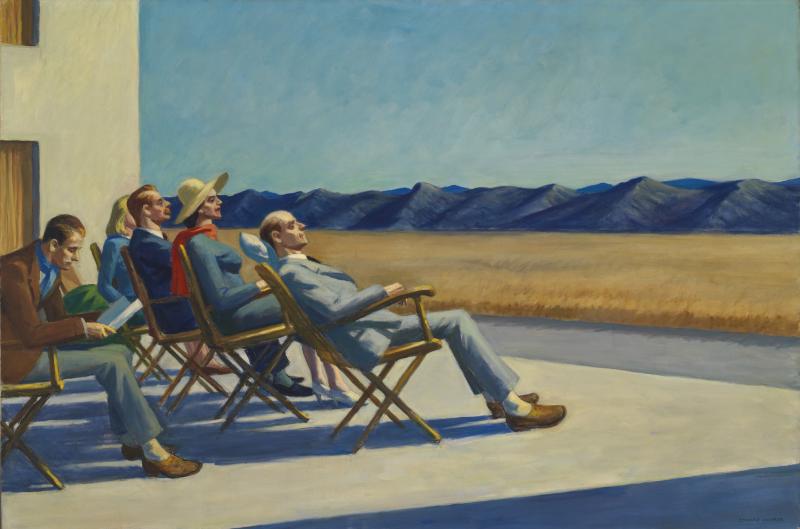
Edward Hopper, People in the Sun, 1960, oil on canvas, Smithsonian American Art Museum (Washington)
The Lord invites his apostles to rest a little. Perhaps the Liturgy is inviting us to consider how we rest. Making a good vacation is an art. Some people think that it is enough to organize the time wisely to get all that kind of enjoyment and fun. Well, it is not that easy! Few things are more painful than seeing people arrive on vacation with a battered spirit and body more tired than ever from the crazy rhythm of summer. You can live a pleasant vacation that, at the same time, improves our quality of life. Taking vacations is, above all, freeing oneself from the dependence and subjection of work to live in relaxation and rest. Some people need to continue their work in some way and are not comfortable without doing nothing. This is a mistake. Work is important, but it does not exhaust the meaning of our existence or reveal its most fundamental and hopeful dimension. The good Christian must learn to live freely and freely enjoying rest, quiet coexistence and joyful contact with nature. In other words: Time spent «doing nothing» is not wasted time, resting is far more than just inactivity. This summer distancing can help us find ourselves, get a clearer vision of our life and even being aware of mistakes and stuff that need to be corrected. Holidays generally offer the possibility of living more freely and creatively, but it is precisely this freedom and lack of daily routine that can create problems. Some people do not know how to «kill time», others need to schedule all their activities. The key lies in living creatively, enjoying free time in body and spirit, around nature and friends, enjoying music and art and real prayer life. There are many ways to hear the call of Jesus: «Come to a quiet place to rest a little.» We must not forget, however, that whoever does not love, cannot rest and rejoice. «Ubi caritas gaudet, ibi est festivitas», Saint John Chrysostom used to say, «where love awakens joy, there are festivities! • AE
Fr. Agustin’s Schedule for the Fifteenth Sunday in Ordinary Time
Sunday, July 11, 2021
7.30 a.m. Mass (English) @ St. Dominic Catholic Church
10.30 a.m. Mass (English) @ St. Dominic Catholic Church
Dear friends, in these weeks of transition I am adapting to the schedule and customs of my new parish community. As you can see, on this weekend’s schedule, I don’t have an official confession schedule, but that doesn’t mean I’m not available. I always am! Please, if you need the Sacrament of Reconciliation, send me an e-mail (agusestrada@gmail.com) and we will find the best time to celebrate the Sacrament of joy. This applies even to every weekday. There is always time for a spiritual talk! Fr. Agustin
XVI Domingo del Tiempo Ordinario
Los cristianos nos preocupamos mucho de que la Iglesia cuente con medios adecuados para cumplir eficazmente su tarea: recursos económicos, presencia social, plataformas de comunicacion eficientes. Nos parece lo más normal. Sin embargo, cuando Jesús envía a sus discípulos a prolongar su misión, no piensa en lo que deben llevar consigo, sino precisamente en lo contrario: lo que no deben llevar. El estilo de vida que les propone es tan desafiante y provocativo, que pronto las generaciones cristianas lo suavizaron. ¿Qué hemos de hacer hoy con estas palabras de Jesús?, ¿borrarlas del evangelio?, ¿olvidarlas para siempre?, ¿tratar de ser también hoy fieles a su espíritu? Jesús pide a sus discípulos que no tomen consigo dinero ni provisiones. Y es que el mundo nuevo que él busca no se construye con dinero. Su proyecto no lo sacarán adelante los ricos, sino gente sencilla que sepa vivir con pocas cosas porque han descubierto lo esencial: el reino de Dios y su justicia. No llevarán alforjas, al estilo de los filósofos que llevaban colgando del hombro una bolsa donde guardaban las limosnas para asegurarse el futuro. La obsesión por la seguridad no es buena. Desde la tranquilidad del bienestar no es fácil crear el reino de Dios como un espacio de vida digna para todos. Sus seguidores irán descalzos, como las clases más oprimidas de Galilea. No llevarán sandalias. Tampoco túnica de repuesto para protegerse del frío de la noche. La gente los debe ver identificados con los últimos. Si se alejan de los pobres, no podrán anunciar la Buena Noticia de Dios a los más necesitados. Para quienes seguimos a Jesus, cosa buena es perder el poder, la seguridad y el prestigio social, todo eso que con tanto celo atesoramos cuando la Iglesia lo dominaba todo. Perderlo practicamente todo podria ser una bendición si nos conduce a una vida más fiel al Senor y a su evangelio. El poder no transforma los corazones; la seguridad del bienestar nos aleja de los pobres; el prestigio nos llena de nosotros mismos. Jesús imaginaba a sus seguidores de otra manera: liberados de ataduras, identificados con los últimos, con la confianza puesta totalmente en Dios, curando a los que sufren, buscando para todos la paz. Sólo así se introduce en el mundo su proyecto. Este fin de semana podriamos deternos en esto, y pedirle a Jesus su luz para entenderlo • AE
LIBROS PARA EL VERANO (2021)
No sé si Jesús, que recomendaba a sus discípulos “llevar un bastón para el camino», tambien aconsejaría hoy a los suyos un buen libro como compañero de viaje. Anyways, el descanso del verano puede ser buena ocasión para una lectura reposada y relajante que oxigene nuestro espíritu. Aquí dejo unas pocas ideas; un modesto servicio de orientación. Comienzo por sugerir los libros de Phil Bosmans. Pueden ser una inyección de energía, serenidad y alegría de vivir para quienes se sientan cansados interiormente y desalentados: La alegría de vivir; Sí a la vida; El derecho al amor; Las flores del bien. Todos estan publicados por Ediciones 29. Entre la inmensa literatura existente sobre la oración, me decido por dos pequeños libros de Jean Lafrance porque pueden conducir espontáneamente al lector a un clima de oración: Cuando oréis, decid Padre y La oración del corazón. Ambos en Ediciones Narcea. Para quienes buscan a Dios en el interior mismo de la vida, apunto dos preciosos libros del pensador rumano Ladislao Boros, el segundo de carácter meditativo: Experimentar a Dios en la vida (Herder); Encontrar a Dios en el hombre (Ed. Sígueme). A quien desee conocer una buena síntesis de la fe católica escrita, recomiendo sin dudar La fe de los católicos de B. Chenu y F. Coudreau (Ed. Sígueme). Es una obra extensa, pero de fácil lectura. Cada edad tiene sus problemas peculiares. Quienes rondan los cincuenta no se arrepentirán de leer el sugerente librito La mitad de la vida como tarea espiritual de A. Grün (Ed. Narcea). Y para los de edad un poquito más avanzada, un sabroso libro: Nuestros abuelos de A. Francia (Ed. Paulinas) A leer! • AE
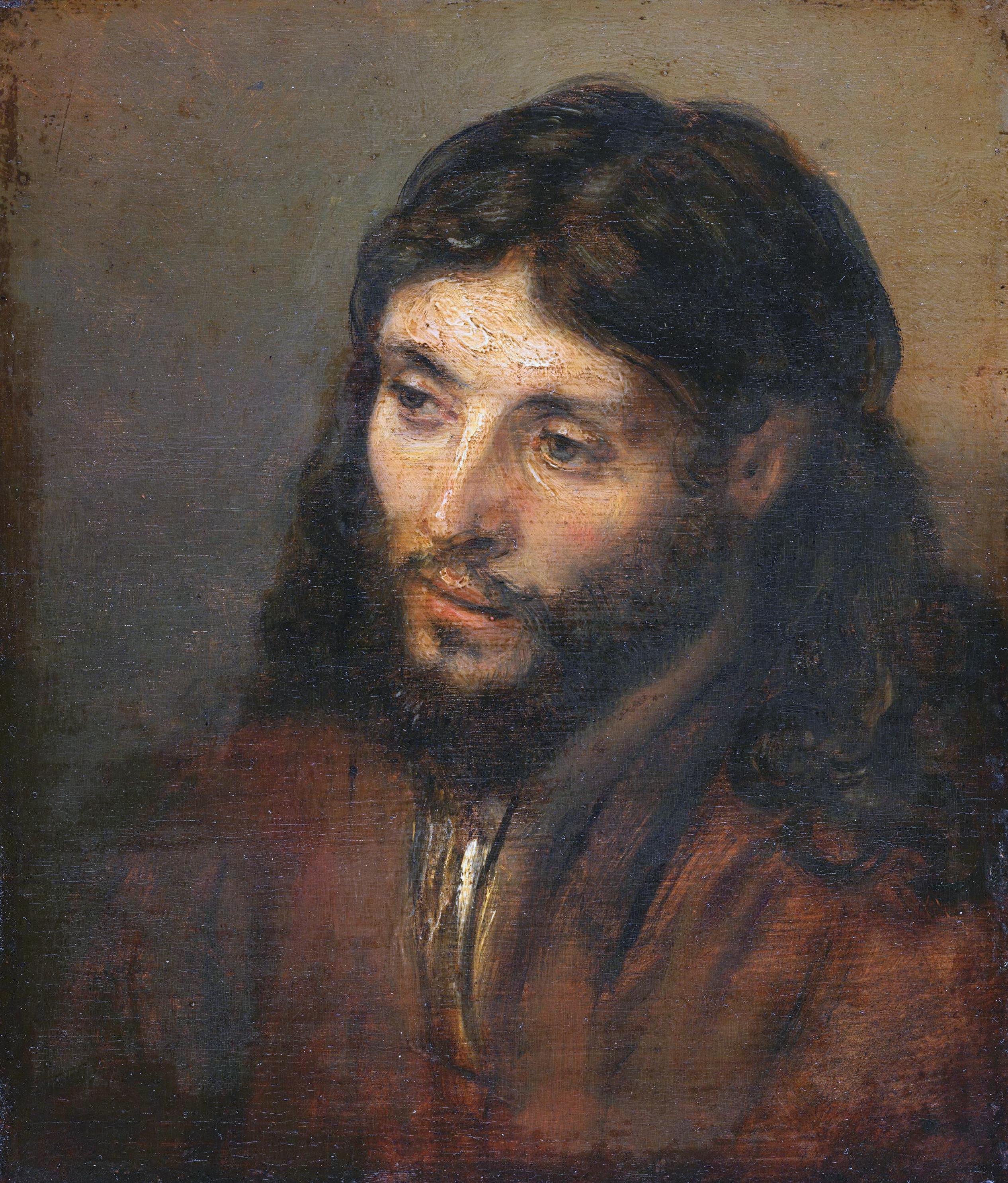
Rembrandt Harmensz van Rijn, Head of Christ (1648), oil on panel, Gemäldegalerie (Berlin)
Jesus did not have cultural power like the scribes. He was not an educated intellectual. He also did not possess the sacred power of the temple priests. He was not a member of an honorable family, nor did he belong to the urban elites of Sephoris or Liberia’s. Jesus was a humble worker from an unknown village in Galilee. He had not studied in any rabbinical school. He was not dedicated to explaining the Law. He was not concerned with doctrinal discussions. He was never interested in temple rites. People saw him as a teacher who taught to understand and live life differently. According to Mark, when Jesus arrived in Nazareth accompanied by his disciples, his neighbors were surprised by two things: the wisdom of his heart and the healing power of his hands. It was what most attracted people. Jesus was not a thinker who explained complicated doctrines, but a prophet who communicated his experience of God and taught how to live under the sign of love. He was not an authoritarian leader who imposed his power, but someone who alleviated suffering around him. It didn’t take long for the people of Nazareth to discredit Jesus. They neutralized his presence with all kinds of questions, suspicions and misgivings. They did not allow themselves to be taught by him, nor did they open themselves to his healing force. Jesus could not bring them closer to God, nor heal them all as he would have liked. The point is that Jesus cannot be understood from the outside. We have to get in touch with him. The invitation today is to let him gradually introduce us into his life, his divine life! When we approach Jesus, he do not force us: he invites us to live in a new way, under his grace and mercy; we cannot forget this! But to experience his saving power, it is necessary to allow him to heal us: little, recovering inner freedom, being free from fears that paralyze us. Jesus continues today laying on his hands, but only those who believe in him can be healed • AE
O, beautiful, for spacious skies,
For amber waves of grain,
For purple mountain majesties
Above the fruited plain!
America! America!
God shed His grace on thee,
And crown thy good with brotherhood,
from sea to shining sea.
O, beautiful, for pilgrim feet
Whose stern, impassioned stress
A thoroughfare for freedom beat
Across the wilderness!
America! America!
God mend thine ev’ry flaw;
Confirm thy soul in self control,
thy liberty in law!
O, beautiful, for heroes proved
In liberating strife,
Who more than self their country loved
And mercy more than life!
America! America!
May God thy gold refine,
Til all success be nobleness,
and ev’ry gain divine!
O, beautiful, for patriot dream
That sees beyond the years,
Thine alabaster cities gleam
Undimmed by human tears!
America! America!
God shed His grace on thee,
And crown thy good with brotherhood,
from sea to shining sea!
Fr. Agustin’s Schedule for the Fourteenth Sunday in Ordinary Time.
Saturday, July 3, 2021
4.00 p.m. Sacrament of Reconciliation @ St. Dominic Catholic Church (main church)
5.00 p.m. Mass @ St. Dominic Catholic Church
Sunday, July 4, 2021
7.30 a.m. Mass @ St. Dominic Catholic Church
10.30 a.m. Mass @ St. Dominic Catholic Church
12.00 p.m. Mass @ St. Dominic Catholic Church
3.00 p.m. Mass (Spanish) @ St. Dominic Catholic Church
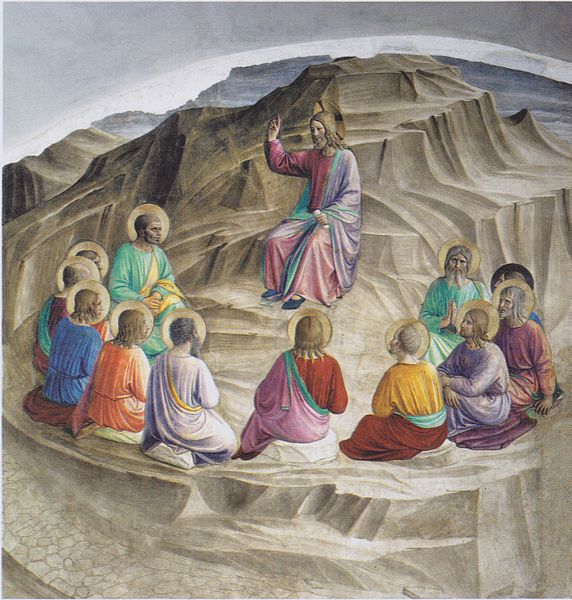
Fra Angélico, El Sermón de la montaña (1437) fresco del convento de San Marcos (Florencia)
El relato no deja de ser sorprendente. Jesús fue rechazado precisamente en su propio pueblo, entre aquellos que creían conocerlo mejor que nadie. Llega a Nazaret, acompañado de sus discípulos, y nadie sale a su encuentro, como sucede a veces en otros lugares. Tampoco le presentan a los enfermos de la aldea para que los cure. Su presencia solo despierta en ellos asombro. No saben quién le ha podido enseñar un mensaje tan lleno de sabiduría. Tampoco se explican de dónde proviene la fuerza curadora de sus manos. Lo único que saben es que Jesús un trabajador nacido en una familia de su aldea. Todo lo demás «les resulta escandaloso». Jesús se siente « despreciado»: los suyos no le aceptan como portador del mensaje y de la salvación de Dios. Se han hecho una idea de su vecino Jesús y se resisten a abrirse al misterio que se encierra en su persona. Jesús les recuerda un refrán que, probablemente, conocen todos: «No desprecian a un profeta más que en su tierra, entre sus parientes y en su casa». Al mismo tiempo, Jesús «se extraña de su falta de fe». Es la primera vez que experimenta un rechazo colectivo, no de los dirigentes religiosos, sino de todo su pueblo. No se esperaba esto de los suyos. Su incredulidad llega incluso a bloquear su capacidad de curar: «no pudo hacer allí ningún milagro, sólo curó a algunos enfermos». Marcos no narra este episodio para satisfacer la curiosidad de sus lectores, sino para advertir a las comunidades cristianas que Jesús puede ser rechazado precisamente por quienes creen conocerlo mejor: los que se encierran en sus ideas preconcebidas sin abrirse ni a la novedad de su mensaje ni al misterio de su persona. ¿Cómo estamos acogiendo a Jesús los que nos creemos «suyos»? En medio de un mundo que se ha hecho adulto, ¿no es nuestra fe quizá infantil y superficial? ¿No vivimos demasiado indiferentes a la novedad revolucionaria de su mensaje? ¿No es extraña nuestra falta de fe en su fuerza transformadora? ¿No tenemos el riesgo de apagar su Espíritu y despreciar su Profecía? Esto mismo le preocupa a San Pablo: «No apaguéis el Espíritu, no despreciéis el don de Profecía. Revisadlo todo y quedaos sólo con lo bueno» (1 Tes 5, 19-21) ¿No necesitamos algo de esto los cristianos de hoy? • AE
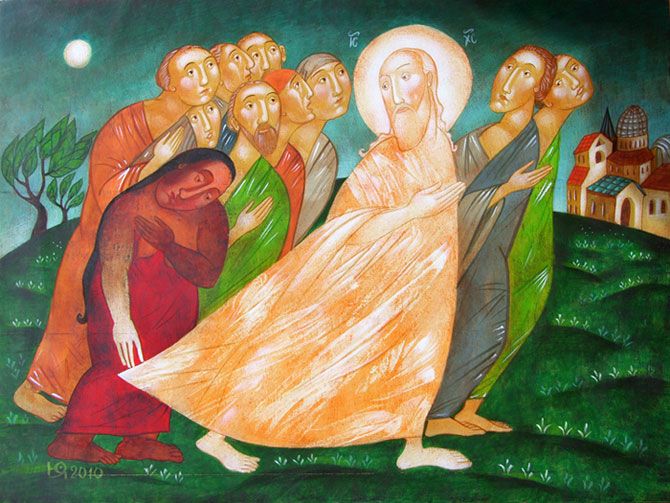
Julia Stankova (Bulgarian, 1954–), Christ healing the bleeding woman (2006), oil wooden panel.
We do not even know her name. She is an insignificant woman lost in the crowd that follows Jesus. She does not dare to speak to him like Jairus, the synagogue´s chief who has managed to get Jesus to go to her house[1]. She can never be that lucky. Nobody knows that she is a woman marked by a secret disease. The teachers of the Law have taught her to look at herself as an unclean woman as long as she has blood loss. She spent many years searching for a healer, but no one has managed to heal her. Where can she find the health she needs to live with dignity? Well, the same happen among us: humiliated by secret wounds that no one knows about, without the strength to entrust their «illness» to someone, our brothers and sisters seek for help, peace and comfort without knowing where to find them. This is one of the greatest tragedies of our time, and at some moments in the life of the Church we have not known how to help. They feel guilty when so often they are just victims; good people who feel unworthy to come to receive Christ in Holy Communion; Christians who have lived in unhealthy suffering because they were taught to see everything related to sex as dirty, humiliating and sinful. Today I remember the words of Pope Francis: «How are we treating the people of God? I dream of a church that is a mother and shepherdess. The church’s ministers must be merciful, take responsibility for the people and accompany them like the good Samaritan, who washes, cleans and raises up his neighbor. This is pure Gospel. God is greater than sin. The structural and organizational reforms are secondary—that is, they come afterward. The first reform must be the attitude. The ministers of the Gospel must be people who can warm the hearts of the people, who walk through the dark night with them, who know how to dialogue and to descend themselves into their people’s night, into the darkness, but without getting lost. The people of God want pastors, not clergy acting like bureaucrats or government officials. The bishops, particularly, must be able to support the movements of God among their people with patience, so that no one is left behind. But they must also be able to accompany the flock that has a flair for finding new paths. Instead of being just a church that welcomes and receives by keeping the doors open, let us try also to be a church that finds new roads, that is able to step outside itself and go to those who do not attend Mass, to those who have quit or are indifferent. The ones who quit sometimes do it for reasons that, if properly understood and assessed, can lead to a return. But that takes audacity and courage»[2]. According to the gospel narrative, this woman hears about Jesus and senses that she is before someone who can remove the impurity from her body, from her entire life. At the gospel, the Lord does not speak of dignity or unworthiness. His message speaks of love. His person radiates healing power. This is the point! SO, the woman seeks her own path to meet Jesus. She doesn’t feel strong enough to look into her eyes: she will come up behind her. She is ashamed to tell him about her illness: she will act quietly. She cannot physically touch him: she will touch only the mantle no matter what. Nothing else matters. To feel clean, that great trust in Jesus is enough. And then the miracle happens, and today we can be sure that Jesus has his ways to heal secret wounds, and to say to those who are looking for him: «Daughter, son, your faith has healed you. Go in peace and in health»[3] • AE
Fr. Agustin’s Schedule for the Thirteenth Sunday in Ordinary Time.
Saturday, June 26, 2021
4.30 p.m. – 5.20 p.m. Sacrament of Reconciliation @ St. Peter Prince of the Apostles
(Due to the repairs and maintenance in the main church; the sacrament of Confession will be celebrated in the Bride’s Room, located in the Narthex of the main church during the months of June and July. The only access to this area is through the main doors of the parish; the side doors will remain closed until further notice)
5. 30 p.m. Mass @ St. Peter Prince of the Apostles (@ Parish Hall)
Sunday, June 27, 2021
9.00 a.m. Mass @ St Peter Prince of the Apostles (@ Parish Hall)
11.00 a.m. Mass @ St Peter Prince of the Apostles (@ Parish Hall)
5.30 p.m. Mass @ St. Peter Prince of the Apostles (@ Parish Hall)
This is the last Sunday that Fr. Agustin will celebrate the Holy Mass at St. Peter Prince of the Apostles. Effective Thursday, July 1, he will take his position as parochial vicar of St. Dominic Catholic Church.
This blog will remain active and updated.
XIII Domingo del Tiempo Ordinario
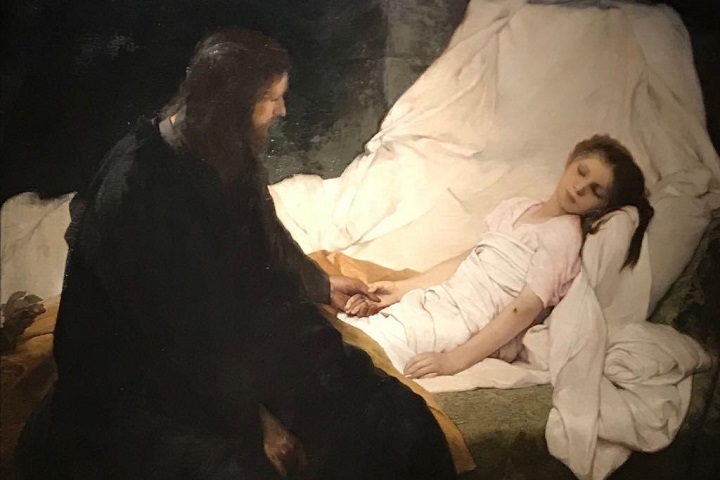
G. Max, La resurrección de la hija de Jairo (1878), óleo sobre tela, Museo de Bellas Artes de Montreal (Canadá)
La palabra «mortal» ha servido desde siempre para designar al hombre. Ésta es su condición. El ser humano es mortal: en cualquier momento puede morir y, ciertamente, cada instante lo acerca un poco más a su final. Lo decía Heidegger de manera muy gráfica: «Desde que nace, el hombre es lo bastante viejo para morir». Pero no es sólo que «puede» morir, sino que «tiene» que morir ¡Ninguno escapamos a la muerte! Es inútil nuestro afán de vivir, nuestro deseo de no enfermar, no envejecer, sobrevivir #Botox Durante muchos años se puede vivir sin sentir la amenaza de la muerte, pero llega un día en que la enfermedad, el mal funcionamiento de algún órgano o la jubilación comienzan a hacernos pensar que también nosotros estamos acercándonos a nuestro final. Casi siempre los humanos han tratado de olvidar la muerte, a ver si desaparece. Lo decía Pascal: «Los hombres, para ser felices, no ha hiendo podido encontrar remedio a la muerte… han tomado la decisión de no pensar en ella». Es asín, y aún peor: hemos convertido la muerte en el gran tabú: no hay que hablar de ella, no hay que pronunciar el nombre de ciertas enfermedades; hay que vivir como si fuéramos inmortales. Basta recordar el grito de Unamuno: «No quiero morirme, no, no quiero ni quiero quererlo; quiero vivir siempre, siempre, siempre, y vivir yo, este pobre yo, que me soy y me siento ahora y aquí»[1]. Queremos vivir, no desaparecer, no caer en la nada. Seguimos repitiendo los viejos caminos de siempre para eludir la certeza de su muerte. Algunos intentan vivir sin esperanza, aunque sin caer en una desesperación angustiosa. Otros se lanzan a vivir a tope lo inmediato cerrando los ojos a todo futuro. Hay quienes viven sin tomar en serio ningún amor y ninguna esperanza, sin arriesgarse en ninguna lucha, sin ligarse a nada ni a nadie. Cada uno sigue su camino, pero nadie puede sustraerse a ciertas preguntas: ¿qué me espera en la muerte?, ¿qué va a ser de mí y de todos mis anhelos?, ¿me aguarda la nada?, ¿hay algo o alguien que me espera para acoger mi deseo de vida y llevarme a una vida plena? El relato que el evangelio nos presenta este domingo, el décimo tercero dentro del Tiempo Ordinario, es de una belleza incomparable, vemos a Jesús devolviendo la vida a una niña a la que todos creían muerta[2]. Este evangelio es una invitación una confianza total en la fidelidad de Dios que, como dice Jesús, es “un Dios de vivos y no de muertos”[3]. El Señor posee la vida en plenitud: donde él actúa, se despierta la vida. También en el interior de la muerte. Estamos invitados pues a escuchar en silencio y en toda su hondura las palabras de Jesús a aquel hombre ante la muerte de su hija: “No temas. Solamente ten fe”[4] • AE
[1]Del sentimiento trágico de la vida, Cap. 3 [2] Cfr Mc 5, 21-43. [3] Cfr Mt 22, 32. [4] Cfr Mc 5, 21-43.
Jan Brueghel, The Older, Christ in the Storm on the Sea of Galilee (1596), oil on copper, Museo Thyssen-Bornemiza (Madrid)
Why are you terrified? Do you not yet have faith?” These two questions are to be responded by the followers of Jesus, two questions that we hear in the midst of our crises. And one more (question): Where is the root of our cowardice? Why are we so afraid of the future? Is it because we lack faith in Jesus Christ? The gospel narrative today is quite short[1]. It all begins with an order from Jesus: «Let’s go to the other shore.» The disciples know that on the other shore of Lake Tiberias is the pagan territory of the Decapolis. A different and strange country. A culture hostile to their religion and beliefs. Suddenly a strong storm arises, a graphic metaphor of what happens in the heart of the apostles. The hurricane wind, the waves that break against the boat, the water that begins to invade everything, express the situation well: What will the followers of Jesus do before the hostility of the pagan world? Not only their mission is in danger, but even the very survival of the group. Awakened by his disciples, Jesus intervenes, the wind ceases and a great calm comes over the lake. What is surprising is that the disciples «are shocked.» Before they were afraid of the storm. Now they seem to fear Jesus. However, something decisive has happened in them: they have turned to Jesus; they have been able to experience in him a saving force that they did not know; they begin to wonder about his identity. They begin to discern that with him everything is possible. So, Christianity is today in the midst of a strong storm, and fear begins to seize us. We are afraid to go to the other shore? Modern culture is a strange and hostile country to us. The future scares us. Some says that is safer to look back in order to better go forward. Let us not forget that Jesus can surprise us all. Always. He has the strength to inaugurate a new phase in the history of Christianity. The only thing he asks of us is faith, a faith that frees us from fear and cowardice and that of course commits us to walk in his footsteps. Our Christian faith is not a psychological recipe to combat fear, but radical trust in a God the Father, and the experience of his unconditional and eternal love offer us the best spiritual basis to face life with peace. Freud said that «loving and being loved is the main remedy against all neuroses.» It’s true. For this reason, it does us good to listen to the words of Jesus to his disciples in the midst of the storm: «Why are you so cowardly? Still have no faith? May we know how to respond with love, and put all our trust in Him! • AE
Fr. Agustin’s Schedule for The Twelfth Sunday in Ordinary Time.
Saturday, June 19, 2021
4.30 p.m. – 5.20 p.m. Sacrament of Reconciliation @ St. Peter Prince of the Apostles
(Due to the repairs and maintenance in the main church; the sacrament of Confession will be celebrated in the Bride’s Room, located in the Nartex of the church, during the months of June and July. The only access to this area is through the main doors of the Parish; the side doors will remain closed until further notice)
5. 30 p.m. Mass @ St. Peter Prince of the Apostles (@ Parish Hall)
Sunday, June 20, 2021
10.30 a.m. Mass @ Our Lady of Grace (indoors Mass)
12.00 p.m. Mass @ Our Lady of Grace (indoors Mass)
5.30 p.m. Mass @ St. Peter Prince of the Apostles (@ Parish Hall)
XII Domingo del Tiempo Ordinario (Ciclo B)
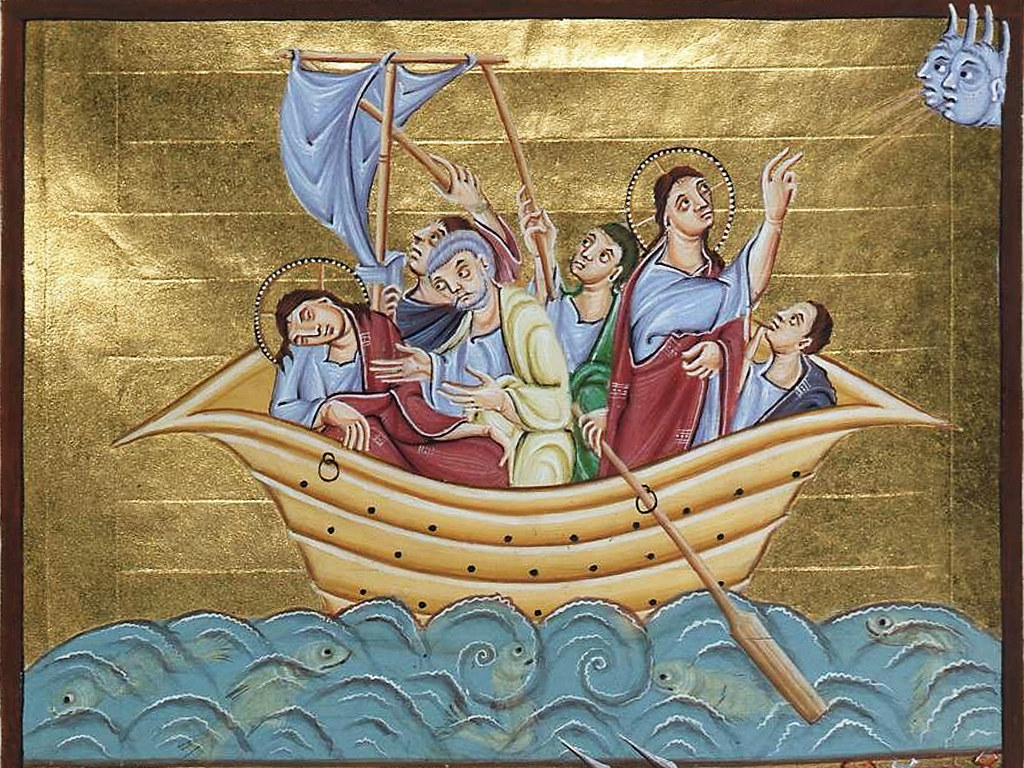
Maestro iluminador de la Abadía de Reichenau (Lago Constanza), Jesus duerme en la Barca, Evangeliario del Emperador Otto III (s. X), Clm 4453 fol-103v; page 43.
La barca en la que van Jesús y sus discípulos se ve atrapada por una de aquellas tormentas imprevistas que se levantan en el lago de Galilea al atardecer de algunos días de verano. El evangelista describe el episodio quizá para despertar la fe de las comunidades cristianas que viven momentos difíciles. El relato no es una historia tranquilizante para consolarnos a los cristianos de hoy con la promesa de una protección divina que permita a la Iglesia caminar tranquila a través de la historia. Es más bien la llamada decisiva de Jesús para hacer con él la travesía en tiempos difíciles: «¿Por qué sois tan cobardes? ¿Aún no tenéis fe?». San Marcos prepara la escena desde el principio. Nos dice que «era al atardecer». Pronto caerán las tinieblas de la noche sobre el lago. Es Jesús quien toma la iniciativa de aquella extraña travesía: «Vamos a la otra orilla». La expresión tiene su aquello. Jesús les pide que vayan juntos, en la misma barca, hacia otro mundo, más allá de lo conocido: la región pagana de la Decápolis. De pronto se levanta un fuerte huracán y las olas rompen contra la frágil embarcación inundándola de agua. La escena es muy singular: en la parte delantera, los discípulos luchando impotentes contra la tempestad; a popa, en un lugar algo más elevado, Jesús durmiendo tranquilamente sobre un cojín[1]. Aterrorizados, los discípulos despiertan a Jesús. No entienden aún la confianza de Jesús en el Padre, lo único que perciben es una increíble falta de interés por ellos. Están llenos de miedo: «Maestro, ¿no te importa que nos hundamos?». Jesús no se justifica. Se pone de pie y pronuncia una especie de exorcismo: el viento cesa de rugir y se hace una gran calma. Jesús aprovecha esa paz y silencio grandes para hacerles dos preguntas que hoy llegan hasta nosotros: «¿Por qué tenían tanto miedo? ¿Aún no tienen fe?». ¿Qué nos está sucediendo a los cristianos? ¿Por qué tenemos tanto miedo para afrontar estos tiempos cruciales, y tan poca nuestra confianza en Jesús? ¿No es el miedo a hundirnos el que nos está bloqueando? ¿No es la búsqueda ciega de seguridad la que nos impide hacer una lectura lúcida, responsable y confiada de estos tiempos? ¿Por qué nos resistimos a ver que Dios está conduciendo a la Iglesia hacia un futuro más fiel a Jesús y su Evangelio? ¿Por qué buscamos seguridad en lo conocido y establecido en el pasado, y no escuchamos la llamada de Jesús a «pasar a la otra orilla» para sembrar humildemente su Buena Noticia en un mundo indiferente a Dios, pero tan necesitado de esperanza? ¡Ojalá tengamos el tiempo de sentarnos conversar con el Señor de todo esto; te aseguro, hermano mío, que Él esta vez no duerme, en la popa, reclinado sobre un cojín • AE












 LA MEDITACION DE LA ESPOSA