
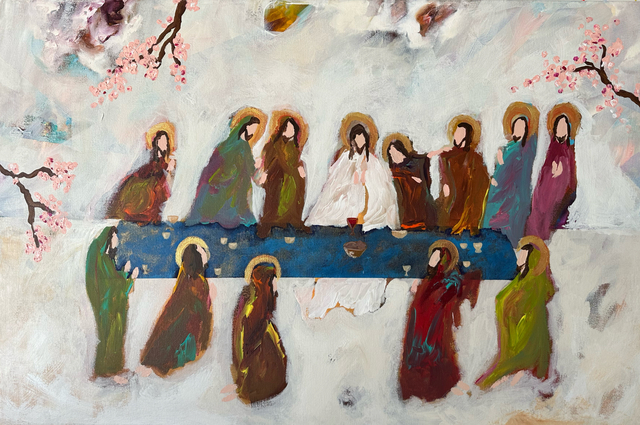
Paulo Medina, Last Supper, 2023. Acrylic on canvas. Private collection.
On Holy Thursday, the mystery of the Eucharist is not presented as an idea, but as a gift placed into human hands. Christ takes bread, gives thanks, breaks it — and gives Himself. No spectacle. No display of power. Only words that will echo through centuries: “This is my body.” The infinite chooses to remain under the form of something fragile, breakable, and ordinary. God does not impose His presence; He entrusts it. But the night does not end at the table. It moves toward the garden. After the gift comes the invitation: “Stay here, and keep watch with me.” The Eucharist is not only received; it is accompanied. To adore is to remain. To remain is to love without distraction. Saint Thomas Aquinas gave the Church words for this trembling reverence in the hymn Adoro te devote, where faith confesses what the senses cannot grasp: sight, touch, and taste fail — yet the heart believes. The hymn does not explain the mystery; it bows before it. And in that bowing, theology becomes prayer. Holy Thursday does not ask us to solve the mystery. It asks us to kneel. To receive. And to keep watch in the quiet presence of the One who chose to remain •
Adoro te devote was composed by St. Thomas Aquinas in the 13th century for the Feast of Corpus Christi, at a time when the Church sought to give poetic voice to her Eucharistic faith. The hymn is deeply theological yet profoundly personal: it moves from adoration to longing, from doctrine to intimacy. In one striking line, Aquinas calls Christ the “loving Pelican.” Drawing on a medieval image, he refers to the legend that a pelican would pierce its own breast to feed its young with its blood. For Aquinas, this became a symbol of the Eucharist — Christ giving His own life to nourish ours. The image is tender rather than dramatic: a quiet reminder that the One we adore is the One who sustains us with His own self-giving love •

St. Joseph Catholic Church (Dilley, TX) • Easter Triduum 2026
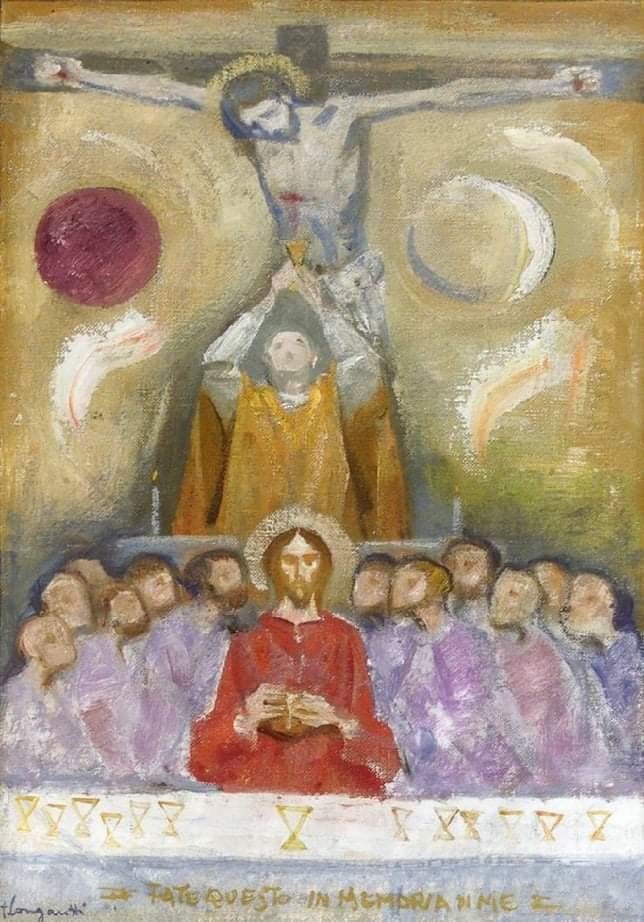
HOLY THURSDAY OF THE LORD’S SUPPER, APRIL 2
6:00 p.m. Mass of the Lord’s Supper (Bilingual)
(Adoration of the Most Holy Sacrament until 10:00 p.m. @ Chapel)
FRIDAY OF THE PASSION OF THE LORD (Good Friday), APRIL 3
10:00 a.m. Los Siete Dolores de la Santísima Virgen María
11:30 a.m. Live Performance of the Passion of the Lord
(We start @ the police station and end @ St. Joseph grounds)
6:00 p.m. Liturgical Celebration of the Lord’s Passion (Bilingual)
HOLY SATURDAY, APRIL 4
7:00 p.m. The Easter Vigil in the Holy Night (Bilingual)
EASTER SUNDAY OF THE RESURRECTION OF THE LORD, APRIL 5
8:30 a.m. English Mass @ St. Mary’s Chapel
11:00 a.m. English Mass @ Church

Jueves Santo. Misa vespertina de la Cena del Señor (2026)
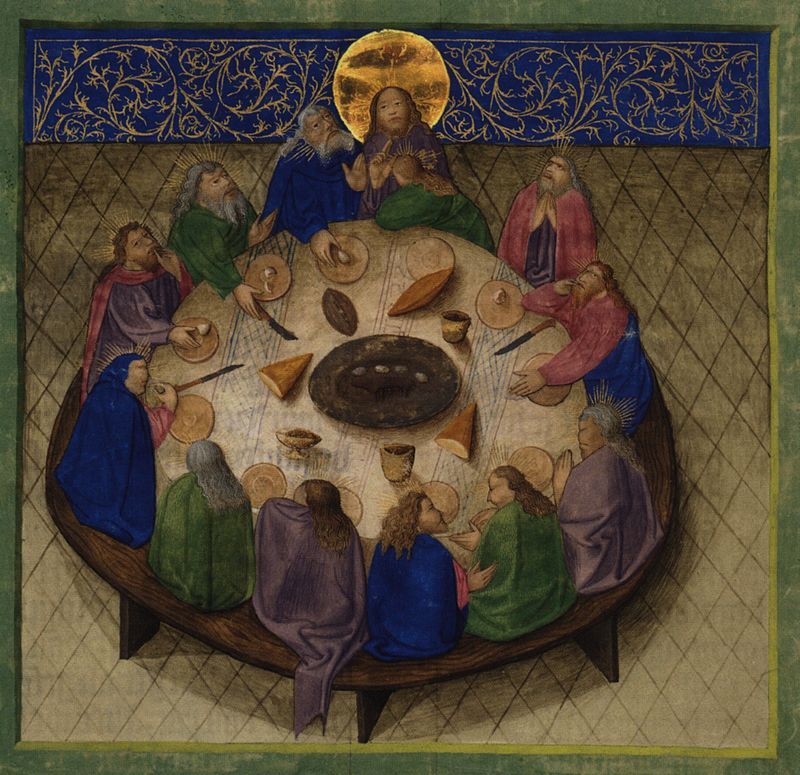
Autor desconocido (Matthäusmaler), La Última Cena (1425–1430), Iluminación sobre pergamino, Ottheinrich-Bibel, Bayerische Staatsbibliothek (Múnich)
Silencio cae en la tarde morada,
huele a incienso y a azahar la acera;
late Sevilla en su noche entera,
con cera viva y luna derramada.
Cristo se queda en pan consagrada,
amor humilde que el alma espera;
mientras la plaza calla y se altera
la voz del paso, lenta y sagrada.
Suena un suspiro por la saeta,
y el barrio entero contiene el llanto;
Dios se arrodilla en forma discreta.
Jueves que arde de amor tan santo:
mesa y cruz en la misma meta,
y un corazón velando en su manto.
Hay noches que no se entienden desde la luz del día. El Jueves Santo no es solo el recuerdo de una cena; es el comienzo de una entrega que no retrocede. Jesús no improvisa lo que está por venir. Sabiendo lo que le espera, toma el pan, pronuncia la bendición y se da. La Eucaristía no nace del entusiasmo, sino de una decisión libre de amar hasta el extremo. San Agustín decía que en el altar recibimos aquello que somos y nos convertimos en aquello que recibimos: Cuerpo de Cristo. No se trata solo de un gesto devocional, sino de una transformación. La Eucaristía no es el premio para los perfectos o invictos, sino el Pan que alimenta en el camino; la medicina el enfermo. No es trofeo para los fuertes, sino alimento para los que saben que necesitan ser sostenidos. Después de la cena, el silencio del huerto. El que se dio como pan pide compañía. “Velad conmigo.” El papa Francisco nos recordó muchas veces que Dios no se cansa de permanecer, que es Él quien da el primer paso y quien sostiene nuestra fidelidad frágil. La adoración nace precisamente ahí: en quedarse cuando no hay aplausos, cuando no hay emoción, cuando solo queda el amor que no huye. El Jueves Santo nos coloca frente a una pregunta sencilla y radical: ¿estamos dispuestos a quedarnos? No solo cuando todo es claro, sino cuando la noche avanza. Cristo permanece. Y espera que también nosotros aprendamos a hacerlo •
Mozart compuso el Ave verum corpus en 1791, pocos meses antes de morir. Es una pieza breve, casi transparente, escrita para la solemnidad del Corpus Christi, pero profundamente vinculada al misterio que celebramos el Jueves Santo. No hay grandiosidad ni dramatismo excesivo; hay una sencillez luminosa que parece arrodillarse ante el sacramento. El texto —“Salve, verdadero Cuerpo nacido de la Virgen María, que verdaderamente padeciste y fuiste inmolado en la cruz”— une la mesa y el Calvario, la Eucaristía y la Pasión. Escucharlo en este día nos ayuda a comprender que el pan consagrado no es símbolo distante, sino presencia real del mismo Cristo que se entrega por amor. La música no explica el misterio; lo rodea con delicadeza y nos invita a adorarlo en silencio •

 LA MEDITACION DE LA ESPOSA