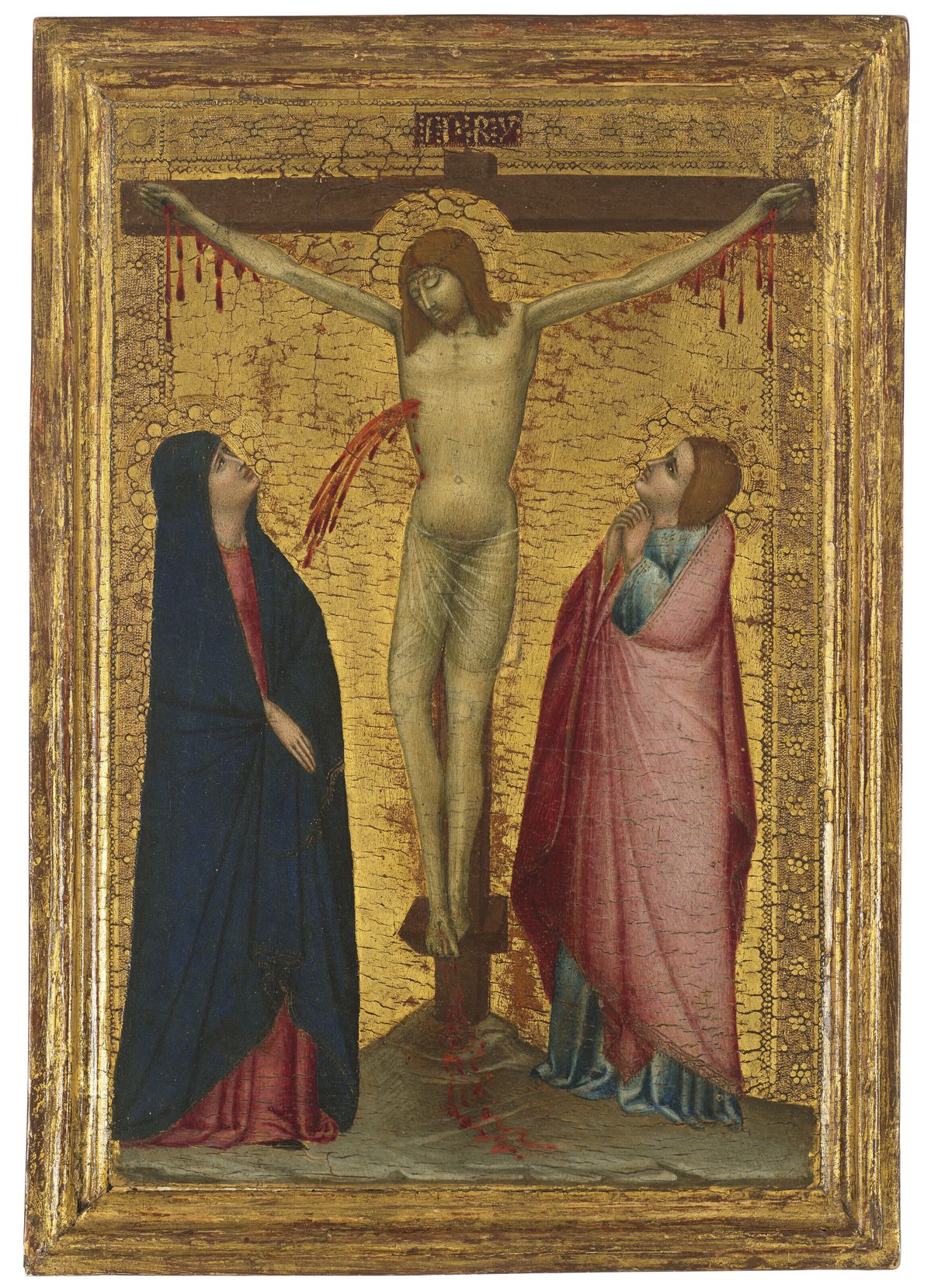
Unknown Master, Crucifixion with the Blood and Water from Christ’s Side, c. 14th–15th century. Tempera and gold on panel. Private collection.
On Good Friday, the liturgy of the Church fixes her gaze on the Cross at Calvary, meditating on the fact that Christ has won our redemption. In the solemn ceremonies of Good Friday (the Adoration of the Cross, the chanting of the Reproaches, the proclamation of the Passion of the Lord and in receiving Holy Communion) we unite ourselves to Jesus and we contemplate our own death to sin. The liturgy, stripped of its ornaments, the altar bare, and with the door of the empty tabernacle standing open, is as if in mourning. This is a day of sorrow. No Mass is celebrated today. The desolate quality of the rites of this day reminds us of Christ’s humiliation and suffering during his Passion, therefore should be a day of profound silence, a day of penance, a day to dedicate to reflection and recollection. Good Friday is the day when the Lord consummated the redemptive sacrifice of humanity on the Cross which, from then on, would become a symbol of salvation for us Christians: Ave crux, spes unica! (Hail to the Cross, our only hope).
I am not moved, my God, to give you love
by thoughts of heaven that you’ve promised me;
nor am I moved by thoughts of dreaded hell
for that alone, to cease offending thee.
You are what moves me, Lord; I’m moved to see
you on a cross and mocked with every breath;
I’m moved to see your body racked with wounds;
I’m moved by your affronts and by your death.
I’m moved, in sum, by love for you so great
that I would love you were not heaven there,
and I would fear you, if there were no hell.
You need give me no prize to love you thus,
for even if what I hope I hoped not,
as I now love you I would love you still •

Musica para el Viernes Santo
Este video corresponde a la Celebración de la Pasión del Señor en la Basílica Vaticana, el Viernes Santo 30 de marzo de 2018. Durante esta liturgia sobria y profundamente contemplativa, mientras se descubre y se venera la Cruz, se cantan los antiguos Improperios, entre ellos el célebre Popule meus en la polifonía de Giovanni Pierluigi da Palestrina. En este texto, es Cristo mismo quien habla: “Pueblo mío, ¿qué te he hecho?” No es un grito airado, sino un lamento de amor herido. La música de Palestrina — clara, equilibrada, sin dramatismos excesivos — deja que el texto respire y que el silencio haga su obra. En el día en que la Iglesia no celebra la Eucaristía, sino que contempla la Cruz, este canto se convierte en oración, examen interior y adoración silenciosa ante el Crucificado •
Viernes Santo de la Pasión del Señor (2026)
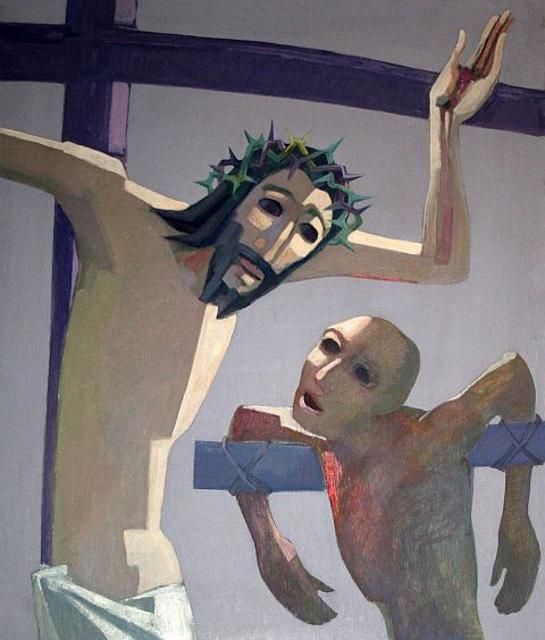
Autor desconocido, The Good Thief, St. Gerlachus Church, Limburg (Paises Bajos).
Hay una salvación que llega en el último instante. El Viernes Santo está lleno de silencio, de abandono y de una aparente derrota. Cristo cuelga de la cruz entre dos criminales. La escena parece el final de todo. Sin embargo, en medio de ese fracaso visible, sucede uno de los encuentros más sorprendentes del Evangelio. Un hombre condenado reconoce algo que nadie más ve con claridad. Mientras otros insultan o se burlan, él mira a Jesús y dice simplemente: “Acuérdate de mí cuando llegues a tu Reino.”No pide milagros. No pide bajar de la cruz. Solo pide ser recordado. Y la respuesta de Cristo es inmediata, desbordante: “Hoy estarás conmigo en el paraíso.” Los Padres de la Iglesia veían en este momento un signo inmenso de esperanza. San Juan Crisóstomo decía que el Buen Ladrón fue el primer hombre que entró en el paraíso después de que Cristo lo abriera con su propia sangre. Mientras el mundo contempla un condenado, Dios reconoce a un creyente. Esta escena nos recuerda algo esencial del Viernes Santo: la cruz no es solo el lugar del sufrimiento de Cristo; es también el lugar donde nace la misericordia. Incluso en la hora más oscura. Incluso en el último momento. Basta una mirada de fe •

 LA MEDITACION DE LA ESPOSA