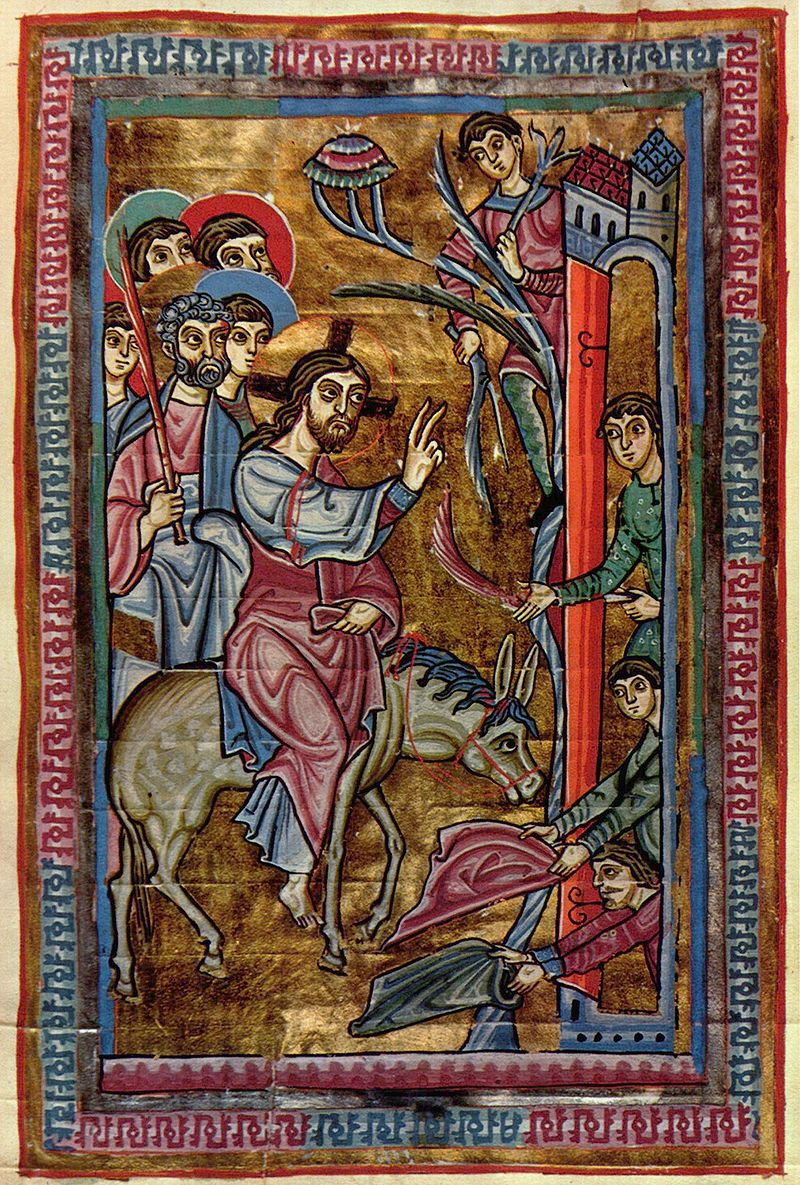
Meister des Perikopenbuches, Miniature of the triumphal entry into Jerusalem, The Yorck Project (2002)
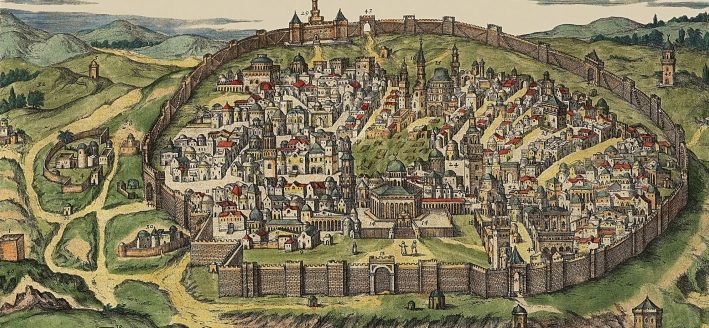
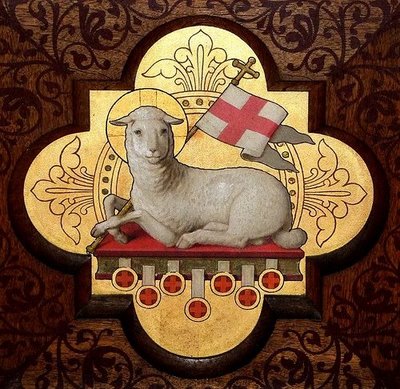
Our liturgy today begins with a celebration of the entry of the Lord into the Holy City and then rapidly focuses in on the Crucifixion of the Lord, this year from the Gospel of Matthew. What a contrast! We go from Jerusalem where the crowds were celebrating Jesus, crowding him, singing hosanna, to Golgotha, where Jesus was mostly deserted by all as he died on the cross. There are contradictions even deeper than that. Mankind was disobedient to God. Jesus was obedient. Mankind was immersed in material possessions. Jesus was only concerned about the spiritual. Mankind was selfish, each person only concerned with himself or herself. Jesus was self-less. He sweat blood the night before, but he accepted the role he would play in the drama of the Kingdom. Mankind feared death clinging to life. Jesus embraced death recognizing death as a passage to eternal life. Mankind had embraced physical life and sacrificed his spiritual life. Jesus surrendered his physical life so that we can possess spiritual life. What is it that we celebrate this Holy Week? Is it the historical events of a little less than 2,000 years ago? Perhaps, but this is only a small part of our commemoration of Holy Week. What we celebrate this Holy week is our participation in the Paschal Mystery, the sacrifice of the Lamb of God. On Holy Thursday we join the disciples at the Last Supper and the Garden of Olives. We remember that the mandate to serve is fundamental The symbolic washing of feet reminds us of that the mandate to serve is fundamental to our being people of the Eucharist. On Good Friday, we call up the courage to stand at the foot of the cross and ask our Savior to allow us to join our lives to his death. At the Solemn Easter Vigil, we remember the promises of the Hebrew Scriptures and rejoice at the fulfillment of the prophesies of salvation. At all the Masses of Easter we reaffirm our Baptismal vows and recommit our lives to living for the Kingdom of God. Come and pray with us this week. Come. Come and celebrate the Life that makes all life meaningful • AE
Pueri Hebreaeorum by G. P. da Palestrina
Fr Agustin´s Schedule for Palm Sunday of the Lord’s Passion 2023
Saturday April 1, 2023
9.00 a.m. Spiritual Retreat for CCD Children of St. Dominic Catholic Church (Main church)
3.30 p.m. Sacrament of Reconciliation (Confessional)
5.00 p.m. Holy Mass (with the blessings of the branches)
Sunday April 2, 2023
12.30 p.m. Holy Mass (with the blessing of the branches)
3.00 p.m. Misa en Español con la bendición de las palmas
Domingo de Ramos De la Pasión del Señor (2023)
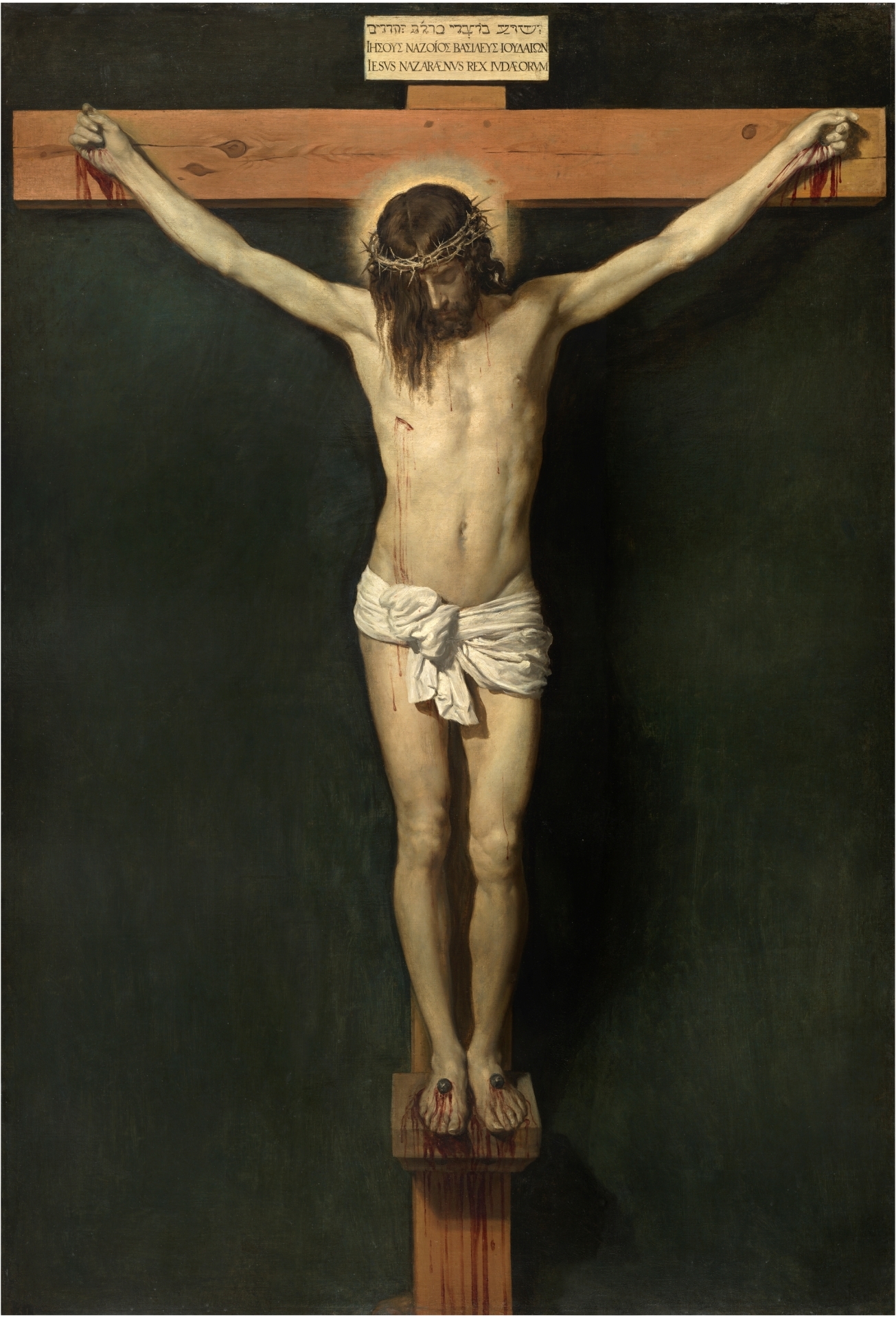
Diego de Silva y Velázquez, Cristo Crucificado (1632) óleo sobre tela, Museo Nacional del Prado (España)
No me mueve, mi Dios, para quererte el cielo que me tienes prometido, ni me mueve el infierno tan temido para dejar por eso de ofenderte.
Tú me mueves, Señor, muéveme el verte clavado en una cruz y escarnecido, muéveme ver tu cuerpo tan herido, muévenme tus afrentas y tu muerte.
Muéveme, en fin, tu amor, y en tal manera, que aunque no hubiera cielo, yo te amara, y aunque no hubiera infierno, te temiera.
No me tienes que dar porque te quiera, pues aunque lo que espero no esperara, lo mismo que te quiero te quisiera
Los primeros cristianos lo sabían. Su fe en un Dios crucificado sólo podía ser considerada como un escándalo y una locura. ¿A quién se le había ocurrido decir algo tan absurdo y horrendo de Dios? Nunca religión alguna se ha atrevido a confesar algo semejante. Ciertamente, lo primero que todos descubrimos en el crucificado del Gólgota, torturado injustamente hasta la muerte por las autoridades religiosas y el poder político, es la fuerza destructora del mal, la crueldad del odio y el fanatismo de la mentira. Pero ahí precisamente, en esa víctima inocente, los cristianos vemos a Dios identificado con todas las víctimas de todos los tiempos. Despojado de todo poder dominador, de toda belleza estética, de todo éxito político y toda aureola religiosa, Dios se nos revela, en lo más puro e insondable de su misterio, como amor y sólo amor. No existe ni existirá nunca un Dios frío, apático e indiferente. Sólo un Dios que padece con nosotros, sufre nuestros sufrimientos y muere nuestra muerte. Este Dios crucificado no es un Dios poderoso y controlador, que trata de someter a sus hijos e hijas buscando siempre su gloria y honor. Es un Dios humilde y paciente, que respeta hasta el final la libertad del ser humano, aunque nosotros abusemos una y otra vez de ese amor. Prefiere ser víctima de sus criaturas antes que verdugo. Este Dios crucificado no es el Dios justiciero, resentido y vengativo que todavía sigue turbando la conciencia de no pocos creyentes. Desde la cruz, Dios no responde al mal con el mal. «En Cristo está Dios, no tomando en cuenta las transgresiones de los hombres, sino reconciliando al mundo consigo» (2 Corintios 5,19). Mientras nosotros hablamos de méritos, culpas o derechos adquiridos, Dios nos está acogiendo a todos con su amor insondable y su perdón. Este Dios crucificado se revela hoy en todas las víctimas inocentes. Está en la cruz del Calvario y está en todas las cruces donde sufren y mueren los más inocentes: los niños con hambre, las mujeres maltratadas, los maltratados por el poder, los explotados por nuestro bienestar, incluso ¡los olvidados por nuestra religión! Los cristianos seguimos celebrando al Dios crucificado, para no olvidar nunca ese amor loco que siente Dios por la humanidad, y también para mantener vivo el recuerdo de todos los crucificados. Es un escándalo y una locura. Sin embargo, para quienes seguimos a Jesús y creemos en el misterio redentor que se encierra en su muerte, es la fuerza que sostiene nuestra esperanza y nuestra lucha por un mundo más humano • AE
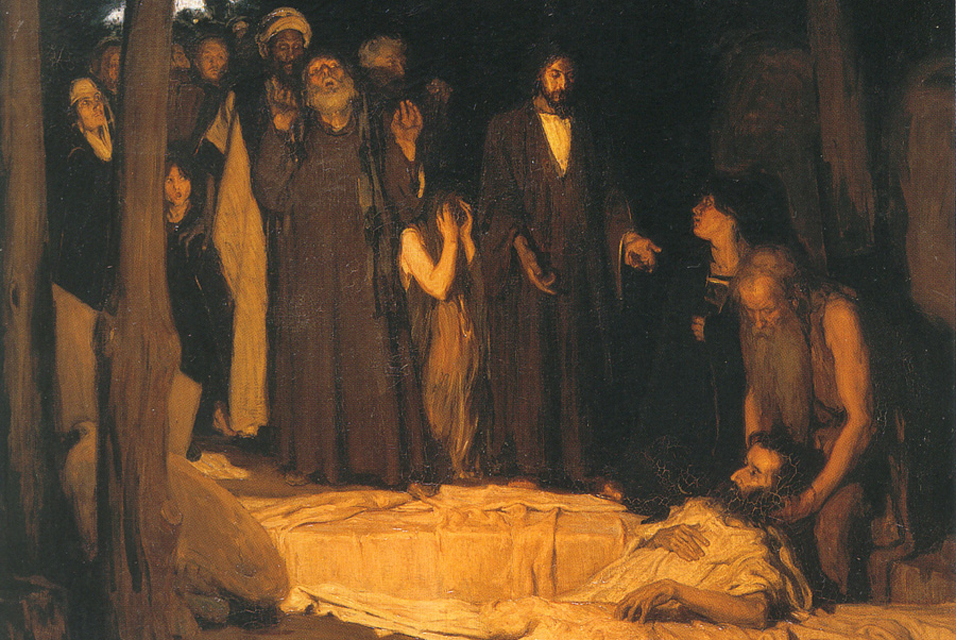
H. Ossawa Tanner, The Resurrection of Lazarus, (1896), oil on canvas, Musee d’Orsay (Paris)
Lazarus come out from that tomb! We all need to come out of the tombs we find ourselves in, whether we put ourselves in those tombs or we were put into the tombs by circumstances beyond our control. The voice of the Lord calls us outside of our sick rooms, calls us to know that if we walk to Him, we will have life. No sickness can take the Lord away from us. Some people are in tombs of their own making. They may feel that there is no hope. But if they listen, they can hear the voice of the Lord, calling them, saying, “Come out of that tomb.” And with the Lord they can walk once more into the light. When Jesus came to the tomb where that dear friend of his had been lain, he wept. That is the shortest verse in scripture. Jesus wept. He wept at what death did to the man he loved. He weeps at what death is doing to us. He does not want us in tombs, whether they are tombs others put us into or tombs we create for ourselves. He calls us out of the tombs. He calls us into the beauty of His world. We have to take the step. We have to decide to leave that which is destroying us and walk out of the tomb. This walk might be difficult. We might have to walk despite the burial clothes tied around us. “Unbind him,” Jesus said to those standing with Him after Lazarus stumbled out of the tomb. “Unbind Him,” the Lord says to the Christian community whenever anyone takes those first uncertain steps into the light. “Unbind Him,” the Lord says to all around us. We recognize our frailty, and allow others to care for us, as we are called to care for them. “Lazarus come out!” Come out. You and I do not belong in cold dark tombs. We belong in the light. We belong dancing in the flowers with the Lord of Life. In two weeks we will be celebrating Easter. We will be celebrating because the One who is the Lord of Life has called us to come out into the Fullness of His Life • AE
Fr. Agustin´s Schedule for the Fifth Sunday of Lent
Saturday March 25, 2023
3.30 p.m. Sacrament of Reconciliation (confessional)
Sunday, March 26, 2023
7.30 a.m. Holy Mass
10.00 a.m. Holy Mass
V DOMINGO DE CUARESMA (CICLO A)
Autor anónimo, La resurrección de Lázaro (1800), vidriera de la iglesia de San Nicolás en Örebro (sur de Suecia)
El relato de la resurrección de Lázaro es sorprendente. Por una parte, nunca se nos presenta a Jesús tan humano, frágil y entrañable como en este momento en que se le muere uno de sus mejores amigos. Por otra parte, nunca se nos invita tan directamente a creer en su poder salvador: «Yo soy la resurrección y la vida: el que cree en mí, aunque muera, vivirá… ¿Crees esto?» Jesús no oculta su cariño hacia estos tres hermanos de Betania que, seguramente, lo acogen en su casa siempre que viene a Jerusalén. Cuando llega Jesús a la aldea, Lázaro lleva cuatro días enterrado. Ya nadie le podrá devolver la vida. La familia está rota. Cuando se presenta Jesús, María rompe a llorar. Nadie la puede consolar. Al ver los sollozos de su amiga, Jesús no puede contenerse y también él se echa a llorar. Se le rompe el alma al sentir la impotencia de todos ante la muerte. ¿Quién nos podrá consolar? Hay en nosotros un deseo insaciable de vida. Nos pasamos los días y los años luchando por vivir. Nos agarramos a la ciencia y, sobre todo, a la medicina para prolongar esta vida biológica, pero siempre llega una última enfermedad de la que nadie nos puede curar. Tampoco nos serviría vivir esta vida para siempre. Sería horrible un mundo envejecido, lleno de viejos y viejas, cada vez con menos espacio para los jóvenes, un mundo en el que no se renovara la vida. Lo que anhelamos es una vida diferente, sin dolor ni vejez, sin hambres ni guerras, una vida plenamente dichosa para todos. Hoy vivimos en una sociedad que ha sido descrita como «una sociedad de incertidumbre» (Z. Bauman). Nunca había tenido el ser humano tanto poder para avanzar hacia una vida más feliz. Y, sin embargo, nunca tal vez se ha sentido tan impotente ante un futuro incierto y amenazador. ¿En qué podemos esperar? Como los humanos de todos los tiempos, también nosotros vivimos rodeados de tinieblas. ¿Qué es la vida? ¿Qué es la muerte? ¿Cómo hay que vivir? ¿Cómo hay que morir? Antes de resucitar a Lázaro, Jesús dice a Marta esas palabras que son para todos los cristianos un reto decisivo: «Yo soy la resurrección y la vida: el que crea en mí, aunque haya muerto vivirá… ¿Crees esto?». A pesar de dudas y oscuridades, los cristianos creemos en Jesús, Señor de la vida y de la muerte. Sólo en él encontramos luz y fuerza para luchar por la vida y para enfrentarnos a la muerte. Sólo en él encontramos una esperanza de vida más allá de la vida • AE
Dios te salve, José, lleno de la gracia divina. Entre tus brazos descansó El Salvador y ante tus ojos creció. Bendito eres entre todos los hombres, y bendito es Jesús, el hijo divino de tu Virginal Esposa. San José, padre adoptivo de Jesús, ayúdanos en nuestras necesidades familiares, de salud y de trabajo, hasta el fin de nuestros días, y socórrenos a la hora de nuestra muerte. Amén”.
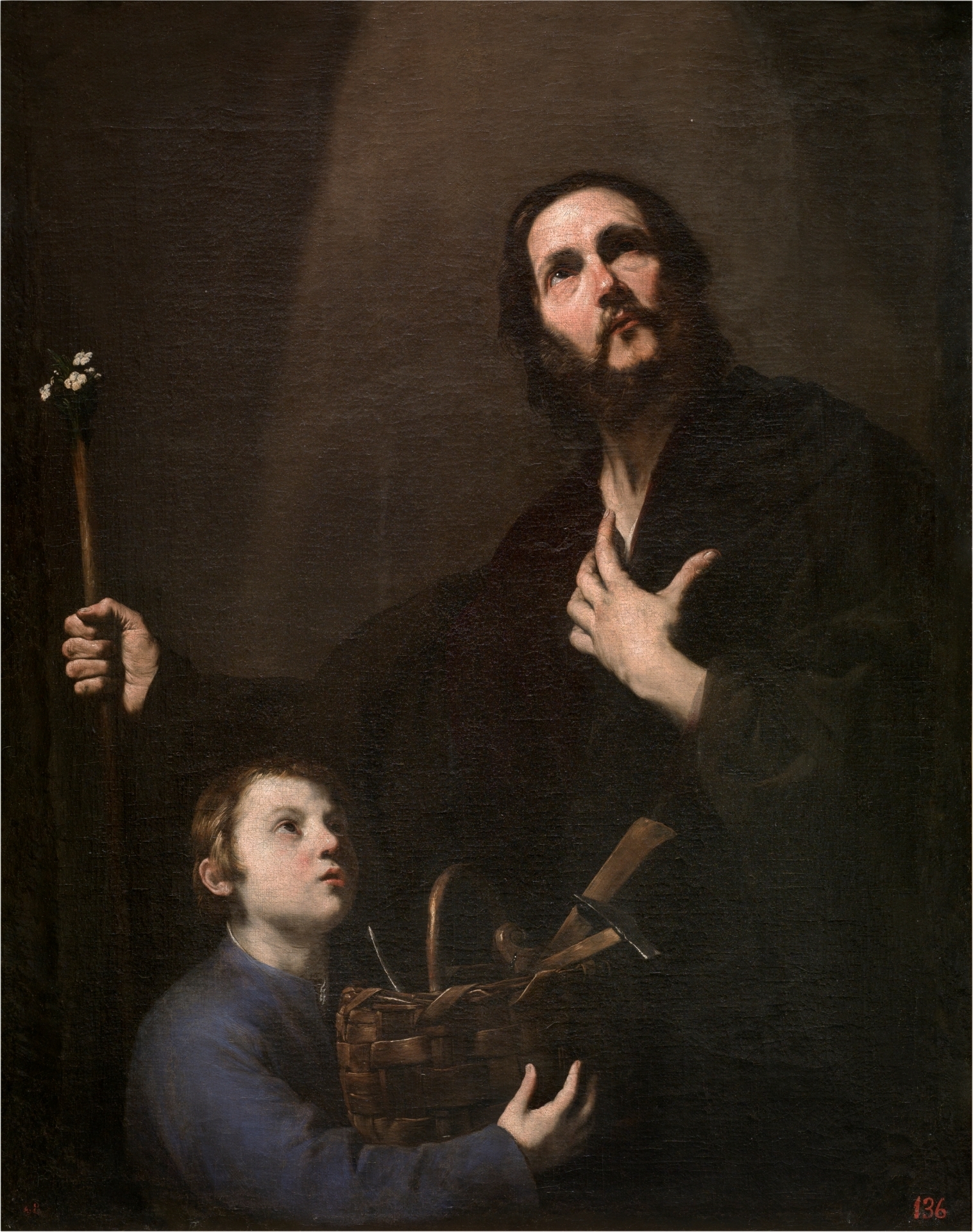
There is a movie from the early fifties, «The Quiet Man» starring screen legends John Wayne, Maureen O’Hara and Barry Fitzgerald. It took place in Ireland, where John Wayne had returned after a boxing career in the US to find some peace and quiet, hence the film’s title «The Quiet Man.» Ironically, he fell in love and found just the opposite. Today is the solemn feast of St. Joseph, the Spouse of Mary. If a film would be made of his life today, I think it might also be called «The Quiet Man» but with a different storyline than that portrayed by John Wayne. St. Joseph was truly «the quiet man» in the history of human salvation. Holy Scripture does not have much to say ABOUT him nor does it contain much of a record ABOUT THING HE SAID. And, yet, his quiet and unassuming role in the lives of the Blessed Virgin Mary and her Divine Son Jesus have earned him an unforgettable and amazing place in our Christian faith. He was husband of the Blessed Virgin Mary. If it were not for that fact, if it were not for her, the world would never have heard of this «quiet man.» He loved a young Jewish maiden who said «yes» to God in complete trust and confidence and he joined her in that «yes.» St. Joseph and the world would never be the same. For the Christian, Joseph as «husband of Mary» is the model of openness to God’s will. Joseph was the «foster-father of the Lord Jesus.» St. Thomas Aquinas wrote that in the incarnation and birth of Jesus Christ, he needed the care and protection of a father. Pope Francis describes the fatherhood of Joseph in several ways: «A beloved father, a tender and loving father, an obedient father, an accepting father, a creatively courageous father, a working father, a father in the shadows.» A quiet man of whom Pope Benedict XVI encouraged, «Let us allow ourselves to be ‘infected’ by the ‘silence of St. Joseph.’ So, we have much need of it in a world which is often too noisy, which does not encourage reflection and listening to the voice of God. For the Christian, Joseph as «foster-father of the Lord Jesus» is the father, guardian and protector of the Church, the «Body of Christ throughout time.» He is our «foster-father.» Joseph was a «working man who found God’s presence in human labor.» Joseph was a humble man who did not seek recognition or privilege in the conduct of his daily life. The callouses on his hands bore great witness to the dignity of everyday ordinary life. For the Christian, Joseph as a quiet «working man» showed what it meant to «practice the presence of God.» He is a «model of quiet prayer and closeness to Jesus, whose example invites us to think about the time we devote to prayer each day.» «Each of us,» Pope Francis has said, «can discover in Joseph – the man who goes unnoticed, a daily, discreet and hidden presence – an intercessor, a support and a guide in times of trouble. Saint Joseph reminds us that those who appear hidden or in the shadows can play an incomparable role in the history of salvation.» On this Feast of St. Joseph let us beg God for the grace to imitate «the quiet man» in the daily unfolding of our own personal salvation • AE
Solemnidad de San José, esposo de la Bienaventurada Virgen María (2023)
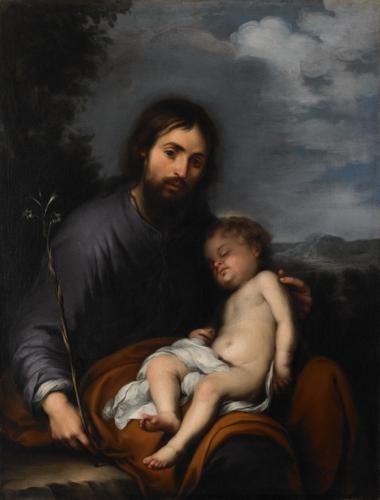
B. Esteban Murillo, San José y el niño (1668), óleo sobre tela, Museo de Arte Kemper (Kansas City)
Cuando María recibió el anuncio del ángel tendría unos quince años. En aquella época la vida era muy breve, por lo tanto las jóvenes se casaban en cuanto podían ser madres. José tendría algunos años más. Las imágenes del San José adulto o viejito no tienen base en la realidad. Eran dos jóvenes de Nazaret que se habían enamorado y ya estaban comprometidos para casarse. Dios interviene en sus vidas. No las invade, les propone un proyecto enrome, de consecuencias increíbles. En primer lugar a María. Aquella jovencita pobre y humilde que iba a la fuente con un cántaro de barro recibe la propuesta más profunda y bella que han escuchado los oídos humanos. Y su respuesta no es ni obligada ni ingenua: “He aquí la esclava del Señor hágase en mi según tu palabra”. Y queda embarazada sin intervención de un varón, sino por obra del Espíritu Santo. La Palabra se hizo carne en María y habitó entre nosotros. No se sentía libre de comunicárselo a su novio. Dios vería qué hacer. El pobre José no entendía nada. Confiaba plenamente en su prometida. Él no la había tocado. Debió pasa días muy duros decidiendo dejarla sin hacer escándalo. Hasta que Dios le comunica la vedad. En ese momento José podía haber rechazado el plan de Dos, pero lo amaba, igual que a su novia. Y acepta. El ángel le dicé: «Le podrás por nombre Jesús». Con ello le está dando toda la función de padre. El profundo amor de José a Dios, a María y a Jesús compensó ampliamente el sacrificio que Dios le pedía. En estas páginas del evangelio hay un ambiente de castidad. Eso no significa de ninguna manera desprecio por lo sexual. Dios todo lo hace bien, y ha querido que las relaciones sexuales sean la forma privilegiada y más bella de manifestar el amor de una pareja. Pero estamos ante un caso muy especial. Ningún varón podía dar la naturaleza divina a Jesús. Jesús no podía tener un padre fisiológico, porque su Padre es Dios. Pero ¿había amor entre María y José? La mejor respuesta es la de Jean Guitton, un teólogo francés: “En general nos quieren hacer creer que María no amó a José realmente, sino que más bien encontró en él a un protector, a una especie de sombra que ocultaba a los demás lo que estaba ocurriendo en su seno. De manera semejante nos hacen creer que José amaba a María como un patriarca ama a una criatura que le ha sido confiada. Si así fuera, efectivamente, el amor no habría tenido lugar en su vida. Pero no fue así, José experimentó el amor de una forma absolutamente inexpresable. Fuerte como los torrentes de la montaña, tranquilo y suave como un lago sereno y con el frescor del agua de una fuente cristalina. El amor del hombre se amolda al amor de la mujer que como hábil educadora modera su impulso para que se transforme en cuidado y ternura que le hace capaz de recibir y dar. (La Vierge Marie, Aubier, Paris, 1949). José y María no eran semidioses sino personas normales, y como tales se amaron. El cardenal Suenens, en los años del Concilio Vaticano II, decía: «María amó a José como ninguna otra mujer ha amado a su marido. José era para ella una permanente fuente de alegría. Ambos se aman plenamente y en sintonía con el llamado que habían recibido. La renuncia a tener relaciones matrimoniales no era ningún obstáculo para el amor, al contrario, lo eleva y fortalece.” La encarnación del Hijo de Dios no hubiera estado completa sin el aporte de su padre adoptivo. De la misma manera que nuestra vida ha sido profundamente marcada por nuestro papá. María le dio la carne y junto con José moldearon su espíritu. José le enseñó muchas cosas. Jesús, percibiendo la ternura de José, descubrió la ternura de Dios Padre. Luego nos dirá que llamamos a Dios Abba (papito), porque así él llamaba a José. Llama la atención que el evangelio nos diga tan poco de una figura tan grande. Ni siquiera nos dice cómo y cuándo murió. Pero si no estaba al pie de la cruz acompañando a María es porque ya habia muerto. Y nada menos que en los brazos de Jesús y María. En un mundo hipersexualizado en el que para muchos el sexo es lo único que importa, la figura de San José tiene un relieve especial por eso nuestra oración, sencillísima, podría ser que nos sintamos agradecidos y orgullosos por estar al cuidado de San José y que luchemos todos los días por parecernos un poco más a él • AE
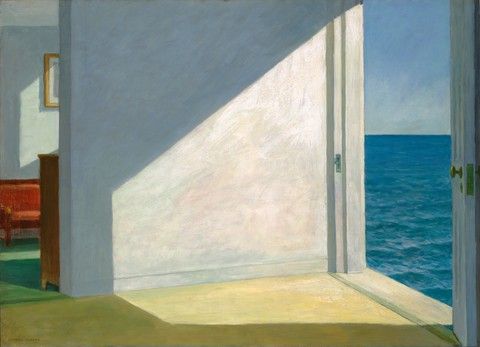
E. Hopper, Rooms by the sea (1951), oil on canvas, Yale University Art Gallery
The Man Born Blind, had experienced the worst of times and was continuing to experience them. He had been born blind. He had never seen his mother and father. There was nothing for him to do in the world except beg, which he did every day by the Pool of Siloam. Perhaps, his parents brought him there every day with the hope that he might got a little help. Or maybe his parents had put him out of the house once he reached a certain age. The man lived in a dark world. Then Jesus came and healed the man. He gave him sight. Now the man was attacked by the Pharisees for daring to say that this Jesus was a prophet. He was thrown out of the Temple, shunned by society. The man did not need the Temple anymore. Nor did he need society. He had Jesus. As the drama progresses, he grows in faith until at the end he worships Jesus. He was living in the best of times. Throughout our lives we all struggle through times of darkness, grasping for light. When will the darkness be over? When will we see the light at the end of the tunnel. Well, we do not know our struggles will come to an end. But we do know this: we can already see the light. Perhaps we are caring for a loved one who is lingering on in a slow death. Or maybe we are going from one crisis to another and wondering if we will ever see light again. We will. We will because the light is there for us. That light is the light of the Lord. A few verses before today’s Gospel, Jesus called out: «I am the Light of the world; he who follows Me will not walk in the darkness, but will have the Light of life.» Jesus is not just setting the scene for the drama of the Man Born Blind. He is speaking directly to us, to you and to me. He is telling us to put our trust in Him, to rest in him, and to know that no matter what happens in this world, good or bad, positive or negative, we will always enjoy the Light of Life. Together let us pray this morning for all who are suffering in anyway. We pray that they and all of us can recognize that Jesus provides us with the Light to guide us through the worst of times to the best of times • AE
Fr. Agustin´s Schedule for the Fourth Sunday of Lent
Saturday, March 18, 2023
3.30 p.m. Sacrament of Reconciliation (Confessional)
5.00 Holy Mass (main church)
Sunday, March 19, 2023
7.30 Holy Mass (main church)
10.00 Holy Mass (main church)
IV Domingo del Tiempo Ordinario (Ciclo A)
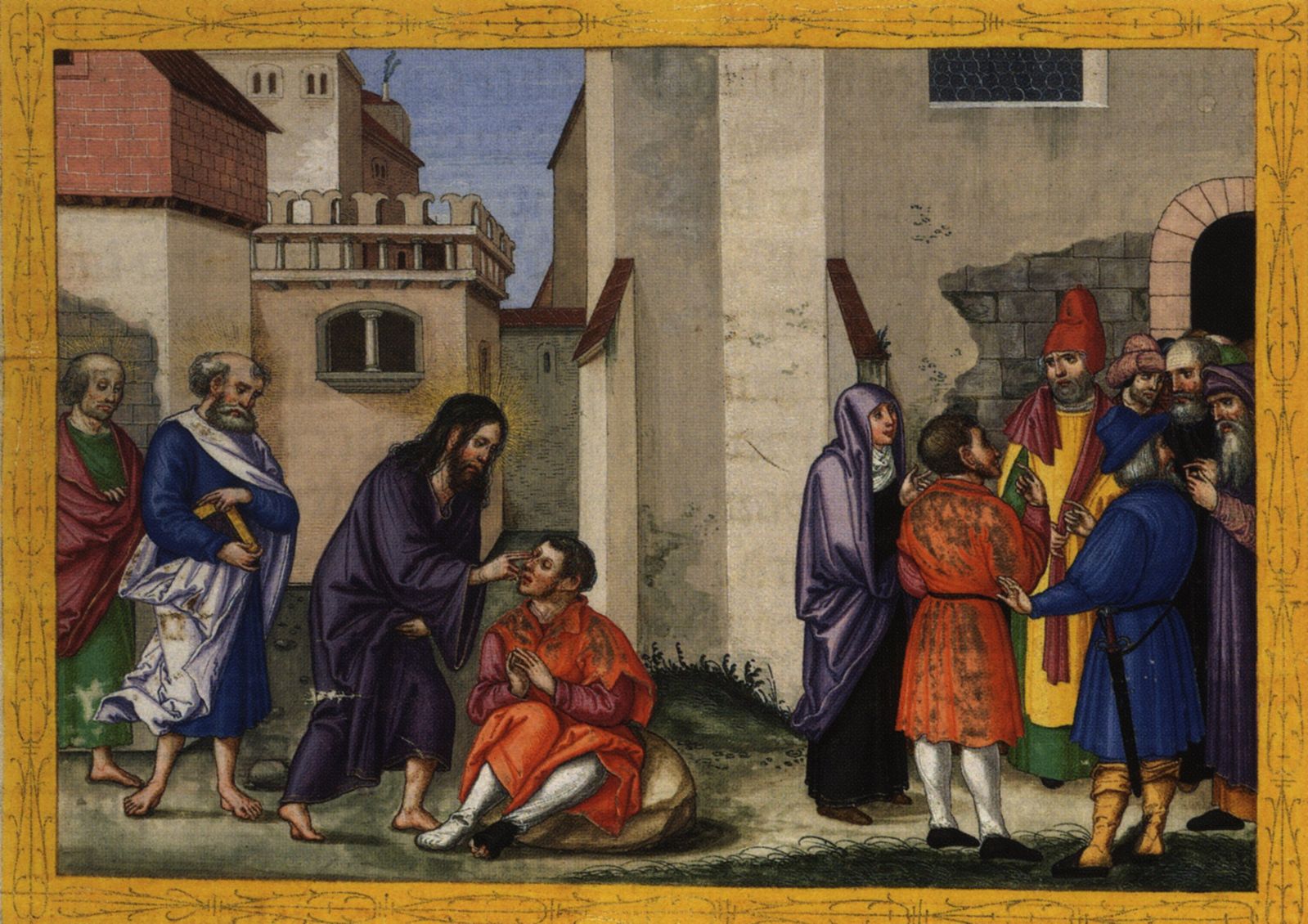
M. Gerung, La Curación del Ciego de Nacimiento (1430), Ottheinrich–Bibel, Biblioteca estatal de Baviera (Munich)
Es «ciego de nacimiento». No sabe lo que es la luz. Nunca la ha conocido. Ni él ni sus padres tienen la culpa, pero allí está él, sentado, pidiendo limosna. Su destino es vivir en tinieblas. Un día, al pasar Jesús por allí, ve al ciego. El evangelista dice que Jesús es nada menos que la «Luz del mundo». Tal vez recuerda las palabras del viejo profeta Isaías asegurando que un día llegaría a Israel alguien que «gritaría a los cautivos: ¡salid! y a los que están en tinieblas: ¡venid a la luz!». Jesús trabaja los ojos del pobre ciego con barro y saliva para infundirle su fuerza vital. La curación no es automática. También el ciego ha de colaborar. Hace lo que Jesús le medica: se lava los ojos, limpia su mirada y comienza a ver. Cuando la gente le pregunta quién lo ha curado, no sabe cómo contestar. Ha sido «un hombre llamado Jesús». No sabe decir más. Tampoco sabe dónde está. Sólo sabe que, gracias a este hombre, puede vivir la vida de manera completamente nueva. Esto es lo importante. Cuando los fariseos y entendidos en religión le acosan con sus preguntas, el hombre contesta con toda sencillez: pienso que «es un profeta». No lo sabe muy bien, pero alguien capaz de abrir los ojos tiene que venir de Dios. Entonces los fariseos se enfurecen, lo insultan y lo «expulsan» de su comunidad religiosa. La reacción de Jesús es conmovedora. «Cuando se enteró de que lo habían echado fuera, fue a buscarlo». Así es Jesús. No lo hemos de olvidar nunca: el que viene al encuentro de los hombres y mujeres que se sienten echados de la religión. Jesús no abandona a quien lo busca y lo ama, aunque sea excluido de su comunidad religiosa.El diálogo es breve: «¿Crees tú en el Hijo del Hombre?». Él está dispuesto a creer. Su corazón ya es creyente, pero lo ignora todo: «¿Y quién es, Señor para que crea en él?». Jesús le dice: no está lejos de ti. «Lo estás viendo: el que te está hablando, ése es». Según el evangelista, esta historia sucedió en Jerusalén hacia el año treinta, pero sigue ocurriendo hoy entre nosotros en pleno 2023 • AE