Twenty-eighth Sunday in Ordinary Time (Cycle A)

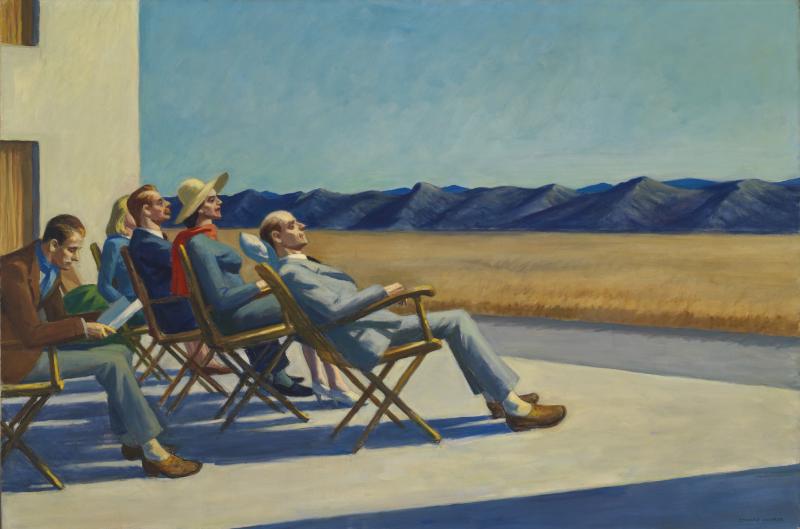
E. Hopper, Girl at a Sewing Machine (ca. 1921), oil on canvas, Museo Thyssen-Bornemisza (Madrid)

The gospel talks about the wedding banquet that a king prepares for his son, only to have the invited guests refuse to come and even mistreat his servants.  The King then invites strangers to the meal, who have a great time. Then, in what really is a second parable, the king spots a man without the proper wedding garment. He throws the man out into the streets, away from the Banquet of Love, where there will be a weeping a gnashing of teeth. Perhaps you might wonder «Why is the Host so upset over this man’s clothes?»  After all, this is a traveler.  How can he be expected to have a fine wedding garment? That would be missing the point for the sake of the detail, something we always have to be careful of regarding scripture.  This parable is not about wearing clothes. It is about wearing Jesus Christ. «Clothe yourselves with the Lord Jesus Christ,» St. Paul tells the Romans, the Galatians, the Colossians, and the Ephesians[1]. The man who came without the proper clothes is the Christian in name only, who refuses to put on Jesus Christ throughout his life. This is the person who accepts the invitation of the Lord, but refuses to exercise his or her responsibility in the Christian community. This is the point. We are invited to share the intimacy of the Banquet of Heaven. We are invited into God’s presence. God expects us to wear our Christianity. The way we respond to His Love must be evident to the world. People should know that we are Christians by the way we live our lives! As Christians we know that cannot just say we are Christians. We have to live our Christianity. Now this living of our Christianity may not always be public, but, and this sounds like a contradiction but isn’t, living our Christianity is always evident, even when not public. Wearing our Christianity is a solution to the problem of polarization in our society. When we identify ourselves first as Christians rather than as members of this or that political party or as liberal or conservative, then our primary mode of action will be to treat others with the kindness of Jesus Christ. Jesus Christ alone is the solution to all our society’s needs! If we really want to heal our country’s ills, we need to wear the garment of the Lord, so this morning let us ask the Lord for the grace to live an active Christianity. May we truly put on Christ, first in our homes, among God’s people, and in our world. Like our patron, the apostle Peter, may we live and die wearing the wedding garment of Christ • AE


Fr. Agustin’s Schedule for Sunday October 11, 2020.

Twenty-eight Sunday in Ordinary Time.

Saturday, October 10, 2020.

4.30 p.m. Sacrament of Confession

5.30 p.m. English Vigil Mass @ St. Peter Prince of the Apostles Catholic C.

Sunday, October 11, 2020.

11.00 a.m. English Mas @ St. Peter Prince of the Apostles Catholic Church

5.30 p.m. English Mas @ St. Peter Prince of the Apostles Catholic Church


XXVIII DOMINGO DEL TIEMPO ORDINARIO (Ciclo A)

De los invitados al banquete la parábola dice que “no hicieron caso. Uno se fue a su campo, otro a su negocio”. Son cada vez más los que entre nosotros se confiesan increyentes. Pero si observamos con cuidado, quizás haya que decir que su increencia no es tanto fruto de una decisión responsable cuanto resultado de una vida superficial, donde el espíritu vive aletargado. Vivimos un estilo de vida donde ni siquiera aparece la necesidad de dar un sentido último a la existencia. Como dice F. Jeanson, ateo contemporáneo, «somos nosotros los que tenemos que dar un sentido a nuestra vida, viviéndola». Dios no tiene la última palabra. Y al vivir buscando un bienestar material cada vez mayor, interesados únicamente en tener dinero y adquirir símbolos de prestigio, preocupados siempre por ser algo y no por ser alguien, vamos perdiendo la capacidad para escuchar la voz de Dios y, eventualmente, las voces de los hermanos, sin oídos para cualquier rumor que no sea el que proviene de su mundo de intereses ni ojos para percibir otras dimensiones que no sean las del bienestar material, la posesión y el prestigio social. Como diría Max Weber, son hombres que «carecen de oído para lo religioso». La parábola de este domingo nos recuerda que la perene invitación por parte de Dios a buscar la libertad y la plenitud está siempre presente. Nuestra mayor equivocación podría ser desoír esa llamada, esa invitación, poniendo atención a nuestras tierras y nuestros negocios. Los hombres seguiremos huyendo de nosotros mismos, perdiéndonos en mil formas de evasión, tratando de olvidarnos de nosotros mismos y de Dios, evitando cuidadosamente tomar en serio la vida. Aún con todo, la invitación sigue, y seguirá presente siempre, porque el Señor no se cansa de buscarnos.  ¿No se esconde un temor al cambio que necesariamente se tendría que producir en nuestra vida si incluyéramos a Dios en nuestra vida? Sin duda se encierra una gran verdad en aquella inolvidable invocación de San Juan de la Cruz: «Señor, Dios mío, tú no eres extraño a quien no se extraña contigo. ¿Cómo dicen que te ausentas tú?» • AE


Twenty-seventh Sunday in Ordinary Time (Cycle A)

The image of the vineyard, and this Sunday we keep it present in the entire liturgy of the Word, always leads me to think about the Church, and the (bad) treatment we give her. I can’t believe how often I hear people who call themselves Catholic make explicit statements of unfaithfulness. It usually goes something like: “I love the Catholic Church and I believe most of what She teaches. I just disagree on a few of Her positions.” (Usually the disagreements revolve around sexual morality, sins against the 6th and 9th commandments, and marriage). This is a much more serious stance than might otherwise be assumed in this age of hypersensitivity. To choose to disagree with the teaching of Holy Mother Church when one claims to be a Catholic has natural consequences that follow as surely as water flows down a stream. When people who call themselves “Catholic” pick and choose what doctrines, dogmas and articles of faith they are willing to believe, they are called by the modern world “cafeteria Catholics. God’s brightest and most beautiful angel Lucifer caught a glimpse of his own beauty and chose himself over his Creator. He was the first subjectivist, because he arrogated to himself the authority to reject God’s authority. Lucifer willfully declared, “I will not serve.” When Catholics reject one of the unchanging and unchangeable teachings of the Church, they echo the original declarative rejection. As simple as this. This is an age of disbelief, material reductionism, and subjectivism. It is increasingly difficult to give our full assent to Holy Mother Church’s teaching because they are difficult to reconcile with our modern ethos. One may rightfully object that there are many things about which men of good will can disagree, but the unchanging, dogmatic articles of faith of the Church are not among them. And this, we have forgotten. Sadly. If we are going to be authentically Catholic, we are not at liberty to dictate what Christ would have us believe. To give assent to the fullness of the Faith is an all or nothing proposition. Here there is no gray: either it is white, or it is black. Either we are with Christ, or we are not. And as that marvelous Mexican saying goes: «Whoever wants the cabbage, wants the leaves.» It is time to tell the truth, to propose it with love and firmness, without offending or trampling, and before that, to ask for humility to remain firm and loyal to our faith that we profess in the womb of our Mother: The Church that is One , Holy, Catholic and Apostolic • AE


XVII Domingo del Tiempo Ordinario (Ciclo A).

Si leemos atentamente la canción de la viña, si oímos seriamente la parábola de hoy, descubrimos que se trata de nosotros mismos, de nuestra propia historia consistente en haber recibido de Dios una serie de posibilidades que no hemos sabido aprovechar. Lo hemos recibido todo, hemos sido cuidados amorosamente por Dios, se nos han dado talentos, unas posibilidades y lógicamente se nos ha pedido, a cambio, una respuesta que no es otra sino la utilización de esas posibilidades. Nuestra respuesta ha sido deficiente, desagradecida, muchas veces rebelde. Pero a esta conclusión llegamos por nosotros mismos si sabemos oír la Palabra de Dios. La parábola en el evangelio de hoy podría ayudarnos a captar con el corazón que todo lo debemos a la donación de Dios. No somos ni independientes ni autónomos. Gratis lo hemos recibido todo y sólo somos autónomos en el agradecimiento, en la respuesta. Y esto nos lleva a un punto que cada uno ha de resolver personalmente. Estamos ante Dios y debemos responder con acción, con fidelidad, con gratitud. Debemos administrar lo dado. Primero hemos de valorarlo, luego saberlo gastar con generosidad. Solamente llevados por la gratitud podemos emplear magnánimamente lo recibido. Cada uno de nosotros tenemos una cuestión personal con Dios que es inaplazable. Nuestra vida, en el fondo, es un «conflicto con Dios»: O nos consideramos herederos que han de dar cuenta de gratitud o nos consideramos dueños de lo que nos han dado. La rebeldía está siempre escondida en nuestro interior. Espera cualquier oportunidad y la aprovecha con los mejores argumentos. A la luz de esta parábola confrontemos nuestras actitudes con respecto a Dios, con respecto a la Iglesia, con respecto a nuestra vocación. Preguntémonos en qué medida enfocamos nuestra vida como algo dado de lo que hemos de dar cuentas o como algo nuestro de lo que podemos hacer lo que nos parezca bien, a veces sin norma y sin mirar siquiera al cielo. Es muy dura y exigente la llamada de hoy. Nos pide no una conclusión de receta práctica sino un autoanálisis duro, exigente, para el que se necesita valor, y sobre todo humildad • AE

Fr. Agustin’s Schedule for October 3-4, 2020

(Twenty-seventh Sunday in Ordinary Time)

Saturday, October 3, 2020.

4.00 p.m. Sacrament of Confession & 5.30 p.m. English Mass

@ St. Peter Prince of the Apostles Catholic Church.

Sunday October 4, 2020.

10.30 a.m. English Mass @ Our Lady of Grace (Outdoors mass)

12.00 p.m. English Mass @ Our Lady of Grace (Main church)

5.00 p.m. English Mass @ Trinity University (Margarite B. Parker Chapel)


Twenty-sixth Sunday in Ordinary Time (Cycle A)

Be like Him,” St. Paul says in the first reading.  “Serve others.  Stop being selfish. Look at others as more important than yourself.” This is difficult.  So much of our society pressures us to think that the world revolves around our wants and us. However, it does not. The world is the Lord’s. With the Grace of God, we can do the work of God. But this is work, and work is hard. Work takes time and strength. For all of us, doing the work of the Lord means emptying ourselves for others. It also means doing everything we can to stay away from all that could hurt us. It takes work to control our temper. It takes work to be spiritual in our homes. It takes work to turn a house into a place of prayer, a little Church. This is the work of Jesus, who humbled Himself for others, for us. Like the two sons in the Gospel, we are called to work in the Father’s vineyard. The vineyard is your house and my house. The vineyard is your life and my life. The vineyard is that place where others are reaching out to us, seeking the love of Christ in us.  They long for Jesus. And they can find Him. They can find Him within us, within us as Church and within us as individuals. For God to work through us, we have to take on the humility of Christ and be more concerned with those for whom we are called then with ourselves. I am sure that every married person has had to be more concerned with caring for his or her spouse then with how he or she has been treated by that same spouse. One snaps at the other, and the other has various choices: retaliate and snap back, employ the old classic passive aggressive behavior known as the silent treatment, sulk, or say, “I’m sorry for my part in this,” and look for something to do together to change the subject and ease the upset. Certainly, the silliest words ever uttered by Hollywood were from the old movie, Love Story, “Love means never having to say you are sorry.” No, love means always having to say you are sorry! However, that takes humility. Pride and marriage cannot co-exist, at least not peacefully. Nevertheless, through humility we can be like Jesus for our brothers and sisters. We can be the people that God needs us to be for His Kingdom. Christ is the victor. With Him we can conquer all that holds us back. And so, we pray to the Father in the (beautiful) Third Eucharistic prayer, “May He make of us an eternal offering to you.” • AE


Fr. Agustin’s Schedule for Sunday September 26-27, 2020.

Twenty-sixth Sunday in Ordinary Time.

Saturday, September 26, 2020.

4.30 p.m. Sacrament of Confession & 5.30 p.m. English Mass

@ St. Peter Prince of the Apostles Catholic Church

Sunday, September 27, 2020.

9.00 a.m. English Mass @ St. Peter Prince of the Apostles Catholic Church

11.00 a.m. English Mass @ St. Peter Prince of the Apostles Catholic Church

5.30 p.m. English Mass @ St. Peter Prince of the Apostles Catholic Church


XXVI Domingo del Tiempo Ordinario (Ciclo A)

Pablo está en la cárcel, probablemente en Éfeso. Cuando escribe a los filipenses, ya ha comparecido ante el tribunal, pero la sentencia está todavía pendiente y no es seguro si lo pondrán en libertad o lo condenarán a muerte. Nadie sabe qué será de él. Encarcelado y juzgado por ser cristiano, Pablo pide a los miembros de aquella comunidad, Filipos, que den a su vez testimonio cristiano. ¿Qué tipo de testimonio? ¡El más difícil de todos! El de la concordia y el amor. El egoísmo, la envidia y la presunción habían empezado a causar estragos en la comunidad; ésta había perdido el ardor de los comienzos, y poco a poco se había convertido en algo escandaloso. En por eso que Pablo pide a los cristianos de Filipos que tengan la grandeza de ánimo suficiente para superar el propio interés y abrirse con sencillez y humildad a los demás. Y al pedirlo, no se apoya en una simple pedagogía humana, sino en un caso bien concreto: el de Cristo Jesús, que, siendo Dios, se hace hombre. Se trata de un paso incomprensible, indecible; pero que Dios lo emprendió porque quería estar abierto al hombre. La salvación de los demás llevó al hijo de Dios a esa profunda kenosis kenosis: una de las palabras más hermosas de todo el nuevo testamento- a despojarse de su rango. Esta es el camino que el Señor Jesús señala al cristiano: el del abajamiento, el de la sencillez, el de la simplicidad delante de Dios y delante de los demás. María Santísima nos dio el mejor y más grande de los ejemplos. “He aquí la esclava del Señor”, le dije al ángel al recibir el anuncio de la Encarnación del Hijo de Dios. ¿Podremos caminar por el mismo camino? • AE