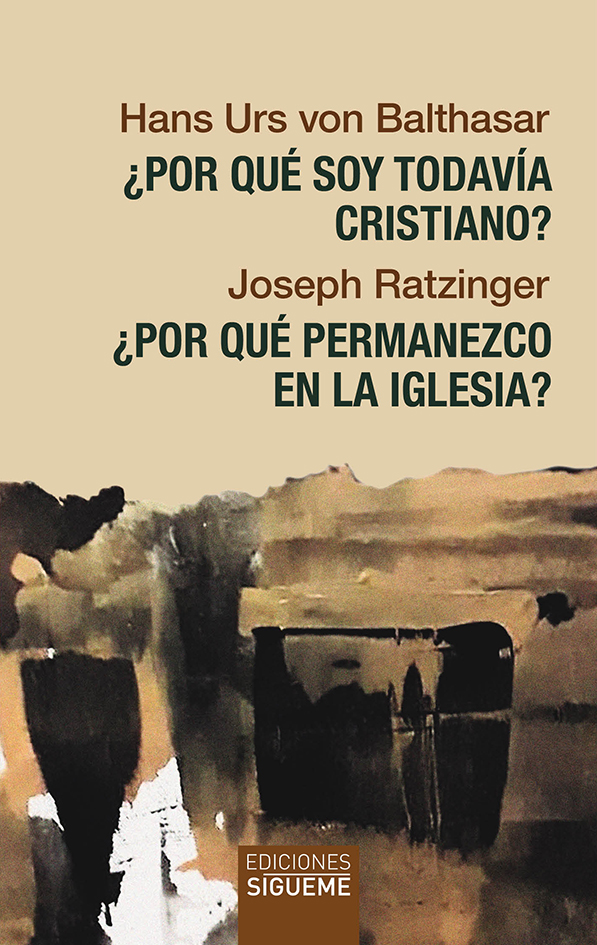
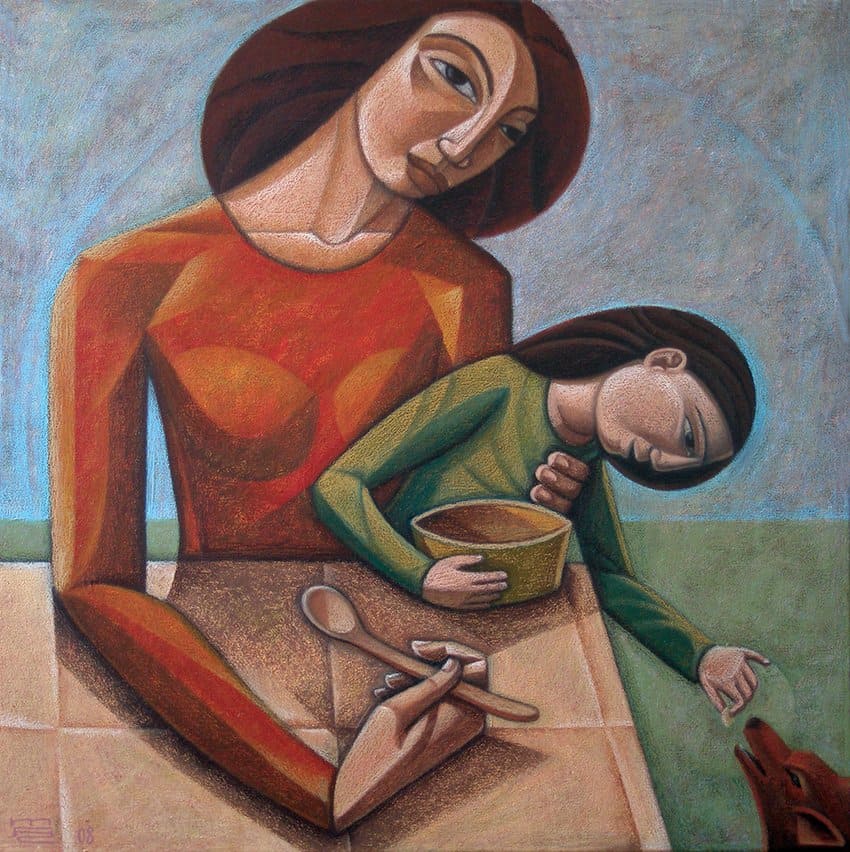
M. Cook, Crumbs of Love (2010), acrylic on paper, Particular Collection.
One of the most difficult experiences in the spiritual life is not suffering itself, but silence. We can endure much when we understand why; what tests faith is praying and receiving no apparent answer. In this Sunday’s Gospel, the Canaanite woman enters precisely that silence. She cries out to Christ on behalf of her daughter, and Matthew records the unsettling detail: «He did not say a word in answer to her.» Yet she does not leave. She remains, approaches Him again, and finally reduces her entire prayer to three words: «Lord, help me.» There is something extraordinarily mature about that prayer. She does not pretend to understand; she does not demand an explanation; she simply refuses to stop trusting. Perhaps great faith is not the ability to understand God, but the willingness to remain with Him when we do not. We live in an age accustomed to immediate responses: messages arrive instantly, information appears in seconds, and almost anything can be summoned with the touch of a screen. Inevitably, we can begin to expect prayer to work the same way. But prayer is not a transaction, and God is not a problem to be solved. The apparent silence of God can become the mysterious place where faith is purified from the need to control and learns simply to trust. The woman begins by asking Christ for a miracle; by the end, Christ reveals something already miraculous within her: «O woman, great is your faith!» Her perseverance did not earn God’s mercy; it revealed how completely she had entrusted herself to it. There are moments when elaborate prayers become impossible and explanations no longer satisfy. Then perhaps her three words are enough: «Lord, help me.» And when the answer seems slow in coming, the Gospel offers one more lesson: stay. Stay with Christ. Sometimes perseverance itself is already an act of great faith • AE
Bach’s Cantata BWV 82, Ich habe genug (“I have enough”), was composed in 1727 for the Feast of the Purification of Mary and reflects the words of the aged Simeon after encountering the Christ Child: “Now, Lord, you may let your servant go in peace.” Rather than dramatic triumph, Bach gives us something quieter and deeper: the serenity of a soul that has finally learned to entrust itself completely to God. The music moves from longing to surrender, and from surrender to peace. It is the sound of faith no longer demanding answers, but resting in the certainty that Christ is enough •

St. Joseph Catholic Church (Dilley, TX) • Weekend Schedule

Fr. Agustin E. (Parish Administrator)
Saturday, August 15, 2026.
10.00 a.m. Solemnity of the Assumption of the Blessed Virgin Mary
5.00 p.m. Sacramento de la Confesión
6.00 p.m. Santa Misa.
Sunday, August, 2026
8.00 a.m. Sacrament of Reconciliation
8.30 a.m. Holy Mass.
10.30 a.m. Sacrament of Reconciliation.
11.00 a.m. Holy Mass.
XX Domingo del Tiempo Ordinario (Ciclo A)

Jesus and the Canaanite woman, illuminated Arabic manuscript, copied in Egypt by Ilyās Bāsim Khūrī Bazzī Rāhib, a Coptic monk, 1684 CE.
Hay personas que parecen estar lejos de Dios y, sin embargo, pueden estar mucho más cerca de Él de lo que imaginamos. La mujer cananea del Evangelio de este domingo pertenece, a los ojos de Israel, al mundo de los extranjeros. No tiene títulos, no pertenece al pueblo elegido y nadie esperaría encontrar precisamente en ella un modelo de fe. Sin embargo, al final del encuentro, Jesús pronuncia sobre aquella mujer pagana unas palabras extraordinarias: «Mujer, qué grande es tu fe.» El Evangelio vuelve así del revés nuestras categorías religiosas. Los discípulos, que caminan diariamente junto a Jesús, quieren despedirla; la extranjera, en cambio, reconoce en Él al «Señor, Hijo de David». Es posible estar físicamente cerca de Cristo y todavía no haber aprendido a mirar como Él mira. Este episodio adquiere todavía mayor fuerza cuando se escucha junto a la profecía de Isaías: «Mi casa será llamada casa de oración para todos los pueblos.» La elección de Israel nunca significó que Dios amara solamente a unos cuantos; era el comienzo de una historia destinada a alcanzar a todas las naciones. La Iglesia heredó esa misión. Por eso el cristianismo no puede convertirse en un club de quienes ya pertenecen, de quienes conocen las respuestas o de quienes nos resultan familiares. Siempre habrá alguien llamando desde fuera, quizá con un acento distinto, una historia complicada o una vida que no encaja perfectamente en nuestras categorías. El Evangelio nos advierte que tengamos cuidado antes de decidir quién está lejos de Dios. A veces, mientras los que creemos estar dentro discutimos sobre quién merece acercarse, Cristo ya ha descubierto una fe extraordinaria en quien nosotros todavía consideramos extranjero • AE
En Gianni Schicchi de Giacomo Puccini, Lauretta parece ocupar un lugar secundario en medio de un mundo dominado por intereses, cálculos y decisiones ajenas. Sin embargo, cuando canta «O mio babbino caro», todo cambia. Su voz sencilla y profundamente humana consigue abrirse paso allí donde los argumentos de los demás no habían logrado hacerlo. Hay algo de esa misma fuerza en la mujer cananea del Evangelio: una mujer situada al margen, sin autoridad ni privilegios, que se atreve a levantar la voz y acercarse a Jesús. En ambos casos, la voz que parecía menos importante termina siendo la que nadie puede ignorar. Puccini convierte la súplica de Lauretta en uno de los momentos más memorables de la ópera; el Evangelio convierte la súplica de una extranjera en una de las declaraciones más hermosas de Jesús: «Mujer, qué grande es tu fe.» •

+ Verano + Lecturas