
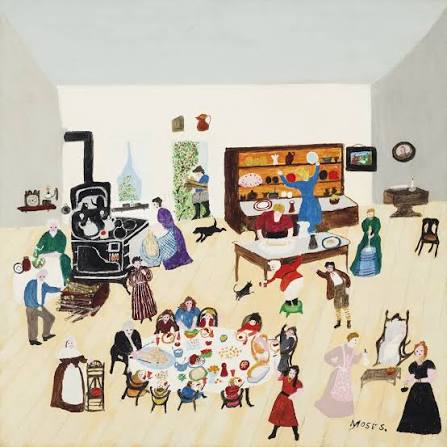
Grandma Moses (1860–1961), Thanksgiving, 1956. The Museum of Modern Art (MoMA), New York.
It is easy to be grateful when life is going well. When the family is healthy, the bills are paid, the people we love are close, and the future seems reasonably secure. But what happens to gratitude when life is complicated, when something is missing, or when tomorrow feels uncertain? On Thanksgiving Day, the Church gives us one of the most beautiful prayers in all of Scripture: Mary’s Magnificat. And there is something remarkable about the moment in which she sings it. Mary is not looking back on a life in which everything has worked out. She is a young woman whose future has suddenly become unimaginably different from what she expected. She does not know what difficulties lie ahead, what sacrifices will be asked of her, or how much sorrow her love will eventually bring. Yet she sings, “My soul proclaims the greatness of the Lord.” Her gratitude is not the result of having all the answers. It comes from knowing that God has looked upon her with love. Perhaps that is something worth remembering around our Thanksgiving tables. Some chairs may be empty this year. Some families may be carrying worries they would rather not discuss. Some prayers may still be unanswered. And yet, even in the midst of these unfinished stories, there are reasons to give thanks: a kindness we did not expect, someone who remained beside us during a difficult time, a burden that became lighter because another person helped us carry it. Mary’s song reminds us that gratitude is not pretending that life is perfect. It is learning to recognize the goodness of God within a life that is still unfolding. We do not have to wait until everything falls into place to give thanks. Sometimes the most beautiful thanksgiving is the one offered while we are still waiting, still hoping, and still trusting. Mary teaches us that we can praise God not only for what he has already done, but also for the faithfulness with which he will accompany us through whatever comes next. And perhaps that is the deepest meaning of Thanksgiving: not that we have received everything we wanted, but that, through everything we have lived, we have never been beyond the reach of God’s love • AE
There is something especially fitting about listening to Count Your Blessings (Instead of Sheep) on Thanksgiving Day. Written by Irving Berlin in 1954, this beloved American song offers a simple but beautiful invitation: when worries keep us awake, remember the blessings that life has given us. In this live performance, Guy Penrod brings the song into the warm tradition of American gospel music. Its message also echoes Mary’s Magnificat. Mary does not sing because her future is free from uncertainty, but because she recognizes the goodness and faithfulness of God. Gratitude does not require a perfect life; sometimes it begins precisely when we learn to recognize the gifts that remain, even in the midst of our difficulties. And perhaps that is a lovely thought to carry with us to the Thanksgiving table •