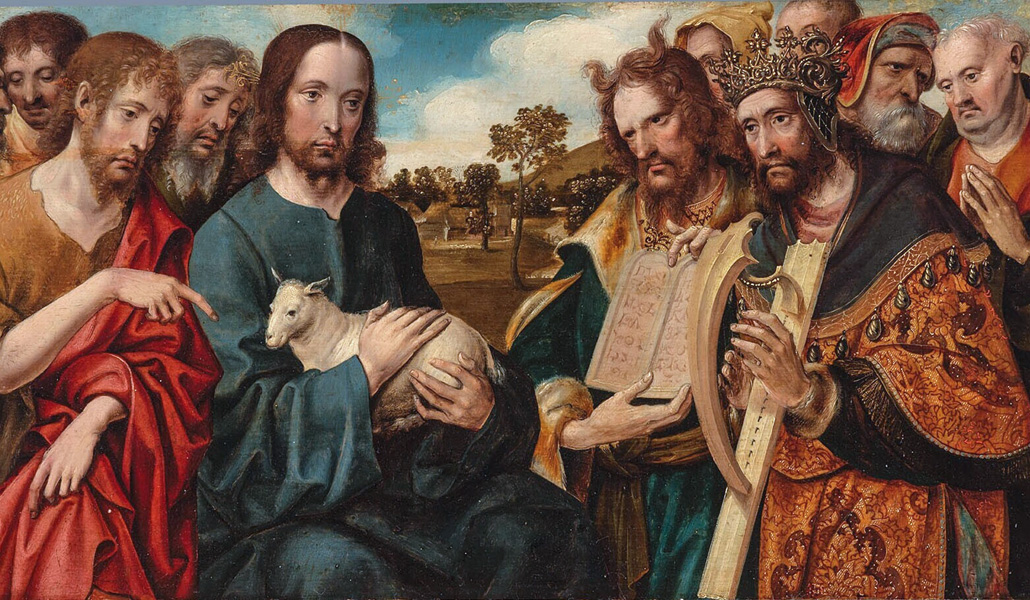
S. del Piombo, Descent of Christ into Limbo (1516), oil on canvas, Museo Nacional del Prado (Madrid)
«What is happening? Today there is a great silence over the earth, a great silence, and stillness, a great silence because the King sleeps; the earth was in terror and was still, because God slept in the flesh and raised up those who were sleeping from the ages. God has died in the flesh, and the underworld has trembled. Truly he goes to seek out our first parent like a lost sheep; he wishes to visit those who sit in darkness and in the shadow of death. He goes to free the prisoner Adam and his fellow-prisoner Eve from their pains, he who is God, and Adam’s son. The Lord goes in to them holding his victorious weapon, his cross. When Adam, the first created man, sees him, he strikes his breast in terror and calls out to all: ‘My Lord be with you all.’ And Christ in reply says to Adam: ‘And with your spirit.’ And grasping his hand he raises him up, saying: ‘Awake, O sleeper, and arise from the dead, and Christ shall give you light. ‘I am your God, who for your sake became your son, who for you and your descendants now speak and command with authority those in prison: Come forth, and those in darkness: Have light, and those who sleep: Rise. ‘I command you: Awake, sleeper, I have not made you to be held a prisoner in the underworld. Arise from the dead; I am the life of the dead. Arise, O man, work of my hands, arise, you who were fashioned in my image. Rise, let us go hence; for you in me and I in you, together we are one undivided person. ‘For you, I your God became your son; for you, I the Master took on your form; that of slave; for you, I who am above the heavens came on earth and under the earth; for you, man, I became as a man without help, free among the dead; for you, who left a garden, I was handed over to Jews from a garden and crucified in a garden. ‘Look at the spittle on my face, which I received because of you, in order to restore you to that first divine inbreathing at creation. See the blows on my cheeks, which I accepted in order to refashion your distorted form to my own image. ‘See the scourging of my back, which I accepted in order to disperse the load of your sins which was laid upon your back. See my hands nailed to the tree for a good purpose, for you, who stretched out your hand to the tree for an evil one. `I slept on the cross and a sword pierced my side, for you, who slept in paradise and brought forth Eve from your side. My side healed the pain of your side; my sleep will release you from your sleep in Hades; my sword has checked the sword which was turned against you. ‘But arise, let us go hence. The enemy brought you out of the land of paradise; I will reinstate you, no longer in paradise, but on the throne of heaven. I denied you the tree of life, which was a figure, but now I myself am united to you, I who am life. I posted the cherubim to guard you as they would slaves; now I make the cherubim worship you as they would God. “The cherubim throne has been prepared, the bearers are ready and waiting, the bridal chamber is in order, the food is provided, the everlasting houses and rooms are in readiness; the treasures of good things have been opened; the kingdom of heaven has been prepared before the ages.»
– From the Office of Readings from the Liturgy of the Hours.
Anonymous Flemish artist, The Descent from the Cross (Stauffenberg Altarpiece) (1454), oil on wood, Unterländer Museum (France)
The best we can do after the proclamation of the Passion of the Lord is to be quiet for a moment[1]. Is there something else to say in the presence such an event with so much pain and physical and moral suffering? Probably not. The Passion of the Lord, is the revelation1 of the love that God has for all humanity and for each one of us and sooner or later we have to respond to that revelation, that’s why we need to be quiet. As Cardinal Sarah says: « If we want to grow and to be filled with the love of God, it is necessary to plant our life firmly on three great realities: The Cross, the Host, and the Virgin: crux, hostia, et virgo… These are three mysteries that God gave to the world in order to structure, fructify, and sanctify our interior life and to lead us to Jesus. These three mysteries are to be contemplated in silence»[2]. That’s why the Church is constantly inviting us to slow down and to take some time to ask ourselves… some good questions: What is God trying to tell me through the Passion of his Son? At this moment in my life, how am I embracing my cross? Gladly? with enthusiasm? Bitterly? If we contemplate the Passion of Jesus from a distance, and we are not really engaged, it is the same as leaving Jesus on the cross and washing our hands, as Pilate did. Or something even worse: It could be that we have the same frivolous attitude of the soldiers who stood at the foot of the cross, watching over the executed. The gospel says that «When the soldiers had crucified Jesus, (…) They also took his tunic from him, but the tunic was one-piece (…) So, they said to one another, «Let’s not tear it, but let us cast lots for it to see whose it will be»[3]. Christ is right there: hanging on the cross, bleeding to death, moaning in pain …dying! And they are there … casting lots! Casting lots! They were killing time…. Bored and yawning… Totally oblivious, insensible to what is happening there, over his head. Well, the same could happen to us, that in the middle of the celebration of the holy sacrifice of the altar at Sunday mass we are boring, full of tedious, looking at the clock because «this is going too slow» wanting to get out as soon as possible. This afternoon, with this eloquent and beautiful liturgy of Good Friday of the Passion of the Lord we have a great chance to remember how important it is to pay attention; how important it is our intention to be present in body, soul, spirit and to receive with gratitude the grace of the Lord. How important is to be on time, wearing our best outfit, participating on the prayers with our best voice, our best postures, our best gestures… our best everything. This is how we can begin to recover a little that sense of reverence that we have been losing and that is so important for the celebration of the mysteries of our faith. It’s Good Friday. the Liturgy of the Word and the tradition of the Church remind us in a liturgical way that the Lord has paid the price of our redemption, that we have salvation at hand. Jesus has climbed the Tree of the Cross out of love for each one of us. And this is not just a pretty phrase, but a reality, And the best way to respond and give thanks is by participating in this and all liturgical our celebrations, or whatever is related with our faith, with love, devotion, and attention. This is the point. The soldiers at the foot of the cross, casting lots are a reminder that, in front of the most sacred… we can be distracted! But we also have the example of the Virgin Mary who, full of pain, remained faithful and loyal to everything that was happening there. At the cross her station keeping, Stood the mournful Mother weeping, Close to Jesus to the last The Stabat Mater sings. So, let us ask the Lord this afternoon for the gift, huge gift, of recovering the sense of the Sacred, the gift of not being indifferent in His presence, the gift of celebrating the mysteries of our faith with devotion, with attention … with love. And today in particular, Good Friday of the Passion of the Lord, let us ask ourselves: What is God trying to tell me through the celebration of the Passion of his Son? At this moment in my life, how am I embracing the cross? gladly? with enthusiasm? bitterly? (Pause) With hearts full of gratitude let us remember that by his passion, death and resurrection our wounds have been healed, our sins have been forgiven, our mistakes have been fixed, and a new opportunity has been given to us5 . How can I repay the LORD for all the great good done for me? The Psalm says, I will raise the cup of salvation and call on the name of the LORD. Today we are invited to lift our hearts in thanksgiving; in silence, in reverence, in devotion and in love. It is Good Friday • AE
[1] 1 Cf. Mark 14-15, Matthew 26-27, Luke 22-23, and John 18-19. [2] Robert Cardinal Sarah, The Power of Silence: Against the Dictatorship of Noise. [3] Cf. Matthew 27:24 4 Cf Jn 18:1—19:42 4
To Christ Crucified
I am not moved to love you, God, By hope for heav’n’s reward; Nor am I moved by fear of hell To turn from sin, my Lord. What moves me, God, is seeing you, Despised and nailed up high Upon that cross with gaping wounds, Rejected, left to die. Your love so moves me, Lord, that if There were no heav’n or hell, I still would fear your holy name And truly love you well. And so I need no promises To sway my love for you; For even if I had no hope, I’d love you as I do.
—Translated by Hugh Seay, Lent, 1978
Passio Domini Nostri Iesu Christi secundum Ioannem
The Passion of Our Lord Jesus Christ according to John
Oración al Cristo del Calvario (Gabriela Mistral)
En esta tarde, Cristo del Calvario, vine a rogarte por mi carne enferma; pero, al verte, mis ojos van y vienen de tu cuerpo a mi cuerpo con vergüenza.
¿Cómo quejarme de mis pies cansados, cuando veo los tuyos destrozados? ¿Cómo mostrarte mis manos vacías, cuando las tuyas están llenas de heridas?
¿Cómo explicarte a ti mi soledad, cuando en la cruz alzado y solo estás? ¿Cómo explicarte que no tengo amor, cuando tienes rasgado el corazón?
Ahora ya no me acuerdo de nada, huyeron de mí todas mis dolencias. El ímpetu del ruego que traía se me ahoga en la boca pedigüeña.
Y sólo pido no pedirte nada, estar aquí, junto a tu imagen muerta, ir aprendiendo que el dolor es sólo la llave santa de tu santa puerta.
Amén,
Viernes Santo de la Pasión del Señor (2023)
Autor anónimo, Ecce Homo (1510), óleo sobre tela, Museo de Arte de Indianapolis (EEUU)
Aquí tienen al Hombre». Esas fueron las palabras de Pilato en la mañana de aquel viernes cuando pone a Jesús a la vista de todos. Para nosotros Él es el hombre, y el cristianismo el verdadero humanismo. ¿Nos hallamos ante un ideal masoquista, de quien se complace en el sufrimiento por el sufrimiento? No: estamos ante un ideal de un hombre -el Hombre- que no pasa por alto la condición histórica y concreta que es la nuestra, y que además conoce la opresión, el abuso de los poderosos sobre los débiles, la violencia institucionalizada, el dolor. He aquí el hombre. Jesús no es el que triunfa a costa de los demás, el que se enriquece con su explotación, el que manda a su antojo y según sus conveniencias, o el que siempre está en la cresta de la ola, como la espuma. Jesús es el humillado, el explotado, el expoliado: El varón de dolores. El Señor soportó realmente nuestros sufrimientos y ha aguantó nuestros dolores. Y es que no es incapaz de compadecerse de nuestras flaquezas, él que, igual que nosotros, ha sido probado en todo. Así, la respuesta de Dios al problema del mal no es una respuesta intelectual a un problema intelectual: sino una respuesta práctica, realista, efectiva y afectiva a una cuestión existencial. Jesús, perfecto Dios y perfecto hombre, asume el mal en su propia carne. Pero el problema continúa problema; la rebelión, rebelión; el miedo, miedo. Pero lo vivimos acompañados: también Jesús ofreció «ruegos y súplicas, con poderoso clamor y lágrimas, al que podía salvarle de la muerte»[1]. Quizá la expresión más fuerte y sintética es aquella de san Pablo: “Al que no había pecado, Dios lo hizo expiar nuestros pecados, para que nosotros, unidos a él, recibamos la salvación de Dios»[2]. Esto es lo que silenciosamente celebramos en este viernes Santo de la Pasión del Señor • AE
Anonymous Bulgarian artist, icon with the Washing of the Feet (18th century), The Temple Gallery (London)
Love and do as you will, love and do what you will. This comes from St. Augustine of Hippo and, of course, It is often misinterpreted. When St. Augustine said, “Love and do as you will,” he meant that we need to be so fully united in love with God, that no matter what we were to do, it would be an expression of our love for God. Jesus loved and did what He willed. He was so united with God His Father and our Father, that His actions gave us a glimpse, only a glimpse mind you, but a glimpse of the depth of His love. He washed the feet of His disciples. He loved His Father so closely, that He humbled Himself to serve those whom His Father had chosen to spread His Kingdom. He emptied Himself. A slave could not be forced to wash someone’s feet. That was an action so despicable that a master could not require his slave to wash his feet. But Jesus washed the feet of His disciples. It was an expression of His love for the Father. It was a message to His disciples. Jesus would empty Himself for them, for mankind. He would accept the humiliation of the cross, for that act of service would restore life to God’s loved ones. He told his disciples to do what He had done. We are called to love God with our whole heart, our whole mind and our whole soul. We are called to serve others not just as a humanitarian act, not just to better the world, but to serve the presence of God in those whom He created in His Image and Likeness. Many people ask, as Judas asked, “What’s in it for me?” Many people will only do that which gives them gratification. Jesus was not concerned with that. He was not concerned with what was in it for Him. He was only concerned with loving His Father. If we are concerned with our love for God, then our actions will be an expression of this love. United in love, we are compelled to give ourselves for others. The Mandatum is a mandate to love. So, today, Holy Thursday of the Lord’s Supper, we pray tonight for the faith and the courage to love and do as we will • AE
Music for Holy Thursday
Jesus, My Lord, My God, My All!
Jueves Santo de la Cena del Señor (2023)
W. Blake, Judas Betray Him (1803), tinta, acuarela y carbón sobre papel, Tate Museum (Londres)
El Jueves Santo es el día de las dos entregas, el día de los dos besos. Una es la entrega de Judas. La traición y el beso hipócrita, detrás hay unas monedas, un dinero, unas ganancias. La otra entrega es la de Jesús: él no vende a nadie; se da él mismo; él no busca el interés, ni el dinero, ni la ganancia, sino la vida para sus amigos, el testimonio que les dará fuerza y ánimo para seguir sus pasos, la ratificación, con su carne y su sangre de que sus palabras no son sólo palabras, ni utopías, ni ilusiones, sino realidades tan auténticas y tan serias que, por ellas, se puede pagar un precio tan caro como el dar la propia vida. Y así, en ese gesto de amor que se teje sobre el pan y el vino Jesús se queda para siempre, para que nunca nos sintamos solos ni desamparados en medio del duro combate de la vida. Frente a uno que vende –que le vende a él por unas pocas monedas- Jesús se da; se quiere quedar para siempre con los suyos y de hecho se queda. Vender o darse; el interés o el ofrecimiento; esa es la gran disyuntiva con la que nos enfrentamos todos los días; necesitamos saber cuál de los dos papeles queremos representar. Aquí no hay gris. O es blanco o es negro. ¿En lugar de quién nos ponemos? ¿Estamos del lado del encarcelado, del drogadicto, de la madre soltera, del homosexual, de la prostituta? ¿Miramos con compasión al inmigrante, al que espera asilo político? Si ante la imagen de Jesús dándose a los hombres que vemos hoy en el evangelio no nos tomamos en serio nuestra conversión, si ante este Jesús que se entrega somos incapaces de ponernos en su lugar, habrá que pensar que nuestro corazón se ha endurecido. Porque el evangelio de hoy no es una parábola más, o un milagro más, o una reflexión, es Jesús mismo dándose a los hombres y dejándonos bien claro lo que espera de nosotros –cristianos- al marcharse • AE
Música para el Jueves Santo
ADORO TE DEVOTE LATENS DEITAS
(TE ADORO CON DEVOCION, DIOS ESCONDIDO)
El Pelicano Eucarístico
Pie pellicane, Iesu Domine, Me immundum munda tuo sanguine. Cuius una stilla salvum facere Totum mundum quit ab omni scelere (Adoro te devote, Santo Tomás de Aquino).
Los primeros cristianos vivían en medio de una sociedad pagana y hostil. Los perseguían, los encarcelaban y se los condenaban al destierro o a la muerte. Como no podían profesar abiertamente su fe, se valían de símbolos que pintaban en los muros de las catacumbas y, con mayor frecuencia, grababan en las lápidas de mármol que cerraban las tumbas; era una forma de decir que ahí se encontraba un cristiano.
El pelícano es un animal poco estético y si se lo compara con la fuerza y la agilidad de un águila o un león, por ejemplo, hasta puede parecer ridículo. Pero la comparación con Jesucristo que hicieron los primeros cristianos, no se basaba en esos primeros aspectos, si no en la belleza y la nobleza de su corazón: Cuando sus crías nacen, los pelícanos, al igual que todos los animales, tienen que buscar comida para alimentarles. Antiguamente se creía que si el pelícano adulto no encontraba comida para sus crías, en vez de abandonarlas, les daba de comer de su propia carne. De esta forma, la gran ave se abría el pecho con su pico para alimentar a sus crías con su sangre y con trozos de su propio cuerpo. Ellos comprendían que sacrificaba su vida para que sus hijos pudieran vivir. He ahí la gran similitud con Cristo que ofreció su Cuerpo y su Sangre para la salvación del hombre. Al igual que las crías del pelícano no podrían vivir sin la carne que se les da, así también nuestra alma no podría vivir sin el alimento de la Eucaristía. Tiempo después, se supo que el pelícano tenía bajo el pico una especie de bolsa, donde colocaba los pescados. Cuando regresaba a su nido, apoyaba enérgicamente el pico contra el pecho para sacar las provisiones de comida para sus crías. Los antiguos, al observar este procedimiento imaginaron que el ave se lastimaba a sí misma para alimentar los pequeños pelícanos hambrientos. De todas formas, es una hermosa imagen de lo que significa la Eucaristía para los católicos y aún hoy es un símbolo cristiano muy fuerte, símbolo de piedad y sacrificio, la más alta expresión del amor humano y divino • AE
Meister des Perikopenbuches, Miniature of the triumphal entry into Jerusalem, The Yorck Project (2002)
Our liturgy today begins with a celebration of the entry of the Lord into the Holy City and then rapidly focuses in on the Crucifixion of the Lord, this year from the Gospel of Matthew. What a contrast! We go from Jerusalem where the crowds were celebrating Jesus, crowding him, singing hosanna, to Golgotha, where Jesus was mostly deserted by all as he died on the cross. There are contradictions even deeper than that. Mankind was disobedient to God. Jesus was obedient. Mankind was immersed in material possessions. Jesus was only concerned about the spiritual. Mankind was selfish, each person only concerned with himself or herself. Jesus was self-less. He sweat blood the night before, but he accepted the role he would play in the drama of the Kingdom. Mankind feared death clinging to life. Jesus embraced death recognizing death as a passage to eternal life. Mankind had embraced physical life and sacrificed his spiritual life. Jesus surrendered his physical life so that we can possess spiritual life. What is it that we celebrate this Holy Week? Is it the historical events of a little less than 2,000 years ago? Perhaps, but this is only a small part of our commemoration of Holy Week. What we celebrate this Holy week is our participation in the Paschal Mystery, the sacrifice of the Lamb of God. On Holy Thursday we join the disciples at the Last Supper and the Garden of Olives. We remember that the mandate to serve is fundamental The symbolic washing of feet reminds us of that the mandate to serve is fundamental to our being people of the Eucharist. On Good Friday, we call up the courage to stand at the foot of the cross and ask our Savior to allow us to join our lives to his death. At the Solemn Easter Vigil, we remember the promises of the Hebrew Scriptures and rejoice at the fulfillment of the prophesies of salvation. At all the Masses of Easter we reaffirm our Baptismal vows and recommit our lives to living for the Kingdom of God. Come and pray with us this week. Come. Come and celebrate the Life that makes all life meaningful • AE
Pueri Hebreaeorum by G. P. da Palestrina
Fr Agustin´s Schedule for Palm Sunday of the Lord’s Passion 2023
Saturday April 1, 2023
9.00 a.m. Spiritual Retreat for CCD Children of St. Dominic Catholic Church (Main church)
3.30 p.m. Sacrament of Reconciliation (Confessional)
5.00 p.m. Holy Mass (with the blessings of the branches)
Sunday April 2, 2023
12.30 p.m. Holy Mass (with the blessing of the branches)
3.00 p.m. Misa en Español con la bendición de las palmas
Domingo de Ramos De la Pasión del Señor (2023)
Diego de Silva y Velázquez, Cristo Crucificado (1632) óleo sobre tela, Museo Nacional del Prado (España)
No me mueve, mi Dios, para quererte el cielo que me tienes prometido, ni me mueve el infierno tan temido para dejar por eso de ofenderte.
Tú me mueves, Señor, muéveme el verte clavado en una cruz y escarnecido, muéveme ver tu cuerpo tan herido, muévenme tus afrentas y tu muerte.
Muéveme, en fin, tu amor, y en tal manera, que aunque no hubiera cielo, yo te amara, y aunque no hubiera infierno, te temiera.
No me tienes que dar porque te quiera, pues aunque lo que espero no esperara, lo mismo que te quiero te quisiera
Los primeros cristianos lo sabían. Su fe en un Dios crucificado sólo podía ser considerada como un escándalo y una locura. ¿A quién se le había ocurrido decir algo tan absurdo y horrendo de Dios? Nunca religión alguna se ha atrevido a confesar algo semejante. Ciertamente, lo primero que todos descubrimos en el crucificado del Gólgota, torturado injustamente hasta la muerte por las autoridades religiosas y el poder político, es la fuerza destructora del mal, la crueldad del odio y el fanatismo de la mentira. Pero ahí precisamente, en esa víctima inocente, los cristianos vemos a Dios identificado con todas las víctimas de todos los tiempos. Despojado de todo poder dominador, de toda belleza estética, de todo éxito político y toda aureola religiosa, Dios se nos revela, en lo más puro e insondable de su misterio, como amor y sólo amor. No existe ni existirá nunca un Dios frío, apático e indiferente. Sólo un Dios que padece con nosotros, sufre nuestros sufrimientos y muere nuestra muerte. Este Dios crucificado no es un Dios poderoso y controlador, que trata de someter a sus hijos e hijas buscando siempre su gloria y honor. Es un Dios humilde y paciente, que respeta hasta el final la libertad del ser humano, aunque nosotros abusemos una y otra vez de ese amor. Prefiere ser víctima de sus criaturas antes que verdugo. Este Dios crucificado no es el Dios justiciero, resentido y vengativo que todavía sigue turbando la conciencia de no pocos creyentes. Desde la cruz, Dios no responde al mal con el mal. «En Cristo está Dios, no tomando en cuenta las transgresiones de los hombres, sino reconciliando al mundo consigo» (2 Corintios 5,19). Mientras nosotros hablamos de méritos, culpas o derechos adquiridos, Dios nos está acogiendo a todos con su amor insondable y su perdón. Este Dios crucificado se revela hoy en todas las víctimas inocentes. Está en la cruz del Calvario y está en todas las cruces donde sufren y mueren los más inocentes: los niños con hambre, las mujeres maltratadas, los maltratados por el poder, los explotados por nuestro bienestar, incluso ¡los olvidados por nuestra religión! Los cristianos seguimos celebrando al Dios crucificado, para no olvidar nunca ese amor loco que siente Dios por la humanidad, y también para mantener vivo el recuerdo de todos los crucificados. Es un escándalo y una locura. Sin embargo, para quienes seguimos a Jesús y creemos en el misterio redentor que se encierra en su muerte, es la fuerza que sostiene nuestra esperanza y nuestra lucha por un mundo más humano • AE