Thirtieth Sunday in Ordinary Time

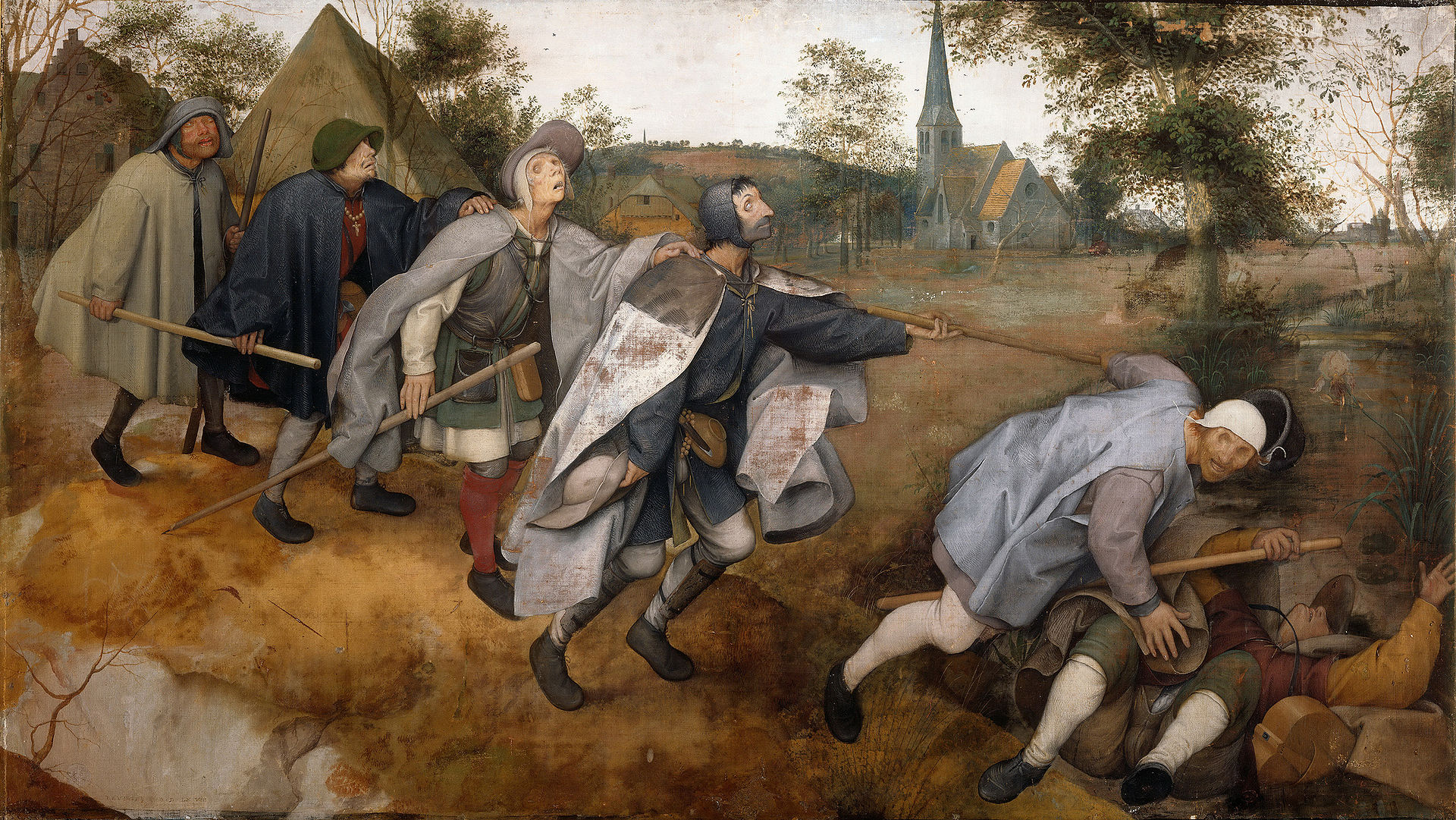
Anonymous Dutch artist, The Healing of the Blind Man from Jericho (c. 1470), oil on oak, Museum Catharijneconvent (Netherlands)

Blind Bartimaeus took a risk. He heard that Jesus was approaching, so he took the risk of calling out to him. Other’s tried to quiet Bartimaeus, but what he lacked in eyesight he made up for in lungs. He just called louder. According to the Gospel reading, Jesus heard Bartimaeus, and then told his disciples to bring him over to him. At first, Bartimaeus hesitated, but then he took a step of trust in the Lord. He threw off his cloak and went to Jesus. This throwing off his cloak might not seem significant to us, but it was an action that was full of meaning. Bartimaeus’ cloak was his mat, his bed, his warmth, his security blanket, and his one possession. It was his everything! To let it go, was to let go of everything he depended on and to trust in the Lord. Bartimaeus let go and let God. And Jesus rewarded his trust, his faith, with sight. Bartimaeus was not just given eyesight. He saw the Work of God. Jesus told him to «Go your way; your faith has saved you,» but Bartimaeus did not go. Instead, he followed the Lord. We are called out of our blindness into the light of the Lord. But to do this, we have to trust in God rather than in ourselves. Many of you took a leap of trust when you fell in love and committed yourselves to that special person who became your spouse. For your love to grow, you know that you cannot hold on to any security other than simple faith, not just in your spouse but, more importantly, in the Lord. You have to have faith that He will help you to love as He loves. That is why it is so important that husbands and wives pray for each other and with each other and pray that they might respond to their vocation to marriage by being good husbands and wives. Certainly, the raising of children demands trusting in the Lord. In this computer age, we check the Internet for the answers to all questions. The only thing is that raising children is not a scientific process. Children have souls, and personalities, and their own unique reflections of God. The closest thing to a handbook on how to raise a child properly is called the Bible. All parents find times that they are overwhelmed. It is a tremendous task to raise a child. You are called to form Christian children, capable of reflecting their unique images of God; yet you have to do this in a society that deifies materialism. You have to trust God to help you raise your children. So, continue to pray for your children every day! Do not be discouraged, continue to ask God to help you be a good Mom, a good Dad, and trust Him! We priests and religious had to take a step of blind faith in the Lord when they decided to embrace the yearning within them to serve God in these special ways. Our whole lives become a matter of just trusting in God. Sometimes that trust involves accepting new assignments. Sometimes that trust is as simple as saying our daily prayers and knowing that God will help us write the homily for next Sunday. The point this Sunday in our prayer time is to consider taking the risk of believing a little more; a Little better; take the risk of jumping, knowing that on the other side we will always find Jesus • AE


Fr. Agustin Schedule for the Thirtieth Sunday in Ordinary Time

Saturday, October 23, 2021.

3.30 p.m. Sacrament of Reconciliation

5.00 p.m. English Mass @ St. Dominic Catholic Church

Sunday, October 24, 2021.

7.30 a.m. English Mass @ St. Dominic Catholic Church

10.00 a.m. @ St. Dominic Catholic Church


XXX Domingo del Tiempo Ordinario

Es posible hacer algo cuando sentimos que la fe se va poco a poco apagando en nuestro interior? ¿Es posible reaccionar? ¿Podemos salir de la indiferencia? El evangelista narra la curación Bartimeo quizá para animar a sus lectores a vivir un proceso que pueda cambiar sus vidas. No es difícil reconocernos en la figura de Bartimeo. Vivimos a veces como ciegos, sin ojos para mirar la vida como la miraba Jesús. Sentados o, mejor dicho, apoltronados en una religión convencional, sin fuerza para seguir sus pasos. Descaminados, al borde del camino. ¿Qué hacer? A pesar de su ceguera, Bartimeo oye que Jesús está pasando y comienza a gritar. Esto es siempre lo primero: abrirse a cualquier llamada o experiencia que nos invita a curar nuestra vida. El ciego no sabe recitar oraciones hechas por otros. Sólo sabe gritar y pedir compasión porque se siente mal. Este grito humilde y sincero, repetido desde el fondo del corazón, podría ser el comienzo de una vida nueva porque Jesús nunca pasa de largo. Bartimeo da unos pasos que van a cambiar su vida. Arroja el manto porque le estorba para encontrarse con Jesús. Luego, aunque todavía se mueve entre tinieblas, da un salto decidido. De esta manera se acerca a Jesús. Es lo que necesitamos muchos de nosotros: liberarnos de ataduras que ahogan nuestra fe; tomar, por fin, una decisión sin dejarla para más tarde; y ponernos ante Jesús con confianza sencilla y nueva. Cuando Jesús le pregunta qué quiere de él, el ciego no duda. Sabe muy bien lo que necesita: «Maestro, que pueda ver». Es lo más importante. Cuando uno comienza a ver las cosas de manera nueva, su vida se transforma. Cuando una comunidad recibe luz de Jesús, se convierte. El evangelio de este domingo nos dice pues que dentro de Bartimeo había aún una fe que le hizo reaccionar. Aquel ciego percibió que el Señor no andaba lejos y por eso pidió a gritos su ayuda. A nadie se le puede convencer desde fuera para que crea. Para descubrir la verdad, cada uno tiene que experimentar que Cristo hace bien y que la fe ayuda a vivir de una manera más gozosa, más intensa y más joven. Dichosos los que creen, no porque un día fueron bautizados, sino porque han descubierto por experiencia que la fe hace vivir • AE


Twenty-ninth Sunday in Ordinary Time

French artist, Jesus washing the feet of this apostles (second quarter of the 14th century), Ivory, Louvre Museum(Paris)

James and John in today’s gospel acted…weird. They felt that they should sit at the right hand and left hand of the Lord when Jesus came into His Glory. They wanted to be clear that they were much better than the others.  Jesus told them that they were clueless. They didn’t understand where greatness came from. There are many people in all walks of life who strut around as legends in their own minds. They may be professionals who look down on others, or they may be people who hold a position of respect in their families, like parents or grandparents, but do so in an arrogant way, as tyrants rather than as sources of family love.  Perhaps we all do this at times. We don’t understand from where greatness comes. Jesus understood how to be great, though. He told James and John, and He tells us, that greatness comes through service.  On the night of the Last Supper, before Jesus gave us His Body and Blood, He washed the feet of His disciples, and then gave them and us this mandate: what you have seen me do, you also must do.  That was the path to greatness. Think about St. Teresa of Calcutta. She died in 1997, so most of us have been blessed to have been witnesses to some of  her life.  Everyone would admit that she was a great lady.  But how did she become great?  She became great by emptying herself to serve the poorest of the poor, first in Calcutta and then throughout the world.  Think about people you know that you can say with confidence that he or she is a great person. My guess is that person is someone who continually reaches out to other people.  Someone is sick, he or she is there.  Someone is having a bad day, he or she is there.  Someone needs help with a difficult job, he or she doesn’t even need to be asked.  You see, truly great people have learned how to be great from He who is the One True Goat, Jesus Christ, the Greatest of All Time. All of us have different gifts. We have a responsibility to develop our gifts in service to the Lord. What can I do best?  What do you do best?  Some people are capable of caring for the incarcerated with mercy, compassion, and justice.  Others have a great deal of empathy for the sick.  Still others have a heart for the poor.  Some are capable of teaching. Others are great parents not just to their own children but to those orphaned by the circumstances of their lives.  We all have many talents. Our talents are given to us to serve others.  We are called to develop these talents.  We are called to greatness. The Lord understands our failures, our limitations, our fears, the times that we lack confidence in ourselves to do His work. He sees this, but He also sees so much more. He sees our talent. He sees our love. He sees our determination to seek Him out in others and serve His Presence. Christ has called us to be his disciples.  We are Christians. We did not take Christianity on ourselves. We were given this Grace freely by the Lord. We are good enough. He makes us good enough. It is not the size of a person’s entourage that demonstrates that he or she is great.  It is not the position of authority that a person holds that demonstrates his or her greatness.  True greatness come from Jesus Christ. He calls us to be people of service • AE


Fr. Agustin’s Schedule for Twenty-ninth Sunday in Ordinary Time

Sunday, October 17, 2021.

12.30 p.m.  English Mass @ St. Dominic Catholic Church

3.00 p.m. Misa en Español @ St. Dominic Catholic Church


XXIX Domingo del Tiempo Ordinario (Ciclo B)

Lo más importante en la vida no es tener éxito y superar a los demás. Lo verdaderamente decisivo es saber crecer como ser humano. Sin embargo, con frecuencia, nos equivocamos desde el punto de partida. Creemos que para afirmar nuestra propia vida y asegurar nuestra pequeña felicidad y libertad, debemos necesariamente dominar a los demás e insatisfechos por no tener siempre todo lo que queremos, temerosos de perder felicidad, queremos asegurarnos frente a todo y frente a todos, tratando de dominar la situación desde una posición de superioridad y de poder sobre los demás. Y así es como tratamos de manipular de mil maneras a quienes son más débiles que nosotros, esforzándonos por mantenerlos al servicio de nuestras expectativas e intereses. Basta con echar un vistazo a las relaciones que hay entre jefes y subordinados, entre poderosos y económicamente débiles, entre profesores y alumnos, esposos y esposas. Se diría que no acertamos a ser algo, si no es manipulando, dominando y oprimiendo a los demás. Una pura neurosis. Este deseo de ser grandes dominando a los demás, no proviene de la fuerza que uno posee, sino precisamente de la debilidad y el vacío personal. Es un intento equivocado de conseguir por la fuerza lo que uno no sabe vivir desde la propia libertad y capacidad de amar. Lo importante es darnos cuenta de que existen otros caminos para encauzar nuestra vida y ser auténticamente grandes. El Señor, en el evangelio de hoy, nos dice que quien quiera ser grande tiene que renunciar a su deseo de poder sobre los demás y aprender sencillamente a servir desde una postura de amor fraterno. Los que viven desde la generosidad, el servicio y la solidaridad son personas con una autoridad moral que arrastra. No necesitan amenazar, manipular, sobornar ni adular. Son hombres y mujeres que atraen por su nobleza de vida. En su existencia resplandece la grandeza del Señor que no vino a ser servido, sino a servir, y dar su vida en rescate por todos[1]. La vida de esos cristianos -alejados del ruido de las redes sociales casi siempre- es grande precisamente porque saben darla sin guardarse nada para sí. Es pues el evangelio de este domingo un llamado a la forma en que debemos asumir nuestro servicio apostólico; en nuestra Iglesia, los puestos no deben de existir como alimento de nuestro ego, sino como compromiso para trabajar por los demás • AE

[1] Cfr Marcos 10, 4


Twenty-eighth Sunday in Ordinary Time.

There is that great movie starring Morgan Freeman and Jack Nicholson called The Bucket List. Two men who were dying but in temporary remission, one of them is rich so he decided to make out a list of the things they wanted to do before they died. In the middle of the movie there is an extremely beautiful scene. The Jack Nicholson character made the huge step and was reconciled with his daughter with whom he had been estranged for years. Then she showed him his little five-year-old grand-daughter. He gave her a hug and a kiss. When he left the house, he crossed off, “Kiss the most beautiful girl in the world.” So, The Bucket List is a good idea for us, an invitation to consider the things we want to do and need to do in our lives, a reminder of some other lists we need to compile. The question today’s readings ask us is simply, “What are the most important things on our lists?” In the first reading, Solomon responds to the invitation by God to ask for anything in return for his constructing the Temple in Jerusalem[1]. To the surprise of many, Solomon doesn’t ask for riches.  He asks for wisdom. Next to wisdom, he says, gold and silver are like mud. But when he possesses wisdom, the Wisdom of God, everything else comes to Him. In the gospel reading, the young guy is asked about his list.  He was sincere. He really wanted to have God’s life. He told Jesus he had kept the commandments all his life. Jesus knew he had and that’s why he offered him treasure in heaven.  What He said to the man shocked him.  It left the man in turmoil. Jesus told him to sell everything he had and give it to the poor, and then follow Him[2]. Jesus was offering the man a place among his apostles. The guy wasn’t ready for this. He was surprised, perplexed, and dismayed. So, what is on your list? What is on my list?  What is there that we could not live without? What is on that list that would leave us devastated if it were destroyed? If it is anything other than the lives of others, the presence of God in their lives and the Presence of God in our lives then we really don’t understand what it means to be a Christian! Some Catholics right now have lost everything they owned and are waiting to lose their lives. Others have refused to sacrifice their faith for the sake of advancing in business and are living far more frugally than ever but they possess all that matters in life: the friendship of Jesus Christ. So, the Liturgy of the Word today hit us to the core of our lives, it is an invitation to consider where we find meaning in life. All of us want to be happy. All of us want to live lives of meaning.  All of us want to finish our physical lives united to God.  To do all this we need to keep the priorities of life straight. God Himself will take care of the rest of our needs.  Solomon said that along with wisdom, all good things came to him. Jesus promises that those who live only for His sake and the sake of the Gospel will receive a hundred times more than they gave up in this age and eternal life in the next[3]. So, what is on our bucket lists, The Word of God, that two-edged sword, asks us today to consider where we are seeking happiness • AE

[1] Wis 7:7-11 [2] Mk 10:17-30 or 10:17-27 [3] Cf Mark 10:30.


Fr. Agustin Schedule for Twenty-eighth Sunday in Ordinary Time

Saturday, October 9, 2021.

3.30 p.m. Sacrament of Reconciliation

5.00 p.m. English Mass @ St. Dominic Catholic Church

Sunday, October 10, 2021.

7.30 a.m. English Mass @ St. Dominic Catholic Church

10.00 a.m. @ St. Dominic Catholic Church


XXVIII Domingo del Tiempo Ordinario (Ciclo B)

Vivimos en una cultura donde tener es importante. Poco a poco el estilo de vida del hombre de hoy se ha ido orientando hacia el poseer. Para muchos es la única tarea rentable y sensata. Todo lo demás viene después. Ciertamente ganar dinero, poder comprar cosas y poseer toda clase de bienes produce bienestar. La persona se siente más segura, más importante, con mayor poder y prestigio. Pero cuando la vida se orienta en esa única dirección, el ser termina arruinándose. El tener no basta, no sostiene, no hace crecer. Sin darse cuenta, la persona va introduciendo cada vez más necesidades artificiales en su vida, olvidando poco a poco de lo esencial. Se rodea de objetos, pero se incapacita para la relación viva con las personas. Se preocupa de muchas cosas, pero no se fija en lo importante. Víctor Frankl hablaba del vacío existencial y de cómo, para desplegar su ser, el individuo necesita salir de sí mismo, servir a una causa, entregarse, amar a alguien, compartir. Es cierto: Sin esta autotrascendencia no hay verdadera felicidad. De este vacío no libera ni siquiera la religión cuando también ella se convierte en objeto de consumo. Y es que podemos vivir en una religión, pero con el corazón lejos de Dios. Podemos tener un magnífico catálogo de verdades que confesamos con los labios, pero podríamos no estar abiertos la verdad de Dios. Acumulamos méritos repitiendo mecánicamente momentos espirituales quasi-perfectos, pero quizá no estamos abiertos a amar de verdad. En el evangelio de este domingo un hombre que es rico se acerca a Jesús. No le pregunta por esta vida, pues la tiene asegurada. Lo que busca es que alguien – ¿Jesús? – le asegure la otra vida, la eterna. Jesús es claro: «Una cosa te falta: Ve y vende lo que tienes, da el dinero a los pobres y así tendrás un tesoro en los cielos. Después, ven y sígueme»[1]. A mí hoy me dice lo mismo, ¿seré capaz de mirarle a los ojos y responder algo? • AE

[1] Cf Mc 10, 17-30


Twenty-seventh Sunday in Ordinary Time.

Hieronymus Bosch, The Garden of Earthly Delights, oil on oak panels, 205.5 cm × 384.9 cm (81 in × 152 in), Museo del Prado, Madrid

So, the Pharisees ask a question to Jesus to put him to the test. Actually, it is a fact that makes the women of Galilee suffer a lot, a topic of heating discussions among rabbinical schools: «Is it lawful for a man to divorce his wife?» It is not about the modern divorce that we know today, but about the situation in which the Jewish woman lived within the marriage, controlled absolutely by the man. According to the law of Moses, the husband could break the marriage contract and expel his wife from home. The woman, on the other hand, subject in everything to the man, could not do the same. Jesus’ response surprises everyone. He does not enter into the discussions. He invites them to discover God’s original project, which is above laws and norms. This «macho» law, in particular, has been imposed on the Jewish people because of the «hardness of heart» of the men who control women and submit them to their will. Jesus goes back into the original mystery of the human being. God «created them male and female.» The two have been created equal. God has not created the male with power over the female. He has not created the woman subject to the man. Between men and women there must be no domination by anyone. From this original structure of the human being, Jesus offers a vision of marriage that goes beyond everything established by the Law. Women and men will unite to «be one flesh» and begin a shared life in mutual surrender without imposition or submission. This marriage project is for Jesus the supreme expression of human love. The man has no right to control the woman as if he were the owner of her. The woman does not have to accept living subject to the man. It is God himself who draws them to live united by a free and gratuitous love. Jesus emphatically concludes: «What God has joined, man must not separate.» With this he is destroying the foundation of patriarchy under all its forms of control, subjugation and imposition of the man on the woman. Not only in marriage but in any civil or religious institution. So, we are to listen to the message of Jesus. It is not possible to open paths to the kingdom of God and his justice without actively fighting against patriarchy. And of course, another important question arises: when will we react in our society, in the Church with energy against so much abuse, violence and aggression by men on women? When will we defend women from the «hardness of heart» of men? Hopefully the Spirit of God will fill us with light so we can take a moment to meditate on the words of the Lord in today’s Gospel • AE


Fr. Agustin’s Schedule for Twenty-seventh Sunday in Ordinary Time

Sunday, October 3, 2021.

12.30 p.m.  English Mass @ St. Dominic Catholic Church

3.00 p.m. Misa en Español @ St. Dominic Catholic Church


XXVII Domingo del Tiempo Ordinario (Ciclo B)

En nuestras comunidades parroquiales cada vez encontramos más y más personas que, una vez fracasado su primer matrimonio, han vuelto a unirse de manera civilmente o han formado una pareja de hecho. La realidad es compleja y delicada. Separación y divorcio son experiencias que generan casi siempre un profundo sufrimiento interior, muchas veces, soledad e incomprensión. La realidad es que muchos de ellos no se sienten queridos ni comprendidos por la comunidad, no obstante, los esfuerzos de algunos pastores. No es sólo la disciplina canónica la que les hace sufrir sino también esa actitud que a veces perciben en su entorno ¿Qué decir? A la luz de las palabras del Señor en el evangelio de hoy podríamos recordar que ser fieles a su enseñanza el amor conyugal único, fiel e indisoluble no significa dejar de tener una actitud de comprensión y misericordia hacia todos, de manera particular, hacia aquellos que más sufren. En el caso que nos ocupa, un sufrimiento interior, callado. La primera actitud del cristianismo ante estas parejas ha de ser de respeto, cercanía y amistad. En realidad, no hay razón alguna -ni religiosa ni moral- para adoptar otra postura diferente contraria al amor compasivo. No deberíamos marginarlos ni excluirlos sino intentar que no se consideren separados de la Iglesia, pues no lo están; de hecho, pueden y deben, en cuanto bautizados, participar la vida eclesial[1]. No puede ser otra la postura de una Iglesia que proclama y al mismo tiempo se sabe ella misma aceptada por su Señor a pesar de sus errores, pecados, caídas e infidelidades. Cristianos como somos, hemos de comprender el desgarro interior de quienes por la razón que fuere no pueden salir, de manera razonable, de la situación en que se encuentran. Nosotros podríamos encerrarnos en nuestros juicios y condenas; podríamos seguir sin comprender los errores y las culpas que los han conducido hasta el divorcio, pero una cosa es segura: Dios sigue escribiendo su propia historia de amor con ellos por caminos que a nosotros se nos escapan • AE

[1] Cfr. San Juan Pablo II, Familiaris Consortio, n. 84


Twenty-sixth Sunday in Ordinary Time (Cycle B)

Today’s readings lead us to a discussion of a topic that is pertinent to our present times in our country. The plurality of various faith traditions leads us to a deeper consideration of the first reading and the first part of today’s Gospel[1]. Moses was told to summon 70 leaders to the Meeting tent to receive a portion of the Spirit he had been given. 68 did go to that Tent, received the Spirit, and began prophesying.  However, the other two leaders, Eldad and Medad, had remained in the camp and were not in the tent. Still, they also received the Spirit and began to prophesy. So, they were not among those with Moses in the Tent but still received the Spirit of prophecy. When this was brought to Joshua’s attention, he wanted Moses to stop them. Moses wouldn’t because he could see that their preaching was authentic, they had the power, the authority of the Spirit of God. Well, in the same way in our own times, there are many people of many faiths whose preaching is authentic.  They may not be part of the Catholic Church, they may not even be Christian, but they still have a share of the Holy Spirit. “Hold on father! There is a dogma or article of faith that says that salvation comes through Jesus Christ.  How can those who do not recognize the seven sacraments or those who are not Christian receive the Spirit of God? What about the words of Jesus “Unless you eat my body and drink by blood you will not have life within you?”[2]. well, God the Father saw the condition of mankind after the fall and sent His Son to offer the eternal sacrifice for the redemption of mankind. Jesus became one of us and allowed our world to do its worst to Him, sacrificing Himself to the Father for us. After his death and resurrection, the Lord was united to his Father in heaven. Together the Father and the Son sent their Spirit, the Holy Spirit, upon people of good will. Some of these people of good will are Catholic. Some people of good will are Christians but not Catholic. Some people of good will are not even Christian such as Jews, Hindus, Muslims and Buddhists.  They all have a share of the Spirit of the Father and the Son and are all in their own way doing the work of God. They should be respected and supported in their work. So then, the question arises quickly: is it acceptable for a Catholic to leave the Catholic faith and join a non-Catholic religion since that religion also has a share in the Spirit of God?  When I am asked that question, I respond, “I need Jesus Christ, and I find Him in the words and sacraments of the Catholic church.”  For any of us to leave the Catholic Church would be for us to leave the Eucharist, to leave the seven sacraments. With the exception of our Orthodox brothers and sisters, no other faith believes that Jesus is really and truly present in the Eucharist as well as the other sacraments. For us to turn from Catholicism to another faith would be for us to turn from a truth we have been called to, the truth of the Eucharist, the truth of the sacraments. We recognize that people of other faiths share in the Spirit of the Father and the Son and proclaim His Truth. We celebrate their proclamation and join them in works of charity.  We pray with them and for them.  But at the same time, we also recognize that we have been given a share in the Spirit of the Father and the Son which includes the Presence of the Son nourishing us in the Eucharist, forgiving us in the sacrament of Confession, binding His Love to that of the husband and wife in the Sacrament of Matrimony, etc.  So, for us to leave the Catholic Church would entail our leaving the sacraments. It is said that millennials and others have done just that, left the Catholic Church to worship in various evangelical Churches. I do not hazard to assume to know why each person who leaves the Church does so, but I do think that our teaching on the Eucharist and the other sacraments need to be strengthened so that those in the Catholic Church have a deeper understanding of the great gifts we have been given. We need to pray together and work together, but we cannot sacrifice our Catholic identity. We join people of good will, people who have received a portion of the Spirit, as who we are. We are Catholic. Eldad and Medad were not in the Meeting Tent. But the Spirit of prophecy would not be confined by the institutional structure of the time.  Nor can it be contained by institutional structures of our time. Eldad and Medad proclaimed God’s Truth. We also need to proclaim God’s truth through our Catholic Church and with those who are not part of the Catholic Church. So, this morning we can pray for a deeper understanding and respect for the Spirit of Truth wherever it may assert itself • AE

[1] Cf Nm 11:25-29; Mk 9:38-43, 45, 47-48 [2] Cf John 6.


Fr. Agustin’s Schedule for Twenty-sixth Sunday in Ordinary Time

Saturday, September 25, 2021.

3.30 p.m. to 4.55 p.m. Sacrament of Reconciliation

5.00 p.m. English Mass @ St. Dominic Catholic Church

Sunday, September 26, 2021.

7.30 a.m. English Mass @ St. Dominic Catholic Church

10.00 a.m. English Mass @ St. Dominic Catholic Church


Domingo XXVI del Tiempo Ordinario (Ciclo B)

La Envidia (1810), caricatura de Timothy Bobbin publicada en Londres

Los cristianos no terminamos de superar esa mentalidad de -digámoslo así- casta privilegiada que nos impide apreciar todo el bien que se realiza en ámbitos alejados de la fe. Con frecuencia tendemos a pensar que somos los únicos portadores de la verdad, y que el Espíritu de Dios sólo actúa a través de nosotros. Una falsa interpretación del mensaje de Jesús nos ha conducido a veces a identificar el reino de Dios con la Iglesia. Según esta concepción, el reino de Dios se realizaría dentro de la Iglesia, y crecería y se extendería en la medida en que crece y se extiende la Iglesia. Pero no es asín. El reino de Dios se extiende más allá de la institución eclesial. No crece sólo entre los cristianos sino entre todos los hombres de buena voluntad que hacen crecer en el mundo la fraternidad. Según Jesús, todo aquél que arroja demonios en su nombre, está evangelizando. Es verdad: todo hombre, grupo u organización capaz de arrojar lejos a los demonios de nuestra sociedad y de colaborar en la construcción de un mundo mejor, está, de alguna manera, abriendo camino al reino de Dios. También a nosotros como a los discípulos, podría parecernos que no son de los nuestros aquellos que no vienen a nuestras parroquias, sin embargo, según Jesús «el que no está contra nosotros, está a favor nuestro»[1]. Todos los que, de alguna manera, luchan por la causa del hombre, están con nosotros. Allí donde se lucha por los humillados, los aplastados, los débiles, los abandonados, allí se combate en realidad con Dios por su reino, se sepa o no, él lo sabe» (G. Crespy). En menos palabras: los cristianos deberíamos valorar con gozo los logros humanos, grandes o pequeños, y los triunfos de la justicia que se alcanzan en el campo político, económico o social, por pequeños que puedan parecer. Lejos de creernos en posesión del monopolio de la salvación, los cristianos deberíamos acoger con alegría y gratitud esa corriente de salvación que se abre camino en la historia de los hombres, no sólo en la Iglesia, sino también junto a ella y más allá de sus instituciones. A esto nos invita la liturgia de la Palabra esta mañana • AE

[1] Cfr. Mk 9:38-43, 45, 47-48